Most fintech teams do not lack automation. They own a CRM, an email platform, a product analytics tool, and a few dozen workflows. Yet leads still stall, onboarding emails arrive after the customer has already left, and nobody can say which campaign produced a funded account.
This article works as a diagnostic. Each section follows the same path: the problem, what it costs the business, the root cause, and a practical fix. Not every team will recognise every problem. The same symptom can also come from different causes, so treat each section as a hypothesis to test against your own data rather than a verdict.
Why Marketing Automation Breaks Differently In Fintech
A typical SaaS signup is simple: a visitor registers, and a trial begins. A fintech signup rarely works that way. The prospect submits an application, uploads identity documents, waits for verification, links a bank account, and only then makes a first transaction. Each step happens in a different system, and each step changes what you may say to that person.
That structure puts pressure on marketing automation services in three ways. First, the customer journey depends on product events, not just page visits. Second, many messages sit in a regulated grey zone between marketing and servicing. Third, the data involved is sensitive, so every integration carries a privacy cost.
Generic automation advice ignores all three. A welcome sequence built for a newsletter will misfire when the subscriber is mid-verification, and a lead score built for a SaaS free trial will mislead a team selling to treasury managers. The sections below start with the problems that appear most often, then move to the constraints that shape every fix.
Fragmented Customer Data Creates Contradictory Journeys
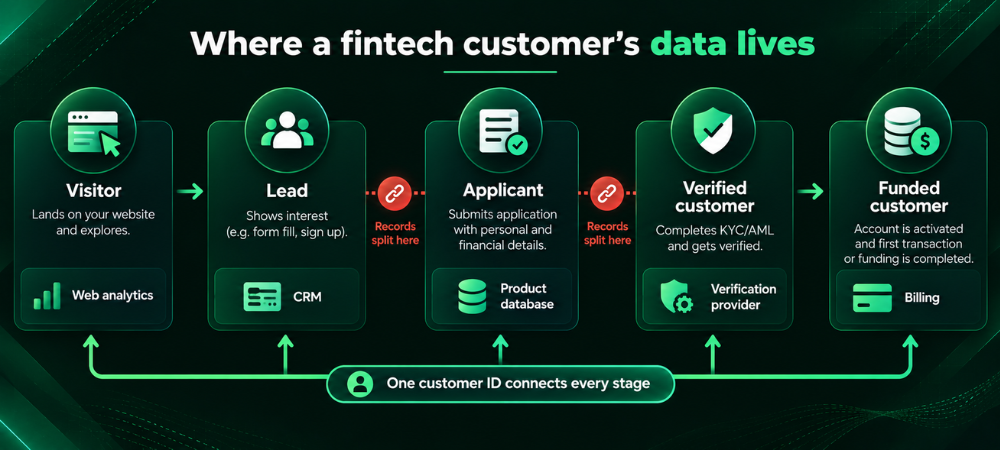
The Problem: One person often exists as four records: an anonymous web visitor, a CRM lead, a product user, and a billing customer. Each system holds a different slice, and none of them agrees on who the person is.
The Business Impact: Contradictions reach the customer quickly. A user who finished onboarding last week still receives “complete your application” emails. An existing customer gets an offer they cannot qualify for. A sales rep calls a prospect whose verification failed yesterday. Each error costs trust, and in financial services, trust is the product.
The Root Cause: Teams usually key every system on email address alone. People, however, apply with a work address and sign up for the product with a personal one. Meanwhile, product events live in a database or warehouse that the marketing platform never sees, and form tools quietly create duplicate contacts.
The Fix: Start with an identity rule. Create one customer ID at the first moment of capture, and carry that ID through the CRM, the automation platform, and the product. Next, decide which system owns each field. The product database should own account status, for example, and the CRM should own sales stage. Then sync a short list of product events instead of everything: application started, documents submitted, verification approved, account funded, first transaction. Finally, schedule a regular duplicate review, because duplicates return.
| Do We Need A Customer Data Platform To Fix This? Not necessarily. A clean CRM with defined fields and a reliable event sync solves the problem for many early-stage teams. A customer data platform starts to earn its cost when you collect events from many sources and need to route them to many tools. Fix identity and field ownership first. Otherwise, a new platform only moves the mess. |
Disconnected CRM and Tool Stacks Leave Handoffs To Chance
The Problem: Marketing automation and the CRM exchange data on a delay, in one direction, or with mismatched fields. A lead’s status in one tool lags behind the other by hours or days.
The Business Impact: Sales follows up late or twice. Marketing keeps nurturing a lead that sales already closed. Dashboards disagree, so meetings turn into arguments about whose number is right.
The Root Cause: Someone connected the tools once, usually with default field mappings, and no one has owned the connection since. On top of that, marketing and sales rarely share a written definition of a lead, a qualified lead, or an opportunity. Without shared definitions, even a perfect sync moves ambiguous data.
The Fix: Write down each lifecycle stage with clear entry and exit criteria, and get both teams to sign off. After that, make the sync two-way for the fields that matter most: lead status, owner, and consent. Add alerts for sync failures, since silent errors do the most damage. Last, name one person who owns the integration. A CRM integration built around those rules stays stable after the original builder moves on.
Poorly Timed Workflows Miss The Moments That Matter
The Problem: Many workflows run on elapsed time: send email two on day three, email three on day seven. Customers, however, move through a fintech product at different speeds, and they move according to events, not calendars.
The Business Impact: Timing errors look careless. A reminder to finish verification lands an hour after approval. A promotional email arrives while the customer has an open support ticket about a failed payment. Alongside the annoyance, these messages raise complaint and unsubscribe rates, which damages sender reputation for every later campaign.
The Root Cause: Workflows rely on time delays because they are easy to build. Few have exit conditions that remove a person once the goal is met. Frequency caps also tend to live inside individual workflows, so a customer enrolled in four of them receives four emails in a week. Batch syncs make it worse: a status change that reaches the automation tool six hours late triggers the wrong message.
The Fix: Rebuild the highest-volume workflows around product events, and give each one an exit condition. Start where onboarding loses the most people; funnel optimization data shows which step that is. Then add global rules above the workflows. A shared frequency cap per person, a pause on marketing messages during open support cases or failed verification, and respect for time zones all belong here.
Also separate transactional and security messages from marketing, and give them priority. The split matters for compliance as well, as the section on regulation explains.
| How Many Emails Is Too Many? No universal number exists. Set a weekly cap per person across all workflows, then watch unsubscribes, spam complaints, and reply sentiment. If those climb after a new workflow launches, the cap is too loose, or the workflow overlaps another one. |
Weak Lead Qualification Wastes Sales Time and Hides Good Leads
The Problem: Lead scores often reward activity: opens, clicks, and page views. A student downloading five guides outscores a finance director who read one pricing page.
The Business Impact: Sales learns to ignore marketing-qualified leads, and the good ones wait in the same queue as the poor ones. Eventually the team stops trusting the score, and the automation that depends on it loses its purpose.
The Root Cause: Engagement tells you what a person did, not whether they can become a customer. In fintech, fit includes factors that most scoring models never consider: the country the prospect operates in, the licences and markets you cover, the transaction volume they expect, and the use case. A lead from an unsupported country can score highly and still be impossible to serve. Sales feedback also rarely flows back into the model.
The Fix: Split the score in two. A fit score covers company type, region, size, and use case, while an intent score covers behaviour. Add hard disqualifiers, such as unsupported countries or restricted business types, so those leads never reach sales. Agree on a response time for qualified leads, and hold a short monthly review where sales marks accepted and rejected leads and gives reasons. Adjust the rules from that feedback. Teams that sell software to other businesses can also read how we frame the wider funnel in our B2B SaaS marketing playbook.
| Should We Use AI Lead Scoring? Only when you have enough closed outcomes to learn from and a clean field recording them. Without that history, a model learns noise. A simple rules-based score, reviewed monthly, usually beats a model trained on thin data. |
Measurement Gaps Make Every Fix A Guess
The Problem: Reporting stops at form fills and marketing-qualified leads. The team cannot see which workflow leads to an activated account, a funded account, or revenue.
The Business Impact: Without outcome data, budget follows proxies. A workflow with a high open rate looks successful even when it produces no customers, and a quiet workflow that moves people through verification looks weak. Teams then double down on the wrong things.
The Root Cause: Attribution breaks at the boundaries. Campaign parameters get lost when a visitor moves from the marketing site to the app, especially across different domains. Consent choices reduce the data you can legitimately collect. Sales cycles run long, and offline conversations never reach the dashboard. None of these gaps has a perfect solution.
The Fix: Give every workflow one primary outcome, and pick an outcome further down the funnel than the click: activated account, funded account, or first transaction. Pass the campaign source into the signup flow and store it on the customer record. Report by cohort so you can compare similar groups over time.
Where volume allows, hold back a small control group from a lifecycle workflow and compare results. Finally, report attribution as a range with stated limits instead of a single precise figure. That honesty protects the team when the numbers shift. For a starting view of your online presence before you tackle deeper attribution, Viacon offers a free digital audit.
Privacy, Consent, And Security Constraints Shape Every Fix
Rules differ by country, by channel, and by whether you message individuals or businesses. What follows summarises how several major regimes treat marketing communications, so you can ask the right questions. It is not legal advice, so confirm the details for your markets with qualified counsel.
United States: Marketing texts and automated marketing calls generally require prior express written consent under the TCPA. Since April 2025, a recipient may revoke consent in any reasonable way, and senders must honour the request within ten business days. Commercial email follows the CAN-SPAM model, which relies on opt-out rather than opt-in.
As the FTC’s CAN-SPAM compliance guide explains, the law makes no exception for business-to-business email, and senders must honour an opt-out request within ten business days. Messages whose primary purpose is a transaction or an existing relationship get lighter treatment, which is one more reason to keep servicing and marketing messages apart. These rules have shifted recently, so check the current status before you design opt-out logic.
EU And UK: In the EU, the ePrivacy Directive generally requires prior opt-in consent before electronic marketing reaches individuals. A narrow exception, usually called the soft opt-in, covers existing customers who receive marketing for similar products and who had a clear chance to opt out when they gave their details.
The UK regulator’s guidance on the soft opt-in sets out the conditions in detail. The GDPR adds a right to object to direct marketing. In the UK, PECR and UK GDPR work the same way in outline, but PECR treats corporate subscribers differently. Sole traders and some partnerships count as individuals.
Financial Promotions: In the UK, the FCA requires financial promotions to be fair, clear, and not misleading. The regulator describes its rules as media-neutral, so they apply to an automated email in the same way they apply to a social post. Other regulators have comparable expectations. An automated template that inserts a rate or a return figure therefore counts as a promotion each time it sends.
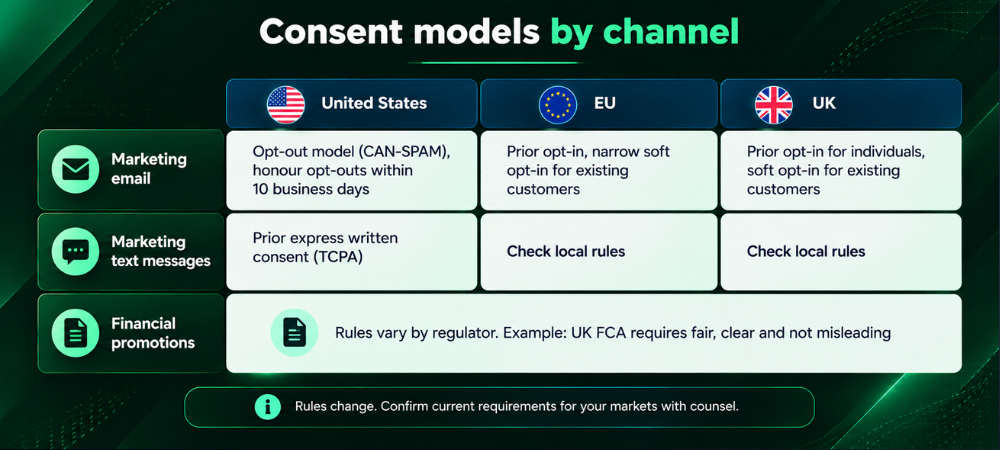
These constraints change how you build automation. Store consent as data: record the timestamp, the source, and the version of the wording the person saw. Sync that record to every tool that sends messages, and keep one shared suppression list. Keep sensitive fields out of marketing tools. A stage flag such as “verification approved” is enough to trigger a message, whereas account numbers, balances, and identity documents never need to leave your core systems.
Review each vendor’s security practices, access controls, and data processing terms before you connect them. Finally, send dynamic content that changes claims, such as rates, fees, or returns, through legal or compliance review. Viacon’s fintech marketing services build those checkpoints into the workflow, which costs less than fixing a complaint after the fact.
| Can We Email Existing Customers About New Products Without Fresh Consent? It depends on the country and the channel. In the EU and UK, the soft opt-in may allow it for similar products if you gave a clear opt-out at collection and in every message. In the US, email follows an opt-out model, while texts need prior written consent. Because the answer changes with the product and the jurisdiction, have counsel confirm it before you automate it. |
How To Decide What To Fix First
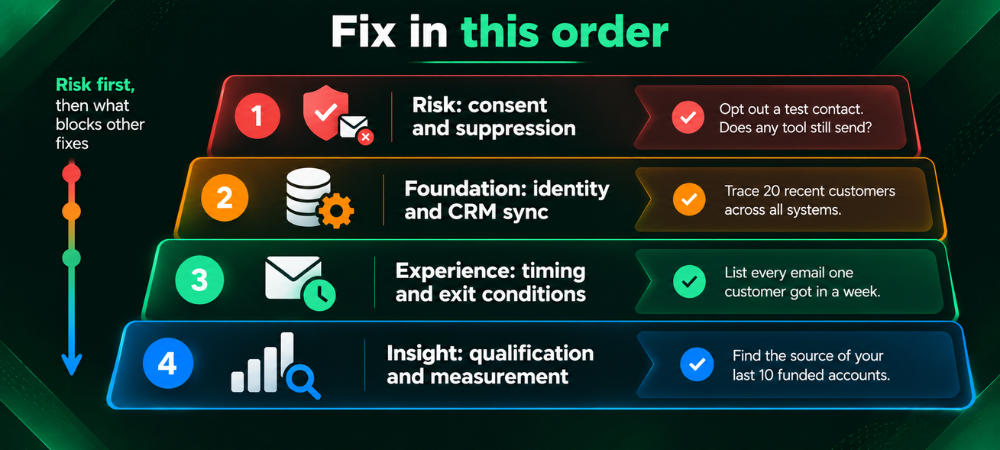
A team that tries to fix everything at once usually fixes nothing. Use a simple rule instead: repair what carries the most risk first, then what blocks other fixes, then what is cheapest, and finally what improves visibility.
Start by checking consent and suppression. If a person who opted out can still receive a message, stop and fix that before anything else, because the downside is regulatory and reputational. Next, turn to identity and CRM sync. Almost every other repair depends on the systems agreeing about who the customer is and where they stand.
After that, fix timing and exit conditions, since those changes usually involve configuration rather than new infrastructure. Qualification comes next, because it needs sales time and clean data. Measurement upgrades can start early in parallel, as a baseline takes months to build, but they rarely need to finish first.
The table below gives a quick check for each problem and a likely first fix.
 Figure 3: Fix in this order, starting with consent and suppression.
| Problem | Quick check | Likely first fix |
|---|---|---|
| Consent and suppression | Opt out a test contact and see whether any tool still sends | Central consent record and shared suppression list |
| Fragmented data | Trace 20 recent customers across all systems | One customer ID and field ownership rules |
| CRM disconnect | Compare lead status in both tools for 20 contacts | Written lifecycle stages and two-way sync |
| Bad timing | List the emails one customer received in a week | Event triggers, exit conditions, global frequency cap |
| Weak qualification | Ask sales how many recent leads they accepted | Separate fit and intent scores with disqualifiers |
| Measurement gaps | Find the source of the last 10 funded accounts | One outcome per workflow and source on the customer record |
The order can change. A team with clean data but no consent records starts in a different place from a team with solid consent handling and duplicate-ridden contacts. Likewise, a company that sells only to businesses faces different consent rules than one that texts consumers. Run the quick checks, note which ones fail, and sequence the repairs by risk and dependency.
If you want a second pair of eyes on the results, you can talk to Viacon’s team and map the fixes to your stack.