Marketing used to reward improvisation. A clever campaign idea, a few sharp social posts, an SEO push timed right any of these could move the needle on their own. That era is over. Buyers now bounce between search engines, social apps, review sites, email, and AI-generated answers before they ever land on a brand’s website, and they rarely follow the tidy path marketing plans assume.
Because that path keeps splintering, marketing has to become more structured, not less. Businesses have responded by buying tools, dashboards, automation platforms, reporting suites, and there’s no shortage of them in 2026. The hard part isn’t finding software. It’s deciding what actually connects to revenue and what just adds noise to a Monday morning report.
This is where a good marketing agency stops looking like an outside vendor and starts looking like an operating advantage. The right partner doesn’t hand you more tools. It tells you which ones matter, in what order, and why.
What Is A Marketing Agency In 2026?
A marketing agency plans, runs, measures, and improves the work a business does to attract and keep customers. That sounds simple. The execution rarely is.
A modern agency has to coordinate brand positioning, search visibility, paid advertising, content, conversion work, automation, and customer data all inside one commercial strategy. Ten disconnected marketing activities don’t help a business. A working system does: paid campaigns reveal how audiences behave, search data shapes what content gets written, the website carries that data through to conversion, and reporting feeds the next round of decisions.
A full-service partner like Viacon’s digital marketing team builds that kind of structure on purpose. The goal isn’t activity across every channel.
It’s Figuring Out Three Things:
- Which channels actually fit the business model.
- How those channels should work together.
- Where the next dollar of investment is likely to move the needle.
| Which Marketing Channels Matter Most For Business Growth? The right channel depends on the business model, not on what’s trending. B2B companies usually get the most out of LinkedIn, SEO, and targeted outreach that supports long, considered sales cycles. B2C and ecommerce brands tend to lean on short-form video, paid social, and automated email flows that raise lifetime value per customer. |
| When Should A Small Business Outsource Its Marketing? Once a small business hits product-market fit and revenue steadies, execution usually becomes the bottleneck, not strategy. If the owner spends more hours posting and boosting than planning, or the highest-ROI channels sit outside anyone’s expertise, that’s the signal to bring in outside help. |
Why Hiring An Agency Makes Commercial Sense?
The usual pitch for agencies is access to specialists. That’s true, but it undersells the real advantage.
A good agency creates a shared strategic layer. Instead of five vendors chasing five separate goals, one team pulls SEO, paid media, content, and design toward the same commercial target. That cuts down on conflicting messaging, duplicated work, and the familiar situation where every channel report looks fine while qualified leads stay flat.
A Wider View Of The Customer Journey
Hiring a marketing partner also changes how a business sees its own customers. Buyers rarely decide immediately. They find a brand through search, a blog post, or a retargeting ad, compare it against two or three alternatives, then sit on the decision for weeks or months.
Plan each of those touchpoints in isolation, and the experience feels disjointed: the offer shifts, the message shifts, the value proposition shifts. An agency examines the full journey instead of treating every touchpoint as its own project, which makes it easier to spot:
- Where interest drops off
- Where trust breaks down
- Where a clearer message would move a prospect forward
That view also changes how a business measures performance. Instead of judging each channel on its own metrics, the team weighs results against actual business outcomes.
Full-Team Expertise Without the Full-Time Hiring Cost
Building an internal marketing department from scratch is never a one- or two-person job. It has to cover SEO, content, social, paid media, design, and analytics, and one hire can only ever cover a slice of that list. A skilled SEO specialist might fix a site’s fundamentals but won’t have bandwidth left for deep technical SEO and link-building work on top of content and reporting.
An agency solves that gap by giving a business access to every specialization it needs without the hiring. That doesn’t make an internal marketing hire pointless; the strongest setups usually combine internal business knowledge with external specialist capacity. The company keeps commercial direction. The agency brings depth, execution power, and an outside view that internal routines tend to dull over time.
| Operating Area | Internal-Only Approach | Agency-Supported Approach |
|---|---|---|
| Expertise | Limited to current hires | Access to several specialists |
| Capacity | Vulnerable to workload spikes | Resources scale with the campaign |
| Technology | Requires separate tools and training | Comes with established workflows and platforms |
| Perspective | Deep organizational knowledge | Broader market and channel exposure |
| Execution | Depends on a few employees | Spread across a coordinated team |
What Does A Marketing Agency Actually Cost?
Cost is the question most businesses ask first, and the one most agency websites dance around. Here’s a straighter answer.
Agencies typically price their work one of four ways: a monthly retainer for ongoing programs, a flat project fee for defined deliverables, an hourly rate for consulting or small fixes, or a performance-based fee tied to results, common in paid media, where agencies often charge a percentage of ad spend on top of, or instead of, a flat fee.
| Service | Typical Monthly Range (2026) |
|---|---|
| SEO | $750 – $10,000+ |
| Paid media / PPC | $2,500 – $10,000+, or 10–20% of ad spend |
| Content marketing | $2,000 – $15,000+ |
| Social media management | $1,000 – $10,000+ |
| Email marketing | $300 – $5,000 |
| Full-service / integrated | $5,000 – $25,000+ |
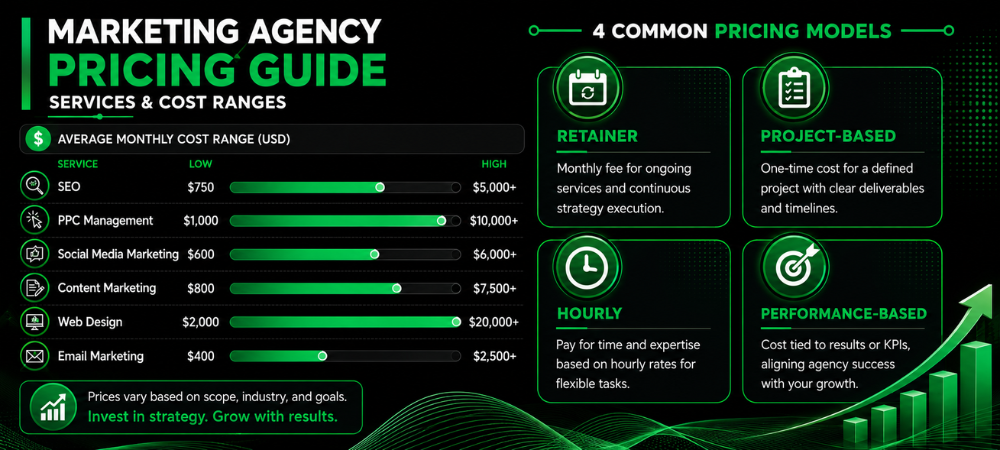
These ranges swing widely because scope, industry competitiveness, and team seniority all move the price. A boutique agency and an enterprise firm can quote five times apart for what looks like the same service on paper. The difference usually comes down to who’s actually doing the work and how much of it they’re doing. This is why comparing quotes line by line, not just the total number, matters more than picking the lowest bid.
A performance-driven paid media partner will usually walk through exactly what’s included at each price point before asking for a signature. If an agency won’t do that, treat it as information.
| Project-based Pricing vs. Monthly Retainer: Which Is Better? It depends on the work. A defined, one-time deliverable, like a site redesign or a single campaign, suits project pricing. Ongoing growth work like SEO, content, or paid media suits a retainer, since it needs continuous adjustment rather than a single handoff. |
| Are Setup Fees Normal For Digital Marketing Agencies? Yes. Setup fees usually cover upfront work like account configuration, technical audits, tracking pixel integration, and CRM setup. It’s a one-time cost that gets baseline infrastructure right before active campaigns launch, not a recurring charge. |
What To Expect In Your First 90 Days With An Agency
The first three months set the tone for everything after. A serious agency starts with a diagnostic phase auditing the website, current campaigns, and analytics setup before touching a single ad or blog post. That audit does two jobs: it surfaces quick wins, and it captures a baseline (current traffic, cost per lead, conversion rates) that the agency measures every later result against. Skip that step, and nobody can prove the agency actually moved anything.
From there, expect the agency to put specific KPIs and success timelines in writing before month one ends, not after a quarter of guessing. Viacon’s audit process follows the same logic: assess first, commit to numbers second, execute third.
| How Long Does It Take For A Marketing Agency To Show Results? Paid campaigns usually produce measurable movement within two to four weeks of launch, since spend and testing can start immediately. Organic work like SEO takes longer, typically three to six months, because it depends on search engines re-crawling, re-indexing, and re-ranking a site. |
Faster Adaptation Without Chasing Every Trend
New formats and platforms show up constantly, and chasing all of them wastes time without building any real advantage. Novelty passes for progress more often than it should.
A good agency filters before it recommends. It asks whether a new format, automation tool, or media opportunity actually fits the brand’s audience and commercial goal, and it’s willing to say “this is probably a distraction” as often as “this could matter.” That restraint is what makes a scalable SEO strategy possible in the first place: consistent execution beats a string of half-finished experiments.
Where Agencies Create The Most Value
An agency earns its keep once marketing has grown too interconnected to manage informally. The warning signs are usually mundane, not dramatic:
- Campaign launches keep slipping.
- Reports track impressions because nobody can trace revenue back to a channel.
- Content exists, but no one can say which customer question it answers.
- Paid traffic lands on pages nobody built to convert.
At that point, the business doesn’t need another isolated tactic. It needs operating discipline, planning cycles, clear ownership, testing processes, and reporting standards. None of that is glamorous, but it’s what turns marketing from a pile of deliverables into a repeatable growth function.
The Most Useful Agency Work Usually Includes:
- Translating business goals into measurable marketing priorities.
- Defining audiences, messages, channels, and conversion paths.
- Coordinating content, creative, media, search, and website execution.
- Testing assumptions before scaling spend behind them.
- Reporting what changed, why, and what happens next.
This matters most for businesses launching something complex. A company introducing an EdTech platform, for instance, has to sell more than features; it needs to address adoption concerns, support user education, and build demand on more than one side of the marketplace at once.
How To Know Your Agency Is Actually Working?
Most disputes between businesses and agencies come down to measurement, not execution. Fix the measurement, and a lot of the friction disappears.
Start with a baseline before the engagement begins: current lead volume by channel, cost per acquisition, and organic traffic split between branded and non-branded search. Without that number, “improvement” is just an opinion. Then agree on KPIs in writing before the first month ends, specifically enough that both sides can check progress against them later.
Watch These Four Numbers Closely:
- Marketing-sourced Pipeline: The dollar value of opportunities the agency’s channels actually originated
- Conversion Rate Trend: Improving click-to-lead and lead-to-sale rates signal the agency is optimizing the full funnel, not just driving traffic
- Non-branded Organic Traffic: For SEO work, growth here over three to six months is the real signal; branded traffic growth usually reflects awareness from somewhere else
- Test-and-learn Velocity: How many experiments ran last quarter, and what changed because of them
Two mistakes distort this picture more than any other. The first is tracking activity instead of outcomes: a report full of “posts published” and “campaigns launched” measures effort, not results.
The second is judging too early: evaluating an SEO engagement at 90 days and calling it a failure ignores how search indexing actually works. Every case study worth reading shows the timeline alongside the result, for exactly this reason.
| What KPIs Should I Ask My Agency To Report On? Ask for cost per acquisition, marketing-sourced pipeline or revenue, conversion rate by funnel stage, and for SEO specifically, non-branded organic traffic. Vanity metrics like impressions and likes can appear in reports, but they shouldn’t be the headline. |
Agency Versus Freelancer Versus Internal Team: Which One Fits
There’s no universally right delivery model. A freelancer suits a defined, one-off assignment. An internal team gives close access to customers, leadership, and product knowledge. An agency earns its place when a business needs several disciplines moving together, or more capacity than its internal structure can support.
The decision should start with the work, not the label. Five landing pages might only need a specialist freelancer. Weak positioning plus inconsistent acquisition plus poor search visibility plus an underperforming website is a different problem; stitching together several disconnected contractors to solve it usually adds coordination cost rather than removing it.
| Business Need | Freelancer | Internal Team | Marketing Agency |
|---|---|---|---|
| One specialized deliverable | Strong fit | Possible | Often unnecessary |
| Daily brand involvement | Limited | Strong fit | Moderate |
| Multichannel campaign management | Limited | Depends on team size | Strong fit |
| Rapid access to varied expertise | Moderate | Slow to build | Strong fit |
| Independent strategic perspective | Moderate | Limited | Strong fit |
| Scaling execution quickly | Limited | Requires hiring | Usually easier |
A hybrid model often works best: internal leaders keep brand knowledge, customer context, and decision-making authority, while the agency or dedicated specialists brought in for specific gaps handle execution and give an outside read on performance. Set clear boundaries early. Without them, approvals drag, and both sides quietly assume the other owns the result.
Red Flags That Signal The Wrong Agency
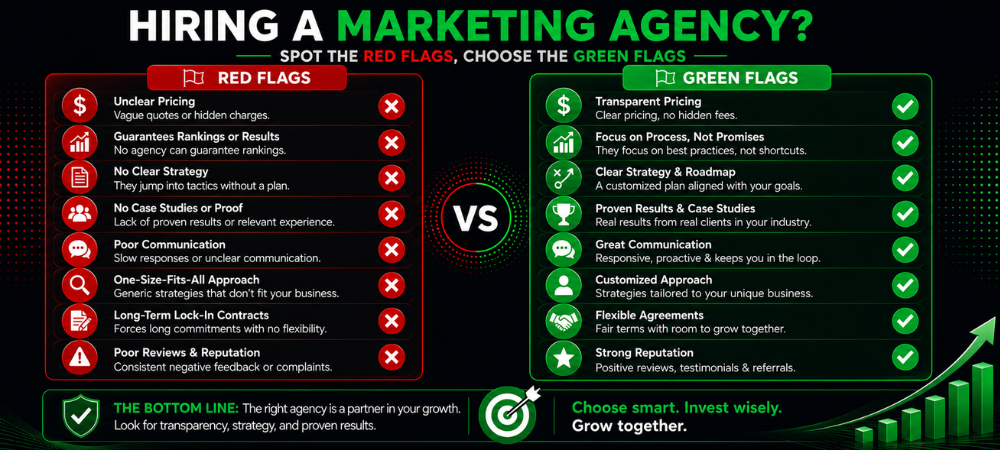
Not every agency delivers what its pitch deck promises. A handful of warning signs tend to show up early, before anyone signs a contract:
- No Access To Your Own Accounts: If an agency won’t grant admin or read-only access to Google Ads, Analytics, or your CRM, that’s not standard practice; it’s a control tactic.
- Proposals Built On Activities, Not Outcomes: “Three posts a week” is an activity. “Ten qualified leads within 90 days” is an outcome. You can only measure one of them.
- The Same Strategy For Every Client: A plan that doesn’t mention your industry, competitors, or sales cycle probably came from a template, not from research on your business.
- Reports Full Of Vanity Metrics: Likes and impressions look fine in a slide deck. They rarely explain why revenue moved or didn’t.
- A Staffing Bait-and-Switch: The senior strategist from the pitch disappears after signing, and a junior account coordinator who’s never touched the account takes over instead.
- Slow, Defensive Communication: An agency that takes days to respond during the sales process rarely speeds up once you sign the contract.
| How Do You Know When It’s Time To Fire A Marketing Agency? If two or three of these signs show up together vague reporting, no account access, and slow communication, for example and the agency doesn’t correct course after a direct conversation, that’s usually enough reason to start evaluating alternatives. |
What To Look For Before Choosing An Agency
Agency pitches lean on the same reassuring language: growth, innovation, data-driven thinking and none of it helps with comparison. What actually separates a strong agency from a mediocre one is how it makes decisions.
Ask how it diagnoses a problem, prioritizes channels, defines a qualified lead, and responds when a campaign underperforms. The quality of its questions often reveals more than the confidence of its pitch.
Does the team ask about margins, sales cycles, and operational capacity, or does it jump straight to a package recommendation? A serious partner needs enough commercial context to know what success would actually mean for the business.
Reporting practices deserve the same scrutiny. A strong report doesn’t just list traffic and clicks; it explains what changed, which assumptions the team tested, and what happens next.
Measurement without interpretation is administration wearing a smarter outfit. Reviewing an agency’s past case studies and portfolio rounds out the picture, showing the kind of work it has actually delivered rather than the kind it claims to.
How AI And Generative Search Are Changing The Agency’s Job
The fragmented customer journey mentioned earlier search, social, review sites, and now AI-generated answers has added a genuinely new layer of work for marketing agencies. Search engines like Google now summarize answers directly on the results page, and AI assistants pull from the web to answer questions without a click ever happening.
That shift doesn’t replace SEO. It sits alongside it. Content still needs to rank in traditional search, but it also needs the structure and clarity that let AI systems cite it accurately: clear answers, credible sourcing, and a site architecture that search crawlers and AI models can both parse. Agencies that only optimize for the old ranking factors are already behind. Structuring content and site architecture for AI search visibility has become its own discipline, sitting next to, not instead of, traditional SEO.
| Do I Still Need SEO If AI Search Engines Are Becoming More Common? Yes. AI answer engines still draw from indexed, well-structured web content, so traditional SEO fundamentals technical health, authority, clear content remain the foundation. What’s changed is that content also needs to be citable and easy for AI systems to extract, not just rankable. |
What A Healthy Agency Relationship Looks Like
The best agency-client relationships are collaborative without being vague. Both sides know their responsibilities, have access to the information they need, and agree on realistic review timelines and a real decision-making process.
Neither side disappears after the kickoff call. The client stays engaged; the agency doesn’t hide behind a monthly report. Good work depends on regular, honest exchanges about performance, constraints, and shifting priorities, not just scheduled check-ins.
Some campaigns will underperform. That’s normal; marketing runs on assumptions, and not every assumption survives contact with the market. The real test is whether the agency catches weak signals early, explains what happened without dressing it up, and adjusts intelligently.
An honest diagnosis beats a polished excuse every time. A good agency will also push back occasionally, narrowing an unrealistic goal, tightening an audience, or delaying spend until the landing page is ready to convert. If every recommendation gets an automatic yes, the relationship might be pleasant, but it’s not doing much strategic work.
Why Businesses Choose Viacon?
Everything above describes what a strong agency partnership should look like. Here’s where Viacon fits that description in practice.
Viacon operates as a Google Premier Partner and coordinates web development, digital marketing, AI automation, and growth solutions inside one team, instead of routing a business through separate vendors for each discipline the coordination problem this guide opens with.
Long-term clients report ROI growth around 300%, alongside a 95% client satisfaction score and a 90% retention rate. Numbers like that only hold up when the transparency and communication habits described earlier get practised consistently, not just promised in a pitch.
The client roster spans more than 50 industries, from healthcare and fintech to hospitality and legal services, so most new clients aren’t the agency’s first attempt at their sector’s specific problems. Client testimonials reflect that pattern directly, and case studies document the same before-and-after numbers a business should ask any agency to show before signing.
Rather than asking a business to take pricing and process on faith, Viacon offers a free digital audit, a free SEO checker, and a free ROAS calculator up front the kind of open access this guide flags as a green light, not the account-locked, PDF-only reporting that signals trouble.
The Right Agency Turns Marketing Into A Growth System
Hiring a marketing agency in 2026 isn’t an admission that a business can’t market itself. Plenty of internal teams understand their customers better than any outsider could. The real constraints are scale, specialization, and coordination, and modern marketing has too many moving parts to manage indefinitely through scattered campaigns and last-minute requests.
The right agency turns those parts into a working system: strategy informs execution, channels share what they learn, reporting drives the next decision, and creative work stays tied to commercial reality. Marketing becomes less reactive and more deliberate. Not a constant stream of activity, but a clearer way to decide what actually deserves time and budget.
That’s the system Viacon builds for clients at every stage of growth. If your marketing feels busy but not aligned, request a free digital audit and see where a more coordinated strategy could take you next.