Most companies treat reviews as something that happens to them. A customer is happy or annoyed, writes a few lines, and the rating moves. That’s a passive way to handle one of the few ranking inputs you can actually influence.
If you run a multi-location business, a services company, or a SaaS product with local customers, reviews affect two things at once: where you show up in map results, and what a buyer concludes about you in the ten seconds before they call or click away. Here’s how we’d approach them in 2026.
Why Reviews Matter More Than A Star Rating Suggests
Google has said plainly that review count and rating feed into local rankings, which makes reviews a core part of any local SEO plan. Beyond ranking, reviews do a quieter job: they answer the question “will this go badly?” before anyone talks to your sales team.
BrightLocal’s 2026 Local Consumer Review Survey (1,002 US adults) found that 97% of consumers read reviews for local businesses, and the average person checks around six different review sites before choosing. Nobody is deciding from one rating on one platform anymore.
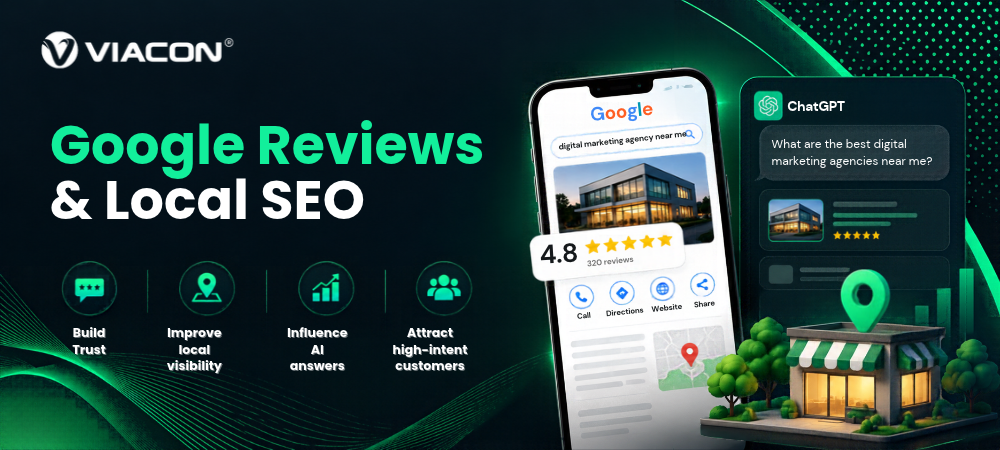
The same survey found that the share of people using AI tools such as ChatGPT to find local recommendations went from 6% in 2025 to 45% in 2026, while Google’s share as a place to read reviews slipped from 83% to 71%. Google is still the biggest source. It’s just no longer the only one, and the two now overlap: a study we covered on our blog found ChatGPT among the most-clicked destinations from Google searches.
What A Useful Review Looks Like
A five-star rating with no text helps your average and little else. The reviews that do real work are specific. They describe the problem the customer had, what it was like to deal with your team, and how it ended.
Compare These Two:
- “Great service, highly recommend.”
- “Our checkout page was losing people on mobile. Viacon’s team found the issue in two days, and we’ve had fewer abandoned carts since.”
The second one gives a prospect something to picture, and it gives Google and AI tools real language about what you do and who you do it for. Reviews that name a staff member, a service, or a result also tend to read as more believable, because they’re harder to fake.
Photos and short videos add to that. A picture of the finished job, the installed system, or the delivered product shows the customer was there. Where it fits your business, ask for one.
Recency Is Part Of The Signal
A business with 300 reviews and none from the last eight months looks like a business that stopped caring, or stopped trading. Fresh reviews tell both buyers and Google that you’re active.
This is why one burst of review requests after a campaign doesn’t hold up. A steady trickle beats a spike. Think weekly, not quarterly.
Two Habits Are Worth Building:
- Track Your Review Count Against Competitors: If the three businesses ranking above you each collect around five reviews a week and you collect one, no amount of profile tweaking will close that gap.
- Check Your Rating And Volume Every Month: Catch drops early. A slide from 4.6 to 4.2 usually has a cause you can fix, such as a slow support queue, a billing complaint, or one location that’s struggling.
How To Ask Without Breaking Google’s Rules
Google prohibits offering customers anything in exchange for a review, and it also prohibits “review gating”, where you only send the review link to people you expect to be happy. Both can get reviews removed or your profile restricted.
What Works Within The Rules:
- Ask At The Right Moment: Right after a problem is solved, a project is delivered, or a customer says thank you. Not three weeks later.
- Make It One Tap: Your Google Business Profile has a direct review link. Put it in a post-service text or email, not behind a page that asks people to “find us on Google.”
- Automate The Request, Not The Tone: A short, plain message from a real person’s name gets more responses than a branded template.
- Reward Your Team, Not The Customer: It’s fine to recognise staff who get named in reviews or who consistently collect them. A monthly gift card or a small bonus keeps requests from falling off.
- Ask Business Contacts Too: Suppliers, partners, and other companies you’ve worked with can review you if they’ve dealt with you in a real business capacity. This helps newer firms and low-volume, high-value ones, such as consultancies and agencies.
Don’t Lean On Google Alone
Here’s the part many local SEO guides skip. BrightLocal’s AI trust research points out that tools like ChatGPT can’t see inside Google’s own review data. When someone asks an AI assistant for the best provider in a city or category, the answer is built from what’s available elsewhere: your website, directories, industry review sites, press coverage, and forum discussions.
For a B2B company, that usually means G2, Capterra, Trustpilot, Clutch, or whatever your category treats as the standard. For a local firm, it might be Facebook, Yelp, or an industry directory.
In Practice:
- Pick two or three platforms beyond Google that your buyers actually use, and keep them current.
- Use the same business name, address, and description everywhere so the sources agree with each other.
- Publish real customer stories on your own site, with names and outcomes where the client allows it.
- Earn mentions in publications your buyers read. This is where digital PR and AI search visibility work overlap with local SEO.
Handling Negative Reviews
You will get them. How you reply matters more than the review itself, because most readers are judging you, not the reviewer.
A useful reply is short, doesn’t get defensive, and says what happens next. Acknowledge the problem, say what you’re doing about it, and offer a direct way to continue the conversation. Skip the copy-and-paste apology.
A rating that’s a little under perfect also tends to look more believable than a flawless 5.0. Don’t chase perfection. Chase a pattern of honest, well-handled feedback.
If a review is fake or breaks Google’s policies, report it through the review management tool in your Business Profile. If it’s a genuine customer who’s unhappy, answer it and move on.
When Reviews Disappear
Business owners regularly report reviews vanishing from their profiles. Part of it is Google’s spam filtering, which sometimes catches legitimate reviews. Part of it has been outright bugs. In July 2026, Google told Search Engine Land it was investigating reports of disappearing Business Profile reviews and would restore any that were removed by mistake.
If it happens to you, take screenshots of your reviews on a regular schedule so you have evidence, then contact Google Business Profile support and use the “review missing” option. If that stalls, the Business Profile Community Forum is the next step.
This is another reason to spread your reputation across more than one platform.
A Simple Monthly Routine
You don’t need a large program. A workable version looks like this:
- Send the review request through marketing automation after every completed job, delivery, or onboarding milestone.
- Reply to every new review within a few days.
- Check your count, rating, and recent reviews against your top three competitors.
- Pull out common themes in the feedback and pass them to whoever owns the issue.
- Add one customer story or case study to your site each month.
The fifth step is the one most teams skip, and it’s the one that gives search engines and AI tools something to quote.
Where Viacon Fits
We help companies connect review strategy to the rest of their search work, from SEO and AI search visibility to conversion rate optimisation and review-request automation. If you’d like a second pair of eyes on your Business Profile, your review pipeline, or how AI tools currently describe your company, get in touch.