For the informational searches (how to, what is, etc.) Google’s AI Overviews (AIO) are actively cannibalizing the open web. It is reducing the click-through rate of the top organic results by an average of almost 34% to 40%.
These statistics clearly indicate where the future of SEO is heading. What began as a mere evolution of technology has now come full circle. Today, AI-powered search engines are changing the very definition of search.
Instead of ten blue links, a well-sythesized answer is not taking its place. Users are now asking follow-up questions and getting the required answer, and they are completely overlooking the websites behind all of this.
It means the traditional SEO strategy of matching keywords will not cut it for brands in 2026. Business owners and marketing teams have to think beyond ‘phrase matching’ and look into content depth, entities, context, and overall brand signals across the web.
So, let’s unpack what is required to create a modern SEO strategy for 2026.
The Evolution Of SEO: From Keywords To Intelligence
The evolution of SEO has been gradual rather than sudden. In its early days, SEO focused on keywords, meta tags, content creation, and backlinks. Strong content helped establish authority, while backlinks acted as trust signals. Together, they became the foundation of search rankings.
Over time, many businesses focused on content volume and link building instead of genuine expertise and brand credibility. As search engines continued rewarding exact-match optimization, websites began creating content for algorithms rather than users. This made SEO more predictable and easier to manipulate, often allowing well-optimized pages to outrank more authoritative sources.
A major shift came with mobile-first indexing. Search engines began prioritizing the mobile version of websites, making user experience, page speed, and mobile usability essential ranking factors. SEO was no longer just about content and links—it also required strong website performance.
The biggest transformation, however, has been the rise of AI-powered search. Instead of presenting users with a list of links, AI systems now generate direct answers by combining information from multiple sources. This improves the search experience but changes how brands earn visibility.
Today, ranking on page one is no longer enough. Brands must ensure their content is clear, trustworthy, well-structured, and supported by strong authority signals. AI-driven search rewards expertise, context, and credibility, making visibility dependent not only on rankings but also on whether AI systems choose to reference and trust a brand’s information.
SEO has evolved from keyword optimization to intelligence, authority, and user-focused experiences.
| If Google answers the question directly in the search results and the user never visits my site, how do I actually generate a lead or a conversion? You actually generated the lead before the answer even surfaced by making your brand a trusted source in the niche. Even if Google offers a quick and well-summarized answer, your content must have the required recall, authority, and next-step intent to drive the user to the end of the conversion path. |
The last part of this evolution, which everyone is experiencing in 2026, is the shift toward contextual search. Why? Because users are asking such questions today, they are no longer typing keywords. For instance, instead of typing in ‘AI SEO strategy for B2B businesses’, users are now entering ‘What kind of SEO strategy should a B2B company use if AI search is reducing clicks? ’. Now, a query like this demonstrates intent, industry, problem, channel impact, and strategic expectations built in, and indicates where the future of SEO is headed.
| The Hidden Opportunity While traffic from AI search tools has declined dramatically, it has been compensated for by intent. Data shows that visitors who come to a website via AI platforms spend 68% more time on the website and are 16% more likely to convert. |
Traditional SEO vs. Modern SEO In 2026
| Area | Traditional SEO Approach | Modern SEO Strategy |
| Keyword strategy | Focuses on exact-match keywords and search volume | Focuses on intent, entities, semantic coverage, and topical depth |
| Content goal | Creates pages to rank for individual queries. | Builds content ecosystems that answer connected user problems. |
| Search visibility | Measures success primarily through ranking and organic clicks | Measures ranking, AI visibility, citations, brand mentions, and assisted discovery |
| Technical SEO | Prioritizes crawlability, indexing, speed, and metadata | Keeps technical SEO strong while adding structured data, content clarity, and AI readability |
| Authority building | Relies heavily on backlinks and domain authority | Builds brand authority through expertise, consistency, digital PR, reviews, and third-party trust. |
| User experience | Often handled after SEO work is complete. | Treated as part of SEO performance, conversion, and trust building. |
| Search format | Optimized mostly for text-based search results. | Optimized for text, voice, image, video, conversational AI, and multimodal discovery. |
Why Will Traditional SEO Not Be Enough In 2026?
You will see a lot of people claiming that ‘SEO is dead’ and that it is no longer relevant in 2026. Whereas the truth is nowhere near it. Yes, SEO in its traditional form is not capable of delivering the results it used to, but it is neither dead nor irrelevant.
There is no doubt that search marketing trends keep evolving, but the basics still matter. A website, content, interlinks, backlinks, trust signals, etc., still matter, but not in the same way. So, here is why the experts are saying traditional SEO won’t be enough in 2026:
(i) Search Is Moving Beyond The Blue Link
In 2026, search is moving beyond the blue link. This matters for the brands because, even if they rank but don’t feature in Google AI overviews, they lose visibility. If an AI answer satisfies the user before the click, or video content catches the eye, or a Reddit-style discussion feels more authentic, users will deviate there and not click through to the website.
It means the future of searchis not only about being indexed. It is about showing up in the formats where decisions actually begin.
(ii) AI Search Engines Are Changing Discovery
The ability of AI search engines to provide well-synthesized answers is changing how brand discovery happens in 2026. Today, a user can ask a layered question and follow-ups, and the AI-powered search engine will provide an accurate response.
This is where the generative search emerges as both a boon and a bane. While it ensures visibility is no longer determined by SERP rank, it also reduces organic click volume. As a result, brands that end up explaining a topic better, build greater authority, and maintain a clear entity relationship are dominating AI search summaries and improving their visibility.
(iii) Users Are Looking For Answers, Not A List Of Results
The next reason traditional SEO is not enough in 2026 is that user search expectations have changed. Today, users want prompt and clear answers to all their queries. They no longer want to scroll through the list of URLs, opening one website at a time. They want the useful part quickly.
The outcome? Traditional SEO writing is no longer valid. There is no longer room to build into the topic; you need to answer quickly and be direct to create the most impact.
| Our competitors are getting cited as the ‘recommended tool’ inside ChatGPT and Perplexity prompts, but we aren’t. What determines who AI recommends? AI recommends brands that it can trust, understand, and verify. So, it is no longer about having the best product page; instead, it is about clear positioning, strong third-party recommendations, reviews, listicle inclusion, and consistent entity data that proves your brand is actually associated with the segment. |
(iv) Visibility Is More Important Than Ranking
In modern SEO, ranking is not everything anymore. Brands can now appear across AI overviews, social media platforms, and video streaming platforms without being on the first page of the SERP, drawing clicks. Whereas another brand ranks first on the SERP but is not getting enough organic clicks.
This gap is where SEO currently lives. Brands can no longer be fixated solely on ranking; they need to ensure visibility as well to achieve the best outcome.
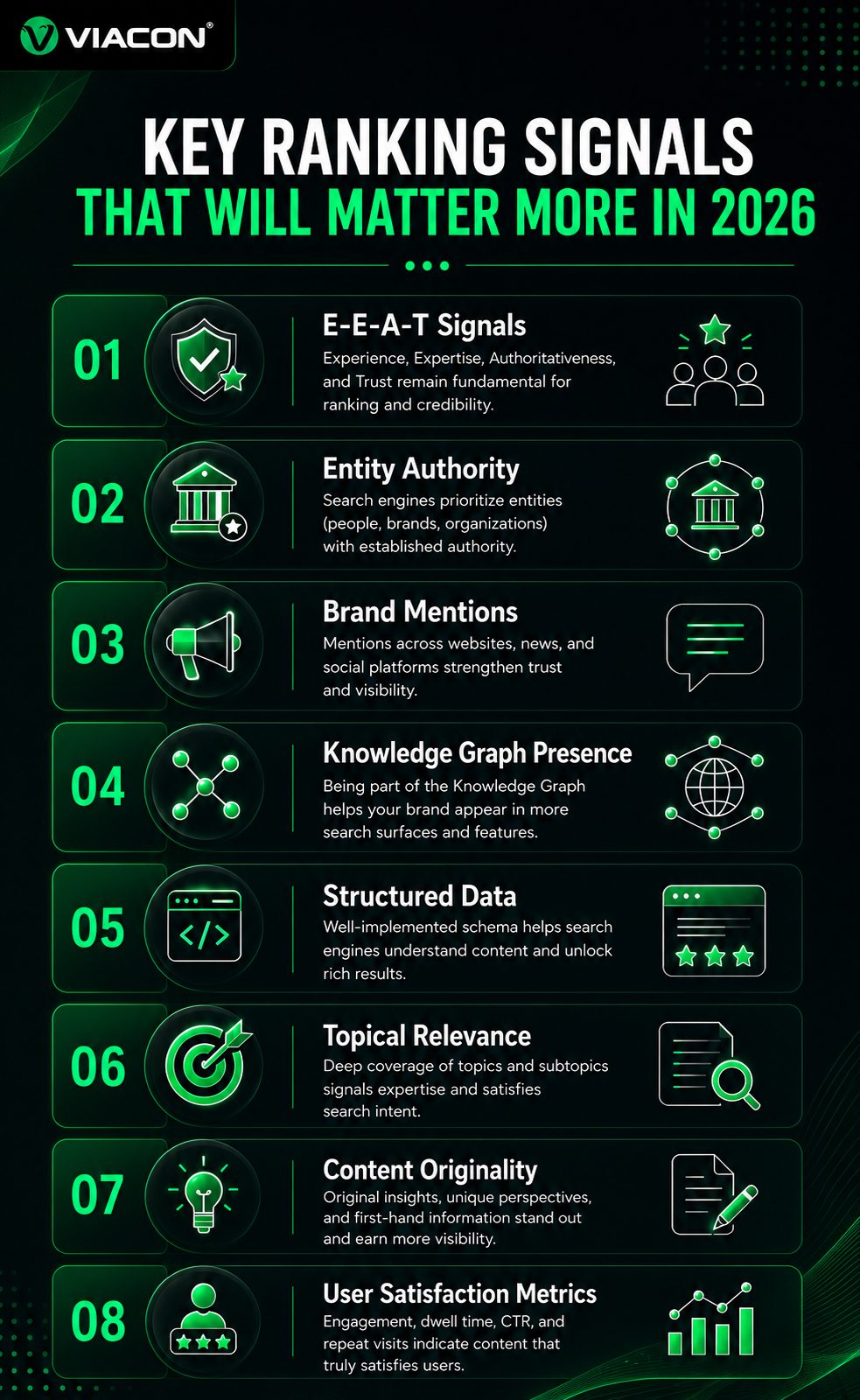
Major SEO Trends Shaping 2026
The conversation surrounding SEO Trends in 2026 has been nothing short of exciting. Here is everything that is expected to unfold this year:
(i) AI Overviews Are Becoming Mainstream
Today, AI Overviews are mainstream in search. Apart from a handful of areas, you will see a properly summarized answer for every topic you search for. It means chasing rankings like you used to is no longer enough. Instead, you need to focus on becoming a trusted source of information that the AI systems trust, reference, summarize, or align with when forming an answer.
However, to implement this in practice, you need content discipline. The pages must have focused topics, accurate explanations, consistent terminology, and enough context to make the message reliable. Also, entity SEOplays a key role here. It connects the brand, topic, expertise, and proof, further boosting visibility.
| Stat Watch: About 60% of all global Google searches are now ending on the search results page without registering a single click. |
(ii) The Rise Of Generative Search
The next trend that needs attention is generative search. It has turned search into a conversation. Today, a user asks a question, refines it, asks follow-ups, compares options, and asks for recommendations. Now, one page rarely carries this whole journey. It means brands need a well-connected content ecosystem that caters to every aspect of the customer journey.
For instance, you want to know about AI search optimization. You will obviously start with its definition, how it works, how it is different from traditional SEO, and which metrics matter. A successful content ecosystem will understand this path and, instead of dumping everything into a single piece of content, create a cluster that caters to every aspect of the user’s interests.
(iii) Growth Of Conversational Search
The next trend to watch in 2026 is the growth of conversational search. Due to the influx of voice search, primarily through smartphones, car infotainment systems, and virtual assistants, people are now searching the way they think. It means they are now asking longer, messier, and more specific questions.
As a result, content built around real decision-making queries, not mere keywords, is being rewarded.
(iv) The Rise Of Personalized Search Results
The next trend that is challenging the very notion of traditional SEO is personalized search results. Today, if two people search for PPC services in India, they are likely to receive very different results based on their location, device, history, behaviour, or preferences.
It means the future of SEO will be kinder to those who build multiple entry points, including use cases, industry pages, pricing explainers, technical content, and thought leadership.
(v) Multi-Modal Search Is Real
Previously, the search was all about what you typed in the ‘search bar’. But today, with the rise of AI search engines, people are sharing screenshots, product photos, voice prompts, and videos to find what they need.
Therefore, brands need to broaden their SEO efforts and treat every element of their content as a search asset.
(vi) Entity-based Search Expansion
Modern search engines are more aware of and better equipped to analyze the context of every piece of content. It means brands need to ensure they maintain consistent information across the board, bolster trust signals, define service pages, and build topical authority in SEO to improve their relevance and authority in the niche.
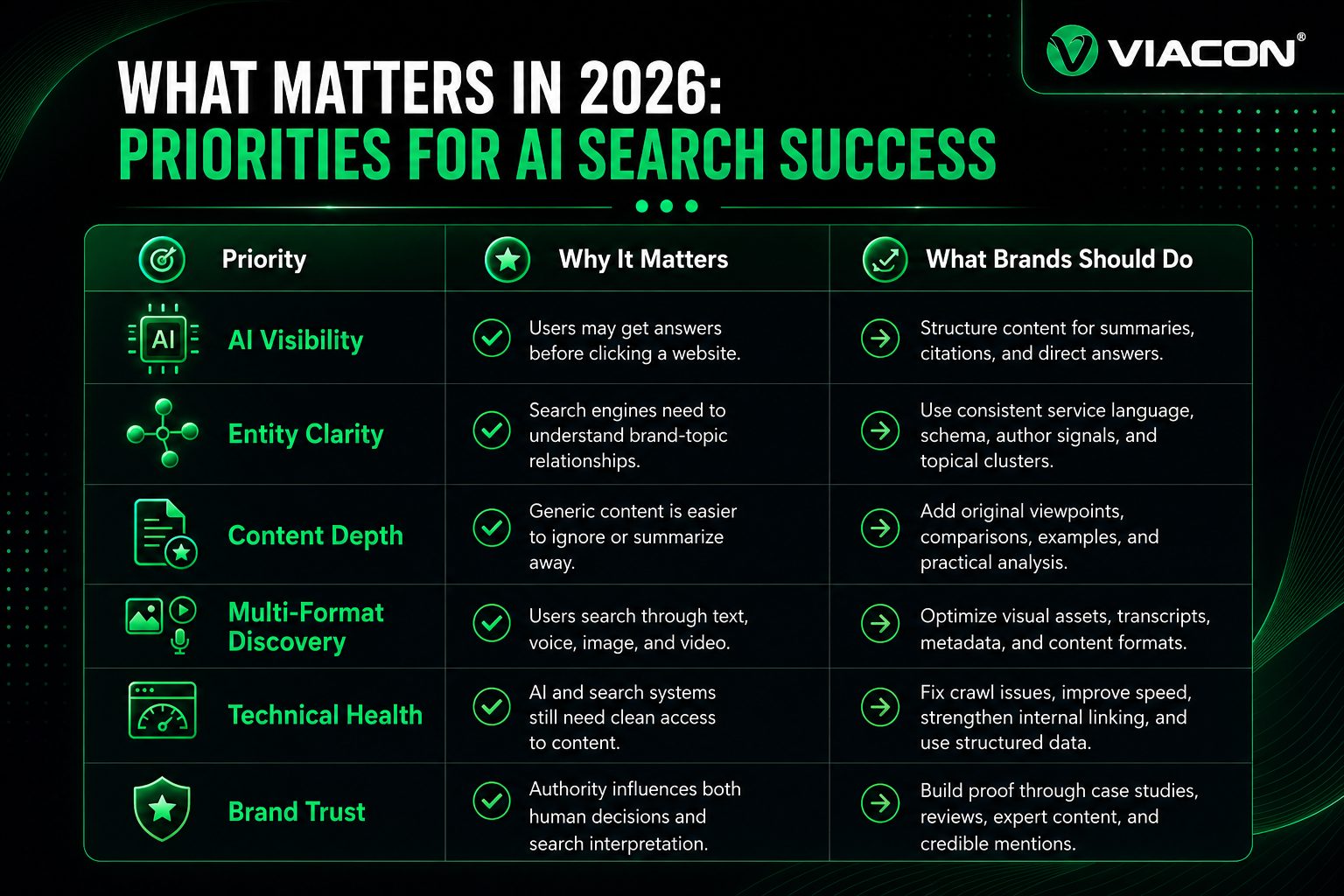
Modern SEO Strategy Of 2026
The future of SEO is not about replacing the previous techniques. It is about expanding and modernizing them to better suit the current purposes. Here is how that can be achieved:
- Combine SEO, GEO, And AEO: SEO continues to support organic visibility, but it has to work with Generative Engine Optimization and Answer Engine Optimization to deliver better results. The goal here is not just to rank, but to appear in AI answers, snippets, voice results, and other answer-first search experiences.
- Focus On topic clusters: Today, random blog publishing is not enough. Brands need a content ecosystem built around pillar pages and supported by articles that cover the full search intent. This helps users move from broad research to particular answers without leaving the brand’s defined content architecture.
- Creating Entity-focused Content: Today, content should also provide a response to the question ‘What should the brand be understood for?’ This entity-focused approach is extremely important in modern content as it helps create meaning. Strong content can connect services, industries, problems, outcomes, and proof points in a consistent way and bolster entity SEO that helps improve visibility of the brand.
- Build Brand Authority: The next element of a modern SEO strategyis building brand authority. Today, search engines, AI systems, and users all look for credible sources online. Using content formats like case studies, expert commentary, author bios, credible mentions, webinars, reviews, and consistent messaging, you can make the brand feel real, established, and worth referencing.
- Optimize For AI Citations: As AI Search Trends continue to reshape discovery, brands should make their content easy for AI systems to verify, summarize, and reference. Clear explanations, consistent terminology, original insights, updated content, structured data, and off-site authority all support AI Search Optimization.
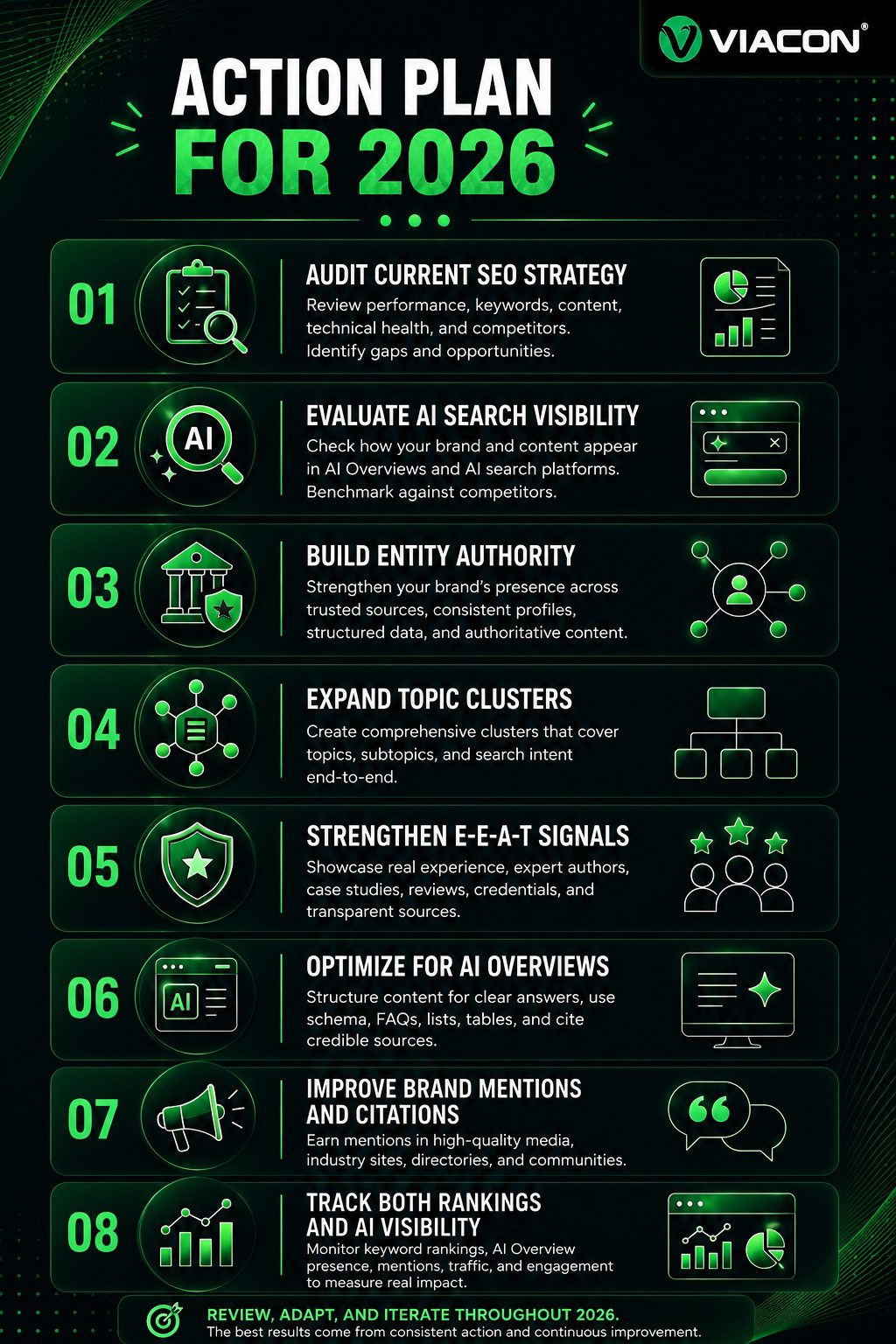
The Future Of SEO Belongs To Brands That Can Be Understood, Trusted, And Cited
In 2026, the biggest mistake that brands can make is treating SEO like old, where you do keyword research, write content, build links, and wait for them to rank. Today, this style of SEO is too small for brands compared to what modern search has become.
It means the future of SEO is now about being understood by machines, useful to humans, and credible across the digital spaces where decisions happen. Therefore, even if traditional SEO remains critical as the foundation, it is not the whole thing anymore.
And this is precisely where brands need sharper strategies, not the same old generic, loud content. They also need technical discipline, entity clarity, topic authority, AI Search Optimization, strong UX, and a realistic understanding of how Generative Search changes the discovery process. Along with this, they also need a trusted partner, like Viacon.
Viacon’s experience as the preferred digital marketing partner for global brands means we have the exposure, expertise, and experience to deliver modern SEO solutions. Our strategic clarity will help your business achieve top SERP rankings and, more importantly, emerge as a trusted source in the niche and rule the AI search ecosystem.
Want a practical view of where your search strategy stands and what your next steps should be? Connect with Viacon and request a digital audit.
Frequently Asked Questions:
A: No, SEO isn’t dead in 2026; it has evolved. Traditional SEO fundamentals like technical optimization, content, keywords, and backlinks still matter, but brands also need to focus on AI search, entity authority, user experience, and visibility across multiple platforms.
A: The future of SEO is more intelligent and user-focused. Instead of just targeting keywords, it emphasizes search intent, topical authority, AI visibility, and trust. The goal is no longer just ranking higher—it’s becoming the most useful, credible, and trusted answer for users.
A: AI is transforming search by providing direct answers and summaries, reducing reliance on traditional search results. To stay visible, brands need clear, well-structured, trustworthy content that AI can easily understand. Original insights and strong authority signals are becoming more important than generic content.
A: AI Search Trends are important because they show how user behavior is shifting. People are relying more on AI-generated summaries, conversational search, and direct answers. If brands ignore this, they may continue to rank in traditional search results while losing influence in newer discovery environments. Understanding these trends helps businesses prepare content, technical assets, and authority signals for the way users will actually search in 2026.