The future of SEO is a bigger job than ranking pages. People now get answers from AI summaries, chat assistants, video, and forums, so your brand has to earn visibility in all of them. Rankings still matter. However, they no longer tell the full story.
That shift changes how buyers find you. A prospect may read an AI answer, notice your brand in it, and search for you a week later. Your analytics will probably log that visit as direct or branded traffic, so the original discovery goes unrecorded.
This guide explains where search is heading, using dated research instead of hunches. You will find six major changes, a comparison of SEO and GEO, and a five-part readiness framework you can score yourself. A 90-day plan with owners and KPIs follows. Business owners, marketing leaders, and SEO professionals can use it as a working document.
What Is The Future Of SEO?
The future of SEO is the move from ranking pages to earning visibility, trust, and revenue wherever people look for answers. Traditional SEO still builds the base: crawlable pages, useful content, and credible authority. AI search optimization adds a second goal. It makes that content easy for AI systems to find, understand, and cite.
Many teams call that second goal generative engine optimization, or GEO. It is not a separate discipline with its own rulebook. Google’s May 2026 guide to generative AI features says its AI features rely on core ranking and quality systems, so standard SEO best practices still apply. The relationship is simple. Traditional SEO gets your content found. GEO helps AI systems use it.
This article separates two kinds of statements. “Established” means research or official guidance backs the point. “Expected” means our reading of the evidence. Nobody knows exactly what search will look like in 2027, so we flag every prediction.
Before you change tactics, check that your SEO strategy starts from business goals instead of keyword lists. A strategy that cannot name the leads, sales, or customers it should produce will struggle in any search environment.
| Is SEO still relevant in the age of AI? Yes. AI features pull from pages that search systems can crawl, index, and trust. Google’s documentation states that no additional requirements or special optimizations apply for AI Overviews or AI Mode beyond SEO fundamentals. Crawlability, indexing, relevant content, and authority remain the entry ticket. What changes is the payoff, because a page can rank well and still receive fewer clicks. |
6 Major Changes Shaping The Future Of SEO
Each change below shows what the evidence says and what to do about it.
1. AI Overviews And AI-Powered Search
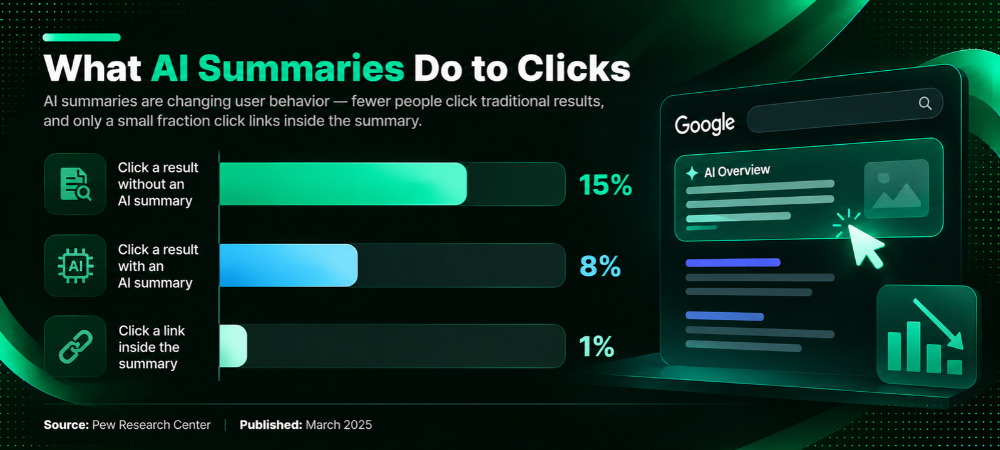
Established: Pew Research Center analyzed 68,879 Google searches from 900 U.S. adults in March 2025. About 18% produced an AI summary. When one appeared, users clicked a traditional result in 8% of visits, compared with 15% when none appeared. Only 1% of visits included a click on a link inside the summary itself. (Pew Research Center, July 2025)
Counterpoint: Google has said that clicks from pages with AI Overviews tend to be higher quality, with visitors spending more time on the site. Pew measured click volume, not click value, so both findings can hold at once.
Expected: AI answers will cover more query types, especially comparisons and multi-step questions. Treat informational traffic as less certain. Then treat visibility inside those answers as a goal in its own right.
What To Do: Test your 20 most valuable queries in Google and note which ones trigger an AI answer. Next, protect the pages where a click still carries commercial value, such as pricing, comparison, and service pages.
2. Generative Engine Optimization (GEO)
GEO is the practice of making your brand and content easier for AI answer engines to retrieve, trust, and cite. It overlaps heavily with SEO. Clear structure, accurate facts, and strong authority help in both.
GEO adds a few extra tasks. You check whether AI tools mention your brand. You look for the sources they cite. You also strengthen the third-party references that shape those answers, such as reviews, industry lists, and expert mentions.
No one can guarantee an AI citation. Models change, prompts vary, and answers differ by user. Be wary of any vendor who promises citations. Google’s guidance also does not support treating GEO as a replacement for technical SEO or content quality.
If you want outside help with this work, Viacon’s AI search optimization services cover visibility audits and entity clean-up.
3. Zero-Click Searches And Changing User Behaviour
Established: SparkToro’s 2026 study, built on Similarweb clickstream data, found that 68.01% of U.S. Google searches ended without a click from January through April 2026. SparkToro said AI Overviews likely contribute but did not isolate their share. The 2024 figure came from a different data panel, so treat the comparison as a direction, not an exact measure.
A zero-click search is not always a lost customer. Many people get a quick fact and move on. Others see your brand in the answer and return later.
Sector context helps here. Viacon’s industry reports hub is a good place to compare your market before you set targets.
To Attract High-intent Visitors Despite This Trend:
- Target questions that need depth, such as pricing breakdowns, comparisons, and “which option fits my situation” guides.
- Offer something a summary cannot deliver: calculators, templates, original data, and downloadable checklists.
- Track branded search, assisted conversions, and demo requests alongside clicks.
| Will AI Search Reduce Organic Website Traffic? For some queries, yes. The impact depends on query type, industry, search experience, and your site’s current performance. Simple definitions and quick facts face the biggest risk. Complex, commercial, and local queries tend to hold up better. Measure your own data by query group before you assume a site-wide loss. |
4. Brand Authority, Entities, And Digital PR
Search systems try to understand who you are, what you do, and whether others vouch for you. That is the idea behind entities. A consistent brand name, description, and set of facts across your site and the wider web make you easier to recognise.
Three Habits Support This:
- Keep company details identical on your website, profiles, and directories.
- Publish expert contributions with named authors and real credentials.
- Earn mentions through original research and legitimate digital PR, never through paid link schemes.
For a deeper look at building recognition, read our guide to entity SEO.
5. Technical SEO And Website Accessibility
Technical SEO decides whether search systems can reach and understand your content at all. Google also notes that internal links help people and systems find content, and that structured data should match the visible text on the page.
Fix technical issues in order of business impact. Start with pages that earn revenue.
Priority 1: Problems That Block Visibility
- Crawlability: confirm robots.txt does not block key pages, and fix server errors.
- Indexability: remove accidental noindex tags from pages that should rank.
- Redirects: replace redirect chains with a single 301 to the final URL.
- XML sitemaps: list only canonical, indexable pages that return a 200 status.
Priority 2: Problems That Dilute Signals
- Duplicate pages: merge them, or point them to the preferred version with canonical tags.
- Internal links: make sure every important page sits within a few clicks of the homepage.
- Structured data: mark up only what visitors can see.
Priority 3: Problems that affect experience
- Core Web Vitals: aim for a Largest Contentful Paint under 2.5 seconds, Interaction to Next Paint under 200 milliseconds, and Cumulative Layout Shift under 0.1.
- Mobile usability: test key templates on real phones.
You do not need special AI files to appear in Google’s AI features. Google states that no new machine-readable files or AI-specific markup are required.
Large sites should run these checks at the template level. That matters most for programmatic SEO, where one template error can affect thousands of URLs.
FAQ: Does technical SEO still matter for AI search?
Yes. AI features draw on indexed content. If search systems cannot crawl or index a page, it cannot support an answer or earn a citation. Accessible, indexable, fast pages remain the base layer.
6. Original Content and First-Hand Expertise
Google’s guide says unique, helpful content has more long-term impact on generative AI visibility than any other tip it lists. Summaries reward sources that add something new. They skip pages that repeat what ten others already said.
To beat competing pages, go past a content-gap list. Use this process:
- Read the top five results and note what each covers, what each skips, and where each is vague.
- Choose one thing none of them offers. Examples include first-hand test results, cost ranges, a decision tree, or screenshots from real projects.
- Assign a named expert to write or review the piece.
- Add a visual that explains the idea faster than text can.
- Cite every statistic to a primary source with a date.
AI-assisted writing has a place in this workflow. It can speed up outlines, first drafts, and edits. A human expert must still supply the experience, verify every fact, and own the final text. Our content marketing services follow this model.
FAQ: Will AI-generated content rank in the future?
It can, but the tool is not the deciding factor. Accuracy, usefulness, originality, and compliance with search spam policies decide the outcome. Google’s spam policies target mass-produced pages made mainly to manipulate rankings, whoever or whatever writes them. Content that helps readers can rank. Thin, repetitive pages will not.
Search Intent and URL Mapping: Give Every Query One Home
Keyword overlap quietly hurts many sites. Two pages chase the same query, trade positions, and neither wins. Mapping intent to URLs prevents that problem.
- Export 12 months of queries and landing pages from Google Search Console.
- Group queries by intent: learn, compare, buy, or find a specific brand.
- Assign each group to one URL. That page owns the primary term and its close variants.
- Flag overlaps. When two URLs swap rankings for one query, cannibalization is likely.
- Resolve each overlap by merging the pages, separating their intent, or redirecting one.
- Record every decision in a keyword map with these columns: URL, primary query, intent, funnel stage, owner, next review date.
Here is an example. A service page and a blog post both target “SEO audit.” Let the blog post own “how to run an SEO audit,” which is informational. Let the service page own “SEO audit service,” which is transactional. Each page now serves a different need.
New to this process? Our guide to keyword research shows how to build the initial list.
Internal Linking and Content Maintenance
Find orphan pages and direct authority
Orphan pages have no internal links pointing to them. Search systems struggle to find them, and visitors never reach them. To locate orphans, crawl your site. Then compare the crawl against your XML sitemap and your Search Console page list. Any URL that appears in the sitemap but not in the crawl is an orphan.
Once you find them, link to each from at least two relevant pages. Use descriptive anchor text. Then point your strongest informational pages toward the commercial pages they support. This sends both readers and authority to the pages that produce leads.
Group related articles into clusters around one pillar page, so each piece supports the others. Our explanation of topical authority in SEO covers the structure.
Refresh, consolidate, or remove old content
Content decays. Facts age, products change, and better pages appear. Review your library every quarter and apply these rules.
| Situation | Action |
|---|---|
| Page ranks and converts, but facts have aged | Refresh with new data, examples, and sources |
| Several weak pages cover the same topic | Consolidate into the strongest URL and 301 the rest |
| Page has no traffic, no links, and no business purpose | Remove, or redirect to the closest relevant page |
| Page has backlinks but outdated advice | Rewrite, then keep the same URL |
Change the published date only when the update is substantial. Readers and search systems can tell the difference.
Teams that publish often, such as SaaS companies, will find a worked example in our SaaS SEO guide.
Will Traditional SEO Be Replaced by GEO?
No. The evidence points to overlap, not replacement. Both aim to put useful, trusted content in front of people who need it. They differ in where that content appears and how you measure success.
Traditional SEO does several things well. It earns steady, compounding traffic. It captures people who are ready to compare and buy. It gives you measurable data in Search Console and analytics. GEO adds work on mentions, citations, and third-party validation.
Teams that run search alongside other channels often fold this work into broader growth solutions, so owners and budgets stay aligned.
To combine them without doubling your effort, follow these rules:
- Build one piece of content that serves both goals. Clear structure, direct answers, and original evidence help in classic results and AI answers.
- Keep one keyword and intent map. Do not create a separate “GEO page” for each existing page.
- Add GEO tasks only where they differ: prompt testing, citation tracking, and off-site references.
- Report both sets of metrics in one dashboard.
What Will Matter Most for SEO in the Next 3–5 Years?
These six priorities are evidence-based expectations, not guaranteed predictions. They reflect Google’s published guidance and the click data above.
- Search intent and content usefulness. Pages that fully resolve a need will outlast pages that only match a phrase.
- Technical accessibility. Content that systems cannot crawl, render, or index cannot compete.
- Original evidence and expert insight. Summaries favor sources that add facts others lack.
- Brand credibility and third-party references. What others say about you shapes how systems describe you.
- Conversion quality and business outcomes. Fewer clicks make each visit more valuable, so conversion work matters more.
- Adaptability to changing interfaces. Search formats keep shifting, so teams need a testing routine, not a fixed playbook.
Most of these priorities cut across channels. That is why many teams plan search inside a wider digital marketing program instead of a silo.
FAQ: Which SEO skills will be most valuable in the future?
Technical SEO, research, content strategy, analytics, and digital PR will all stay valuable. Beyond those, the strongest SEOs will adapt to AI-assisted discovery. They will test how AI tools describe a brand, interpret messy data, and tie search work to revenue. Curiosity and clear writing will separate good practitioners from average ones.
Viacon’s Future-Ready SEO Readiness Framework
We built this framework to help teams decide what to fix first. It scores five dimensions of search readiness on a simple scale, then shows where to focus.
How scoring works: Each dimension has four criteria. Score each criterion 0 (absent), 1 (partial), or 2 (consistent and documented). Each dimension therefore totals 0–8, and the full framework totals 0–40.
Dimension 1: Technical Discoverability
- Key pages are crawlable, indexable, and listed in a clean XML sitemap.
- Redirects, canonicals, and duplicates are under control.
- Core Web Vitals pass on priority templates.
- Every important page has at least two relevant internal links.
Dimension 2: Content Differentiation
- Each target query maps to exactly one URL.
- Priority pages include original data, first-hand experience, or expert input.
- Named authors and reviewers appear on key content.
- A quarterly refresh process exists and runs on schedule.
Dimension 3: Brand and Entity Credibility
- Company facts match across your website, profiles, and directories.
- Independent sources mention or review your brand.
- Experts from your team contribute to external publications or events.
- You publish original research or data that others cite.
Dimension 4: Search and AI Visibility Measurement
- You track impressions, clicks, CTR, and rankings by query group.
- You test a fixed set of AI prompts monthly and record the results.
- Branded search and referral traffic from AI tools are tracked.
- Reports go to named stakeholders on a set schedule.
Dimension 5: Conversion and Business Impact
- Organic landing pages connect to leads in your CRM.
- You separate qualified leads from raw form fills.
- Key pages have a clear next step, and you test it. Our conversion rate optimization work covers this stage.
- Leadership sees organic revenue or pipeline, not only traffic.
How to read your score
| Total score | Interpretation | Next step |
|---|---|---|
| 0–15 | Foundation at risk | Fix Dimension 1 first, then build the baseline |
| 16–27 | Developing | Close the lowest-scoring dimension |
| 28–35 | Competitive | Strengthen differentiation and measurement |
| 36–40 | Leading | Test new formats and defend your position |
Prioritization rule: Fix any dimension scoring below 4 before you polish a dimension scoring above 6. Technical Discoverability comes first when scores tie, because it blocks everything else.
Methodology and limitations: We built this framework from Google’s published guidance and from checks that SEO teams commonly run in audits. It is a self-assessment tool. We have not validated it statistically against ranking or revenue outcomes. Scores depend on who rates each criterion, so ask two people to score independently and compare. A high score does not guarantee rankings or AI citations. Re-score every quarter.
Infographic suggestion: “The Viacon SEO Readiness Scorecard.” Draw a five-point radar chart, one axis per dimension, scaled 0–8. Overlay a sample “before” and “after” shape in different colors, labeled as illustrative. Add the four score bands beneath it. Alt text: “Radar chart showing five SEO readiness dimensions scored from zero to eight.”
How to Prepare Your Business for the Future of SEO
This plan works best when each task has an owner, a deadline, and a metric. The three phases below build on each other.
Days 1–30: Audit and Establish a Baseline
Deliverables:
- Technical crawl report with issues ranked by revenue impact
- Keyword and URL map, with cannibalization flags
- Baseline dashboard: impressions, clicks, CTR, conversions, and revenue by landing page
- AI visibility baseline: a fixed list of 20 prompts, tested and recorded
- Orphan page and content inventory
Owners: SEO lead (audit and map), web developer (crawl fixes list), analyst (dashboard and CRM link).
KPIs: Percentage of priority pages audited, baseline conversion rate, number of cannibalization conflicts found.
Need a starting point? Viacon’s SEO services include a full audit and baseline.
Days 31–60: Fix Priority Issues and Improve Content
Deliverables:
- Priority 1 technical fixes live (blocking issues, redirects, sitemap)
- Cannibalization conflicts resolved through merges or redirects
- Orphan pages linked, with new internal links to commercial pages
- Five to ten priority pages rewritten with original evidence and named expert input
- Outreach plan for original research or expert placements
Owners: Developer (technical fixes), content lead (rewrites), subject experts (input and review), PR or partnerships lead (outreach).
KPIs: Indexed priority pages, crawl errors resolved, internal links added, and pages refreshed.
Days 61–90: Measure Results and Refine
Deliverables:
- 90-day performance report comparing results with the baseline
- Second AI prompt test, compared with month one
- Decisions on which refreshed pages to expand, consolidate, or retire
- Next-quarter roadmap tied to the lowest framework score
Owners: SEO lead (analysis), analyst (reporting), marketing leader (budget and priorities).
KPIs: Change in qualified leads from organic, conversion rate on priority pages, branded search growth, and AI mention rate in your prompt set.
Dependencies, resources, and reporting rhythm
Most SEO plans stall on dependencies, not ideas. Developers need to schedule technical fixes, so book their time in week one. Subject experts need a clear request and a short interview slot. The analyst needs CRM access before the baseline can show revenue.
For reporting, send a short weekly update to the SEO team, a monthly report to marketing leadership, and a quarterly review to executives. Keep each report to the same five metrics so trends stay visible.
Infographic suggestion: “90-Day SEO Readiness Roadmap.” Create a three-column timeline (Days 1–30, 31–60, 61–90). List two or three deliverables, the owner, and one KPI in each column. Alt text: “Three-phase 90-day SEO roadmap with deliverables, owners, and KPIs.”
How to Measure SEO Performance as Search Evolves
Track metrics at four levels, from visibility to revenue:
- Visibility: organic impressions, clicks, CTR, and rankings for your priority queries.
- Engagement and leads: qualified leads, conversions, and demo requests from organic landing pages.
- Business impact: pipeline and revenue where your CRM can connect them.
- Brand and AI signals: brand mentions, relevant referring domains, AI citations, and referral traffic where reliable data exists.
Connect SEO goals to revenue
Traffic is not a business goal. Start from the outcome you want, such as booked demos, and work backward. Define a qualified lead with your sales team. Then tag each lead with its landing page and source in the CRM. Finally, report on qualified leads and revenue per landing page, not sessions alone.
Add a free-text “How did you hear about us?” field to forms. It often reveals discovery that analytics misses, including AI tools and word of mouth.
To see how teams report search results against business outcomes, browse Viacon’s case studies.
Separate SEO’s contribution from other channels
Perfect attribution does not exist, but you can get close enough to decide. Set a 90-day baseline before you change anything. Annotate every major change on your dashboard. Compare organic cohorts with paid and email cohorts on lead quality, not just volume. Combine first-touch landing page data with self-reported source. Then describe results as contribution, not proof of cause.
Know the limits of AI visibility tools
Third-party AI visibility tools can help, but their data is directional. Answers change with the prompt wording, location, model version, and personalization. Sample sizes are often small. Two tools can disagree about the same brand. Use them to spot trends, and confirm important findings by hand.
FAQ: How can I check whether my website appears in AI search results?
Use four methods together, because each has gaps.
- Manual query testing: Run 15–20 representative prompts in Google, ChatGPT, Perplexity, and other tools. Record whether your brand appears and which sources get cited. Results vary by session, so repeat tests monthly.
- Platform reporting: Google says appearances in AI features count within overall Search Console traffic, so you cannot always isolate them.
- Referral analytics: Check your analytics for visits from AI tools. Many AI visits arrive without a clear referrer, so this undercounts.
- Third-party tools: Use them for trends, not as exact counts.
Frequently Asked Questions About the Future of SEO
Will SEO still exist in 2030?
Almost certainly, in some form. People will keep searching for information, products, and services. The interfaces may look different, and more answers may appear before a click. Someone still has to make content findable, accurate, and trusted. That is a prediction, not a guarantee.
Can small businesses compete in AI search?
Yes, especially in narrow or local niches. Small businesses often have first-hand experience that larger competitors lack. Google also points site owners to keep Business Profile and Merchant Center information current. Reviews matter too, and our piece on Google reviews and local SEO explains what still works.
How often should a business update its SEO strategy?
Review it every quarter and rebuild it once a year. Also react to specific triggers: a major search update, a new SERP layout, or a sustained drop in conversions. Between reviews, keep your keyword map and measurement dashboard current.
Should companies invest in SEO or GEO first?
Invest in SEO foundations first. AI visibility depends on the same crawlable, trusted, useful content. Once your baseline is in place, add GEO tasks such as prompt testing and third-party mentions. You do not need to choose one over the other.
Conclusion: Prepare for the Future of SEO Without Abandoning SEO Fundamentals
The future of SEO rewards teams that do the basics well and then extend them. Search now includes AI answers, zero-click results, and conversational discovery. Research from Pew and SparkToro shows that clicks are shrinking for many queries. Google’s own guidance, however, confirms that core SEO practices still support visibility.
Four priorities stand out. Keep your technical foundation clean. Publish content that adds original evidence and expert insight. Build credibility that others can verify. Measure results through leads and revenue, not traffic alone.
You do not need to rebuild your strategy this week. Score yourself against the framework, fix the lowest dimension, and start the 90-day plan.
Want an expert view of where your search strategy stands? Request a digital audit from Viacon, and we will show you what to fix first.
Further reading: Google Search Central explains how AI Overviews and AI Mode use your content in AI features and your website.