Let’s start with an example: A product team ships its first usable prototype to 40 customers. Fast forward six months: 4,000 users are now running on the same architecture, and clients are demanding tailored solutions that threaten the foundation.
Now, it’s clear from this scenario that the product has grown, but its operating model hasn’t. And this is the gap that explains why SaaS product development can’t be treated as a sequence of feature sprints. Each stage changes what the product must withstand, from more users to bigger contracts to stricter controls, noisier data, and far less tolerance for downtime. The work shifts from proving demand to managing a system customers may depend on every working day.
How SaaS Product Development Lifecycle Moves From MVP To Enterprise Scale
Developing a scalable SaaS product from MVP (minimum viable product) requires more than adding a few features. Each stage brings its own requirements for architecture, security, integrations, performance, and user management.
The SaaS product development lifecycle is the sequence of stages a subscription software product passes through. It starts with validating a problem and ends with serving large organizations that have strict security and governance rules. Teams that treat it as one long build often over-invest early or under-invest late. Teams that treat it as a series of changing risks make better calls about what to build next.
Viacon’s SaaS product development services follow the same logic. Each stage gets its own goal, its own evidence, and its own architecture decisions.
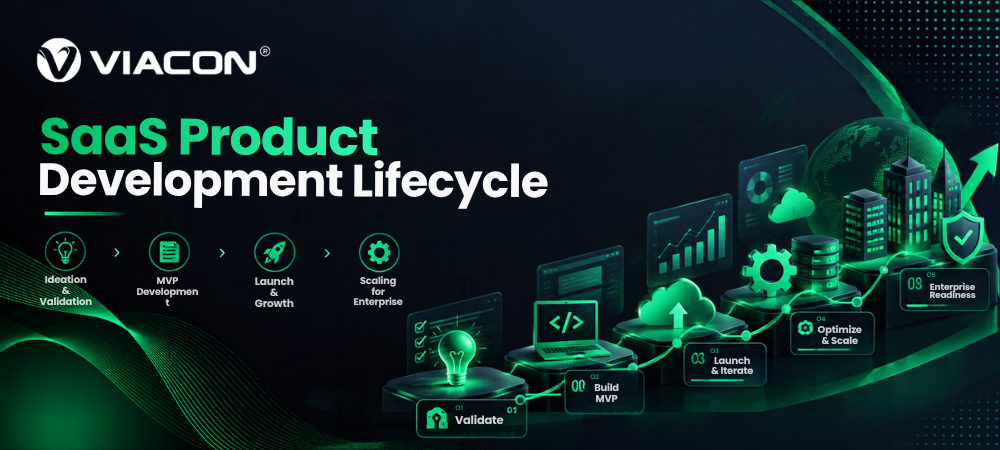
So, here is a brief idea of what SaaS product development will look like when moving from MVP to enterprise scalability:
- Discovery: Confirm the problem is expensive enough to solve.
- MVP: Prove the core workflow earns repeat use.
- Productization: Replace custom favors with features every customer can use.
- Growth: Absorb rising demand without runaway cost.
- Enterprise: Meet identity, audit, and compliance demands.
The stages overlap. A product with 20 large customers may need enterprise controls long before it needs scale. The sections below walk through each one.
Start With The Business Constraint, Not The Backlog
The primary decision of any SaaS product development lifecycle is not about deciding which framework is ideal, but which uncertainty the team must remove.
For new products, this could be whether operations managers will pay to replace a spreadsheet. Similarly, for an established company, it may be whether customers will adopt a self-service version of an internal tool.
So, in this instance, even if the proposed features look similar, they offer different bets. That’s why before you turn discovery into an interface mock-up, write down the following four things:
- The user and the job they’re trying to complete.
- The current workaround, including what it costs or delays.
- One behavior that would indicate repeat value.
- The reason this product should exist as recurring software rather than a one-time build.
This may sound basic, but it rarely stays that way in a review meeting. Because the sales team wants flexibility, product wants a clean use case, and engineering can already see exceptions piling up. Therefore, a written product boundary gives the team something firmer than opinion to argue against.
Technical discovery belongs here too. Data sensitivity, likely integrations, tenant isolation, regional hosting, and expected transaction volume can change the architecture before the first sprint.
That’s why a team planning custom web development for a public-facing tool faces a different load pattern from one building a multi-tenant workflow product with background jobs and customer-specific permissions.
Build An MVP That Can Answer A Commercial Question
SaaS MVP development is often reduced to shipping fewer features. But that’s not the right interpretation because an MVP must contain enough of the real workflow to demonstrate its capabilities in a real-world scenario.
That’s Why You Need To Draw A Hard Line Around The First Release And Ensure The MVP Factors In The Following:
- One clearly defined user group, even if the market could later be broader.
- A complete path from account creation to the product’s main outcome.
- Basic authentication, error handling, event tracking, and support access.
- Billing only if payment behavior is part of the hypothesis.
- Manual operations behind the interface where automation would slow learning.
Now, in this list, the last point is often a point of contention for teams. While manual account approval or report generation could be unfinished, which it is at times, automating an unproven workflow may consume six weeks and freeze assumptions into code before customers have challenged them.
On the other hand, there is a fair case for doing otherwise when manual handling introduces financial, privacy, or safety risk. Payment calculations and access revocation, for instance, aren’t good places for improvised back-office work.
Therefore, the MVP should end here. Because evidence changed, not because the roadmap reached a date. It must look for repeated use of the core action, successful onboarding without a founder on the call, support patterns, conversion behavior, and clear reasons for churn.
Once those signals are strong enough to justify wider promotion, teams can use AI-powered link-building services to strengthen product visibility through relevant third-party publications rather than relying entirely on owned channels.
Set the pass mark before launch. Pick a target for activation, week-four retention, and willingness to pay, then write it down. A target chosen after the data arrives is a story, not a test.
| How Long Does It Take To Build A SaaS MVP? Most published estimates land between two and seven months. A tight scope with one user group sits at the short end, often 10 to 16 weeks with a small team. Billing, role management, and third-party integrations push the timeline toward the long end. Because every extra workflow adds testing and support work, scope is the biggest lever you control. |
Choose A Tenancy Model Before Customer Data Piles Up
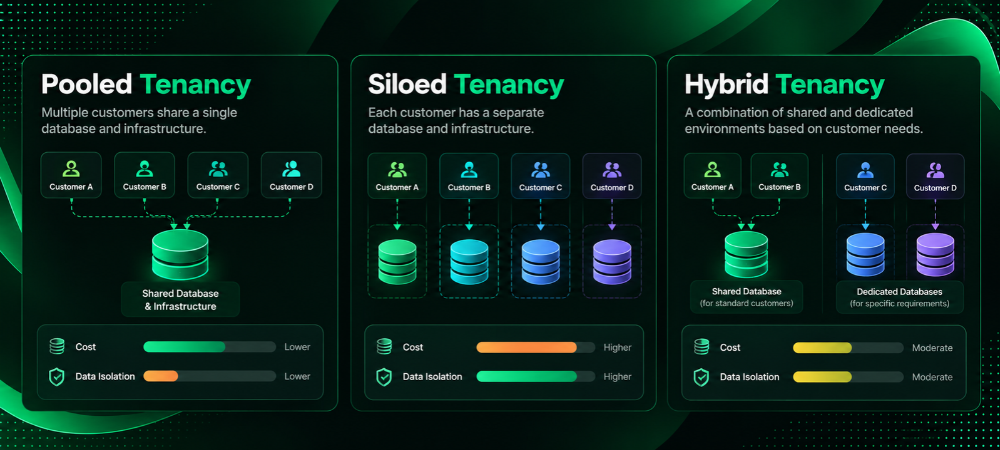
Multi-tenancy means one deployment serves many customers while keeping each customer’s data separate. It shapes cost, security, and the contracts you can sign later, so it deserves a decision early. Three models cover most products:
| Model | How it works | Best for | Trade-off |
|---|---|---|---|
| Pooled | Customers share one database, separated by tenant ID and row-level security | MVPs and small-business products | Lowest cost, but one noisy customer can slow others |
| Siloed | Each customer gets a separate database or deployment | Regulated industries and data-residency contracts | Cost estimates run 20 to 30 percent higher per customer to operate |
| Hybrid | Pooled by default, siloed for selected large accounts | Products moving upmarket | Highest upfront cost, but it unlocks the biggest deals |
A pooled model works well for the first few thousand customers, according to one widely used cost model. Still, many founders over-engineer this decision on day one and regret it. A cleaner path is to start pooled, put a tenant identifier on every table and query, and keep the option to move a large account into its own environment later.
| Should A SaaS MVP Be Multi-Tenant? Yes in the data model, not necessarily in the infrastructure. Tag every record with a tenant ID from the first migration. Then keep hosting simple until customer demand justifies more. Retrofitting tenant isolation into a live product costs far more than planning it at the start. |
Turn Early Usage Into A Repeatable Product
The next phase of the SaaS development process is less visible and often more expensive. Here, the product must stop behaving like a series of customer-specific favours.
The initial adopters will ask for specific fields, reports, roles, exports, and integrations. While some of these requests reveal common requirements, most reflect a company’s internal process. So, combining both into one product will only make things more confusing.
That’s why you must ask one question before accepting a large request: if this customer left next quarter, would we still want to maintain the feature? If the answer is no, charge for custom work, put it behind an extension layer, or decline it.
This is the point where product analytics needs to mature beyond logins and page views, and move into tracking:
- Activation steps
- Time to first useful outcome
- Adoption by account
- Permission failures
- Feature abandonment
- Usage near plan limits
Instrumentation should also help product and engineering explain behaviour without querying five unrelated systems.
Alongside product data, track four business metrics. Activation rate shows how many new accounts reach the first useful outcome. Logo churn counts customers who leave. Net revenue retention shows whether existing customers spend more or less over time. CAC payback measures how many months a customer takes to repay what it cost to win them. Together, these numbers tell you whether growth is healthy or just expensive.
Match Your Pricing Model To The Value Customers Receive
Pricing is a product decision, not a finance task. Per-seat pricing suits tools that every team member uses daily. Usage-based pricing suits products where value scales with volume, such as messages sent or records processed. Tiered plans work when customers fall into clear size groups. Many products end up with a hybrid, for example, a platform fee plus usage. Whatever you pick, the pricing metric should grow when the customer’s value grows. Otherwise, your best accounts become your least profitable ones.
The same evidence-led approach should extend to go-to-market decisions. As the product enters more competitive segments, platforms supporting enterprise authority and market visibility can help teams identify publisher opportunities and coordinate campaigns around the product’s evolving commercial position.
For channel choices and positioning at this stage, Viacon’s B2B SaaS marketing playbook covers what founders should prioritize.
Teams Also Need A Release Discipline That Fits Recurring Software:
- Small changes move through automated tests and a staging environment.
- Database migrations can roll forward safely and, where practical, roll back.
- Feature flags separate deployment from customer exposure.
- Logs, metrics, and traces identify which tenant or transaction failed.
- Support gets release context before customers discover the change.
Rework The System Before Growth Forces The Issue
The area to focus on during SaaS product development from MVP to scalable enterprise solutions is a very familiar mistake, i.e., not fixing the issue before the product scales. In most cases, the issue ultimately is either premature engineering or delayed engineering.
One burns the budget on hypothetical scale. The other waits until every release carries operational risk.
So ideal capacity planning starts with measurable pressure. You focus on database latency, queue depth, error rates, infrastructure cost per active account, deployment duration, and recovery time because “We might have millions of users” isn’t a capacity requirement.
That’s Why A Growing Product May Need Several Changes Before It Adds Microservices:
- Better database indexes and query limits
- Background processing for slow jobs
- Caching around read-heavy paths
- Rate limits for customers and integrations
- Tenant-aware monitoring
- Clear ownership for scheduled tasks and third-party failures
In This Process, Integration Design Also Deserves Similar Restraint, Which Includes:
- OAuth scopes
- Retry behavior
- Webhook signatures
- Idempotency
- Versioned APIs
- Reconciliation jobs
Now, these aren’t decorative engineering. They determine whether a temporary failure creates a delayed update or twenty duplicate invoices.
The stakes rise when your product connects to a customer’s internal systems. Any CRM and ERP integration needs its own test plan, because a sync error there can corrupt records your customer relies on.
| When Should A SaaS Product Move To Microservices? Move when measurements point to it, not when the user count feels impressive. Two signals justify the change. First, several teams block each other during deployment. Second, one component needs to scale on its own, such as a reporting engine that spikes at month-end. If neither applies, a well-structured monolith with good indexes, queues, and caching usually costs less and ships faster. |
Enterprise Scale Changes The Product Contract
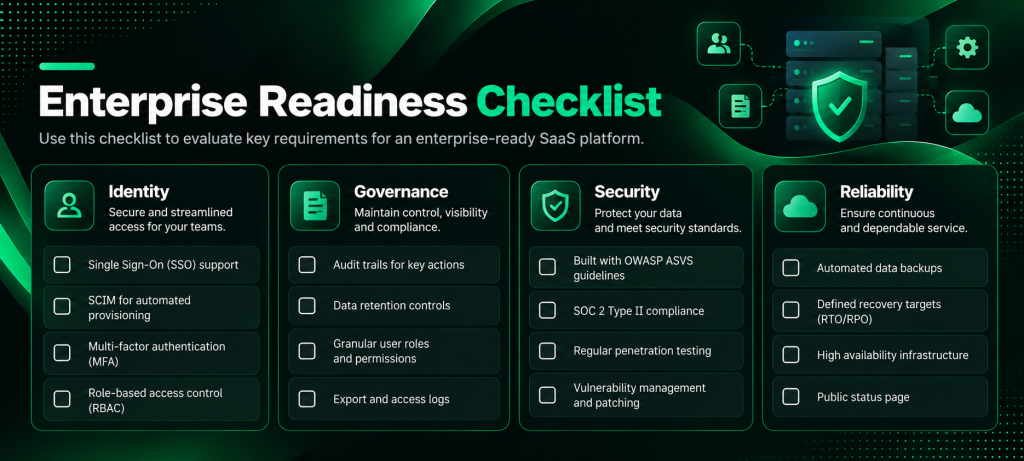
At the MVP stage, a SaaS product operates in a limited scope. But when it is time to move upmarket, it’s never about increasing the price or adding one procurement call. Enterprise buyers bring identity systems, internal controls, legal review, data retention rules, approval chains, and incident reporting expectations.
Therefore, SaaS product development stages need to account for these requirements and add product capabilities that smaller accounts may never open:
- SAML or OpenID Connect single sign-on.
- SCIM-based user provisioning and deprovisioning.
- Granular roles rather than broad admin and member labels.
- Searchable audit trails with consistent event definitions.
- Configurable retention, deletion, and export controls.
- Usage limits and billing rules at account level.
- Backups with tested restoration procedures.
- Status communication and incident ownership.
Besides these, security also needs a verification standard, not a pile of last-minute checks. The OWASP Application Security Verification Standard provides requirements for testing application security controls and can give engineering, QA, and reviewers a shared reference.
Compliance frameworks come next. SOC 2 is the most common request from US buyers. A Type I report confirms your controls exist on a given date. A Type II report confirms they worked over a period, usually several months, so buyers trust it more. ISO 27001 carries more weight with European and Asian buyers.
GDPR applies whenever you handle data about people in the EU, and HIPAA applies to US health data. Published estimates for audit and implementation vary widely, from about $10,000 to $200,000, and the work can add three to six months to a roadmap.
Recovery targets belong in the contract too. Define a recovery time objective (how fast you restore service) and a recovery point objective (how much data you can afford to lose). Then test both. A backup you have never restored is a guess.
When Does A SaaS Product Need SOC 2?
Usually when enterprise buyers start asking for it in security questionnaires or procurement reviews. Start readiness work one or two quarters before you expect the first large deal. Auditors need time to observe your controls, and a stalled contract costs more than the audit.
This is where SaaS product development services should connect architecture, product decisions, and release operations rather than treating development as a handoff between separate teams.
For companies coordinating work across departments, an enterprise growth solution can also align system integration with the operating model.
What Each Stage Costs And How Long It Takes
Cost and timeline top the list of questions founders ask, yet few articles give a straight answer. The ranges below come from published agency and calculator estimates. They differ by region, team, and scope, so treat them as planning inputs rather than quotes.
| Stage | Typical timeline | Typical cost range | What drives the cost |
|---|---|---|---|
| MVP | 2 to 7 months | $30,000 to $80,000 | Scope, authentication, billing, admin tools |
| Full product (productization and growth) | 6 to 12 months | $75,000 to $500,000 | Integrations, multi-tenancy, QA automation, analytics |
| Enterprise platform | 9 to 24 months | $240,000 to $1,000,000+ | SSO, audit trails, compliance, data residency, support |
Two cost drivers surprise first-time founders. One calculator estimates that multi-tenancy, billing, permissions, and admin tooling can take up to 40 percent of the build budget before any customer-facing feature ships. Native mobile apps add another $80,000 to $200,000 and two to four months in some estimates.
Monthly running costs matter as much as build costs. Hosting, monitoring, third-party services, and support can reach $8,000 to $30,000 a month for enterprise products. If you need help scoping a roadmap against a real budget, Viacon’s business model consulting can pressure-test the plan before you commit.
| How Much Does It Cost To Build A SaaS Product? A focused MVP typically costs $30,000 to $80,000. A full multi-tenant product with billing and roles ranges from about $75,000 to $500,000. An enterprise-grade platform starts near $240,000 and can exceed $1 million. The gap between the low and high figures comes mostly from scope, compliance needs, and team location. |
Decide Who Builds Each Stage
The right team changes with the stage. An MVP team is small and senior. A typical setup is a product owner, two or three full-stack engineers, and a part-time designer. Growth adds QA automation, a DevOps or site reliability engineer, and someone who owns analytics. Enterprise work adds a security engineer, a compliance lead, and support engineers who can handle customer incidents.
Most companies mix in-house and external capacity. Keep product ownership and customer knowledge in-house. Bring in outside help for peaks, specialist skills, or work that would take months to hire for. If you need extra engineers without a long hiring cycle, Viacon offers dedicated resource hiring that slots into your sprint process.
| Should You Build A SaaS Product In-House Or Hire An Agency? It depends on where your edge sits. If the product logic is your competitive advantage, build the core team in-house. If you need to reach the market quickly or fill a skill gap, an agency can move faster. Either way, insist on full code ownership, written architecture notes, and a handover plan from day one. |
Manage The Lifecycle As A Set Of Changing Risks
MVP, growth, and enterprise: this is the trajectory that almost every SaaS product follows. However, the practical application differs: one product might need enterprise identity controls while serving 20 customers because each account has thousands of employees. Another may support 10,000 small businesses on a relatively plain architecture.
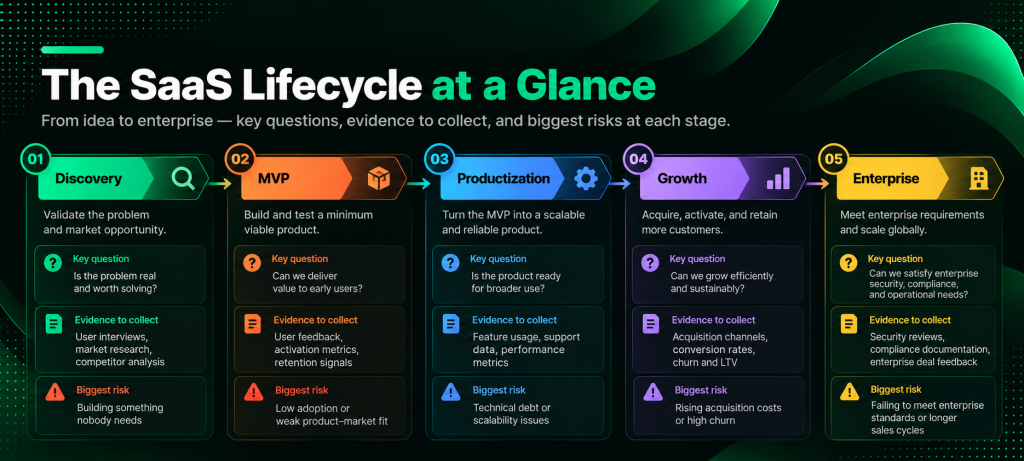
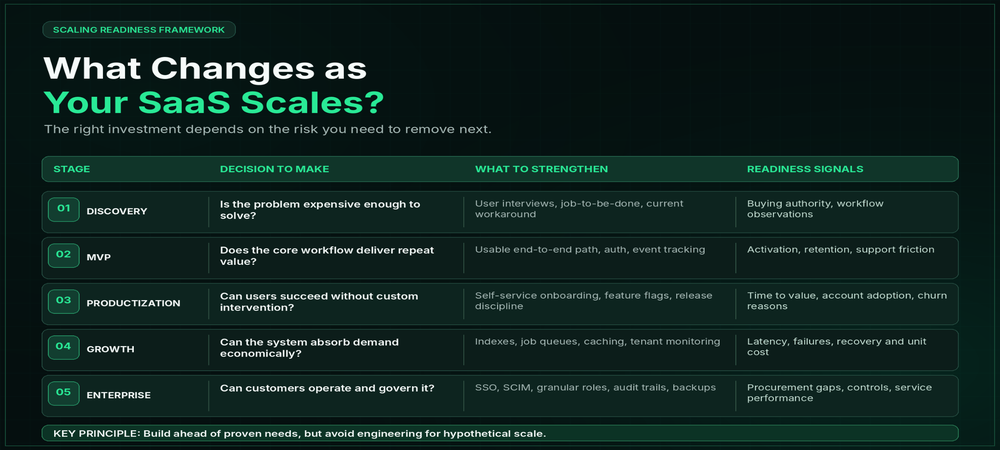
So, use stage gates, but base them on evidence:
| Stage | Decision to Make | Evidence That Matters |
|---|---|---|
| Discovery | Is the problem expensive enough to solve? | Interviews, workflow observation, buying authority |
| MVP | Does the core workflow create repeat value? | Activation, retention, task completion, support friction |
| Productization | Can customers succeed without custom intervention? | Onboarding time, adoption by account, churn reasons |
| Growth | Can the system absorb rising demand economically? | Latency, failure rates, recovery time, unit cost |
| Enterprise | Can larger customers operate and govern the product? | Identity controls, auditability, procurement gaps, service performance |
Each gate should trigger a funding choice. More features may be the right answer. So might two months spent on observability, permission redesign, or unwinding a billing model that no longer matches usage.
The same build-versus-buy assessment can apply outside engineering. For example, comparing an internal content function with an external blog management service can help a growing SaaS company understand the staffing, tooling, coordination, and scalability costs behind each model.
Mistakes That Cost The Most At Each Stage
- Discovery: Designing for a user who never pays.
- MVP: Automating a workflow before customers confirm it, or launching without event tracking.
- Productization: Saying yes to every custom request and ending up with ten versions of one feature.
- Growth: Splitting into microservices before fixing slow queries.
- Enterprise: Treating single sign-on and audit logs as a late checkbox instead of a design requirement.
MVP To Enterprise-ready: A Journey Beyond Mere Features
Successful SaaS application development from MVP to enterprise scale isn’t about tweaking code or adding features. It is about recognizing the main risks and knowing when to plan for the future, so you don’t get caught out.
There is no doubt that building something from scratch always runs the risk of creating something irrelevant and then carrying it long enough that failures cost more and contracts are harder to replace.
But this is precisely the trap that you must avoid. You build enough ahead of demand to avoid trapping the product, then invest decisively when customer behaviour, system pressure, or commercial requirements prove the need. The codebase will change. The harder job is making sure the team’s decisions keep pace.
Try one exercise this week. Place your product in the stage-gate table, name the decision it faces, and list the evidence you already hold. The gaps in that list are your next sprint.