Digital marketing is how people find you, trust you, and choose you online. Your future customers search for answers, compare options, and read reviews long before they speak to a business. If you show up in those moments, you earn their attention. If you don’t, a competitor does.
The idea sounds simple. The hard part is knowing where to start. SEO, social media, email, paid ads, and now AI search all claim to be the answer. As a result, most beginners try everything at once, spread a small budget thin, track nothing, and quit after a few weeks.
This digital marketing guide takes a different route. It explains what each channel does, which ones suit your situation, and how they connect through the customer journey. You will also learn how to build a simple strategy, set a realistic budget, and track the numbers that matter. Finally, it flags the mistakes that cost beginners the most money.
The guide fits small business owners, founders, and new marketers. You don’t need a technical background or a large budget. You need a clear goal and a willingness to test.
Here Is What You Will Learn:
- What digital marketing is and how the customer funnel works
- How SEO, content, social media, email, and paid ads each work
- How AI search is changing visibility in 2026
- How to build a strategy, set a budget, and measure results
- When to do the work yourself and when to hire help
Read it in order, or jump to the section you need. By the end, you will have a plan you can start this week.
What Is Digital Marketing?
Digital marketing is any effort to reach customers through the internet. That includes search engines, social platforms, email, websites, and paid ads. The goal matches every other kind of marketing: put the right offer in front of the right person at the right time.
What changes online is the feedback. You can see who clicked, who bought, and who left. Then you can adjust within days instead of waiting months for a campaign to end.
Most businesses combine several channels instead of relying on one. A team that handles them together, like Viacon’s digital marketing services, keeps the message consistent from the first ad to the final sale.
| What Is Digital Marketing In Simple Terms? Digital marketing means promoting a business online to attract visitors, turn them into leads, and turn leads into customers. The main channels are SEO, content, social media, email, and paid ads. |
Why Digital Marketing Matters for Every Business Size
Most buyers research online before they spend money. They read reviews, compare prices, and ask search engines or AI tools for recommendations. If your business does not appear in those moments, a competitor will.
Traditional marketing pushes a message at everyone and hopes the right people notice. Digital marketing works differently. It reaches people who already search for what you sell, and it shows you exactly what that effort costs.
| Do Small Businesses Need Digital Marketing? Yes. Small businesses often benefit the most because digital channels let them compete without a large media budget. Start with one or two channels, such as a Google Business Profile for local searches and a simple email list. Add more only after the first ones work. |
How The Digital Marketing Funnel Works
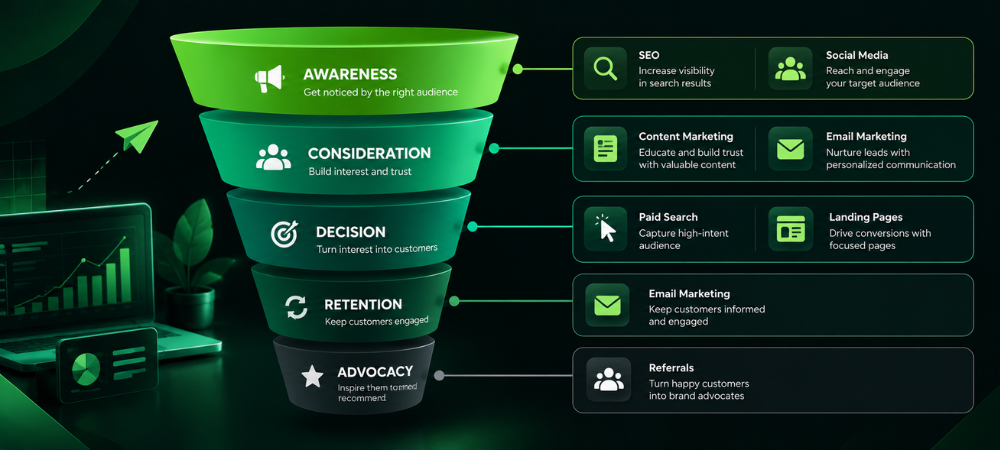
Every customer moves through a series of stages before and after a purchase. Marketers call this path a funnel. Understanding it helps you decide which channel to use and when.
- Awareness: A person discovers you through a search result, a post, or an ad.
- Consideration: They compare you with other options and read your content.
- Decision: They buy, book a call, or sign up for a trial.
- Retention: You deliver on your promise and stay in touch.
- Advocacy: Happy customers refer others or leave reviews.
Beginners often pour their budget into the first stage and ignore the rest. That mistake gets expensive. Keeping a customer usually costs less than finding a new one, so retention deserves a real share of your effort. Small improvements at the decision stage also pay off quickly, which is why many teams invest in conversion rate optimization early.
Search Engine Optimization (SEO)
SEO earns free clicks from search engines by making your pages easier to find and more useful to read. The clicks are free, but the work is not. It costs time, skill, or money, and it pays off slowly.
Good SEO Has Three Parts:
- On-page SEO: Clear titles, helpful content, and sensible headings that match what people search for.
- Technical SEO: Fast loading, mobile-friendly pages, clean site structure, and no crawl errors.
- Off-page SEO: Links and mentions from trusted sites that signal credibility.
Start by finding the questions your customers type into Google. Then build one strong page for each question. If you want expert help covering all three parts, Viacon’s SEO services are a good place to see what a full approach looks like.
| How Long Does SEO Take To Work? Most sites see early movement within three to six months. Competitive topics can take longer. Results build over time, so steady publishing and fixes matter more than one big push. |
Content Marketing
Content marketing means creating useful material that answers your audience’s questions. Think blog posts, guides, videos, checklists, and case studies. The aim is trust. People buy from brands that helped them first.
Strong content starts with listening. Check your sales emails, support tickets, and search queries for repeated questions. Then answer each one better than the pages already ranking. Add original details, such as your own data, screenshots, or lessons from real projects.
Distribution matters just as much as writing. Share each piece by email and on social media, and consider partnering with an industry expert who already has an audience. Also, update older posts every few months, so they stay accurate. For ideas on what deserves your time this year, read our breakdown of content marketing trends for 2026.
Social Media Marketing
Social media marketing builds awareness and community on platforms where your customers already spend time. It also gives you a direct line for feedback, product ideas, and customer support.
Pick platforms based on your audience, not on hype. LinkedIn suits B2B companies. Instagram and TikTok work well for consumer brands with strong visuals. YouTube fits products that need demonstrations. Choose one or two, and post consistently rather than everywhere.
Organic posting costs no ad budget, but it does cost hours. Plan for content creation, replies, and reporting. If your team lacks that time, a social media marketing agency can take over the routine work while you focus on the product.
Email Marketing
Email gives you a direct channel that no algorithm controls. You own the list, so you can reach customers even when social reach drops or ad costs rise.
Building the list comes first. Offer something worth an email address, such as a discount, a template, or a short course. Then send a welcome sequence of three to five messages that introduce your brand, share your best content, and make one clear offer.
After that, segment your list. A new subscriber and a past buyer need different messages. Tools like Mailchimp or Klaviyo handle segmentation and automation for most small teams.
Always get permission before you send. Laws such as GDPR in Europe and CAN-SPAM in the United States set rules for consent and unsubscribe links, and breaking them hurts both your reputation and your deliverability.
Paid Advertising (PPC)
Paid advertising puts your message in front of people immediately. In pay-per-click models, you pay only when someone clicks your ad. Google Search, Meta, LinkedIn, and YouTube all offer versions of this.
Speed is the main advantage. You can launch on Monday and see leads by Wednesday. The catch is that traffic stops the moment your budget does. Ads rent attention, while SEO and content build an asset you keep.
Start small. Run one campaign with a modest daily budget, one clear offer, and one dedicated landing page. Track cost per lead from day one. When the numbers work, increase spend gradually. Teams that want that level of testing handled for them often turn to a performance marketing agency.
| Should I Start With SEO Or PPC? Choose PPC if you need leads quickly and can afford to test. Choose SEO if you can wait and want lower costs over time. Most businesses eventually use both. Ads bring fast data, and SEO turns that data into lasting traffic. |
Lead Generation And Nurturing
A lead is someone who shares their contact details because they want to hear from you. They might download a guide, join a webinar, or request a quote. A lead is not a sale yet, and treating it like one drives people away.
Nurturing closes the gap. You send helpful follow-ups, answer objections, and show proof, such as reviews or case studies. Over time, the lead decides whether you are the right fit. Your job is to make that decision easy.
Keep forms short. Every extra field lowers the number of people who finish. Ask only for what your sales team truly needs.
AI Search And Answer Engines
People now ask questions to Google’s AI Overviews, ChatGPT, and Perplexity instead of scrolling through ten blue links. These tools summarize answers and cite a handful of sources. Being one of those sources builds visibility even when nobody clicks.
No one can guarantee a citation.
However, You Can Improve Your Odds With A Few Habits:
- Answer questions directly in the first lines under each heading.
- Use clear headings and short paragraphs.
- Keep your business name, services, and details consistent across the web.
- Publish original data, examples, or expert input that other pages lack.
- Collect genuine reviews and mentions on trusted sites.
Viacon calls this work AI search optimization, sometimes shortened to GEO.
| Does AI Search Replace SEO? No. AI tools draw from the same web that search engines index, so crawlable pages, helpful content, and real authority still matter. Think of GEO as an extension of SEO, not a replacement. |
How To Build Your First Digital Marketing Strategy
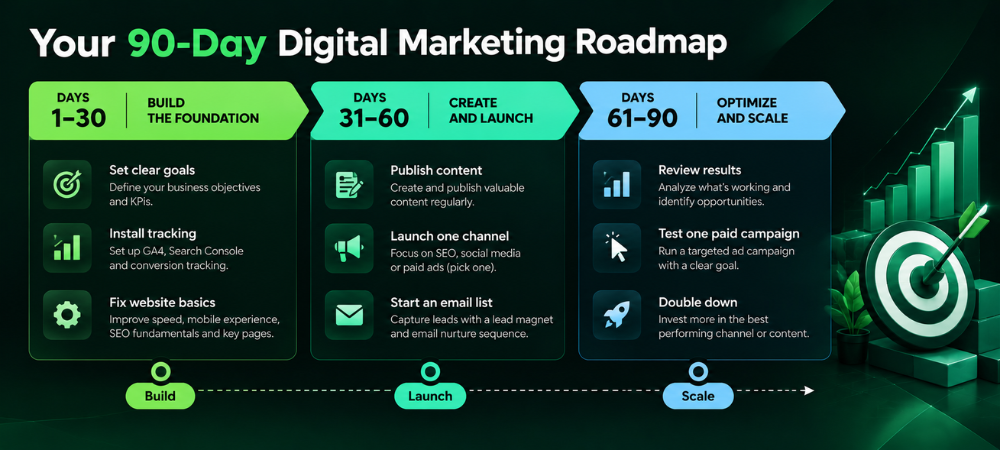
A strategy keeps you from chasing every new tactic. Follow these six steps in order.
- Set One Clear Goal: For example, “generate 30 qualified leads per month by December.” Specific goals make decisions easier.
- Define Your Audience: Write down who they are, what problem they face, and where they look for answers.
- Pick One Or Two Channels: Match them to your audience and your skills, not to trends.
- Set A Budget: Decide what you can spend on tools, content, and ads each month.
- Install Tracking: Set up Google Analytics 4 and Google Search Console before you publish anything.
- Review Monthly: Keep what works, fix what almost works, and drop what does not.
How Much Should You Spend On Digital Marketing?
There is no universal number. Many small businesses start with a modest share of revenue, often cited in the range of 5 to 10 percent, and adjust as they learn. New companies with little revenue may spend a higher share to gain traction.
Here is a sample split for a $1,000 monthly budget. Treat it as a starting point, not a benchmark.
| Area | Share | Monthly amount |
|---|---|---|
| Content creation | 40% | $400 |
| Paid ads (testing) | 35% | $350 |
| Tools and software | 15% | $150 |
| Learning and training | 10% | $100 |
Adjust the split after your first 60 days. If ads produce leads at a fair cost, shift more money there. If content brings steady traffic, invest more in writing.
Which Metrics Matter Most
Beginners drown in dashboards. Focus on a few numbers tied to your goal.
| Goal | Metric | How to calculate or find it |
|---|---|---|
| Visibility | Impressions and organic clicks | Google Search Console |
| Interest | Engaged sessions | Google Analytics 4 |
| Lead quality | Conversion rate | Conversions ÷ visitors × 100 |
| Efficiency | Cost per lead | Ad spend ÷ leads |
| Profit | Return on ad spend (ROAS) | Revenue from ads ÷ ad spend |
| Loyalty | Repeat purchase rate | Returning buyers ÷ total buyers |
Check these monthly. Weekly checks create panic over normal swings, while quarterly checks react too slowly.
Common Digital Marketing Mistakes To Avoid
Most early failures come from the same few habits.
- Doing Everything At Once: Spreading effort across six channels weakens all of them.
- Skipping Tracking: Without data, you cannot tell which effort works.
- Chasing Gurus And Shortcuts: Promises of overnight results usually lead to wasted spend.
- Ignoring Existing Customers: Past buyers cost less to reach than strangers.
- Quitting Too Early: SEO and content need months, and many beginners stop right before results appear.
- Sending Traffic To A Weak Page: Ads and posts cannot fix a slow, confusing website.
Should You Do It Yourself Or Hire An Agency?
Both paths work. Your choice depends on time, budget, and complexity.
Do it yourself if your budget is tight, your needs are simple, and you can spare several hours each week. You will learn faster, and you will understand every dollar you spend.
Hire help if you lack the time, need technical SEO or ad management, or want to scale quickly. Before you sign anything, ask how the agency reports results, who will actually do the work, and what happens if targets slip. A trustworthy partner answers plainly.
Not sure where you stand? Viacon’s free digital audit reviews your online presence and compares it with competitors, so you can decide with real information.
Final Thoughts: Start Small, Measure, Then Grow
Digital marketing rewards patience and focus. You do not need to master every channel. Pick a goal, choose one or two channels, track the results, and improve each month.
The tools will keep changing, especially as AI reshapes search. Still, the basics hold: understand your customer, offer real value, and measure what happens. Start this week with one small step, such as setting up tracking or writing down your goal. That single move puts you ahead of most beginners.