Your website ranks. The phone still doesn’t ring. If that sounds familiar, the problem usually isn’t your rankings; it’s where you’re ranking.
Here’s how most people actually find a lawyer on Google. They type something like “personal injury lawyer near me.” A box appears above the regular search results: three business listings. A map with pins, star ratings next to each name. They glance at it, pick one, and call before they ever open a website.
That box is the Google Map Pack (sometimes called the Local Pack), and for law firms, it’s usually where the decision gets made, often before a single click reaches your site.
If your firm wasn’t in that box, this guide is for you. We’ll walk through Google Business Profile optimization, citations, reviews, the technical setup your site needs, and a few things most local SEO for law firms guides skip entirely: profile suspensions, Local Services Ads, and what a realistic timeline actually looks like.
Why Local SEO For Law Firms Actually Matters Right Now
This isn’t new advice. But it’s gotten more competitive, because more firms have caught on. The ones still treating their Google Business Profile as a set-it-and-forget-it directory listing are the ones falling behind.
A Few Things Worth Knowing Before You Start:
- Most legal searches carry local intent. People type a city name or add “near me” because they want someone they can meet face to face if the case demands it.
- Map Pack listings pull more clicks than the organic blue links underneath them, especially on mobile.
- Most people searching for an attorney are on their phone, often in the middle of a stressful situation. They tap to call or get directions straight from the pack; the website is a secondary stop, if they visit it at all.
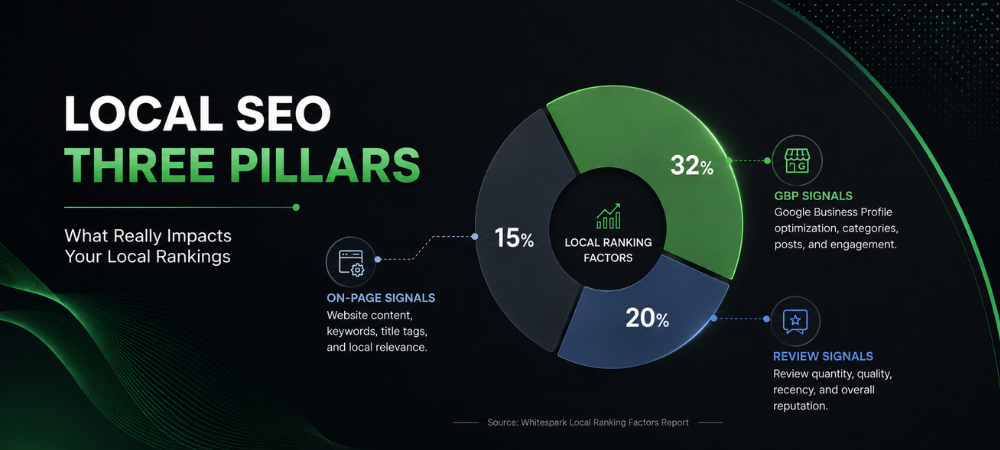
- Competition keeps climbing. Whitespark’s 2026 Local Search Ranking Factors report puts Google Business Profile signals alone at roughly a third of total local ranking weight. Which tells you where firms are putting their effort and where you need to compete.
Everything downstream starts with mastering your Google Business Profile. That’s the foundation of local SEO for attorneys, and it’s where we’ll begin.
How Google Decides Who Shows Up In The Map Pack?
Google has said publicly that three factors decide Map Pack placement: relevance, distance, and prominence. Your categories, your reviews, your citations all of it feeds into one of these three buckets.
- Relevance: Your profile needs to match what the searcher typed, and Google reads that match through your categories, your business description, and the services you’ve listed. A firm that only lists “Lawyer” as its category is competing against every type of attorney in the city. A firm that lists “Personal Injury Attorney” as primary, with accurate secondary categories layered on, is telling Google exactly who to show it to.
- Distance: This is mostly about your pinned address, unless you operate as a service-area business, which we’ll get to later. A precise pin matters more than people expect. Being a few doors off on the map can quietly cost you visibility in the surrounding blocks.
- Prominence: This is reputation, made measurable: reviews, citations, links, and general visibility across the web. It’s also the pillar with the most moving parts, and where a marketing team earns its keep.
Ranking takes time no matter how well you execute each piece. We cover a realistic timeline further down, once you’ve seen the full list of what goes into it.
A Step-by-Step Local SEO Strategy For Law Firms
Here’s the order we actually work through with clients, from foundation to advanced tactics.
A. Google Business Profile Optimization: The Foundation
Quick terminology note before we go further: Google renamed Google My Business to Google Business Profile back in 2021. You’ll still see “GMB” used out of habit, including by some of your competitors, but we’ll use GBP throughout since that’s the current name.
Start by claiming and fully verifying your profile if you haven’t already. Then fill out every section; don’t leave anything blank. An incomplete profile signals low prominence before Google has even looked at your reviews.
Pick The Right Primary Category: This trips up more firms than almost anything else. “Lawyer” is too generic to compete on its own. Google offers dozens of legal-specific categories: Personal Injury Attorney, Divorce Lawyer, Criminal Justice Attorney, DUI Attorney, Immigration Attorney, Estate Planning Attorney, Bankruptcy Attorney, Family Law Attorney, and more. Choose the one that matches your primary practice area, then add secondary categories only where they genuinely apply. Stacking categories to catch extra search traffic is one of the fastest ways to trigger a suspension review, which we’ll cover shortly.
Should I Use “Lawyer” Or “Attorney” In My Categories And Content? Use whichever term your potential clients actually search for in your market. “Lawyer” and “attorney” both work, and there’s rarely a strong reason to favour one everywhere. Check your GBP Insights for the search terms actually bringing people to your profile if you’re not sure. And use both naturally across your categories and content.
Description, Messaging, And Photos
Write A Description That Sounds Like A Person Wrote It: List your services in plain language, set accurate hours, add appointment booking links, and turn on messaging and the Q&A feature so potential clients can reach you directly.
One caution on messaging: treat GBP chat as intake, not consultation. Keep early exchanges limited to scheduling and general availability, and move anything case-specific to a secure, monitored channel. Most bar advertising rules weren’t written with GBP messaging in mind, and an attorney-client relationship can form through casual back-and-forth more easily than people expect. Set the expectation early, and keep a record of what’s discussed.
Use Real Photos, And Don’t Skip The Alt Text: Photos of your actual office, your team, and your building exterior build more trust than stock imagery ever will. Give each one a short, descriptive file name and alt text. Something like “downtown-austin-personal-injury-law-office-exterior” tells Google and screen readers exactly what they’re looking at. It’s a small signal a surprising number of firms skip entirely. Post updates and case results anonymized and consistent with your bar’s rules on discussing outcomes through Google Business Profile posts on a regular schedule, not just once at setup.
| What’s The Difference Between A Google Business Profile And Regular SEO? Your Google Business Profile controls your map listing specifically. Regular SEO covers your website’s visibility in the standard organic search results below and beside the map. You need both: a strong website with weak GBP signals still won’t crack the Map Pack, and a strong GBP paired with a thin website won’t convert well once someone clicks through. |
B. NAP Consistency And Law Firm Citations
NAP consistency sounds minor and isn’t. And NAP stands for Name, Address, Phone number, and it needs to match, exactly, everywhere your firm appears online:
- Your website
- Avvo
- FindLaw
- Justia
- Super Lawyers
- Yelp
- Apple Maps
- Bing Places
- Your local bar association directory
- Your chamber of commerce listing
“Match exactly” means exactly. “St.” versus “Street,” a missing suite number, an old phone number still sitting on a directory you forgot about any of it creates enough doubt that Google hesitates to treat your listings as the same business.
The legal directories deserve more than a NAP checkbox, too. Avvo, Justia, and Super Lawyers aren’t just citation sources. They’re lead-generation surfaces in their own right, with their own search visibility.
A thin, unclaimed profile on any of them is a missed opportunity, not just a technical gap. Fill out the bio, list your practice areas, collect peer endorsements where the platform allows it, and keep each profile as current as your own website.
Get Your Free Local SEO NAP Checklist
Download the Checklist
Run an audit across your existing citations before building anything new. BrightLocal, Whitespark, and Moz Local all offer citation tracking that surfaces inconsistencies faster than checking each directory by hand. Fix what’s wrong first, then build new citations steadily, favoring reputable legal-specific directories over the low-quality sites that exist only to sell citations in bulk.
If you’d rather not run this audit yourself, our SEO team does the cross-referencing for you and flags every inconsistency by directory.
C. Reviews And Reputation Signals
Reviews aren’t decoration. They’re a direct ranking input, and Whitespark’s most recent Local Search Ranking Factors report puts review signals at roughly a fifth of total local ranking weight, with review recency now sitting among the top five individual factors the surveyed experts track, a sharp jump from where it ranked just a couple of years ago.
That shift matters practically. A firm with two hundred reviews from five years ago is weaker, in Google’s eyes, than a firm with a steady trickle of recent ones. Build a simple, ethical process for asking satisfied clients to leave a review, and stay within your bar’s advertising and solicitation rules. Most bars are fine with a general request made after the matter closes, and uncomfortable with anything that resembles an incentive or a scripted testimonial.
Respond to every review, good and bad. It shows the profile is actively managed, and a large share of consumers specifically look for reviews written in the last few months before deciding who to call. A wall of five-star reviews with no recent activity reads as inactive, even if the firm is thriving.
Handle negative reviews carefully. A calm, professional response acknowledging the concern without confirming or discussing case details, since confidentiality rules apply here too, does more for your credibility than getting the review removed ever will.
| How Important Are Reviews For Attorney Local Search Ranking? Very, review signals make up a meaningful share of the overall Prominence factor, and recency now matters nearly as much as volume; a small, steady stream of new reviews outperforms a large batch that stopped a year ago. |
D. Google Business Profile Suspensions: What Law Firms Need To Know
Law firms get suspended more often than most other business categories, and it usually isn’t because anyone did anything sketchy. It’s almost always one of these:
- A Virtual Or Shared Office Address: Regus, WeWork, and similar shared-office addresses are a common trigger, even when the firm has a real, staffed presence there. Google has grown increasingly strict about verifying that a business genuinely operates, full-time, at the address it lists.
- A Burst Of Quick Edits: Changing your name, address, category, and phone number within the same afternoon looks like account manipulation to Google’s automated systems, even when every edit is legitimate.
- A Competitor Flagging Your Listing: Anyone can suggest an edit or flag a profile as spam, and it happens more often in competitive legal markets than firms expect.
- A Keyword-Stuffed Business Name: Listing your firm as “Smith & Doe LLP – Best Injury Lawyers in Austin” instead of your actual registered name is one of the fastest paths to suspension.
- Service Area Misrepresentation: Claiming a service radius that doesn’t match your actual address or capacity raises flags.
- Duplicate Listings. If every attorney at the firm created a separate profile at the same address, expect Google to treat it as spam.
Recovering From A Suspension And Preventing The Next One
If it happens to you, don’t panic, and don’t immediately relocate to a new address. Pull together proof that you operate legitimately at your listed address: a lease agreement, a utility bill, signage photos, and your business registration and submit it through the reinstatement request in your GBP dashboard. You typically get a limited number of appeal attempts before you need to escalate further, so make the first one count rather than rushing it.
| Can I Use A Virtual Office Address On My Google Business Profile? It’s risky, as the list above shows, it’s one of the most common suspension triggers, even when the firm has a legitimate presence there. The best fix is prevention. If your firm doesn’t have a dedicated, staffed office, plenty of solo and virtual practices don’t set your profile up correctly as a Service Area Business from the start instead of reaching for a virtual office address. We cover exactly how to configure that later in this guide, under Advanced Tactics. |
E. On-Page And Technical Local SEO Support
Your website needs to back up what your Google Business Profile says, and Google checks the two against each other more than firms assume.
Build Dedicated Location Pages: If you serve multiple cities, that means practice-area-plus-city pages”Car Accident Lawyer in Austin” rather than one generic “Locations” page trying to cover all of them. Each page needs unique content, not a template with the city name swapped out. Google’s systems catch thin, duplicated location pages quickly, and they tend to get filtered out of results rather than penalized outright, which is arguably worse: you just quietly stop showing up.
Keep The Basics Tight: A mobile-friendly, fast-loading site, an embedded Google Map on your contact page, and a footer NAP that matches your GBP listing character for character. Link internally from your service pages to your location pages, and back again. A practice-area page that never links to the city pages it serves is leaving easy relevance signals on the table.
| Can A Law Firm Rank In Multiple Cities? Yes, but it takes dedicated location pages for each city and practice area, and, depending on how you operate, either additional verified locations or a correctly configured service area setup. A single generic “we serve everywhere” page won’t do it. |
F. Local Services Ads: The Fast Lane Above The Map Pack
The Map Pack isn’t the only local placement worth fighting for. Local Services Ads are the pay-per-lead listings that carry a “Google Screened” badge and sit above both the paid search ads and the organic Map Pack for many legal searches. Google has been rolling out changes to this badge, and some profiles now display an updated “Google Verified” checkmark instead, so check what actually shows on your own listing rather than assuming.
LSAs work differently from regular Google Ads. You don’t bid on keywords, and you don’t pay for clicks. You pay when someone calls or messages you directly, after Google has run your firm through a screening process that checks your license, insurance, and background. That screening typically takes a few weeks, and it’s what gives the badge its trust value with searchers.
A few things worth knowing before you invest budget here: legal LSA leads have run roughly $195 to $250 each in 2026, with personal injury sitting at the high end because more firms compete in that category. What a lead is actually worth depends on your intake process tracking cost per retained client, not just cost per lead; that is the number that tells you whether the spend is working. Our performance marketing team can help you weigh whether LSAs are worth the spend, alongside your organic local presence, since the two work best together.
| What To Watch For With LSAs Right Now? One more thing worth flagging: Google has started migrating Local Services Ads out of its standalone dashboard and into the main Google Ads platform, in phases, beginning in August 2026. Legal wasn’t in the first wave, but some reporting places it in the next group later this year. If you’re already running LSAs, export your historical performance data now, before your account migrates; you don’t want to lose the record of what’s been working. |
G. Content That Supports Local Rankings
Locally relevant content genuinely moves the needle here. Guides like “What to Do After a Car Accident in Austin” or “Texas Statute of Limitations for Personal Injury Claims” answer real questions your future clients are searching for, and they give Google more reasons to associate your site with that city. Reference specific neighbourhoods, courthouses, or landmarks where it’s natural; it’s a small signal, but it adds up across a site.
Video content filmed around your actual office or city adds a layer of authenticity stock photography can’t fake, and it doubles as material for your Google Business Profile posts and social channels.
| What’s The Difference Between The Map Pack And Local Services Ads? The Map Pack is organic; you don’t pay Google directly to appear in it, though you invest time and resources into ranking there. Local Services Ads are paid, pay-per-lead placements that require passing Google’s screening process, and they typically appear above the Map Pack. They aren’t competing strategies, though: most firms that dominate local search run both, LSAs for immediate, high-intent leads, and Map Pack visibility for everyone still comparing options before they call. |
H. Ongoing Optimization, Monitoring, And A Realistic Timeline
Local SEO for law firms isn’t a project with an end date. It’s a maintenance habit. Track your Map Pack rankings by keyword and location, review your Google Business Profile Insights monthly, keep an eye on what competitors are doing differently, and run a citation and review audit every quarter.
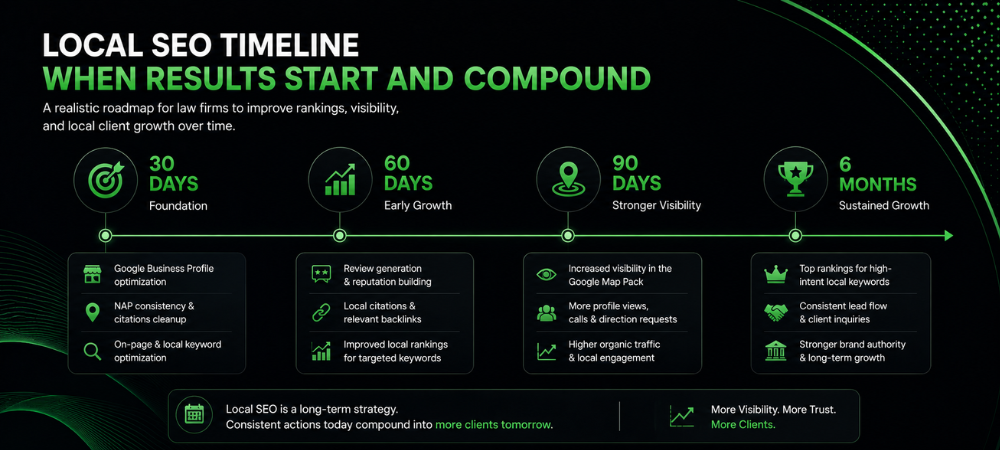
| How Long Does It Take For A Law Firm To Rank In The Map Pack? It varies by market and competition, but most firms see the first measurable movement more profile views, a few new calls, a rank improvement on lower-competition terms within 60 to 90 days of consistent work. Competitive practice areas in dense metro markets, like personal injury in a major city, often take four to six months before cracking the top three. Anyone promising Map Pack rankings in two weeks is either overpromising or gaming something that will cost you later. |
Advanced Tactics To Outrank Competing Firms
Once the foundation is solid, these are the tactics that separate firms sitting at position three from firms sitting at position one.
Set Up A Service Area Business Correctly If You Don’t Have A Public-Facing Office: If your practice serves multiple cities without a storefront clients walk into, don’t reach for a virtual office; set your profile up as a Service Area Business (SAB) instead. That means hiding your public address and listing the specific cities, counties, or zip codes you actually serve. Keep the list realistic: claiming service across an entire state when you only handle cases within an hour of your home base looks like the service area misrepresentation that triggers the suspensions covered earlier. Google generally recommends not extending a service area more than about two hours’ drive from your base location. We cover setups like this in more depth on our blog.
Use Geo-Grid Rank Tracking: A single rank check tells you almost nothing, because Map Pack results shift depending on exactly where the searcher is standing. Geo-grid tools BrightLocal’s Local Rank Tracker and Whitespark’s Local Rank Tracker are the two most widely used in this space run your target keywords across a grid of points throughout your service area, so you can see whether you’re strong downtown and invisible in the suburbs, or the other way around. That’s a level of detail a single-point rank checker simply can’t give you.
Use Google Posts And Q&A Actively: Most firms set up Q&A once and never touch it again, which means competitors, or random searchers, end up answering questions about your firm instead of you. Seed it yourself with the questions clients actually ask, and post updates through GBP Posts on a regular cadence, not just at launch.
Building Authority The Right Way
Build Real Local Links And Community Ties: Sponsor a local event, get listed on your bar association’s member directory with a live link, contribute a guest article to a local news or business site, or set up a scholarship tied to a local school. These generate legitimate citations and prominence signals, and they build actual community relationships, not just backlinks.
Stay Away From Shortcuts: Spammy citation building and keyword-stuffed business names cause real damage; the suspensions covered earlier are the direct result of exactly these tactics. A short-term ranking bump isn’t worth the weeks you’ll spend appealing a suspended profile afterwards.
Measuring Success: Key Metrics To Watch
Track these on a recurring basis, not just when something feels off:
- Average Map Pack rank for your core keywords, tracked across a geo-grid rather than a single point.
- Google Business Profile views, searches, calls, and direction requests, pulled from Insights.
- Citation consistency across your top directories.
- Review volume, rating, and, increasingly, recency.
- Local Services Ads leads and cost per retained client, if you’re running them.
- How many Map Pack and LSA actions actually turn into booked consultations.
That last one is the metric most firms skip, and it’s the one that actually matters. A firm generating twenty Map Pack calls a week that convert to two consultations is in worse shape than a firm generating eight calls that convert to five. Track intake, not just visibility.
Common Mistakes We See Law Firms Make
A few patterns show up again and again in the profile audits we run:
- Inconsistent NAP details across directories, often left over from an old office move nobody cleaned up.
- Keyword-stuffed business names that invite a suspension review.
- Reviews left unanswered for months, or handled defensively when they are answered.
- The wrong primary category, chosen once at setup and never revisited.
- Duplicate or spammy citations bought in bulk from low-quality directory services.
- A profile that got full attention during setup and then nothing since.
- All the SEO budget going to the website, with the Google Business Profile treated as an afterthought.
Any one of these can quietly cap a firm that’s doing everything else right.
Local SEO For Law Firms Pays For Itself
Local SEO for law firms is one of the higher-return investments available to a firm, because it puts you in front of people who are ready to hire, not people browsing for later. It takes consistency, though. Your Google Business Profile, your citations, your reviews, your Local Services Ads none of it is a one-time setup. It compounds if you keep at it, and it stalls the moment you stop.
If you want a clear picture of where your firm actually stands, start with a free local SEO audit. We’ll show you exactly what’s holding your Map Pack visibility back and what to fix first.
Want a second opinion on where your citations stand today? Talk to our team, and we’ll walk through what’s inconsistent and what to fix first.