Search behavior has changed more in the past two years than in the previous decade, and it’s shaping up to be one of the defining SEO trends of 2026. Two years ago, getting an answer from Google meant thinking carefully about which keywords to type. Today, on Google’s AI Mode, people just ask in full sentences, with follow-up questions, until they get a complete answer.
That shift matters even if your page still holds the number-one spot on Google. The answer to your target keyword might already be sitting inside an AI Overview, quoted in a ChatGPT response, or folded into a Perplexity answer, all before anyone clicks through to your site.
Businesses that treat visibility as a checkbox are already behind. In 2026, the companies that win are the ones planning, earning, measuring, and monetizing visibility across every channel where AI search shows up, not just Google’s blue links. That’s the dual-system reality behind this year’s biggest SEO trends 2026: two visibility systems running in parallel, each rewarding different signals. and exactly why traditional SEO alone won’t be enough in 2026.
This report breaks down what the data says about how people search now, what’s actually driving AI citations, and what businesses need to change to stay visible in both systems.
Key Takeaways
- AI search and traditional search run as two separate systems; only 14% of URLs and 21.9% of domains rank in both.
- Position-one CTR for informational keywords has dropped from 7.6% to 3.9% since 2023, and AI Overviews cut clicks by up to 58%.
- Citation likelihood is driven by measurable signals, content freshness, section length, referring domains, and technical speed, not by traditional keyword rankings alone.
- AI-referred traffic converts up to 4× better than average (12.3% vs. 3.1%), which makes AI visibility a revenue lever, not just a marketing metric.
The State Of Search In 2026: Two Systems Running At Once
Every major technological shift changes how people search the internet did it, social media did it, and now AI is doing it again. But this time, the old system hasn’t gone away. AI search hasn’t replaced Google search; the two are running in parallel, and each rewards different things.
Traditional search is still query-driven. Users type short phrases, scan a list of ranked links, and decide what’s worth a click. The average Google query is still just 3.4 words. But the volume of those clicks is shrinking: click-through rate from position one on informational keywords fell from 7.6% in 2023 to 3.9% in 2025, and AI Overviews alone have cut clicks by 58% on the queries where they appear.
AI search runs on a different logic entirely. The average ChatGPT prompt is about 60 words closer to a spoken question than a typed keyword. Users expect one synthesized answer, not a list of links to sort through, and the conversational format means clicking through often feels optional rather than necessary.
| Traditional Search | AI Search | |
| Query style | Short keyword phrases (~3.4 words avg.) | Conversational prompts (~60 words avg.) |
| Output | Ranked list of links | Synthesized answer |
| User action | Click to evaluate | Read, then decide whether to click |
| Position-1 CTR trend | Down from 7.6% to 3.9% (2023–2025) | No fixed “position one” |
| Click impact | Baseline | AI Overviews cut clicks by up to 58% |
This is where it gets complicated for businesses: the two systems don’t overlap as much as you’d expect. Only 14% of URLs and 21.9% of domains show up in results for both traditional search and AI search. A strong traditional ranking doesn’t guarantee AI visibility; the two are related, not identical. Which means a visibility problem can’t be solved by SEO services alone anymore; it needs a strategy built for both systems at once.
Content Signals
Freshness is one of the clearest examples of how the two systems diverge. A two-month-old, well-structured article can outperform a year-old page that still ranks well on traditional search, a shift that changes how often content teams need to revisit existing pages, not just publish new ones. The keyword-ranking playbook that works for traditional search doesn’t automatically translate into AI citations, which makes earning AI-driven visitors a genuinely different discipline from earning traditional organic traffic.
AI Search Engine Statistics 2026: The Numbers That Matter
Before getting into strategy, it’s worth seeing the scale of this shift. These numbers are driving SEO trends 2026 more than any single algorithm update. Here’s how fast AI search is growing, and how much of the market it already controls.
Adoption And AI Search Market Growth
| Metric | Figure | Source / Note |
| AI search traffic growth (YoY) | +527% (~17,076 → 107,100 sessions, Jan–May 2025) | Tracked dataset analysis |
| AI traffic growth (broader study) | ~10× YoY | Ahrefs, ~81,000+ websites analyzed |
| ChatGPT monthly visits | ~5–5.5 billion | One of the top 5 most-visited sites globally |
| Google AI Overviews reach | 2 billion monthly users | 200+ countries and territories |
| Google AI Mode users | 100 million+ monthly | Currently live in the US and India |
That growth isn’t evenly distributed. Platform-level share varies significantly: according to the Loamly State of AI Traffic 2026 benchmark report, ChatGPT currently holds the largest share of AI-driven visits. (Note: I couldn’t independently verify a live URL for this specific “Loamly” report — worth swapping in a source link once you confirm it, or citing SE Ranking’s AI search stats roundup instead, which tracks similar platform-share data.)
Don’t read that as a permanent lead, though. Perplexity is gaining ground, Google is folding AI deeper into its core search interface, and the overall market is expanding fast enough that second- and third-place platforms represent real, growing reach not an afterthought. For marketers, that means building visibility across multiple AI platforms, not just optimizing for whichever one is winning today.
Zero-Click Reality
This is where the disruption hits organic traffic hardest. Roughly 60% of all searches on traditional search engines now end without a single click.
| Metric | Without AI Summary | With AI Summary |
| Click-through rate | 15% | 8% |
| Searches ending with no further action | 16% | 26% |
| Zero-click rate (queries with AI Overviews) | 54% | 72% |
Data point for context: Pew Research’s panel work found that a substantially higher share of AI-Overview-present sessions end the search entirely compared with non-AIO sessions, directionally consistent with the table above, though exact percentages vary by study and methodology.
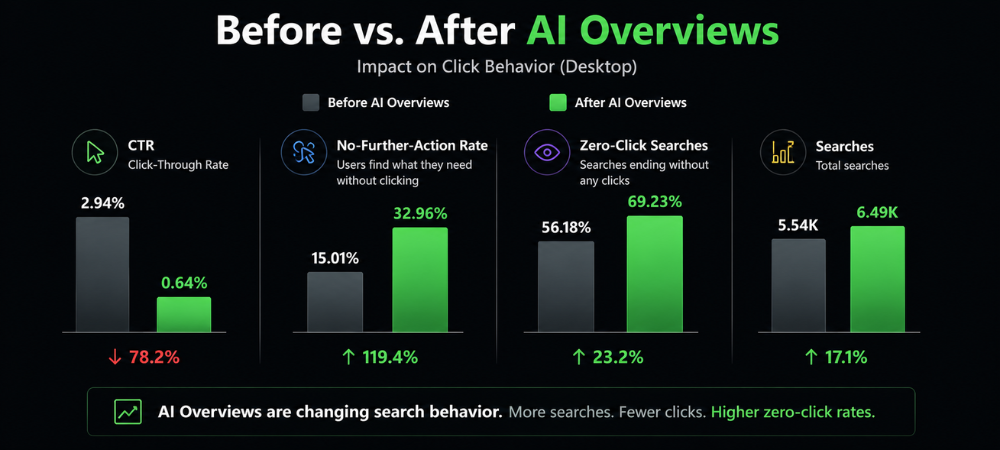
Content strategies built around informational queries are hitting a structural wall. The traffic hasn’t disappeared, despite what many marketers assume; it’s just landing somewhere other than the website. The user still gets an answer; the AI Overview is simply where they get it.
AI Search Adoption By Demographic
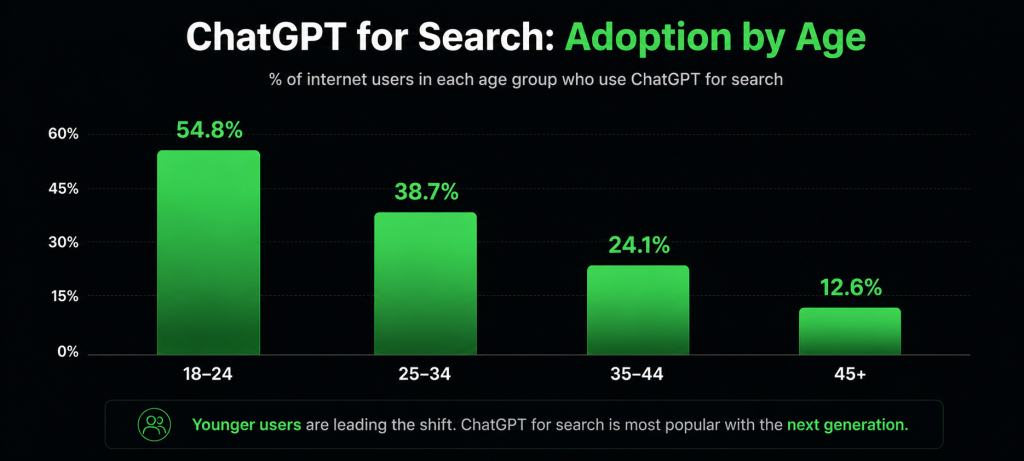
The generational divide here is real and accelerating. A significant share of Google searchers aged 18–24 now use ChatGPT for the same queries they’d previously typed into Google, a clear sign that AI-first search habits are taking hold fastest among younger users, and one likely to shape default search behavior as that cohort becomes the primary spending demographic.
How Google AI Overviews Are Reshaping Organic Performance?
AI Overview usage is no longer a niche behavior it’s mainstream across most demographics, and younger audiences are adopting it fastest. Getting your content picked by Google AI Overviews has become its own discipline.
- AI Overviews now appear for 20–25% of US SERP keywords.
- Nearly all queries that trigger an AI Overview were, in earlier tracking periods, overwhelmingly informational in intent, though by late 2025, that mix had already started shifting toward commercial and navigational queries too.
- Transactional queries trigger AI Overviews only 1.2–2.1% of the time.
- AI Overviews appear on 81% of triggered queries on mobile.
- Science and health-related queries generate the highest volume of AI Overview appearances.
This pattern matters because it shows exactly where click erosion is concentrated. Informational and comparison content absorbs most of the impact. Product and purchase-intent content is largely untouched for now, at least, while AI Overviews stay focused on answering “what” and “why” questions rather than closing transactions.
What Drives AI Citation: The Ranking Factors That Actually Matter?
This is where strategy comes in. Getting cited in AI Overviews, ChatGPT responses, and Perplexity answers isn’t random it’s driven by measurable signals that raise or lower citation likelihood. Understanding these signals is the foundation of effective SEO in 2026.
| Factor | Impact on Citation Likelihood | Source |
| Articles over 2,900 words | +59% more citations (vs. pages under 800 words, per a 129,000-domain SE Ranking study) | SE Ranking study, via PushLeads |
| Content updated within 3 months | 2×–3.2× more citations | Rankeo Content Freshness Study (2026) — no independently verifiable public URL found; consider citing Digital Applied’s 2026 meta-analysis, which found cited content runs ~25.7% fresher on average, as a corroborating source |
| Sections between 120 and 180 words | +70% more citations vs. thin sections | SE Ranking structure analysis, via PushLeads |
| Fast page load (Core Web Vitals / FCP) | Significant positive impact on visibility & citations | Google PageSpeed Insights; Moz Page Speed Guide |
⚠️ Worth flagging: a separate, more recent Ahrefs study (174,048 pages / 1.6M cited URLs) found word count itself correlates only ~0.04 with AI Overview citations, and that 53.4% of citations went to pages under 1,000 words (Ahrefs, “Update: 38% of AI Overview Citations Pull From The Top 10”). The two studies aren’t necessarily contradictory longer pages tend to cover more subtopics with better structure, which is likely the real driver but it’s worth softening the “over 2,900 words” framing so it doesn’t read as “just write more.”
Authority Signals
| Authority Signal | Threshold | Citation Impact | Source |
| Referring domains | 32k+ | 3.5× more likely to be cited vs. low-link domains | Aliboost |
| Referring domains (Google AI Mode) | 24k+ | ~6.8 citations vs. ~2.5 for smaller domains | SE Ranking |
| Community discussion volume | Strong presence on Quora/Reddit | Up to 4× higher citation rates | — |
Niche and community sources matter more than most SEO strategies account for. ChatGPT will pull an answer from a niche blog, forum thread, or Q&A post as readily as from a major publication, as long as the answer is direct and actually addresses the query.
What AI Overviews Typically Look Like?
AI Overviews typically run 100–300 words, clustering around 150–200, and pull in 6 to 11 citation links from multiple domains, though the exact mix shifts with search intent. Contrary to what most SEO teams assume, the length of the AI Overview response itself doesn’t correlate strongly with how many sources it cites. That’s a separate dynamic from the article-length factor noted above, which affects whether a given page gets chosen as a source in the first place.
Overall, citation quality remains high across the board, with only a small share of cited links leading to broken pages or errors. This suggests that AI systems are reasonably effective at filtering for accessible, valid sources. At the same time, platforms such as Reddit, YouTube, Quora, and Wikipedia consistently appear alongside select Google-owned properties in AI-generated citations.
That pattern alone should shape where brands invest presence as part of any SEO trends 2026 strategy. A well-placed Reddit thread or Wikipedia mention can do more for AI visibility than another blog post.
The Three Disciplines Shaping AI Visibility In 2026
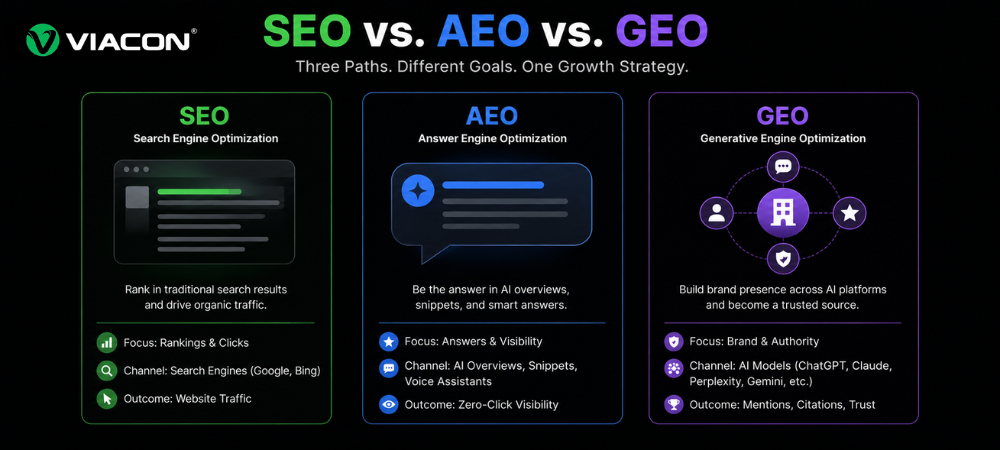
Three disciplines now sit alongside traditional SEO for AI-driven visibility. None of them replaces SEO; each extends it in a different direction.
Entity SEO: From Keywords To Concepts
At its core, Entity SEO helps search engines and AI systems understand what a brand is, what it covers, and how it connects to a broader topic network. As a result, optimization shifts away from exact-match phrases and instead focuses on meaning, context, and relationships.
| Aspect | Keyword SEO | Entity SEO |
| What gets optimized | Exact phrases and frequency | Concepts, relationships, and topic networks |
| How Google reads it | String matching | Semantic understanding |
| Content focus | Word count and keyword density | Topic coverage and entity connections |
| Success measured by | Ranking position | Citation frequency and topical authority |
Building Entity Authority Comes Down To Five Concrete Steps:
- Identify 5–10 core topics the brand should be consistently associated with, organized as topic clusters rather than isolated pages.
- Build a dedicated page for each topic with a clear definition and scope, not just passing mentions.
- Implement Organization, Person, Product, and Article schema markup site-wide.
- Use the sameAs property to link brand profiles across authoritative platforms.
- Keep brand descriptions consistent word-for-word where possible across every website, directory, and profile.
Answer Engine Optimization (AEO): Structured For Extraction
AEO makes content easy to pull out and surface as a direct answer. If SEO helps a page get found, AEO helps a page get quoted.
Practical AEO Implementation Means:
- Lead each major section with a direct 40–60-word answer to the implied question.
- Add a 1–2 sentence TL;DR under key H2 headings that stands alone if extracted.
- Use question-based headers “What is…”, “How does…”, “Why does…” instead of generic labels.
- Define terms in plain language before introducing nuance or technical detail.
- Add FAQ and HowTo schema markup so crawlers can parse the structure.
- Keep sections to 120–180 words that range shows the strongest citation lift (+70% vs. thin sections).
The formatting should feel readable, not robotic. AEO rewards clarity, not keyword density. The goal is a page that gives a useful answer in compressed form without losing the authority behind it.
Generative Engine Optimization (GEO): Surviving Summarization
GEO is the newest of the three, focused on getting content and brand entities into AI-generated responses even when the user never sees or clicks the original URL. Generative systems don’t return ranked lists; they synthesize answers from multiple sources at once. That means a page can shape an AI’s answer without ever earning a click, which is why GEO treats visibility as a brand-level outcome, not just a URL-level one.
GEO Works Best When:
- Instead of focusing solely on individual pages, content is structured around consistent entity signals across the entire site. As a result, search engines and AI systems can better understand topical relevance and brand authority.
- Topic clusters reinforce the same category relationships and service area.
- Author bylines and credentials appear consistently and link to external profiles.
- Content can withstand summarization without becoming generic or losing meaning.
- The brand appears across multiple surfaces: social profiles, industry publications, review platforms, and directories.
SEO vs. AEO vs. GEO: Where Should You Invest First?
| Traditional SEO | AEO | GEO | |
| Goal | Rank in search results | Get quoted as a direct answer | Get cited inside AI-generated responses |
| Optimizes for | Keywords, backlinks, on-page signals | Extractable, answer-first structure | Brand-level entity signals across the web |
| Primary unit | The page | The section | The brand |
| Success metric | Ranking position | Extraction/citation frequency | Presence across AI-generated answers |
| Core tactic | Technical SEO, link building | Answer-first formatting, schema | Entity consistency, multi-platform presence |
The right starting point depends on your query mix, not on which discipline sounds newest. See our full breakdown of SEO vs. AEO vs. GEO for the deeper comparison:
- Mostly Informational Traffic? Prioritize AEO, that’s where AI Overviews concentrate, and where answer-first formatting pays off fastest.
- Mostly Transactional Traffic? Traditional SEO still carries more weight. AI Overviews trigger on only 1.2–2.1% of transactional queries.
- Chasing Broad Brand Visibility Across ChatGPT, Perplexity, And Google AI Mode At Once? GEO and entity-building deserve a bigger budget, since those systems synthesize from brand-level signals rather than single pages.
Building The Authority That AI Systems Trust
Getting cited takes more than on-page optimization the trust signals AI systems weigh span a brand’s entire web presence, not just its own website.
Backlinks Have Evolved, Not Disappeared
Backlinks haven’t disappeared as a signal link building has evolved, shifting from a ranking factor to an authority signal. They still matter; how they matter has changed.
| Link Building Tactic | Effort Level | Link Quality | Best For |
| Digital PR with original research | High | Very high editorial | Sites with data and industry stories |
| Guest posting on industry sites | Medium | High editorial | Sites with existing domain authority |
| HARO and journalist queries | Low–medium | High press | Any site with genuine expertise |
| Resource link building | Medium | Medium–high | Comprehensive evergreen guides |
| Broken link building | Medium | Medium | Established niche content |
Brand Mentions Across Platforms
AI systems treat brand mentions as authority signals too, including mentions that don’t carry a backlink at all. Quality matters more than volume here: a recent meta-analysis of AI citation studies found brand mentions outweigh raw backlink counts by roughly 3× as a citation signal.
Brands with a presence across multiple platforms are significantly more likely to appear in AI-generated responses. Community-driven platforms like Reddit and Quora earn frequent citations because they provide direct, discussion-based answers that closely match user intent.. Reddit in particular stands out as a dominant AI source, while LinkedIn carries outsized weight for B2B visibility, especially in professional services.
The takeaway: AI systems weigh relevance, engagement, and content quality over raw mention counts. A focused presence on the two or three platforms your audience actually uses beats a scattershot presence on a dozen. That’s on top of the baseline brand-visibility case for why social media still matters for growth, AI citation aside, it remains a distribution channel that feeds the mentions and engagement this section is about.
Reviews As Trust Signals
Customer reviews have become more than conversion drivers; they’re now trust signals that directly shape how AI systems surface and recommend products.
- Nearly 90% of products featured in AI Mode include customer ratings.
- About 89% of those have ratings between 4.1 and 5 stars.
- Low-rated products (under 3 stars) are rare, appearing in only 0.9% of listings.
Moreover, AI systems don’t rely solely on on-site reviews. Instead, external review platforms appear in more than a third of AI Overviews for commercial queries, making third-party validation not just on-site star ratings a key part of the visibility equation.
Author Profiles And E-E-A-T
Google has confirmed that high scores on the other E-E-A-T dimensions can’t make up for a page that fails on trust. Trust is the foundation, not one factor among equals. The standard is even higher for YMYL (“Your Money or Your Life”) categories, such as finance, health, and cybersecurity SEO all face stricter trust thresholds before AI systems will cite them at all.
| Component | Key Signals | How To Implement |
| Experience | Author bylines, first-person examples, case results | Named authors on every article; real client outcomes with data |
| Expertise | Credentials, qualifications, professional profiles | LinkedIn profiles, industry memberships, detailed bios |
| Authoritativeness | Backlinks, press mentions, industry recognition | Digital PR for original research; guest publishing |
| Trustworthiness | HTTPS, accurate sourcing, privacy transparency | SSL mandatory; cited sources; visible correction policy |
Technical Performance: The Signals Most Teams Overlook
Page speed isn’t just a user-experience metric anymore, it’s a citation signal. These technical benchmarks directly affect AI search visibility and deserve a place in every technical SEO audit this year:
| Technical Metric | Target | Impact On Citation Likelihood | Source |
| First Contentful Paint (FCP) | Under ~0.4s | ~3× higher likelihood of being cited | LumenGEO |
| Interaction to Next Paint (INP) | Low (good Core Web Vitals range) | Improves interactivity and citation eligibility (no fixed multiplier confirmed) | DigitalReach |
| Largest Contentful Paint (LCP) | Under ~2.5s (ideally <2s) | Helps avoid performance-related exclusion from AI citation | DigitalReach |
| HTTP Status Code | 200 (valid page) | Required for crawling, indexing, and citation eligibility | — |
| HTTPS | Mandatory | Core trust signal aligned with E-E-A-T and ranking systems | Search Engine Land |
A slow site doesn’t just frustrate users, its content becomes less likely to appear in AI-generated answers, no matter how good that content actually is. Technical performance and content strategy aren’t separate workstreams anymore; a page has to be fast enough to be eligible before it can be good enough to be cited.
Content Strategy Aligned To Business Type
Not every site needs the same content strategy. SaaS, ecommerce, and local businesses all need different playbooks. The right approach depends on the business model, audience, and the specific problems your content needs to solve.
| Website Type | Content Priority | High-Value Query Patterns |
| Publishers and content hubs | Educational breadth | Definitions, comprehensive guides, “what is” |
| Service and lead generation | Problem-solution mapping | Comparisons, “how does this work,” pre-conversion questions |
| Product and e-commerce | Use cases and alternatives | “Best of,” comparisons, “is it right for me” |
| B2B SaaS | Category leadership | “What it is,” “how it works,” “why it matters” |
Two content formats consistently outperform everything else for AI traffic right now: best-of roundups and comprehensive guides. Both serve answer-intent queries directly, run long enough to earn a citation, and position the brand as a reference point rather than just another result in a list.
Original research deserves special attention here. Data, surveys, benchmark reports, and proprietary analysis all become citation sources that AI systems pull from repeatedly when answering related queries. One well-distributed industry report can earn citations across dozens of prompts for months, and an upfront investment that compounds in a way individual articles simply don’t.
What The Numbers Say About Business Impact
| Metric | Figure |
| Retailers reporting a positive revenue impact from AI | 87% |
| Marketers planning to use AI in content creation (2026) | 94% |
| Average time saved per week using AI tools | ~4 hours (some report 10+) |
| Conversion rate lift from AI chat interactions | Up to 4× (12.3% vs. 3.1%) |
The disruption is real, but it isn’t uniformly negative. Businesses that have adapted their visibility strategy report AI traffic that converts better, sticks around longer, and bounces less than traditional organic traffic. The problem was never AI search itself, it’s optimizing for the old system, while the new one redistributes where the value goes.
For businesses weighing where to put budget, the conversion-rate gap is the number that matters most: AI-referred traffic isn’t just additional traffic, it’s traffic that’s already primed to convert.
Where This Is Heading: 2027 and Beyond
Based on current growth trajectories, a few shifts are already taking shape:
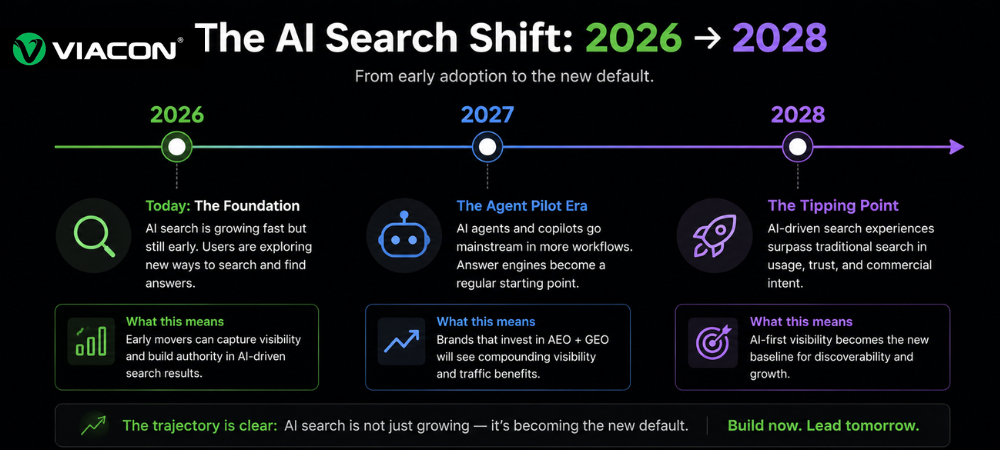
- AI Search Could Overtake Traditional Organic Search Volume By 2028. If Google makes AI Mode the default experience rather than an opt-in, that timeline could move up.
- Zero-click Rates For Informational Queries Will Likely Keep Climbing as AI Overviews get more capable and more trusted.
- AI Agents Are Moving From Experimental To Mainstream. 39% of organizations are already running agent pilots. Once agentic interfaces start handling research, comparison, and purchasing decisions on their own, getting cited by AI stops being a marketing metric and starts being a revenue one.
That last point is the one worth sitting with. Businesses building AI visibility now are compounding an advantage that’s genuinely hard to copy. Citation frequency, entity strength, and topical authority all take time to establish, and competitors can’t replicate them overnight. Businesses that leave their content strategy unchanged won’t just miss new traffic; they’ll watch their existing visibility erode as the two search systems keep drifting apart.
AI Visibility Checklist: Where To Start
- Audit– Test your top 15–20 keywords across ChatGPT, Perplexity, and Google AI Mode. Log whether your brand appears, and where.
- Restructure Priority Pages– Start by rewriting key sections with a 40–60-word direct answer at the beginning. Then, add a standalone TL;DR beneath each H2 to summarize the main takeaway. Finally, replace generic headings with question-based headers to better match how users search and how AI systems interpret content.
- Ship Structured Data – Add Organization, Article, FAQ, and HowTo schema to pages that don’t already have it.
- Consolidate Entity Signals – Standardize brand descriptions across your site and every directory listing; link them with sameAs markup.
- Earn Mentions, Not Just Links – Prioritize digital PR, HARO responses, and active participation on Reddit, Quora, and LinkedIn over volume link-building.
- Fix Technical Debt First – Get FCP under ~0.4s and LCP under ~2.5s before investing further in content; slow pages get excluded from citation regardless of content quality.
- Re-audit Monthly – Track citation frequency the same way you track rankings. Rank tracking alone won’t show you what’s happening in AI search.
If your visibility spans multiple countries or languages, add one more item: this checklist covers AI citation factors, not hreflang, regional indexing, or market-specific technical setup that’s what a dedicated international SEO audit is for.
Is your content strategy keeping pace with these SEO trends 2026, or is it still built for the one search system you already know how to rank in? If you’re not sure, reach out for a free audit of where your brand currently stands and doesn’t in AI search. Evaluating partners instead of going it alone? Here’s what to actually look for in an SEO agency in 2026.
Frequently Asked Questions
Q1. What Are The Biggest SEO Trends For 2026?
A: This year, five trends stand out. First, search is splitting into two parallel systems, traditional and AI-driven, that overlap on only 14% of URLs. Meanwhile, zero-click behavior continues to climb as AI Overviews answer more queries directly. At the same time, Entity SEO, AEO, and GEO are emerging as distinct disciplines alongside traditional SEO. In addition, E-E-A-T and technical performance (including page speed and HTTPS) now function as citation signals, not just ranking factors. Finally, AI-referred traffic is converting at up to 4× the rate of traditional organic traffic. Together, these SEO trends for 2026 show that visibility strategies must account for both search systems—not just one.
Q2. What Is AI search?
A: AI search is a search experience where users get a direct, synthesized answer instead of a list of links to click through. The AI model pulls from websites, Q&A platforms, and reference sites like Wikipedia to assemble that answer. Google AI Overviews, ChatGPT citations, Perplexity responses, and Google AI Mode are all examples.
Q3. What Is Entity SEO?
A: Entity SEO optimizes for relationships and concepts instead of exact-match keywords. An entity is anything Google’s Knowledge Graph can recognize as a distinct concept: a person, brand, product, service, or idea and Entity SEO is about making sure AI systems understand how your brand connects to the entities in your space.
Q4. What Is GEO?
A: Generative Engine Optimization (GEO) structures content so AI systems like ChatGPT, Google AI Overviews, and Perplexity can find, understand, and cite it inside generated responses. In practice, that means answer-first structure, concise TL; DRs, question-based headers, plain-language definitions, and content that stays current.
Q5. What’s The Difference Between SEO, AEO, And GEO?
A: Traditional SEO optimizes a page to rank in search results. AEO structures a page’s sections so AI systems can extract and quote them directly. GEO works at the brand level, building the entity signals that get a brand cited across AI-generated responses, even on pages the AI never directly quotes. Most businesses need all three, in different proportions depending on their query mix.
Q6. How Does AI Search Affect SEO?
A: AI search doesn’t replace SEO, it adds a second layer on top of it. Traditional rankings still matter, but appearing in AI Overviews is now just as important for overall visibility. Click-through rate from position one on informational keywords has fallen from 7.6% to 3.9% since 2023, and AI Overviews cut clicks by as much as 58% on the queries where they appear.
Q7. How Can Businesses Improve Their AI Search Visibility?
A: Start with an audit: test your priority keywords across AI tools and note where and whether your brand gets cited. From there, optimize with answer-first formatting, regular content refreshes, structured data, strong internal linking, and a real presence on platforms like Reddit and LinkedIn, where AI systems already look for answers.