B2B SaaS marketing is how a subscription software company attracts, converts, and keeps business customers. In 2026, that job no longer fits inside one channel. Buyers research on Google, ask AI assistants for shortlists, read reviews, and watch communities long before they book a demo. By the time they talk to sales, they have already formed an opinion.
Acquisition costs keep climbing, too. Scattered tactics waste money, while a connected system compounds it. This playbook shows how to build that system: customer research, positioning, search, content, product experience, and retention working as one.
What B2B SaaS Marketing Covers In 2026
B2B SaaS marketing spans every step between a stranger’s first search and a customer’s third renewal. Three traits set it apart from other marketing. Revenue recurs, so you must prove value every month. Several people influence each purchase, from the end user to the finance lead. And the product itself sells through trials, demos, and onboarding.
That scope changes who owns what. Marketing now shares goals with product, sales, and customer success. A well-built digital marketing strategy ties those teams to one revenue number instead of four separate dashboards.
| How Is B2B SaaS Marketing Different From B2C SaaS Marketing? B2B SaaS marketing targets teams with budgets, approval chains, and security reviews, so sales cycles run for weeks or months. B2C SaaS targets individuals who decide fast and often pay by card. As a result, B2B messaging centres on business outcomes, risk, and proof rather than personal convenience. |
Start With The Market, Not The Marketing Channel
Founders often open with channel questions. Should we invest in SEO, LinkedIn, paid media, or webinars? Those questions arrive too early. Market definition comes first, because it decides which channel deserves your budget.
Build An Ideal Customer Profile Around Observable Signals
List the traits you can verify before a sales call: company size, industry, existing technology, operational pain, decision authority, and urgency. Then add trigger events, the moments that push a team to change. A funding round, rapid hiring, a compliance deadline, or a failing legacy system can each open a buying window. Document these events, because they tell you when to reach out.
Price matters here, too. A product sold at $30 per seat each month cannot support the same acquisition cost as an annual contract worth $40,000. Your pricing model sets the ceiling on what you can spend to win a customer.
Sharpen Your Positioning
Say what your product replaces. Explain why the current approach fails. Describe outcomes in the buyer’s own words. Skip broad claims about productivity or transformation, since buyers ignore them. Compare “Transform your finance workflow” with “Cut month-end close from ten days to four.” Only the second one can be proven.
Set Goals Before You Pick Tactics
Write targets that carry a number and a deadline, such as “40 qualified demo requests per month from organic search by Q3.” Vague goals produce vague campaigns. Viacon supports this step by auditing market language, search behavior, competitor claims, and conversion paths, so founders can see where a clearer position is open.
Match The Growth Motion To Your Business Stage
No two startups should run the same plan. A company before product-market fit needs a very different channel mix from a mature SaaS business.
| Business Stage | Primary Marketing Goal | Recommended Focus |
|---|---|---|
| Pre-product-market fit | Validate demand | Founder-led sales, customer interviews, message testing |
| Early traction | Build repeatability | SEO foundations, use-case content, focused outbound |
| Growth stage | Increase pipeline | Paid acquisition, lifecycle automation, partnerships |
| Scale stage | Improve efficiency | Account expansion, attribution, retention campaigns |
In the early stage, stay close to sales conversations. Record every objection and note the exact phrases buyers use. Then reuse that language in landing pages, emails, product demos, and sales enablement assets. It sounds basic, yet many teams skip it, and it costs almost nothing.
| How Much Should A SaaS Startup Spend On Marketing? No single figure fits every company. Many SaaS businesses spend roughly 10 to 20 percent of revenue on marketing, and early-stage startups often spend more while they hunt for a repeatable channel. Treat that range as a starting point. Fund 90-day tests, then double down on channels that produce qualified pipeline rather than raw traffic. |
Build A Search System For Google And AI Discovery
Most prospects still start on Google. However, many also use AI assistants to compare products, understand implementation options, and draft a shortlist. So your pages must answer buyer questions in a form that people and machines can both read.
Organize your content around buyer problems, not loose keywords. Each cluster should include an authoritative guide, supporting articles, feature pages, comparison pages, FAQs, and a relevant case study. That structure builds topical depth and gives readers several routes from research to evaluation. A focused SEO strategy turns those clusters into steady, qualified traffic.
Integration pages deserve their own place in the plan. Buyers expect new software to fit the tools they already use. A dedicated page for each major integration, with setup steps and a clear use case, captures searches like “CRM that works with Slack.” It also gives AI tools clean facts to cite.
| How Do SEO And AEO Work Together? Strong SaaS marketing needs both search engine optimization (SEO) and answer engine optimization (AEO). Use descriptive headings and define key concepts early. Add named authors, expert commentary, and original examples. Update older pages whenever the product or market shifts. If you draft with AI, edit hard before publishing, because serious buyers can spot rearranged advice. |
Ejaz Ahmed (COO & CDO at Viacon): “In 2026, visibility is no longer limited to rankings. Brands need credible content that can earn trust across search engines, AI answers, and conversion journeys.”
| What Is Answer Engine Optimization For SaaS? Answer engine optimization structures content so AI assistants and search features can pull a clear answer from it. For SaaS, that means direct definitions, comparison tables, and consistent product facts across your site, review profiles, and documentation. |
Build Authority That Search Engines And AI Assistants Trust
Strong content still needs outside proof. Search engines weigh links from respected sites. AI assistants, in turn, tend to name brands that independent sources mention again and again. For a young SaaS company, authority works as a growth input, not a vanity project.
Start with the sources your buyers already read: industry publications, analyst blogs, partner sites, and newsletters. Earn mentions there with original data, expert commentary, and useful tools instead of launch announcements. Digital PR, guest contributions, and integration partner pages all create links that point back to your best guides. Then measure the result. Track referring domains, branded search growth, and how often AI answers name your product for your core queries.
| What Is Authority Building In SEO? Authority building is the work of earning links, citations, and mentions from trusted sites, so search engines and AI assistants see your brand as a credible source. It combines digital PR, backlink outreach, and content worth referencing. |
Turn Content Into A Pipeline Asset
Content marketing must reduce uncertainty at every buying stage. Generic thought-leadership posts do not do that. Good content explains the problem, and the best content helps readers price the cost of leaving it unsolved.
Write for the whole buying committee. An operations leader wants workflow impact. A finance leader needs a commercial case. IT cares about security and integration. End users want software that will not add one more clumsy process.
Match formats to stages. Publish problem-led guides for early discovery and implementation pages for technical evaluators. Add comparison pages for active buyers and customer stories to reduce perceived risk. Then repurpose expert insights into email and social posts. Pick a pace your team can sustain, because a steady rhythm beats a burst followed by silence. Our look at content marketing trends shows which formats are gaining ground.
Distribution deserves equal attention. Share every asset through founder profiles, employee networks, email sequences, partner channels, and sales conversations. Without that push, even a strong article never reaches a prospect. That is a distribution gap, not a content problem.
| What Content Should An Early-stage SaaS Company Create First? Start with four assets: one problem guide, one use-case page, one comparison page, and one customer proof page. Together, they cover discovery, evaluation, and decision. Add more only after those four earn traffic and conversions. |
Earn Trust With Security-Conscious And Technical Buyers
Regulation keeps tightening, and buyers have less patience for vague claims. Trust now affects conversion directly. Publish a security page that names your certifications, data handling practices, and uptime history. Document your API and integrations in public, so technical evaluators can judge fit without a sales call.
Reviews matter just as much. Build profiles on the platforms your buyers check, such as G2 and Capterra, and reply to critical reviews calmly and specifically. Keep customer proof concrete: the company, the result, and the timeframe. Security vendors face the highest bar of all, and our guide to cybersecurity content marketing shows how to write for skeptical technical readers.
Combine Demand Creation With Demand Capture
Good B2B marketing does two jobs. It creates interest among buyers who are not shopping yet, and it captures prospects who already search for a solution. Founders need both, but the ratio depends on market maturity. A new category needs more creation. An established one rewards capture.
Search ads and SEO reach people with existing intent. To create demand, use founder-led posts, podcasts, original research, communities, and educational video. Retargeting and email nurture keep you visible through a long evaluation cycle.
| Approach | Best use | Common mistake |
|---|---|---|
| SEO | Compounding discovery | Chasing traffic without buying relevance |
| Paid search | Capturing active demand | Sending every click to the homepage |
| Reaching defined accounts | Posting company updates with no buyer value | |
| Nurturing evaluation | Automating before fixing the message | |
| Partnerships | Borrowing trust | Choosing reach over audience fit |
For capture, paid search campaigns work best when each ad group lands on a page built for that exact query.
Account-based Marketing And Outbound
Account-based marketing (ABM) works once you can name your target accounts. Start earlier than most teams expect. Warm the account with relevant content and ads, then bring in sales. Outbound follows the same logic. Reference a trigger event, offer something useful, and aim for engagement, not just replies.
Communities and events add another route. User groups, Slack communities, and small webinars let buyers meet peers who already use your category.
Lead Scoring And Handoff
Do not treat all form fills equally. A pricing-page visitor from a target account carries far more commercial weight than a broad ebook download. Build scoring around fit, behavior, product interaction, and buying signals. Then define exactly when marketing hands an account to sales, so no one argues about it later.
Make The Product Part Of The Marketing System
Your product must prove what your marketing promised. That holds for free trials, freemium plans, interactive demos, and product-led journeys. When onboarding confuses new users, acquisition spend turns into disappointment.
Map the shortest path to first value, and remove setup steps that do not support that moment. Use contextual messages to guide users toward meaningful actions. You do not need to show every feature during a trial. You do need the customer to grasp the product’s value fast.
Next, connect usage to sales activity. High-fit accounts that complete key actions may deserve personal outreach. Low-usage accounts usually need education instead. Viacon builds these journeys around the first-value moment, joining acquisition campaigns, conversion-focused experiences, content, and performance tracking.
| What Is A Product-Qualified Lead? A product-qualified lead (PQL) is a user or account that has taken actions signaling buying intent, such as inviting teammates or connecting an integration. PQLs often convert better than form fills because behavior shows real use. |
Keep Customers And Grow Their Accounts
Customer marketing is one of the cheapest growth levers in SaaS, yet most startups treat it as an afterthought. Retention and expansion decide whether acquisition spend ever pays back.
Begin with structured onboarding: a short email sequence, a setup checklist, and a check-in after the first two weeks. Then schedule usage reviews with larger accounts. Share product updates in ways that tie new features to the problems each customer already reported. Watch for expansion triggers, such as hitting a seat limit or a new team adopting the tool. Contact renewal accounts about 90 days before the date, not 10.
Referral programs and case studies close the loop. Happy customers supply the proof that your next buyer wants to see. Finally, log every churn reason. Those notes often point to messaging problems at the top of the funnel.
Measure Revenue Movement, Not Marketing Motion
Traffic, impressions, and click-through rates describe activity. They do not define success. A credible program shows how marketing influences qualified pipeline, conversion, customer value, and retention. Track a compact set of metrics, and review them by segment and channel.
| Metric | What It Tells You | Common Starting Benchmark |
|---|---|---|
| Customer acquisition cost (CAC) | Efficiency of spend | Varies by price point |
| CAC payback period | Time to recover acquisition cost | Under 12 months for many SaaS teams |
| LTV to CAC ratio | Return on each customer | Around 3 to 1 |
| Pipeline velocity | Speed of movement through stages | Rising quarter over quarter |
| Trial-to-paid conversion | Message and product alignment | Varies widely by model |
| Net revenue retention (NRR) | Ability to keep and expand customers | Above 100 percent |
Treat the benchmarks as reference points, not rules. Your own trend line matters more.
Attribution needs care, too. Ad platforms tend to credit themselves, and a lot of influence happens in private chats, podcasts, and communities that no pixel sees. Add a “How did you hear about us?” field to demo forms.
Then compare self-reported answers with platform data. One campaign may bring many leads and few suitable accounts, while another brings fewer opportunities with larger contracts. Choose investments by revenue quality, not raw volume.
Avoid These Common SaaS Marketing Mistakes
Teams stumble in the same few places. Some copy a competitor’s positioning instead of finding their own. Others spread thin across too many channels. Paid clicks land on the homepage rather than on a page built for the query. Email gets automated before the message works. And the board hears about traffic when it wants pipeline. Fix these five habits, and most of your gains arrive without extra budget.
Introducing Corda: Viacon’s Own SaaS Product
Viacon has spent years helping startups with SaaS marketing. Now it has launched a SaaS product of its own. Corda Marketing is an AI-powered authority-building platform that helps brands find, execute, and measure SEO, digital PR, backlink, and AI-search visibility campaigns.
The launch puts Viacon in the same position as the founders reading this playbook. A software company must earn trust, compete for attention in search and AI answers, and prove results in revenue terms. Corda covers the authority side of that job in one place, so teams stop juggling spreadsheets, inboxes, and separate reporting tools.
| What Does Corda Do? Corda helps brands find opportunities to earn links and mentions. It supports campaign execution across SEO, digital PR, and backlinks. It also measures results, including how visible a brand is in AI search. |
| How Does Corda Fit Into A SaaS Marketing Plan? Corda supports the search and authority layer of your plan. It does not replace positioning, content, or product experience, which still decide whether visitors convert. Use it alongside the rest of the system described in this guide. |
Build A Learning System That Compounds
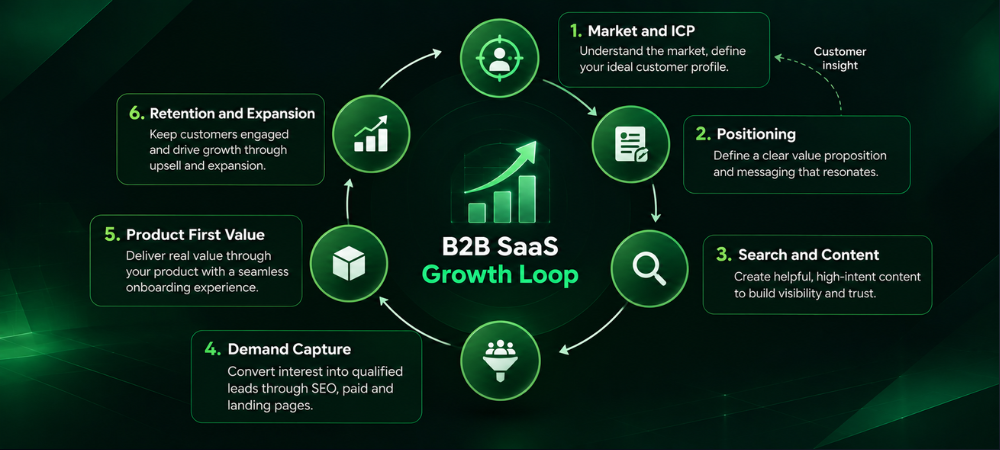
You do not need more channels to win. You need a system that learns faster than your competitors. Focus on a precise market. Clarify your position. Build useful content. Capture active demand. Let the product support conversion. Measure what reaches revenue.
Each part strengthens the next. Search insights improve content. Content improves sales conversations. Product behavior sharpens qualification. Customer outcomes feed future acquisition.
Viacon helps startup founders build this connected system, from SEO and paid media to conversion optimization, content, automation, and go-to-market support. With the launch of its own SaaS product, Corda, the team now works on both sides of this playbook: as an agency for clients and as a SaaS company with its own growth to earn.
Its work for BKS offers one practical example. Viacon’s web solution improved engagement and increased time spent on the site within 90 days, while mobile optimization and faster performance strengthened the visitor experience.
Ready to build a clearer growth engine? Contact Viacon for a tailored B2B SaaS growth assessment.