In today’s highly competitive market, every “inch” matters, and a rightly executed ecommerce platform can take your business meters ahead of the competition. But the real question founders ask isn’t whether to build an online store, it’s how to build one that becomes a strategic weapon rather than just another website.
The answer almost always comes down to partnering with the right team for ecommerce website development services. A dedicated ecommerce development agency works to build a fully functioning store from which customers purchase your products, engage with your brand, and keep coming back across India, the USA, and global markets.
Global ecommerce sales are projected to keep climbing year over year (see our Industry Report for the latest figures), which makes this one of the few areas of digital spend founders genuinely cannot afford to under-invest in.
In this guide, we’ll break down what ecommerce website development services actually include, the types of ecommerce platforms and business models they support, what the process looks like, how much it typically costs, and how to choose the right partner, whether you’re a DTC startup or a B2B brand scaling into new markets.
Is Hiring An Ecommerce Development Agency Worth It For Founders?
For founders, hiring an ecommerce development agency is less about outsourcing work and more about reducing execution risk. Building a high-performing ecommerce platform requires technical depth, conversion expertise, and scalability planning areas that are costly and time-consuming to manage in-house, especially for early-stage teams.
An experienced ecommerce website development company brings proven frameworks, faster execution, and cross-industry insight that helps founders avoid expensive rebuilds later. Viacon’s teams across India and the USA combine this technical execution with digital marketing services, so the store isn’t just built well, it’s built to actually convert traffic into revenue from day one.
The Role Of Ecommerce Website Development Services
Ecommerce website development services design, build, and maintain the platforms that let your business compete and grow locally and globally. Done right, this isn’t a one-time project; it’s an ongoing partnership across design, engineering, SEO, and performance.
Why Are Dedicated Ecommerce Development Services Important?
- Revenue Impact: A dedicated ecommerce development service has a direct, measurable impact on revenue. The site is built to represent your brand’s vision and fulfil business objectives, not just look good.
- Faster Time-to-Market: Agencies that specialize in ecommerce development typically deliver on a fixed timeline, so you launch when you said you would.
- Reduced Founder Workload: Partnering with a dedicated team frees founders to focus on sourcing, operations, and customers, not staging environments and checkout bugs.
- Lower Risk During Scaling: Experienced developers build in headroom for traffic spikes, new SKUs, and new markets, so you’re not rebuilding the platform every time you grow.
- Better Customer Experience: Agencies that live in ecommerce UX daily know what makes shoppers convert and what makes them abandon carts.
Do eCommerce Agencies Only Build New Websites? No. Ecommerce developers also handle platform migrations, redesigns of existing stores, performance audits, and ongoing maintenance. See the custom web development page for the full scope.
What An Ecommerce Development Agency Actually Does: The Full Process
This is where most guides stop short. Here’s what a genuine end-to-end ecommerce website development services engagement looks like, stage by stage:
- Discovery & Strategy – Defining your business model (B2B, B2C, D2C, or marketplace), target audience, competitor benchmarking, and tech-stack selection.
- UX/UI Design – Wireframes, mobile-first layouts, and a conversion-focused design system tailored to your industry (a healthcare D2C brand and a B2B electronics distributor need very different UX patterns).
- Platform Development – Front-end and back-end built on your chosen platform, with clean, scalable code.
- Integrations – Payment gateways, CRM/ERP systems, inventory and shipping tools, and marketing stacks. See CRM/ERP Integration for how this is handled at scale.
- QA & Testing – Cross-device, cross-browser, load, and security testing before anything goes live.
- Launch – Hosting setup, DNS/SSL configuration, and a phased go-live plan to avoid downtime.
- Post-launch Growth – SEO, conversion rate optimization, and performance marketing to turn traffic into recurring revenue.
Types Of Ecommerce Websites We Build
Not every store is the same, and the right ecommerce website development services partner should be fluent in all of these models:
- B2C (Business-to-Consumer): Direct-to-consumer storefronts the most common model for retail, beauty, and F&B brands.
- B2B (Business-to-Business): Bulk pricing, quote requests, gated catalogs, and account-based checkout flows for wholesale and manufacturing clients.
- C2C (Consumer-to-Consumer): Marketplace-style platforms connecting individual buyers and sellers.
- Multi-vendor marketplaces: Platforms supporting multiple sellers under one storefront, with vendor dashboards and commission logic.
Ecommerce Platforms We Work With
A genuine ecommerce website development company should be platform-agnostic and recommend what’s right for your business, not push whatever they’re most comfortable building.
Viacon’s Developers Work Across:
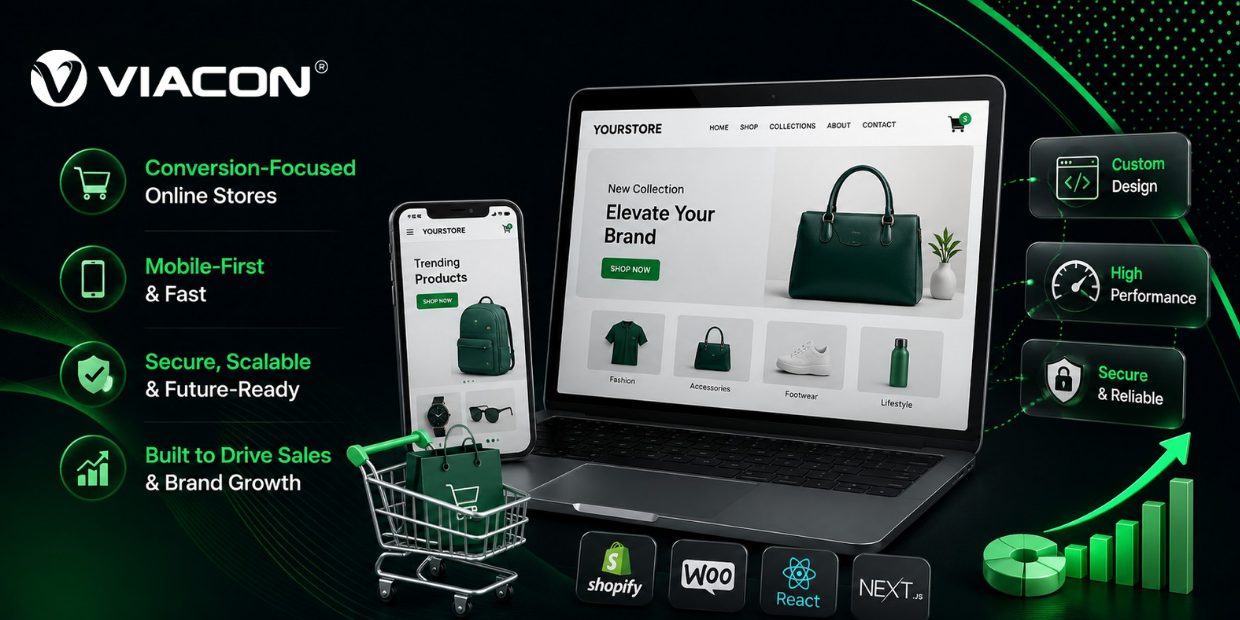
- Shopify & Shopify Plus – Fast to launch, ideal for D2C and growing retail brands.
- WooCommerce (WordPress) – Flexible, content-friendly, and budget-efficient for SMBs.
- Magento / Adobe Commerce – Built for complex catalogues, multi-store setups, and enterprise-scale B2B.
- Headless / custom commerce – For brands that need full control over front-end performance and omnichannel delivery, built via our custom web development team (also covers SaaS-based commerce builds).
Industries We Build Ecommerce Stores For
Viacon’s ecommerce website development services span a deliberately broad mix of industries, including:
- Retail & D2C – Fashion, lifestyle, and consumer goods brands needing fast, conversion-focused storefronts.
- Food & Beverage (F&B) – Subscription models, delivery-zone logic, and perishable inventory handling.
- Healthcare – Compliant, secure ecommerce for pharmacies, wellness, and medical device/supply brands.
- Electronics – Complex catalogs, variant/SKU management, and warranty/service integrations.
Case Study: Birla Tyres
Viacon partnered with Birla Tyres to modernize its digital experience through a complete website transformation built on Next.js and Strapi CMS. The engagement focused on delivering a faster, SEO-friendly, mobile-first platform with intuitive product discovery, intelligent tyre search, streamlined content management, and a scalable architecture for future growth.
By eliminating content publishing bottlenecks and optimizing technical SEO and site performance, the new platform achieved 30% higher user engagement, reduced bounce rates by 20%, increased organic enquiries by 40%, and accelerated content publishing by 3×, helping Birla Tyres strengthen its digital presence alongside its market leadership
Why Choose Viacon For eCommerce Web Development? See How We Helped Birla Tyres Build A High-Performance Website That Increased Engagement And Organic Enquiries.
Download The Case StudyHow Much Do Ecommerce Website Development Services Cost?
Pricing varies widely based on platform, design complexity, number of integrations, and catalog size. As general industry ranges:
| Project Type | Typical Range | Typical Timeline |
| Template-based Shopify/WooCommerce store | Lower budget tier | 3–6 weeks |
| Custom-designed B2C store with integrations | Mid budget tier | 6–10 weeks |
| Enterprise/B2B or headless commerce build | Higher budget tier | 10–16+ weeks |
These are directional, not quotes. The only accurate number is one based on your actual scope. Talk to our team for a tailored estimate, or start with a free audit if you already have a store and want to know what a rebuild or revamp would realistically cost.
Don’t Forget: Ecommerce SEO & AI Search Visibility
A beautifully built store that nobody finds doesn’t grow revenue. Two things matter increasingly together in 2026:
- Traditional eCommerce SEO – Technical SEO, site structure, and content that ranks in Google.
- AI Search Visibility – Shoppers increasingly ask AI assistants and AI Overviews for product and brand recommendations, not just Google. Stores need structured data, a clean product schema, and content built for AI retrieval, not just keyword ranking. This is a growing gap that most ecommerce development agencies still ignore. Viacon builds it in from day one through our AI Search Optimization (GEO) service.
This is how a store goes from “built” to “found”, not just ranking, but actually being recommended.
How To Choose The Right Ecommerce Website Development Company?
Use this checklist before signing with any agency:
- Do they show real, industry-relevant case studies (not just generic templates)?
- Do they work across multiple platforms, or only push one?
- Is post-launch support, SEO, and CRO included or a separate add-on?
- Do they understand AI search visibility, not just traditional SEO?
- Can they scale with your mobile app, CRM/ERP, automation, or will you need a new vendor in 12 months?
If you’re also evaluating a broader digital partner rather than just a build, our Growth Solutions page outlines how Viacon supports founders end-to-end, from build to scale.
What Makes Viacon Different From Other Ecommerce Agencies
Most ecommerce agencies look similar on paper — “custom design,” “platform expertise,” “ongoing support.” The real differences show up in how the work actually gets delivered:
| Typical Agency | Viacon | |
|---|---|---|
| Platform approach | Pushes one platform regardless of fit | Recommends Shopify, WooCommerce, Magento, or headless based on your business model |
| Scope of work | Build it, hand it off | Builds it, then owns SEO, CRO, content, and AI search visibility post-launch |
| Buyer types | Usually specializes in either B2B or B2C | Ships both — D2C storefronts and B2B/dealer-network platforms, sometimes for the same brand |
| Industry context | Generic templates applied across industries | Walks in with working knowledge of Retail, F&B, Healthcare, and Electronics catalog/compliance needs |
| Team structure | Project-based freelancers or a single point of contact | Dedicated team of 100+ specialists across engineering, design, SEO, and growth |
| Geographic delivery | Single time zone, single market focus | India-based engineering cost/time-zone advantage + USA-facing client and growth support |
| Search readiness | Optimizes for Google rankings only | Builds for traditional SEO and AI Overviews/AI shopping assistants from day one |
The short version: most agencies hand you a website. Viacon hands you a revenue channel and stays accountable for it after launch.
Ecommerce Website Development Services
Q1.What Are eCommerce Website Development Services?
A: They are the design, development, integration, and maintenance services used to build and run an online store covering UX/UI, platform engineering, payment and CRM integrations, testing, launch, and ongoing growth support.
Q2.How Long Does It Take To Build An eCommerce Website?
A: Most stores take 3–6 weeks for a template-based build, and 8–16+ weeks for a custom or enterprise-level build, depending on integrations and catalog complexity.
Q3.Which Platform Is Best For eCommerce Development Shopify, WooCommerce, Or Magento?
A: Shopify suits fast-launching D2C brands, WooCommerce suits content-heavy SMBs already on WordPress, and Magento/Adobe Commerce suits complex, high-SKU B2B or enterprise catalogs. The right choice depends on your business model, not a universal “best.”
Q4. Do eCommerce Development Agencies Also Handle SEO And Marketing?
A: Many do, but few combine traditional SEO with AI search optimization. Viacon bundles SEO, content marketing, and AI search optimization with development so the store is built to be found, not just to function.
Q5.Can An Agency Migrate My Existing Store Instead Of Building From Scratch?
A: Yes, migration, redesign, and ongoing maintenance of existing ecommerce sites are standard services, not just new builds. See custom web development for the migration scope.
Why Choose Viacon For Ecommerce Website Development Services?
There’s no shortage of agencies offering ecommerce development.
Here’s What Actually Sets Viacon Apart For Founders Evaluating Partners:
- Multi-platform Expertise, Not A One-Tool Pitch – Shopify, WooCommerce, Magento/Adobe Commerce, and headless/custom builds, recommended based on your business model, not our comfort zone.
- Built For B2B, B2C, And Everything Between – From D2C storefronts to dealer-network platforms like our Birla Tyres engagement above, we’ve shipped for both buyer types, often on the same brand.
- Cross-industry Execution – Live experience across Retail, F&B, Healthcare, and Electronics means we walk in already understanding your catalog logic and compliance needs, not learning on your dime.
- Development Growth Under One Roof – SEO, content, performance marketing, CRO, and AI search optimization sit inside the same team that builds the store, so handoffs and conflicting priorities don’t slow you down post-launch.
- India USA Delivery – Global-standard execution with the cost and time-zone advantages of an India-based engineering team, backed by a USA-facing client and growth team.
- 100+ Solutions Deployed, Real Named Clients – See the breadth of our work across industries in our Case Studies, not just this one example.
Build Your Ecommerce Platform With Viacon
Whether you’re launching your first D2C store, scaling a B2B catalog, or rebuilding an underperforming platform, Viacon’s ecommerce website development services team, working across India and the USA, handles design, development, integrations, and growth under one roof.