Most SEOs and marketers would agree that Google’s Knowledge Panel is the fruit of steady, calculated, and strategic SEO efforts.
Yet, a large number of brands can’t seem to reach there. Most of them have tweaked their website, polished their content, and built their fair share of backlinks.
But when they search their brand name on Google. That much-desired information panel doesn’t appear on the right side of the results page. No logo, no description, no quick facts. Just a list of links.
That panel you’re missing? That’s the Google Knowledge Graph at work. Or, in your case, not working yet.
Here’s the thing, though. Most brands that don’t show up there aren’t missing out because Google has something against them.
They’re missing out because they haven’t sent Google the right signals. Specifically, the entity signals that tell Google: “This brand is real, it’s consistent, and it’s worth knowing about.”
Google search has moved beyond noticing your brand for the keywords it ranks for. It notices your brand based on what the brand stands for and its entity on the search engine.
That entity is built over time by preparing a virtual database for your brand called “Google’s Knowledge Graph.”
That’s what we’ve solved in this post. Learn what a Knowledge Graph is and why your brand might be absent from it. And with a clear 7-step plan to change that.
Not sure where to start?
Get your Free SEO Audit from Viacon to identify exactly what’s limiting your rankings.What Is Google Knowledge Graph And Why It Matters For Brands?
The Google Knowledge Graph is a massive database, not of web pages, but of entities. But what are entities? Well, those are distinct real-world things (objects, people, locations, concepts) and aren’t simply built on web pages.
Google connects various pieces of information across the web, cross-references structured sources like Wikipedia, Wikidata, and authoritative directories to understand relationships between things, thereby building entities.
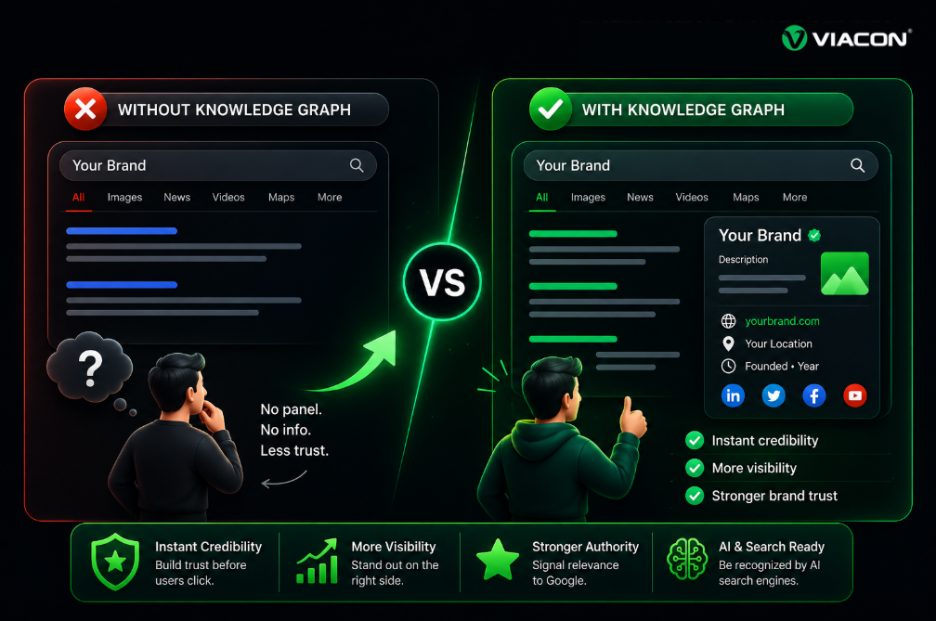
So, let’s say someone searched “search engine.” Google would produce an AI overview along with a list of blue links. But if they search “Google,” they’ll find a panel on the right with structured information, description, and logo on the right.
Then there’s the “Top Stories,” followed by a list of blue links. That’s the Google Knowledge Graph in action. There’s enough information about “Google” with data that can be cross-referenced on different citable sources, presenting Google as an entity.
Why Does Google Knowledge Graph Optimization Matter To Brands?
That example with Google should make it evident. Here’s what you want to know: Google Knowledge Graph establishes your business as an entity, which is important for AI and search algorithms to show your business in searches.
Here’s What It Does For Your Brand:
- You get a Knowledge Panel that appears on the right side of search results, above organic links. This gives users instant credibility signals before they even click.
- Your authority compounds. A verified entity presence signals to Google that your brand is established, trustworthy, and worth surfacing.
Think of it from a business perspective. Take two SaaS providing companies. One of them has a Knowledge Panel, and the other doesn’t. Which one do you think attracts the clients when they Google the brands? Surely the one with a Knowledge Panel.
Is your SaaS brand the one that lacks a Google Knowledge panel? If yes, we can help fix that.
5 Top Reasons Your Brand Isn’t In Google’s Knowledge Graph
Here’s why your brand isn’t in Google’s Knowledge Graph:
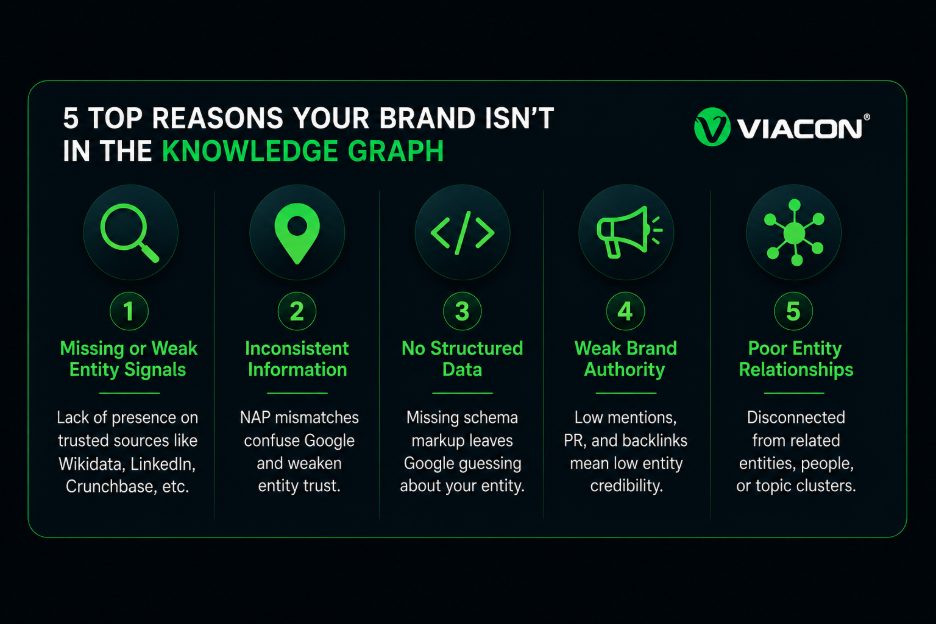
1. Missing Or Weak Entity Signals
Google needs signals from trusted, structured sources to confirm that your brand is a real entity. “But we do have a working website!” If that’s what you’re thinking, then you’re simply at the foothill with a long climb ahead.
Google needs citable data sources beyond your own website to see your business as an entity and include it in the Google Knowledge Graph.
Wikidata is one of the primary structured data sources Google uses to build entity knowledge. Similarly, an incomplete or missing LinkedIn Company Page, or the absence of your brand on platforms like Crunchbase, removes the corroborating signals Google looks for.
The more authoritative platforms that consistently reference your brand, the stronger your entity signal becomes. Again, this isn’t about quantity; it’s about the right quality sources.
2. Inconsistent Business Information (NAP Problems)
NAP stands for Name, Address, and Phone number. If your business name appears as “Viacon” on your website, “Viacon.io” on Google Business Profile, and “Viacon Digital” on LinkedIn, Google gets confused. Confused entities don’t make it into the Knowledge Graph.
This is more common than you’d think. Brands evolve, rebrand, or simply get listed differently across different platforms. Those inconsistencies pile up quietly, and they create real problems when Google tries to verify who you are.
3. No Structured Data Implementation
This one’s technical, but it’s critical. Structured data (specifically JSON-LD schema markup) is how you directly tell Google about your organization’s identity.
Without an Organization Schema on your homepage and About page, without SameAs properties linking to your authority profiles, Google has to guess, and guessing means slower, weaker entity recognition.
Poor or missing schema implementation is one of the most fixable problems on this list, yet most brands skip it entirely.
4. Weak Brand Authority And Mentions
Entity signals? Check.
NAP consistency? Check.
Structured data implementation? Check.
So, is that all it takes to build a strong Google Knowledge Graph presence? No, not entirely. Google is also looking for what the broader web is talking about your brand. That’s where your press coverage, brand mentions, and thought leadership content come in.
Without all that, your brand has a thin content profile, which isn’t ideal for SEO or building the Knowledge graph.
Remember, E-E-A-T (Experience, Expertise, Authoritativeness, Trustworthiness) isn’t just a content quality signal; it feeds directly into how Google weights your entity. If nobody reputable is talking about your brand, Google has little external validation to work with.
5. Poor Entity Relationships
The Knowledge Graph is built on connections. Google connects brands to their founders, founders to their other projects, products to brands, and brands to industry topic clusters. If your brand is a standalone island with no meaningful connections to other known entities, you’re harder to classify and verify.
This means pages for your founders matter. Linking your products to your brand matters. Your content strategy’s topical depth matters, too.
How To Check If Your Brand Exists In The Knowledge Graph?
Use this easy guide to analyze if your brand exists in the Google Knowledge Graph.
(i) Start With A Quick Search Test
Go to Google and type your exact brand name. Does that make the Knowledge Panel appear on the right? If not, then it could be for two reasons:
- You’re not in the Google Knowledge Graph yet.
- Your entity is too weak to trigger the panel.
(ii) Run An Advanced Check
For a more definitive answer, you can use Google’s Knowledge Graph Search API (available via Google’s developer tools) or search Wikidata directly for your brand name.
If there’s no Wikidata item for your brand and the API returns no results, your entity simply doesn’t exist in Google’s structured world yet.
(iii) What To Look For
- Whether a panel appears at all.
- Whether the information shown is accurate and consistent with your other profiles.
- Whether your panel links to the right social accounts, website, and related entities (founders, products).
Unsure if your brand is an entity?
Book a consultation with Viacon’s SEO team for an Entity Audit.7-Step Action Plan To Get Into Google Knowledge Graph
Try this step-by-step guide to get your brand into Google’s Knowledge Graph:
Step 1: Audit Your Existing Entity Signals
Google Knowledge Graph is something on which you build your brand’s presence. But if you’re already invested in SEO, then you’ve already done some solid groundwork. So, before you build anything, understand what you already have.
Run a search for your brand name, check out every major platform where you’re listed, and look for inconsistencies in naming, descriptions, and contact information.
Manually check different platforms like Google My Business, your website, LinkedIn, and business listings to check NAP consistency. You can also use AI to simplify the searching and matching process.
Step 2: Standardize Your Brand Information
Pick one version of your brand name and stick to it everywhere. Same spelling, same capitalization, same punctuation. The same goes for your address and phone number if you’re a local business.
Create a simple internal brand style guide that documents your official name, tagline, logo versions, and description so every platform profile matches.
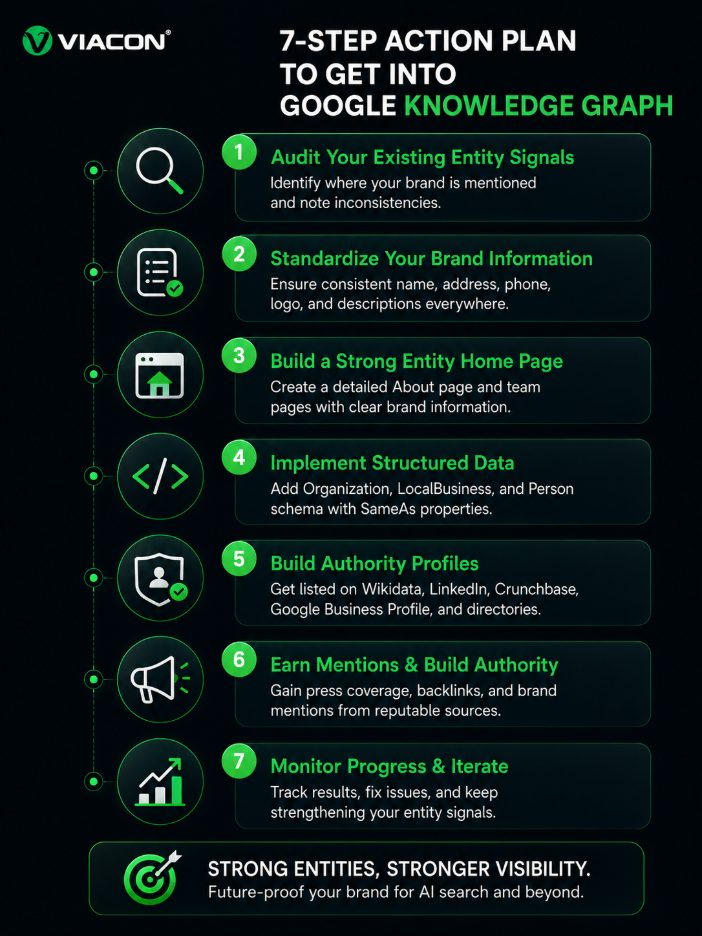
Step 3: Build A Strong Entity Home Page
Building a brand entity on a search engine is essential for inclusion in the Google Knowledge Graph. And that’s where the About Us page plays the most critical role. Therefore, accurate and complete information on this page is non-negotiable.
Add pages for your founders and core team members and mark them with Person Schema. This is also where On-Page SEO meets entity SEO: the clearer and more thorough this page is, the easier it is for Google to understand your brand’s identity.
Step 4: Implement Structured Data
Add Organization Schema to your homepage and About page using JSON-LD. Include SameAs properties that link to every authority profile: LinkedIn, Wikidata, Crunchbase, and your social media accounts.
If you’re a local business, add LocalBusiness Schema. Add Person Schema for founders. This is the most direct technical signal you can send Google, and skipping it is leaving a huge opportunity on the table. For a full breakdown, check out our technical SEO checklist.
Step 5: Build Authority Profiles On Trusted Platforms
Once again, getting Google Knowledge Panel visibility starts with building credibility across platforms that Google trusts. Start with Wikidata. Make the LinkedIn company page your next target. Fill out the necessary areas with accurate business information with NAP consistency.
Wait, There’s More To Do.
- Claim and optimize your Google Business Profile if you serve a local area.
- Get listed on Crunchbase, relevant industry directories, and anywhere your competitors are present.
- Get press coverage done for your business.
Each of these is another corroborating data point for your entity.
Step 6: Earn Brand Mentions And Build Authority
Google starts to recognize your brand entity when it’s all over the internet, and you can ensure that by running strong PR campaigns that earn press mentions, backlinks on reputable and authority publications, and business blogs.
There’s More Than One Way To Get Backlinks And Brand Mentions:
- Appear on podcasts.
- Contribute to expert roundups.
- Get featured in industry reports.
- Publish guest posts.
- Get featured on business listings.
All of these create third-party mentions that strengthen your SEO strategy and feed Google’s understanding of your brand’s authority. Unlinked brand mentions count too, not just backlinks.
Step 7: Monitor Progress And Keep Iterating
Track your branded search results weekly. Check Google Search Console under Enhancements for any schema-related improvements or errors. After you’ve implemented everything, be patient.
Knowledge Graph inclusion typically takes 4 to 8 weeks, sometimes longer, depending on your starting authority level. If your panel appears but contains incorrect info, you can claim it and request edits directly through Google.
Skip the trial and error. Viacon’s Entity Optimization service gets your brand into the Knowledge Graph in 60-90 days.
Get your custom strategy today.Common Mistakes That Keep Brands Out Of The Knowledge Graph
Most brands invested in SEO and are still failing to get into Google’s Knowledge Graph, which might be making these mistakes:
(i) Chasing Backlinks Only
Don’t only chase backlinks if your goal is to get into the Google Knowledge Graph. While backlinks are great for SEO and ranking, entity SEO signals require more. Structured profiles, schema markup, consistent information, and authoritative mentions are a must.
(ii) Ignoring Unlinked Brand Mentions
A great many brands only focus on link-building and completely ignore plain mentions. Trust us, those simple mentions can do a lot more for your Knowledge Graph than a couple of backlinks can.
When an article references your brand by name without linking to you, that still feeds entity recognition. Monitor and encourage these mentions, not just the linked ones.
(iii) Inconsistent Branding Across Platforms
We’ve said it before, but it’s worth repeating. Different logos, different name spellings, and different descriptions on different platforms confuse Google’s entity detection. Consistency isn’t just good branding; it’s a technical SEO requirement here.
(iv) Skipping Schema Markup
Without structured data, Google can’t efficiently map your entity relationships. It’ll figure things out eventually, maybe. But giving it a clear JSON-LD roadmap speeds up recognition dramatically. Schema is not optional if you’re serious about Knowledge Graph inclusion.
(v) Giving Up Too Early
Knowledge Graph inclusion isn’t instant. It can take anywhere from 4 to 12 weeks after you’ve done everything right. We’ve seen brands implement all the fixes and then abandon ship after two weeks because “nothing happened.” Give it time. The signals need to propagate.
Why The Knowledge Graph Matters Even More For AI Search
Whether building a personal brand or boosting search visibility for your SaaS, always think beyond today’s search. Google AI Overviews, Gemini, Perplexity, and other AI search tools don’t just crawl web pages. They pull from structured knowledge sources, and the Knowledge Graph is one of the most important ones.
Brands that boast a strong entity presence have stronger chances of getting cited in AI-generated answers. But brands that fail to fulfil those markers get left behind (even the ones with good content). Keyword ranking?
Well, that’s still relevant. But generative engine optimization requires your business to be more than simply “keyword-optimized.” AI-driven search starts with entity recognition, and it requires a lot more effort than researching keywords and publishing pages with keywords in them.
Viacon’s GEO service is built specifically to help brands build the entity foundation they need to thrive in this new search environment.
Ready to future-proof your brand for AI search?
Start with a digital audit from Viacon and see exactly what’s holding you back.Frequently Asked Questions:
A: It’s Google’s database of real-world entities and the relationships between them. Rather than just matching keywords to pages, the Knowledge Graph helps Google understand that “Apple” is a tech company founded by Steve Jobs, distinct from the fruit. It powers Knowledge Panels and increasingly feeds AI search tools.
A: Search your exact brand name on Google. If no panel appears on the right side of the results, you’re likely not in it. For a more definitive check, search for your brand on Wikidata or use Google’s Knowledge Graph Search API.
A: The most common reasons are inconsistent NAP data across platforms, missing or broken structured data, weak authority signals (few third-party mentions or press coverage), and no Wikidata profile. Usually, it’s a combination of these, not just one.
A: After implementing all the recommended fixes, most brands see results within 4 to 12 weeks. The timeline depends on your current authority level and how quickly Google re-crawls and processes the new signals.