Patients rarely search by hospital name. They search by symptom, treatment, or location, and they want an answer immediately.
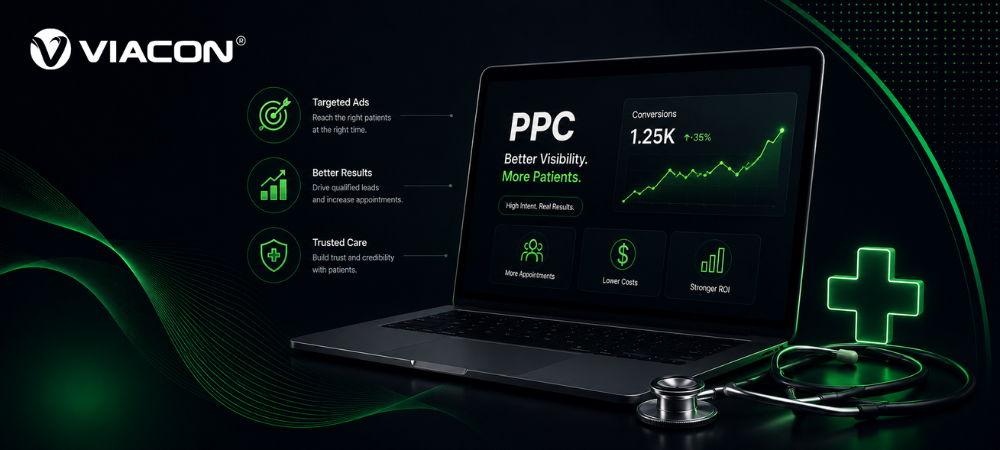
Healthcare PPC is paid advertising across search, social, and display that puts hospitals, clinics, and medical practices in front of patients during those high-intent moments. Visibility alone means little, though. A campaign has to connect search intent with clinical relevance, patient trust, privacy, and a clear path toward booking care. That balance is where things get tricky.
Healthcare advertising also operates under stricter platform policies than most commercial categories, and patients rarely choose a provider on price or convenience alone. Reputation, proximity, insurance acceptance, physician credentials, appointment availability, and plain emotional reassurance all shape the decision just as much.
Healthcare PPC In 60 Seconds
- It’s paid advertising that puts hospitals, clinics, and specialists in front of patients at the exact moment they’re searching for care.
- Google Search Ads capture the highest purchase intent, since the patient has already decided to look for help.
- The landing page determines whether a click turns into an appointment, often more than the ad copy does.
- Cost per booked appointment, not cost per click, is the metric that actually reflects performance.
- Compliance isn’t optional. Google’s healthcare ad policy and HIPAA both shape what a campaign can say and target.
- Patient lifetime value, not just the price of a single click, should guide how much a practice is willing to spend.
What Is Healthcare PPC?
Pay-per-click advertising allows a healthcare organization to display sponsored ads across search engines, social platforms, websites, and other digital placements. Typically, the advertiser pays when someone clicks the ad, though some campaigns optimize toward impressions, calls, completed forms, or other conversion events instead.
Search advertising remains especially valuable in these cases because it captures existing demand. Someone has already expressed a need if they’re searching for an orthopaedic surgeon, an urgent care facility, a dermatology appointment, or a pediatric clinic.
A click doesn’t automatically indicate patient readiness, though. The campaign has to distinguish between early research and immediate treatment intent, which is why healthcare PPC works best as part of a broader performance marketing agency strategy rather than as an isolated campaign.
PPC Channels At A Glance
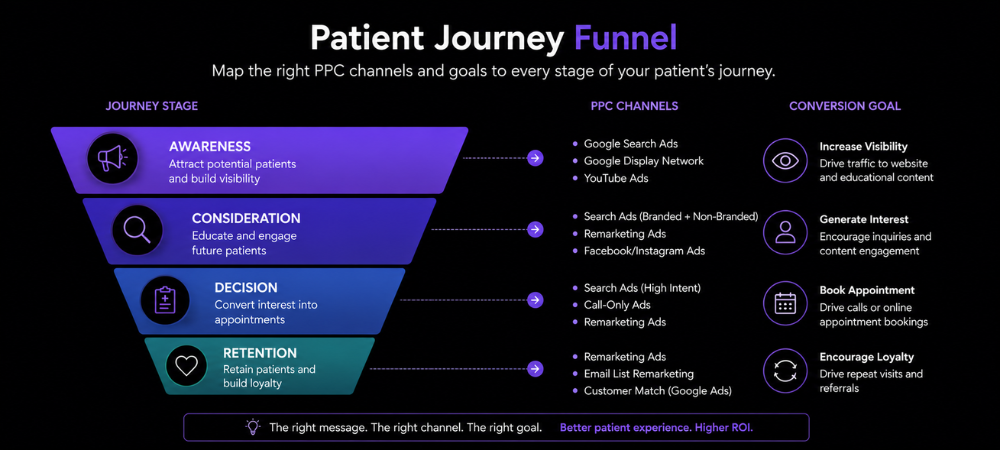
Not every channel earns the same role in a healthcare campaign. Search captures people actively looking for care. Display and social build awareness for procedures patients haven’t searched for yet.
| PPC Channel | Best For | Typical Cost | Conversion Strength |
|---|---|---|---|
| Google Search Ads | High-intent patients ready to book | High | Excellent |
| Google Display Ads | Brand and service-line awareness | Low | Moderate |
| Meta (Facebook/Instagram) Ads | Awareness and community trust | Medium | Moderate |
| YouTube Ads | Patient education, procedure explainers | Medium | Good |
| Google Local Services Ads | Local clinics, pay-per-lead | Medium | Excellent |
Why Does Healthcare PPC Work?
Organic visibility takes time, particularly in competitive medical markets. Paid campaigns place a provider near the top of relevant search results almost immediately. That speed helps new practices enter a market, established hospitals defend service-line visibility, and specialist clinics promote procedures with measurable demand.
This matters most in healthcare, where trust and urgency both shape how quickly a patient converts. A cardiology group launching a new stent procedure, for example, can use PPC to capture referral-stage searches months before organic content would have a chance to rank for those terms.
Major Benefits Of Healthcare PPC
Unlike broad awareness campaigns, PPC allows control over geography, schedule, device, keywords, audience, and landing page destination. It also creates useful feedback. Search-term reports reveal what patients actually call their conditions, which locations produce qualified inquiries, and where the appointment journey starts to fall apart.
Healthcare campaigns still work best as part of a broader patient acquisition system. Ads create the inquiry, but front-desk response time, call handling, insurance verification, scheduling, and follow-up determine whether that inquiry becomes an appointment.
Healthcare PPC Generally Helps A Practice:
- Reach patients actively searching in a specific location.
- Generate phone calls and appointment requests, not just clicks.
- Promote high-margin or newly launched specialty services.
- Fill appointment gaps during slow booking periods.
- Surface which search terms convert, informing SEO and content decisions.
- Track cost per booked appointment instead of cost per click alone.
When Healthcare PPC Isn’t The Right Fit?
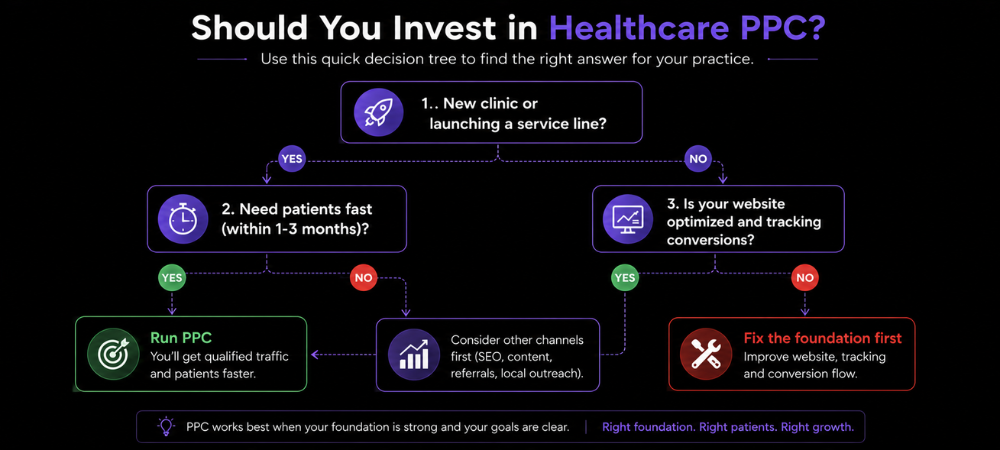
PPC gets sold as a universal fix, and it isn’t one. A campaign built on top of a weak foundation just burns budget faster.
Healthcare PPC Probably Isn’t The Next Move If:
- The website converts poorly, regardless of how much traffic it gets.
- Appointment scheduling still happens by phone only, with no online booking path.
- Online reviews are weak or inconsistent across locations.
- Conversion tracking and call tracking aren’t set up yet.
- The available monthly budget sits under roughly $500, which rarely survives contact with competitive healthcare CPCs.
- The practice can’t handle additional appointment volume right now.
Fixing these first, even for a few weeks, usually produces a better return than launching campaigns on top of them.
Google Ads Healthcare Policy Explained
The Google Ads healthcare policy restricts content related to healthcare generally, personalized advertising, prescription drugs, addiction services, speculative treatments, and certain medical products. Requirements vary by country, so an ad approved in one market may face restrictions elsewhere.
Advertisers should avoid language that appears to diagnose users, exploit health concerns, promise guaranteed outcomes, or overstate treatment effectiveness. Remarketing requires extra caution too, since health information falls within sensitive-interest categories. Policy review should happen before campaign development starts, not after ads begin receiving disapprovals.
| Policy Area | Practical Campaign Consideration |
|---|---|
| Sensitive health conditions | Avoid audience targeting that implies knowledge of a person’s medical status |
| Treatment claims | Use accurate, supportable language without guarantees or exaggerated outcomes |
| Prescription services | Review certification and location-specific advertising requirements |
| Patient information | Collect only necessary data through secure, privacy-conscious forms |
| Landing-page content | Keep business details, treatment information, and disclosures clear |
Healthcare PPC Compliance Checklist
A quick pre-launch pass against this list catches most disapprovals before they happen:
- HIPAA considerations reviewed for any form, chatbot, or remarketing pixel on the landing page.
- Ad copy checked against Google’s healthcare and medicines policy.
- No language that implies a guaranteed outcome or diagnoses the reader.
- Landing pages carry an accurate privacy policy and clear data-use disclosure.
- Call tracking configured in a way that doesn’t record or store sensitive health details without consent.
- Remarketing audiences reviewed to confirm they don’t imply a specific medical condition.
Healthcare PPC Keyword Research
Healthcare keyword research should start with the patient’s situation, not a large export from a keyword tool. Someone researching symptoms behaves differently from someone searching for an appointment today, so keyword groups should reflect awareness, consideration, and action rather than getting mixed into one campaign.
| Funnel Stage | Example Keyword |
|---|---|
| Awareness | “why does my knee hurt when climbing stairs” |
| Consideration | “orthopedic surgeon vs physical therapist” |
| Decision | “knee specialist near me same day appointment” |
High-intent phrases typically combine a service with a city or neighborhood, an urgency signal, an insurance term, or a direct appointment request. PPC for dentists, for instance, may target emergency appointments, implants, cosmetic procedures, or family dentistry. PPC for doctors usually needs separate structures for specialties, symptoms, procedures, locations, and physician names.
Negative Keywords That Quietly Drain Healthcare Budgets
Negative keywords deserve as much attention as the keywords being bid on. A few terms consistently pull in searchers who were never going to book:
- free
- jobs/careers/hiring
- salary
- courses/certification
- definition/meaning
- symptoms of (when the campaign targets treatment, not research)
- pdf/download
- wikipedia
Excessive exclusions can block legitimate searches, though, so search-term reviews should stay contextual rather than mechanical. A monthly pass through the search terms report, not a one-time negative list, is what actually protects the budget.
Many of these keyword insights also feed organic strategy. The search terms that convert well in PPC are often worth building into long-term SEO services, so paid and organic efforts reinforce each other instead of competing for budget.
Building High-Converting Campaigns
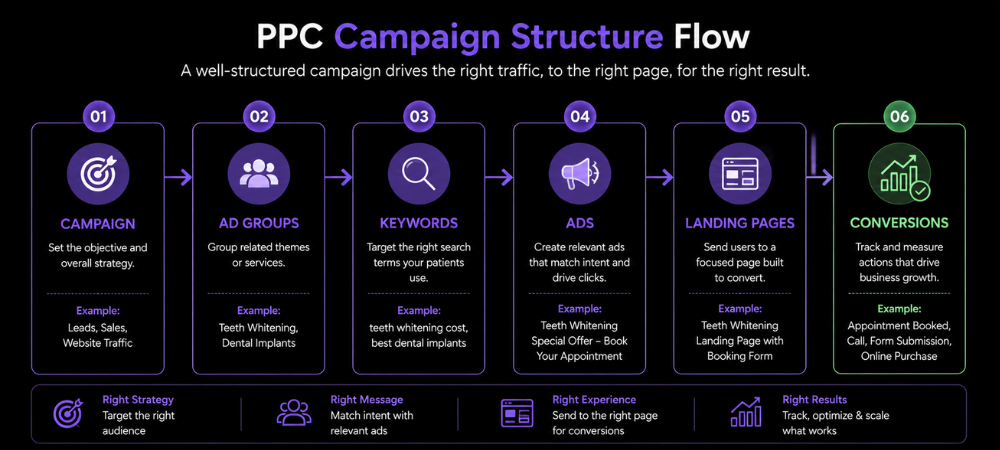
Strong account structure usually mirrors the organization itself. A hospital may separate campaigns by service line, location, urgency, and patient intent. A smaller practice may need fewer campaigns, though each ad group should still have one identifiable purpose.
The funnel also needs more than a final appointment form. Some users are ready to call. Others want physician profiles, treatment details, insurance information, or a second-opinion request. Google Ads for healthcare should support several meaningful actions, not just one.
| Funnel Stage | Typical Search Behaviour | Suitable Conversion |
|---|---|---|
| Awareness | Symptom or condition research | Service-page visit or educational resource |
| Consideration | Treatment, specialist, or provider comparison | Physician profile view or insurance check |
| Decision | Location, appointment, or urgent-care search | Call, booking, or completed inquiry form |
| Retention | Follow-up service or continuing care search | Portal access or return appointment |
Account structures like this look different for every organization. Our case studies show how this plays out across different service lines and patient volumes.
Writing Effective Healthcare Ad Copy
Medical advertising needs restraint from the outset. Fear-based headlines may grab attention, but they tend to weaken trust and create policy problems. Better copy establishes relevance quickly, communicates a defensible benefit, and offers a sensible next step. Nothing more.
For Example:
- Weak: “Best Dermatologist in Town — Book Now!”
- Stronger: “Board-Certified Dermatologist — Same-Week Appointments, Most Insurance Accepted”
The stronger version swaps an unverifiable superlative for specific, checkable details, a distinction that Google’s ad policy and patient trust both reward.
Headlines generally do best referencing the specialty, location, appointment availability, or accepted insurance options. Descriptions should explain what patients might expect without promising a cure or implying a specific outcome. Ad assets can highlight phone numbers, departments, locations, services, and appointment links.
Credentials support trust, but dense acronyms mostly confuse patients. Stick to plain language. The ad should sound informed and reassuring, ideally consistent with the messaging already used across your organic pages. Our healthcare SEO guide covers how to keep that language aligned across both channels.
Designing Healthcare PPC Landing Pages
Sending every click to the homepage remains a common mistake. The homepage serves many audiences, while a paid-search visitor generally arrives with one problem. A dedicated page should continue the exact conversation started by the keyword and the ad.
Effective healthcare landing pages explain the condition or service, introduce relevant clinicians, clarify locations, address insurance questions, and present a clear appointment route. They also need to work well on mobile, since many urgent searches happen there.
Trust elements deserve equal attention: physician credentials, patient reviews, facility information, accreditations, and privacy language all matter. A landing page should support the decision rather than overwhelm it, and forms should request only what the scheduling team genuinely needs at that stage. Ongoing CRO and funnel optimization is what turns a decent landing page into one that consistently converts at a lower cost per appointment.
Real Healthcare PPC Campaigns And Results
Numbers land better with context. Here’s what three different specialties typically see once tracking, negative keywords, and a dedicated landing page are in place. Treat these as illustrative benchmarks to plan against, not guarantees; actual figures depend heavily on location, competition, and service pricing.
- Orthopaedic Clinic Monthly budget: $3,000 Results: roughly 450 clicks, 82 calls, 31 booked appointments, cost per appointment near $48
- Dental Practice Monthly budget: $2,000 Results: roughly 600 clicks, 95 calls (largely emergency and implant searches), 40 booked appointments, cost per appointment near $50
- Dermatology Practice Monthly budget: $4,500 Results: roughly 500 clicks, 70 calls, 22 booked appointments, cost per appointment near $205, reflecting higher-value cosmetic and procedural consultations
The pattern across all three: cost per click matters far less than cost per booked appointment, and that number varies enormously by specialty and case value.
AI-Powered PPC Optimization
Automated bidding can process signals like device, location, time of day, audience behavior, and likelihood of conversion. Still, artificial intelligence cannot rescue weak tracking or poor conversion definitions.
If every form submission counts equally, the system may optimize toward low-value inquiries. Whenever the data environment allows it, campaigns should distinguish calls, qualified forms, booked appointments, attended appointments, and service-line value from one another. AI can also support query analysis, ad variation, budget pacing, and anomaly detection.
Human oversight remains essential, especially in medicine. Policy context, clinical nuance, brand risk, and patient sensitivity require judgment that automated systems don’t consistently provide. This is where thoughtfully applied AI automation earns its place, handling repetitive optimization while leaving policy and clinical judgment calls to people. Paid campaigns increasingly sit alongside programmatic advertising approaches too, which extend the same targeting logic across display and video inventory at scale.
Budget Planning And ROI
Budget planning should start with capacity and economics. A clinic can’t profitably generate more inquiries than its physicians or scheduling team can handle, and a high-cost procedure may justify a larger acquisition cost than a low-margin consultation.
Patient lifetime value adds another layer. A primary-care patient may return for years, while a surgical campaign may produce a single substantial episode of care.
Before setting a budget, confirm the basics are actually in place: can the practice handle the appointment volume PPC would realistically generate, is call tracking and conversion tracking already live, is cost-per-appointment (not cost-per-click) the primary KPI, and has policy review been completed for this service line?
With that foundation set, return calculations should weigh service-line margin, appointment attendance, treatment acceptance, repeat visits, and referral value together, rather than looking at any one in isolation.
Healthcare PPC Cost Benchmarks
Average CPC varies by specialty and market. The ranges below are directional starting points for planning, not live figures; pull current numbers from your own Google Ads account or a benchmark source like WordStream before finalizing a budget, since healthcare CPCs shift with seasonality and local competition.
| Specialty | Typical CPC Range |
|---|---|
| General/Family Dentistry | $8–$20 |
| Plastic and Cosmetic Surgery | $15–$45 |
| Orthopedics | $10–$30 |
| Urgent Care | $6–$18 |
Estimating A Budget
A rough back-of-envelope approach works before a campaign has its own historical data:
Monthly budget ÷ estimated CPC → estimated clicks. Estimated clicks × typical call rate (often 10–18% for healthcare search) → estimated calls. Estimated calls × booking rate (often 30–45%) → estimated booked appointments
Once real campaign data exists, replace every assumption in that chain with the account’s actual numbers. The estimate is only useful for setting an initial budget, not for judging performance after launch.
Experienced healthcare PPC management connects media spending with actual patient outcomes. Cost per click still matters, but cost per qualified appointment and revenue by service line provide a far clearer picture. If you’re unsure where your current budget stands against these benchmarks, a free digital audit is a low-effort way to find out.
Healthcare PPC Metrics
Clicks and impressions describe activity rather than business impact. A campaign might generate a strong click-through rate and still produce very few meaningful appointments, so reporting should extend beyond the ad platform to follow the patient journey.
Useful metrics generally include conversion rate, qualified lead rate, call answer rate, booking rate, cost per booked appointment, no-show rate, and revenue by campaign. Impression share can also reveal lost visibility, while search-term quality shows whether the targeting reflects genuine patient demand.
Common PPC Mistakes
The most expensive PPC errors are usually the ordinary ones. Broad targeting and weak exclusions drain budget slowly, without triggering any obvious red flag. Generic landing pages that send clicks to the homepage instead of a page matched to the search quietly cost conversions. Incomplete call tracking leaves a major share of conversions invisible to reporting altogether.
A few other recurring problems show up just as often: combining unrelated medical services inside one campaign, which weakens message relevance and budget control; optimizing for raw leads without checking whether those inquiries actually convert into appointments; ignoring policy reviews until ads or accounts face restrictions; using the same strategy across every location despite real differences in competition, capacity, and patient needs; and letting unanswered calls or slow responses undermine otherwise effective advertising.
Healthcare PPC vs. Healthcare SEO
These two channels get compared often, and the honest answer is that neither replaces the other.
| Healthcare PPC | Healthcare SEO |
|---|---|
| Fast, visible results | Long-term, compounding growth |
| Paid traffic that stops when spend stops | Organic traffic that persists |
| Immediate visibility for new services | Builds durable topical authority |
| Higher ongoing cost per lead | Lower cost per lead over time |
| Ideal for launches and urgent demand | Ideal for sustained category leadership |
Most mature healthcare marketing programs run both at once. PPC fills the gap while organic content builds, and the search terms uncovered through paid campaigns often become the next SEO content brief.
Why Healthcare Organizations Choose Viacon For PPC?
Viacon approaches paid media as a revenue and patient-acquisition system, not a traffic exercise. Campaign structures reflect specialties, locations, service lines, and search intent, while landing-page optimization helps maintain continuity after the click. Reporting is built around cost per booked appointment rather than cost per click alone, so budget decisions reflect what a campaign actually produces for the practice, not just how much traffic it drives.
ROI-focused management connects keyword decisions, bidding, conversion tracking, and landing-page performance into one system rather than treating them separately. Healthcare growth rarely depends on one advertisement; it depends on how well the entire digital path moves a patient from uncertainty toward a suitable medical provider. Paid campaigns paired with strong content marketing services tend to sustain that trust well beyond the click.
Healthcare PPC Launch Checklist
A short pre-launch checklist a team can run through before spending a single dollar:
- Conversion tracking enabled for calls, forms, and bookings.
- Call tracking configured and tested end-to-end.
- HIPAA and Google healthcare policy review completed.
- Negative keyword list built and scheduled for monthly review.
- Mobile landing page tested on an actual phone, not just a browser preview.
- Budget approved against realistic appointment capacity.
- Ad extensions (call, location, sitelink) configured.
Better Patient Journeys Lead To Better Campaigns
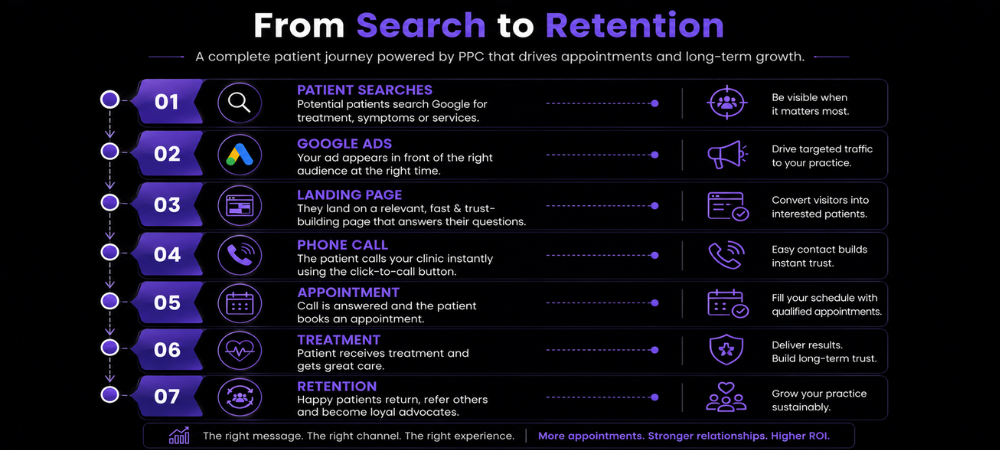
Effective healthcare PPC doesn’t come from bidding on every treatment keyword, and it doesn’t come from pushing more money into automation. It comes from knowing what patients need at each stage, respecting advertising policies, and measuring the outcomes that matter after the click.
Hospitals, clinics, and medical practices should treat paid search as part of their operational system, where campaign structure, landing pages, call handling, scheduling, and reporting all work together. That’s what makes PPC predictable.
Reviewing your current campaign structure against the funnel stages above is the fastest way to spot where patient inquiries are quietly falling through. For a broader view of how paid, organic, and reputation channels work together, see our full healthcare marketing guide.
This is only possible through a dedicated performance marketing agency. At Viacon, we help ambitious brands scale quicker with growth-focused PPC campaigns.
Frequently Asked Questions:
A: Most practices start with a controlled monthly test budget before scaling toward campaigns that consistently produce qualified appointments. Actual spend depends on location, competition, service value, appointment capacity, and conversion performance, so start with a controlled test, then scale the qualified results.
A: Campaigns can generate traffic within days, but dependable optimization typically requires several weeks of accumulated search-term, conversion, and appointment-quality data.
A: Yes, but with meaningful limits. Remarketing options remain restricted for sensitive health categories, so providers should review platform restrictions and avoid targeting that implies knowledge of a patient’s medical condition.
A: A focused, mobile-friendly page dedicated to the exact service searched for usually performs best; one that matches search intent, explains the service, establishes trust, and simplifies appointment booking.
A: Yes, when tracking is reliable and conversion volume is sufficient. Automated bidding still requires human oversight for policy compliance and lead-quality control; it’s a tool for efficiency, not a substitute for clinical and brand judgment.
A: For most specialties, yes, provided call tracking and a dedicated landing page are already in place. Without those two pieces, even a well-built campaign will look worse than it actually is.
A: Specialties with high per-patient value and urgent search behaviour tend to see the strongest returns: cosmetic and elective procedures, dental implants and emergency dentistry, orthopaedics, and urgent care among them.