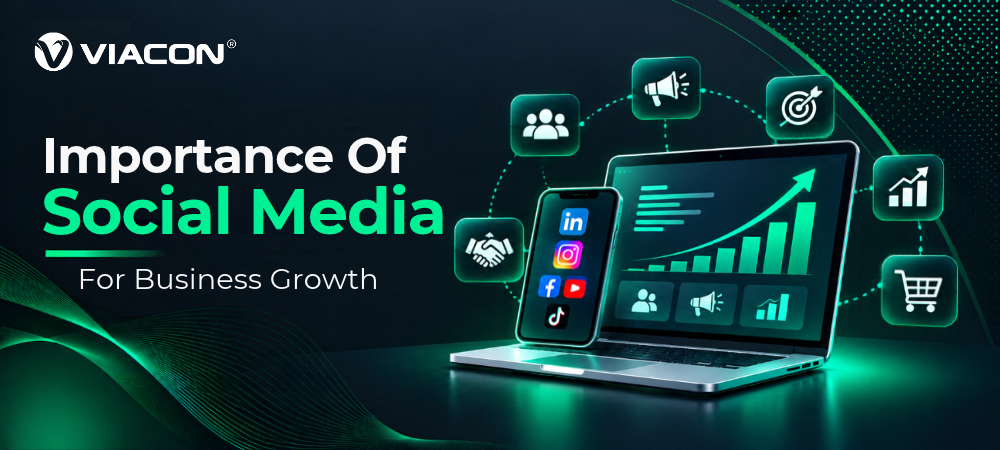
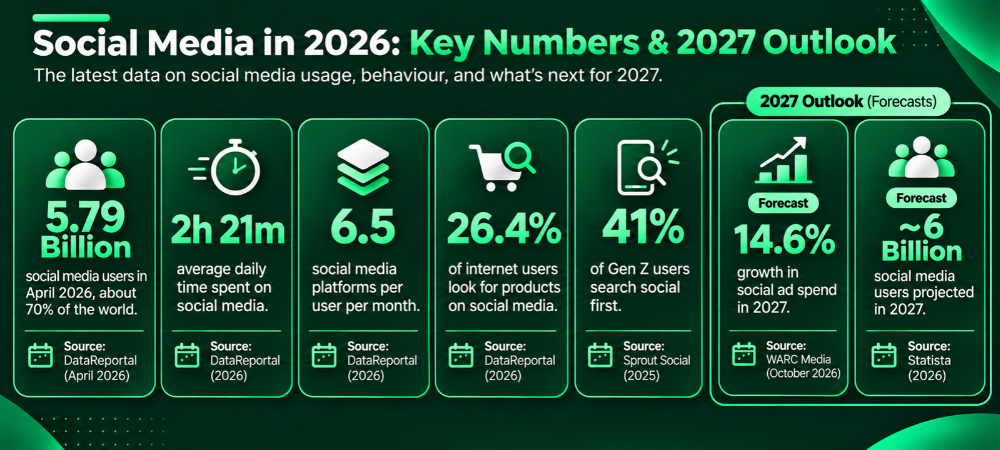
The importance of social media for business comes down to four things. People find brands there, they judge brands there, they contact brands there, and a growing share buy there. About 5.79 billion people used social platforms in April 2026, according to DataReportal’s mid-year update, and the average user spends roughly 2 hours 21 minutes a day on them.
That attention shapes buying decisions long before anyone opens your website. Still, many companies post without a goal, ignore replies, and then conclude that social media doesn’t work.
This guide explains the benefits of social media for business, where it falls short, how to measure it honestly, what to plan for in 2027, and how to start without wasting budget.
Why Is Social Media Important For Business?
Social media is important for business because it puts your brand in front of buyers while they research, lets you answer questions in public, and sends trackable visitors to your site. It also supports search visibility, reputation, and hiring. The effect grows when social works alongside your other channels instead of running on its own.
The numbers explain why:
- 5.79 Billion People used social media in April 2026, about 70% of the world’s population, and the typical user visits roughly six and a half platforms a month (DataReportal).
- Daily Use Has Plateaued at around 2 hours 21 minutes, so your content competes for a fixed amount of attention.
- 26.4% Of Internet Users go to social media to find products to buy (DataReportal, 2026).
- 41% Of Gen Z turn to social platforms first when they look for information, ahead of search engines at 32% (Sprout Social Pulse Survey, 2025).
Because of this shift, most growing companies now plan social media together with SEO and paid ads. A joined-up digital marketing strategy stops those channels from repeating work or contradicting each other.
What Are The Benefits Of Social Media Marketing?
The main benefits of social media marketing are wider brand awareness, direct sales and leads, faster customer support, qualified website traffic, social proof, market insight, and easier hiring. Most of these gains compound over time, so businesses that post consistently and reply to people see stronger results than those that post in bursts.
The eight benefits below each get their own section:
- Brand awareness without a big budget
- Sales and lead generation
- Better customer service and loyalty
- Qualified website traffic
- Indirect support for SEO and AI search
- Market research and early warning
- Social proof that builds trust
- Stronger employer branding and hiring
1. Social Media Builds Brand Awareness Without A Big Budget
Most small brands can’t outspend their competitors on ads. Social media lets them earn attention instead. A bakery that posts short Reels of its signature cake, tagged by location, can reach locals who have never heard of it, and the main cost is time.
The pattern holds across the industry. Hootsuite reports that 83% of marketers name increased exposure as the top benefit of social media marketing. Meanwhile, HubSpot’s 2026 trends report found that 85% of social marketers rate the channel more important for brand building than for performance marketing.
To make reach count, repeat a few clear ideas instead of chasing every trend. One strong idea can become a Reel, a carousel, a short post, and a story. If you need format ideas, our Instagram trends guide shows what works right now.
2. Can Social Media Drive Sales, Not Just Awareness?
Yes, in two ways. Directly, shoppable posts, in-app checkout, and live shopping let people buy without leaving the app. Indirectly, social content shapes what people search for and which brand they trust when they finally compare options.
Younger buyers lean on this even more. According to Sprout Social, 52% of Gen Z trust brand and product information on social media more than information from Google or AI chatbots.
Friction decides whether interest turns into revenue, because every extra tap costs you buyers. So test a direct checkout link or an in-app shop, and pair each call to action with proof, such as a customer video or a real review. For ad formats and targeting by platform, read our guide to social media advertising strategies.
3. Social Media Improves Customer Service And Loyalty
Customers now treat social media as a support desk. Nearly three-quarters expect a response within 24 hours, according to the Sprout Social Index. Slow replies cost more than goodwill. Because comments are public, every unanswered question tells other buyers how you treat people.
Set simple rules instead of hoping someone notices. Answer DMs within a few business hours, reply to every genuine comment, and move complaints to private messages once you’ve acknowledged them in public. Chatbots can handle first-line questions. Hand the conversation to a person when it involves money, health, or an angry customer.
Loyalty follows from this. People stay with brands that remember them, and a named human reply does that better than a polished ad. Behind-the-scenes posts, customer stories, and public shout-outs add to the effect.
4. Social Media Sends Qualified Traffic To Your Website
A social post rarely converts on the first click. Even so, it sends visitors who already know something about you. Instagram, LinkedIn, Pinterest, YouTube, and Facebook all support links in posts, profiles, or descriptions, although each one limits them differently.
Tag every link with UTM parameters so your analytics show which platform and which post sent each visitor. Then match the landing page to the post. If a Reel promises a seasonal offer, send people to that offer, not to your home page. A conversion rate optimization review often shows that this mismatch is where social traffic leaks away.
5. Does Social Media Help SEO And AI Search?
Not directly. Google has said that social signals are not a ranking factor. Still, social media helps search in three indirect ways.
First, social profiles often rank for your brand name, which gives you more space in the results. Second, strong content gets shared, and sharing can earn links and mentions from sites that publish. Third, AI answer tools often draw on public reviews, discussions, and brand mentions, so an active and accurate presence gives them better material to work with.
Some older guides claim that more shares lead to faster crawling or higher rankings. No reliable evidence supports that, so treat social as a visibility and trust channel, not a ranking tactic. To see what AI answer engines look for before they cite a brand, read our guide to Google AI Overviews, or explore our AI search optimization services.
6. Social Media Doubles As Market Research And An Early Warning System
Every comment, search, and hashtag tells you something about demand. Social listening tools such as Hootsuite and Sprout Social track mentions of your brand, your competitors, and your topics. Even free native search shows what people ask. If listening catches the same complaint again and again, the product team can fix the problem before it spreads.
Reputation works the same way. A spike in negative mentions at 9 a.m. gives you time to respond before it grows into a bigger story. Review competitors weekly, note which posts earn saves and shares, and look for questions your content doesn’t answer yet. Those gaps often become your best posts. For a wider view of what’s shifting, see our social media trends roundup.
7. Social Proof Builds Trust Faster Than Ads
Buyers trust other buyers. Reviews, customer videos, creator partnerships, and tagged photos show your product in real use, which a branded ad can’t do.
Honesty matters more than polish here. HubSpot found that 77% of social marketers consider authenticity more important than production value. Likewise, Sprout Social reports that consumers rank human-generated content as their top priority for 2026. Founder videos, staff explainers, and unedited customer stories fit that preference.
Creators work best when their audience matches yours. Micro-creators often have smaller followings but tighter communities, so a long-term partnership with a few of them can build more trust than a one-off post from a famous name. Disclose paid partnerships clearly and follow local advertising rules, such as the FTC’s endorsement guidance in the US and the ASCI influencer guidelines in India.
8. Social Media Strengthens Employer Branding And Hiring
Candidates look you up before they apply. A page that shows real people, real projects, and honest day-to-day work answers questions a job post can’t. That matters most in fields where skilled workers have options, such as IT, healthcare, and fintech.
Start small. Ask employees to share milestones, post short “day in the life” clips, and spotlight team wins. Sprout’s employee advocacy research notes that posting company content also helps employees reach their own goals, which makes participation easier to sustain.
How Social Media Supports The Whole Customer Journey
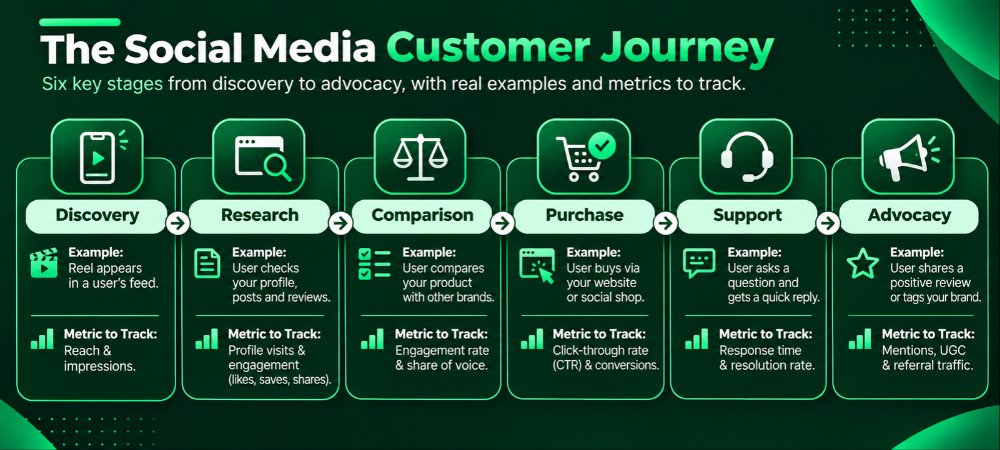
Social media no longer sits at the top of the funnel alone. It touches discovery (a Reel or a social search), research (reviews and comments), comparison (creator opinions), purchase (checkout links), support (DMs), and advocacy (shares and reviews), often inside one app.
Problems start when teams split these stages. Organic and paid work from different plans, and nobody owns measurement. Pairing organic content with performance marketing keeps every stage on one plan.
How Do You Measure The Value Of Social Media?
Match each goal to the metric that fits it, and don’t force every post to prove a sale. Hootsuite makes this point well: social often builds demand, credibility, and insight that never show up as a last-click purchase.
| Goal | Metrics to track | What it tells you |
|---|---|---|
| Awareness | Reach, impressions, follower growth, share of voice | Whether new people see you |
| Engagement | Saves, shares, replies, comment quality | Whether your content resonates |
| Traffic | UTM-tagged clicks, sessions, engaged time | Whether social sends interested visitors |
| Conversion | Leads, purchases, assisted conversions | Whether social moves people toward buying |
| Service | Response time, resolution rate, sentiment | Whether customers feel heard |
| Hiring | Applications from social, career-page visits | Whether social attracts talent |
Two traps skew the picture. First, private sharing in WhatsApp or DMs (often called dark social) hides real influence, so add “How did you hear about us?” to your forms. Second, disconnected tools hide results. Sprout Social found that over half of marketing leaders blame poor integration between social tools and the rest of their stack for not seeing social’s business impact. Our guide to social media ROI walks through the formulas step by step.
Organic Or Paid Social: Which Should You Use?
Use both, in different roles. Organic content builds trust, community, and a library of proof. Paid promotion pushes your best posts and offers to people who don’t follow you yet. Put money behind a post only after it has earned real engagement without it.
| Organic social | Paid social | |
|---|---|---|
| Main cost | Staff time and tools | Ad spend plus campaign management |
| Speed | Builds over months | Starts delivering within days |
| Reach | Followers plus shares | Targeted audiences beyond your followers |
| Best for | Trust, service, social proof, community | Launches, offers, retargeting, lead generation |
| Common failure | Posting without a goal or replies | Sending paid clicks to a page that doesn’t match the ad |
What Should Businesses Plan For In 2027?
Plan for a more crowded social feed in 2027. WARC Media forecasts global social ad spend to grow another 14.6% in 2027, after 21.3% growth in 2026, while time spent per user has stopped rising. More brands will compete for the same attention, so content quality and reply speed will matter more than posting volume.
| Measure | 2026 | 2027 outlook | Source |
|---|---|---|---|
| Global social ad spend | $394.6 billion, up 21.3% | Up 14.6%, to roughly $452 billion | WARC Media forecast, October 8, 2026 |
| Social media users | 5.79 billion (April 2026) | Projected between 5.85 billion and 6 billion; estimates vary | DataReportal; Statista projections |
| Time spent per user | About 2 hours 21 minutes a day | Share of media time expected to decline after a 2026 peak | DataReportal; eMarketer |
Four moves fit that outlook:
- Budget for tougher ad auctions. More ad money chasing flat attention can push costs up, so keep a fixed test budget and scale only winners.
- Write for social search. With 41% of Gen Z starting on social platforms, put the questions buyers ask into captions, on-screen text, and profile bios.
- Protect owned channels. Build an email list and keep your website converting, so a feed change doesn’t cut off your audience.
- Set a 2027 baseline in January. Pull 2026 reach, clicks, leads, and response times from your analytics now, so you can show year-over-year change by the end of Q1.
For help turning these into a plan, see our social media marketing services.
When Social Media Doesn’t Pay Off
Social media isn’t magic. These problems explain most failures:
- No clear goal: Posting “to be visible” gives you nothing to measure.
- The wrong platform: Your buyers may spend their time somewhere else.
- Broadcast-only habits: Brands that post but never reply waste the channel’s main advantage.
- Short patience: Most accounts need months of steady work before results show.
- Platform dependence: An algorithm change can cut your reach overnight, so keep an email list and a strong website as your own assets.
- Compliance blind spots: Healthcare, finance, and legal brands must check claims, testimonials, and data handling before posting.
If your buyers truly don’t use social platforms, spend your budget elsewhere.
Which Social Media Platform Is Best For Business Growth?
The best platform is the one where your buyers already spend time. Start with one or two, then expand once you can keep up with them.
| Platform | Best for | Starting rhythm |
|---|---|---|
| Visual brands, Reels, social commerce | 3–5 posts a week plus Stories | |
| B2B, professional services, thought leadership | 3–5 posts a week | |
| Local businesses, communities, broad audiences | 3–4 posts a week | |
| TikTok and YouTube Shorts | Discovery, younger audiences, social search | 3–5 short videos a week |
| Google Business Profile | Local search, reviews, “near me” visibility | Weekly updates, fast review replies |
Treat the rhythm as a starting point, not a rule. Two strong posts a week beat daily filler. Facebook still deserves a look, since Sprout Social found that 85% of consumers across generations have a profile there.
Is Social Media Important For B2B Companies?
Yes. B2B buyers check a vendor’s LinkedIn page, read employee posts, and watch founder videos before they book a call. Social works best for thought leadership, proof of expertise, and staying visible through long sales cycles. Most B2B teams begin on LinkedIn, and our LinkedIn trends guide covers what to post.
How Should A Small Business Start With Social Media?
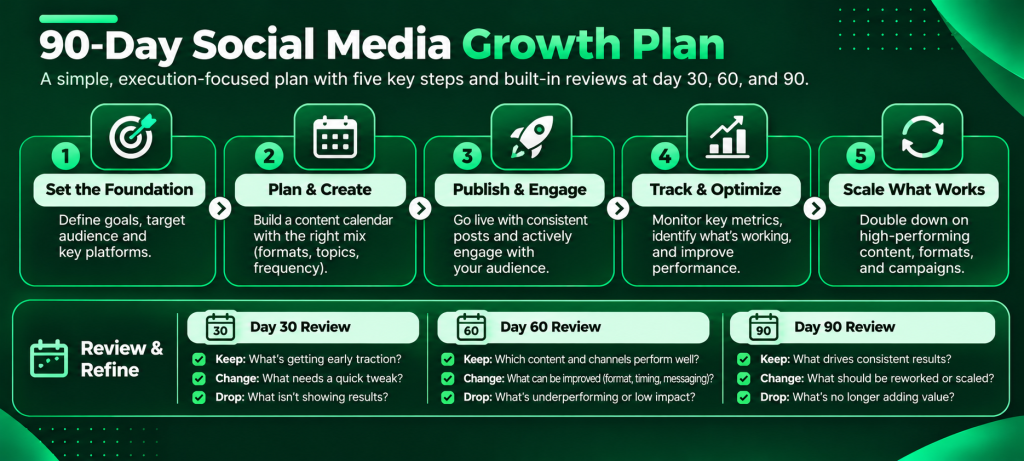
Follow five steps:
- Pick one goal for the next 90 days, such as leads, bookings, or awareness.
- Choose one or two platforms where your buyers already are.
- Define three content themes, such as customer questions, behind-the-scenes, and proof.
- Write response rules: who replies, how fast, and when to escalate.
- Review results monthly and drop what doesn’t work.
How Much Does Social Media Marketing Cost?
Social media marketing costs vary with scope and industry. The main cost lines are staff or agency time, creative production, tools, creator fees, and ad spend. A small business can start with a few hours a week and a small test budget, then raise spend only when its metrics justify it.
Start with time before ad money. Post organically for a few weeks to learn what resonates, then put a small, fixed budget behind your best posts. Many platforms allow campaigns at a few dollars a day. A digital audit can show where your first budget should go.
How Long Does Social Media Marketing Take To Work?
Organic accounts usually need a few months of steady posting before patterns show, and growth often arrives unevenly. Paid campaigns return data within days, but they need a few weeks of testing before you can judge them. Treat these as general guides, because timing depends on your industry, audience size, and how often you publish.
How Do Different Industries Use Social Media?
The goal stays the same, but the content and the risks change by sector.
| Industry | What works | What to watch |
|---|---|---|
| Healthcare | Patient education, clinic updates, community trust | Privacy and unproven medical claims |
| Fintech | Product explainers, security tips, support replies | Regulated claims and required disclaimers |
| E-commerce | Shoppable posts, customer videos, creator partnerships | Stock, delivery, and returns questions in comments |
| Legal services | Plain-language explainers, attorney profiles | Advertising rules and outcome promises |
| Hospitality | Visual storytelling, reviews, local discovery | Fast, polite replies to public reviews |
See how we work with healthcare, fintech, e-commerce, and legal services brands.
Case Study: How Shaad-E-Bangla Grew On Facebook And Instagram
Discover how Viacon helped Shaad-E-Bangla achieve 126K+ social clicks and improve engagement through strategic Facebook and Instagram marketing.
See How Viacon Delivers Measurable Social Media Growth Discover how our data-driven social media strategy helped Shaad-E-Bangla achieve 126K+ social clicks, stronger engagement, and sustained brand growth.
Download The Complete Case StudyFinal Thoughts On The Importance Of Social Media
The importance of social media shows up in results only when it has a goal, an owner, and honest measurement. Done well, it builds awareness, answers customers, supports search, and helps with hiring. It rewards consistency more than volume.
Your next step is small. Pick one goal for the first 90 days of 2027, choose the platform where your buyers already are, and review the numbers once a month. If you’d like a second opinion on your current approach, talk to our social media marketing team about a tailored audit, or request a digital audit to see where your budget should go first.