Security buyers research long before they talk to sales. They read vendor blogs, check threat write-ups, compare architectures, and ask peers what they trust. By the time a demo request arrives, the shortlist is often set.
That makes content your first sales conversation. It also makes bad content expensive. A thin post on “top cyber threats” does not impress a CISO who reads incident reports for a living.
This guide covers how cybersecurity content marketing works, who you are writing for, which formats earn trust, how to rank in search and AI answers, and how to measure results. It ends with a real Sangfor case study you can download.
Why Cybersecurity Content Marketing Works Differently?
Most B2B buyers want clarity. Security buyers want proof. They are choosing a vendor to protect their data, their uptime, and sometimes their job. One wrong claim can end the conversation.
Three Things Set This Market Apart:
- Buyers Are Skeptical By Default: Fear-based copy and vague promises make them close the tab.
- Several People Decide: A security architect, a compliance lead, a finance approver, and a CISO may all read different pages.
- Accuracy Carries Legal And Reputational Weight: A wrong statement about a standard or a threat can hurt you in public.
So the goal is not volume. It is credibility at every touchpoint. If you also need a steady flow of buyers, pair this guide with our breakdown of lead generation for cybersecurity companies.
| What Is Cybersecurity Content Marketing? Cybersecurity content marketing is the practice of publishing useful, technically accurate material that helps security buyers understand a problem and trust your answer. It includes blog posts, whitepapers, research reports, case studies, webinars, and product documentation. The aim is to educate first and sell second. |
Know Who You Are Writing For
Generic “IT decision maker” personas produce generic content. Split your audience by what each person needs to see before they say yes.
| Role | What They Worry About | Content That Helps |
|---|---|---|
| CISO | Risk, board reporting, budget | Executive briefs, ROI case studies, research reports |
| Security architect or engineer | Integration, detection quality, false positives | Technical whitepapers, architecture guides, product docs |
| Compliance or GRC lead | Audit readiness, regulatory change | Framework checklists, mapping guides, regulation explainers |
| IT or MSP manager | Workload, deployment time | Setup walkthroughs, comparison pages, webinars |
| Finance or procurement | Cost, vendor risk | Pricing explainers, case studies with measurable outcomes |
Interview five recent customers before you plan anything. Ask what they searched, which pages they read, and who else joined the decision. Their answers will beat any assumption.
Map Content To The Buyer Journey
A buyer who is learning about ransomware needs a different page from a buyer comparing three vendors. Match each stage to a format and a goal.
- Awareness: The reader is naming a problem. Publish threat explainers, glossary pages, and trend reports.
- Consideration: The reader is comparing approaches. Publish whitepapers, comparison guides, webinars, and technical deep dives.
- Decision: The reader needs proof. Publish case studies, customer stories, security documentation, and pages that answer procurement questions.
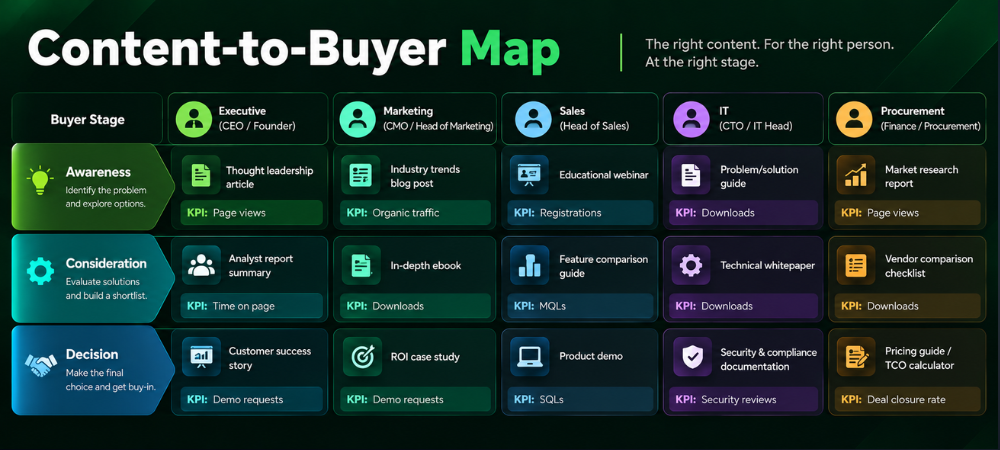
Many cybersecurity teams skip the decision stage. They publish plenty of awareness posts and then send buyers to a product page with no proof. Fill that gap first, because it sits closest to revenue.
For help building the full system, see our content marketing services.
Choose Content Formats That Earn Trust
Not every format carries the same weight. These five do the most work for security brands.
Original Research: Survey your customers, analyze your own telemetry (with permission and anonymization), or study public breach data. Original numbers earn backlinks, press mentions, and citations in AI answers. Few competitors publish them, so the gap is wide.
Technical Whitepapers: Engineers read them to judge whether you understand the problem. Write them with practitioners, not for them. Show your method, state your limits, and skip the sales pitch.
Case Studies: Buyers want to see someone like them succeed. Use real numbers, name the starting problem, and explain what changed. A short quote from the customer helps.
Threat And Vulnerability Explainers: Fast, accurate coverage of a new CVE or attack technique builds a reputation for expertise. Speed matters here, but accuracy matters more.
Comparison And “How It Works” Pages: Buyers search for “X vs Y” and “how does X work” late in the process. Answer honestly, including where your product is a poor fit. That honesty builds more trust than any claim.
| Do Whitepapers And Case Studies Still Convert? Yes, when they solve a real problem. Gated whitepapers attract higher-intent readers, but only if the first page proves its value without a form. Many teams now publish a detailed summary openly and gate the full report. That keeps the content visible to search engines and AI tools while still capturing leads. |
Build Topic Clusters Around A Few Pillars
Publishing random posts spreads your authority thin. Pick three to five pillars that match what you sell and what buyers search. A cloud security vendor might choose cloud misconfiguration, identity and access, compliance automation, and incident response.
Each pillar gets one in-depth page. Supporting articles cover narrower questions and link back to it. This structure shows search engines that you cover the topic completely, and it helps readers move from a basic question to a buying decision.
Our guide to topic clusters walks through the setup step by step.
Start with a content gap check. List the questions your sales team hears most. Then search each one and note who answers it well. Where results are thin, outdated, or wrong, you have an opening.
Rank In Search Without Sounding Like SEO
Security content sits in a sensitive part of search. Google looks closely at who wrote a page and whether they know the subject. That favours brands that show real expertise.
Follow These Practices:
- Name Real Authors: Add a bio with credentials, certifications, or hands-on experience.
- Add Expert Review: A line such as “Reviewed by [name], [title]” signals care.
- Match Search Intent: A query like “what is zero trust” wants a definition. “Zero trust vendors” wants a comparison. Do not mix them on one page.
- Cite Primary Sources: Link to NIST, CISA, vendor advisories, or the original research.
- Update On A Schedule: Review high-traffic pages every quarter and note the date.
- Fix The Technical Basics: Fast pages, clean headings, and schema markup help both people and crawlers.
Keyword stuffing does not work here. Write for the reader, use the terms they use, and let the page answer the question fully. Our SEO services team applies this approach to security clients.
Show Up In AI Search Answers
Buyers now ask ChatGPT, Gemini, Perplexity, and Google’s AI results questions like “which tools detect lateral movement?” If your brand is absent from those answers, you lose visibility before anyone visits your site.
AI tools tend to cite pages that are clear, specific, and easy to extract.
You Can Help In Four Ways:
- Answer Questions Directly: Put a plain answer in the first two sentences under a question-style heading.
- Publish Original Data: Unique statistics get cited because no one else has them.
- Keep Your Entity Consistent: Use the same brand name, product names, and descriptions across your site, LinkedIn, review sites, and press.
- Earn Mentions off-site: Reviews, analyst notes, and quality backlinks all feed the signals AI tools rely on.
What Content Do AI Tools Cite Most Often?
Patterns vary by tool, but security brands tend to get cited when a page does one of these jobs well:
- Defines A Concept Clearly: A page that explains “what is zero trust” in plain terms gets reused in answers.
- Compares Options Fairly: Neutral comparison pages answer the “best tool for X” questions buyers type.
- Publishes Original Data: Survey results and research findings give AI tools something no other page offers.
- Documents The Product: Clear docs and security pages help AI tools describe what you actually do.
Vague pages get skipped. So do pages that bury the answer under a long introduction.
How Do You Audit Your AI Visibility?
You can run a basic audit in an afternoon.
- List 25 to 30 Buyer Questions: Pull them from sales calls, support tickets, and search data. Cover all three journey stages.
- Ask Each Question In Several Tools: Try ChatGPT, Gemini, Perplexity, and Google’s AI results.
- Record What Happens: Note whether your brand appears, which page gets cited, and which competitors show up instead.
- Check Accuracy: AI tools sometimes describe products wrongly. Write down every error, such as outdated features or wrong pricing.
- Fix The Cause: Missing mentions usually point to a content gap. Wrong details usually point to outdated or conflicting pages across the web.
- Repeat Each Month: Answers shift, so one check tells you little.
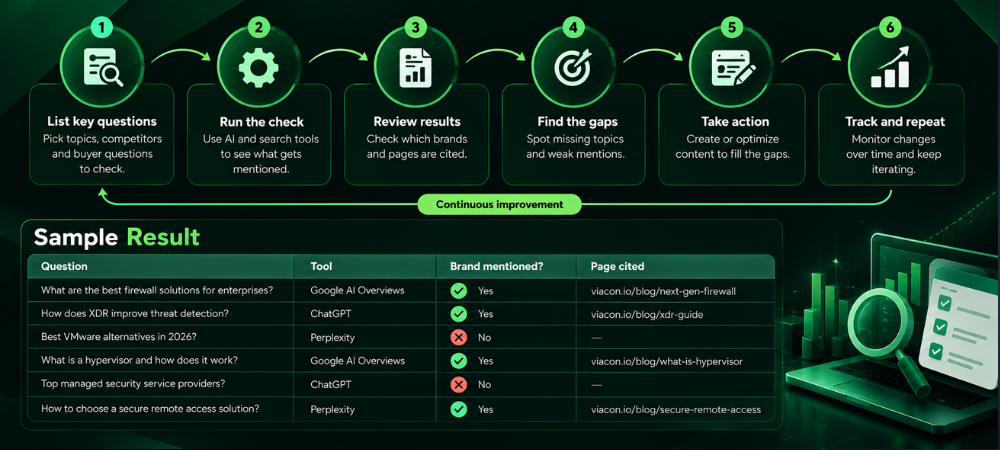
Several platforms now report an AI visibility score. Methods differ, so compare scores only within the same tool and the same question set. Our AI search optimization services cover the full process.
| How Is AI Visibility Different From SEO? SEO aims to rank a page in a list of links. AI visibility aims to get your brand named or cited inside the answer itself. The two overlap because strong pages tend to earn both. However, AI visibility rewards clear structure, consistent brand facts, and third-party mentions even more. |
| Can You Track Traffic That Comes From AI Tools? Partly, some AI tools send visitors with a referral source you can filter in your analytics. Many answers, though, influence buyers without a click. So also track branded search growth and ask new leads in the form, “How did you hear about us?” Together, these signals show the effect that clicks alone miss. |
Write Technical Content Without Losing The Reader
Security teams often hold the best knowledge and the least time to write. Marketers have the writing skill but not the depth. Bring them together with a simple process.
- Interview The Expert For 30 Minutes: Record it and ask for examples, not summaries.
- Draft In Plain Language: Define each acronym on first use. Explain why a detail matters, not only what it is.
- Send The Draft Back For A Technical Check: Ask the expert to flag errors, not rewrite style.
- Verify Every Claim: Check statistics, standard names, and dates against the source.
- Get Legal Or Compliance Sign-off on anything that makes a performance or guarantee claim.
Avoid fear tactics. Buyers see through them, and they damage trust. Describe the risk honestly, then show how to reduce it.
Distribute And Repurpose Every Asset
A great whitepaper that nobody sees does nothing. Plan distribution before you write.
One Research Report Can Become:
- A landing page with a summary and a gated download.
- Three or four blog posts on individual findings.
- A LinkedIn series from your executives and engineers.
- An email sequence for leads at the consideration stage.
- A webinar with a customer or analyst.
- Short quotes for press outreach.
LinkedIn works well for security because your buyers already follow practitioners there. Posts from named experts usually outperform brand-page posts. Partner webinars, industry newsletters, and conference talks add reach that ads cannot buy.
If you run paid campaigns, promote the research or whitepaper instead of a product page. Cold visitors respond better to something useful. Our performance marketing team builds these funnels for B2B clients.
Keep Your Own Marketing Compliant
A security brand that mishandles data loses credibility fast.
Build Privacy Into The Process:
- Use clear consent language on every form.
- Collect only the fields you need.
- Prefer first-party data from gated assets and newsletter sign-ups.
- Store and delete lead data according to the rules in your markets, such as GDPR.
Buyers notice this. A clean privacy page and a short form tell them you practice what you sell.
Measure What Matters
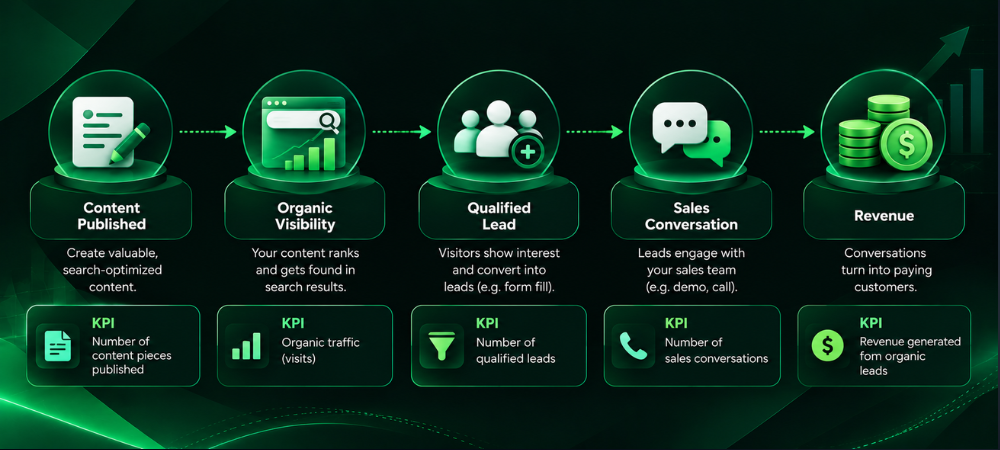
Page views feel good, but they rarely pay the bills. Track signals that connect content to revenue.
| Metric | Why It Matters |
|---|---|
| Qualified leads by content asset | Shows which pieces attract the right buyers |
| Whitepaper-to-demo conversion rate | Tests whether deep content moves people forward |
| Pipeline and revenue influenced | Connects content to sales outcomes |
| Branded search growth | Shows rising awareness |
| Backlinks and referring domains | Measures authority from trusted sites |
| AI visibility for core questions | Tracks presence in AI answers |
| Engagement on key pages | Reveals whether readers finish and act |
| How Long Does Cybersecurity Content Marketing Take To Work? Expect early signals, such as rankings and engagement, within the first three months. Pipeline impact usually shows between three and six months. Authority compounds after that, so the second year often outperforms the first. Timing varies with your starting point, competition, and publishing pace. |
Turn more of that traffic into leads with conversion rate optimization.
Avoid These Common Mistakes
- Writing For Everyone: A page for “all businesses” convinces no one.
- Publishing Without Expert Review: One factual error can undo months of work.
- Gating Everything: Hidden content cannot rank or earn citations.
- Ignoring Existing Pages: Updating a strong post often beats writing a new one.
- Stopping After Six Weeks: Trust builds slowly, and results arrive late.
- Skipping The Decision Stage: Buyers need proof pages before they sign.
Case Study: How Viacon Grew Sangfor’s Search And AI Visibility
Sangfor is a global cybersecurity and cloud computing company. Viacon worked with the brand for two years to grow its organic visibility and its presence in AI search results.
The Goal: Build authority for a technical brand across competitive security topics, and make Sangfor easier to find in both search engines and AI answers.
What We Did: We ran a content-led SEO program built on authority, backlinks, and topic coverage. Over time, we added work focused on AI visibility, so that Sangfor appeared more often when buyers asked AI tools security questions.
Early Results: In the first three months, Sangfor gained 27% more organic traffic and ranked for 7,000 new keywords.
Download the full story; the case study covers the strategy, the timeline, and the two-year report data in detail.
The case study covers the strategy, the timeline, and the two-year report data in detail.
Want Results Like These?See more client work on our case studies page.
Where To Start: A 90-Day Plan
You do not need to do everything at once. Use this order.
Days 1 to 30: Foundation: Interview customers, define your personas, pick three to five pillars, and audit your current content for gaps.
Days 31 to 60: Build: Publish your first pillar page, two supporting articles, and one case study. Set up tracking for leads and AI visibility.
Days 61 to 90: Distribute And Refine: Promote your best asset on LinkedIn and email. Review what earned traffic and leads, then plan the next quarter around it.
Build Trust First, And Pipeline Follows
Cybersecurity content marketing works when it respects the reader. Security buyers are skeptical, technical, and short on time. They reward brands that teach clearly, prove their claims, and answer the question they actually asked.
Here Is What To Carry Forward:
- Write for specific roles, not a generic “decision maker.”
- Cover all three journey stages, especially the decision stage.
- Publish original research and case studies that others can cite.
- Organize your content into a few strong topic clusters.
- Optimize for search engines and AI answers together.
- Measure leads, pipeline, and visibility instead of page views.
The Sangfor project shows what steady work can do. Two years of consistent content, authority building, and AI visibility work produced gains that a short campaign cannot match.
If you want help turning this into a working program, request a free audit. We will show you where your biggest content and visibility gaps are.