Ever since generative engines became part of the marketing conversation, brands, marketers, and creators have been going on and on about this debate. There’s a good reason for that.
Search doesn’t look the same in 2026 as it did two years ago. Earlier, whenever a user had a query, they used Google. Google used to produce a list of ten blue links (still does), and users used to choose whatever satisfied their needs.
But that’s not happening any longer. AI tools like ChatGPT, Gemini, and Perplexity aren’t just helping people find information. They’re delivering it instantly.
So naturally, businesses are starting to wonder… is traditional SEO still enough?
That’s where the whole SEO vs GEO conversation begins. And honestly, it’s a fair question.
In this guide, we’ll break down the difference in simple language with clear directions regarding your marketing needs. So, let’s get to it.
What Is Traditional SEO?
SEO ensures search engine visibility. It’s a practice, or a process, to refine your website’s quality according to Google’s algorithm’s best practices so that the website ranks higher in search results.
| Simplification: Optimize your website for higher search appearance, get clicks, and lead to conversion. |
We’ve all done it. You search for something, click on the first or second result, and move on. That’s SEO at work.
How Did Search Engines Traditionally Rank Content?
Search engines such as Google decide which page deserves a spot at the top for a specific search phrase. The search algorithm uses various factors such as relevance, authority, and user experience to decide which article deserves a spot at the top.
For years, keywords played a big role. Add the right phrases, build links, and you can climb the rankings.
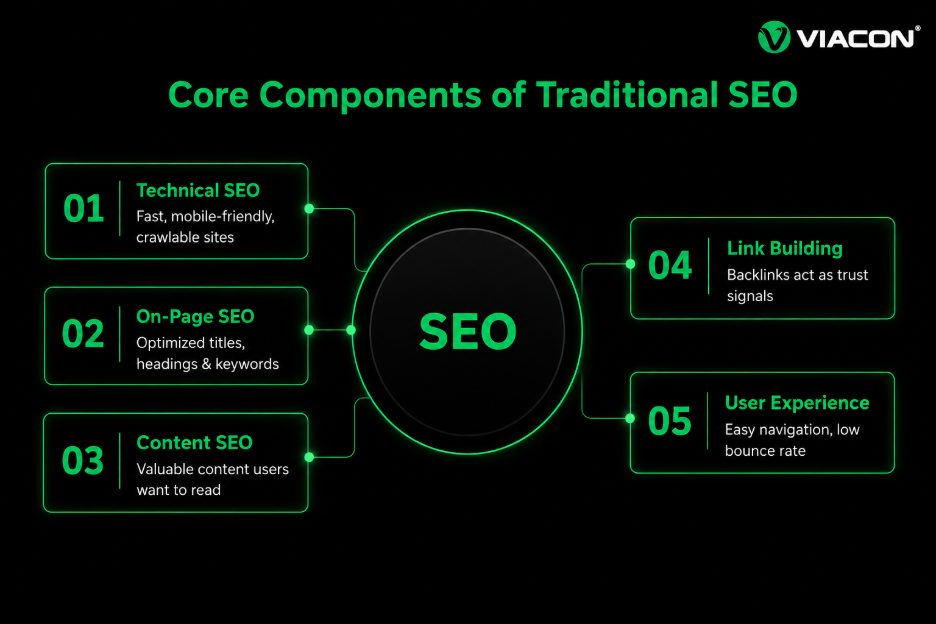
What Are The Core Components Of Traditional SEO?
Traditional SEO involves optimizing the website for different search devices, creating high quality content, improving user experience, and high-quality link building.
What Are The Benefits Of Traditional SEO?
Traditional SEO is still relevant and is the source of a huge amount of traffic. It’s reliable, scalable, and measurable. And when done right, it works for years. We’ve seen pages rank and bring in leads long after they were published. That’s the beauty of it.
What Is GEO (Generative Engine Optimization)?
Generative Engine Optimization, or GEO, is a process of optimizing your content so that it appears on AI systems. Here, instead of search engines, content creators must optimize the content for Large Language Models (LLMs) so that they can understand the content, trust it, and use it in direct AI answers.
Simply put, instead of ranking on a page, you get cited by AI.
How Does Generative Search Work?
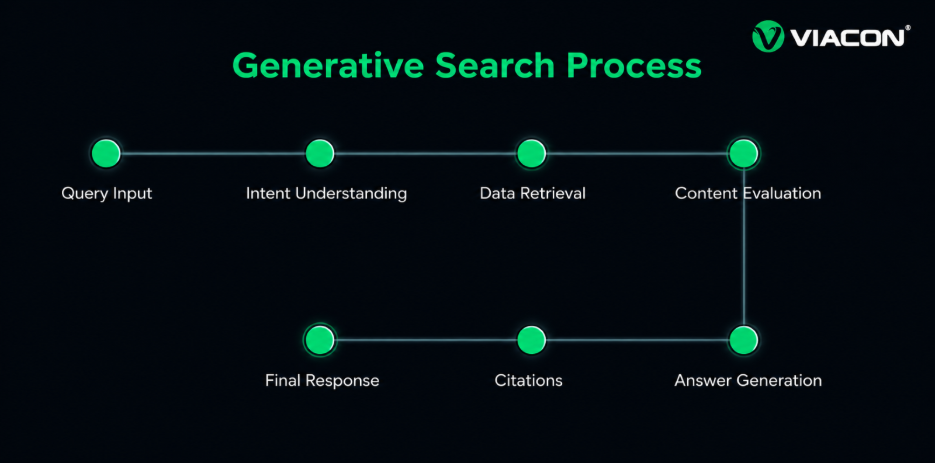
Generative engines produce direct answers to search queries along with sources cited. Whenever someone puts a query on ChatGPT, Perplexity, or checks Google AI overview, they get a direct answer pulled from multiple sources with source links. If structured well, your content can also appear there for relevant searches. That’s what GEO is all about.
GEO Explained For Beginners
Think of SEO optimized results as ‘mentions,’ whereas SEO meant getting clicks. In AI search, being part of the answer is more valuable than being one of ten links.
Why GEO Emerged In The AI Era
AI doesn’t think in keywords. It understands meaning, context, and relationships.
That’s why optimization is shifting toward entities, authority, and structured information.
It’s less about what you say and more about how clearly AI can trust and extract it.
SEO vs GEO: Key Differences Explained
Here’s a quick comparison table to help you understand the difference better:
| Factor | SEO | GEO |
| Goal | Rankings | AI Citations |
| Search Surface | SERPs | AI Answers |
| Focus | Keywords | Entities |
| Success Metric | Traffic | Mentions & Visibility |
| Optimization | Pages | Information & Authority |
User Intent Processing
SEO vs GEO debate becomes clearer once you understand how AI models and the search engine manage intent processing.
SEO matches queries with pages. On the other hand, GEO understands deeper intent and context, often across multiple queries.
Content Discovery Methods
AI models and search engines have different ways of making content discoverable. SEO relies on crawling and indexing, whereas GEO focuses on knowledge graphs, datasets, and trusted sources.
Ranking Signals vs Citation Signals
The ranking and mentioning systems for the SEO vs GEO debate make the difference between the two clearer.
- Goal: With SEO, the goal is to rank in the top 10 list of blue links. But in GEO, the goal is to get cited in synthesized answers to specific queries.
- Core Mechanisms: Keyword density, the PageRank system of Google, and the site’s technical performance help with SEO ranking. GEO mentions depend on entity recognition, multi-source triangulation, and verifiable factuality.
- Signals: The key signals of good SEO optimization include a high volume of valuable backlinks, domain authority, core web vitals, and meta tags. Definitive mentions in the third-party media and a robust E-E-A-T signal indicate good GEO optimization.
- Success Metrics: SEO success is measured by click-through rates, traffic, and impressions. On the other hand, citation rates, brand mentions, and source diversity are the core success metrics for GEO.
SEO uses ranking signals like backlinks and keywords. GEO focuses on citation signals such as brand mentions and authority.
Search Results vs AI Answers
How SEO and GEO help gain visibility and clear the SEO vs GEO differences. SEO shows your brand alongside others in a list of ten links on the top page. Users must click on your content to visit the platform.
GEO, on the other hand, puts your brand’s name inside the answer it generates for a search query. There’s a big difference between how they work.
Where Does AEO Fit Into SEO vs GEO?
If you’ve also seen the term AEO(Answer Engine Optimization) alongside SEO and GEO, you’re not imagining a third front — you’re right to wonder how they relate.
The short version:
- SEO gets your content discoverable and indexed.
- AEO focuses on getting your content selected as the direct answer inside a featured snippet, a voice assistant response, or a “People Also Ask” box.
- GEO focuses on getting your content used and cited inside AI-generated answers from tools like ChatGPT, Gemini, and Perplexity.
In practice, the three overlap more than they compete. Content structured clearly enough to win a featured snippet is usually also structured clearly enough for an AI system to extract and cite, and both still depend on the crawlability, authority, and technical health that SEO has always required.
For a deeper explanation, read our guide to SEO vs AEO vs GEO and our dedicated Answer Engine Optimization (AEO) Guide.
Technical GEO: Can AI Crawlers Even Reach Your Content?
Before any content strategy matters, there’s a simpler question: can AI systems actually see your website in the first place?
Every major AI platform runs dedicated crawlers, and most run at least two per platform, one for training their models, and a separate one for retrieving live results when someone asks a question. That split matters because you can control them independently.
- OpenAI: GPTBot crawls for model training; OAI-SearchBot and ChatGPT-User handle live ChatGPT search and on-demand fetches.
- Anthropic: ClaudeBot crawls for training; Claude-SearchBot and Claude-User handle search indexing and real-time fetches for Claude.
- Perplexity: PerplexityBot crawls for its search index; Perplexity-User handles user-triggered fetches.
- Google: Google-Extended is the separate opt-in/opt-out token for Gemini and AI Overview training, independent of standard Googlebot indexing.
These bots are documented to honour robots.txt, so the real decision is what you allow, not whether you’re technically capable of blocking them.
- Block a training crawler (GPTBot, Google-Extended), and you keep your content out of future model training.
- Block a search/retrieval crawler (OAI-SearchBot, PerplexityBot), and you remove yourself from that engine’s real-time citations entirely, even if your content was already used to train the underlying model.
For most businesses pursuing GEO, the sensible default is to leave the search and retrieval bots open, since that’s what makes citation possible, and make a separate, deliberate call on the training bots based on how comfortable you are with your content shaping model outputs generally.
A newer, complementary file llms.txt is also emerging. It doesn’t control access the way robots.txt does think of it as a curated pointer to your most valuable pages, similar in spirit to an XML sitemap. Adoption is still early, but it costs little to add.
Key takeaway: A perfectly optimized article can still be invisible to AI search if a training-crawler block was copy-pasted into robots.txt years ago and never revisited. That’s a five-minute audit worth doing before investing further in GEO content. |
Why AI Search Is Changing The Rules?
The rules of SEO or producing content for the search engine are changing, and AI is at the centre of the shift. The scale of that shift is already measurable: Gartner projects traditional search engine volume will drop 25% by 2026 as generative AI tools absorb queries that used to run through a search engine.
Here’s how AI is changing the rules of content discovery:
Rise Of AI Overviews
Google’s AI summaries are changing how users interact with search. People are getting answers without clicking and the scale is real. SparkToro’s June 2026 study, built on Similarweb clickstream data, found 68.01% of US Google searches ended without a click in the first four months of 2026, up from 60.45% in 2024. Google’s own AI Mode, while still early, had already surpassed 1 billion monthly users by I/O 2026.
ChatGPT Search And Conversational Search
Searchers are more problem-aware now, and they don’t quit their search until they reach a conclusive answer. Therefore, the search turns into a conversation. Users ask follow-up questions, refine queries, and expect human-like responses.
Google’s Shift Toward Entity Understanding
Google is focusing more on search entities than just keywords. This connects closely with topical authority in SEO. Entity SEO is at the centre of how brands and businesses appear on search results.
The Decline Of Pure Keyword Matching
You can add exact keywords to a piece of content and hope to get it ranked on the search results page. Now, it’s no longer about that. Those keywords don’t carry the same weight anymore. Now, it’s more about context.
Search Becoming Answer-Centric
Here’s the biggest shift that happened after AI dominance. AI-powered search engines no longer provide a list of alternative solutions to choose from. Instead, tools like ChatGPT, Gemini, and Perplexity provide direct answers with the brand mentioned and the source cited.
How Traditional SEO Works In 2026
AI introduced GEO and Answer Engine Optimization (AEO). But, most importantly, it changed how traditional SEO worked until 2026. Here’s what changed and what stayed the same:
- Keyword Optimization: Keywords still matter. But they aren’t the only thing driving visibility. Smarter and intent-driven content is the baseline for Google search visibility now.
- Topical Authority: Topical authority is a critical area to consider for brands, as Entity SEO and E-E-A-T parameters are the current norms for search appearance. Brands must present themselves as authorities to the search engine. Therefore, deep explorations into relevant content are non-negotiable.
- Backlinks: Backlinks and link building are still relevant and even more necessary in an AI-first search landscape. High-quality backlinks boost a website’s authority, and high-authority websites are likely to get mentioned in AI searches.
- Technical SEO: Speed and structure still matter. Fast and well-structured websites signal trust, are easy for LLMs to cite, and are easier for search engines to rank.
- User Experience Signals: Good UX boosts both SEO and GEO by improving engagement, reducing bounce rate, increasing dwell time, enabling faster navigation, and supporting a clear structure that helps search engines and users easily find, understand, and rank content.
- Search Intent Alignment: Aligning search intent with what the audience really wants improves both SEO and AI visibility.
How GEO Works In 2026
Here’s how GEO works and how to optimize for AI search engines:
- Entity Optimization: Entity optimization is critical for AI search appearance. It’s just like covering basic SEO principles. Start by clearly defining what the brand stands for, use consistent names, add author bios and pages, and an about section. Align across your website, social profiles, and directories for AI to recognize your brand easily.
- Knowledge Graph Signals: Build connections between your brand and known entities (people, places, topics). Use structured data, Wikipedia/Wikidata presence (if applicable), and authoritative mentions to strengthen your inclusion in knowledge graphs.
- Brand Mentions: This part works just the way backlinks work for SEO. Earn organic mentions across reputable platforms, websites, and media. With or without backlinks, these mentions build consistent brand references that are the bedrock for AI-driven search systems.
- Structured Data: Implement schema-type articles, FAQs, and products into the website. The LLM and the search algorithm must first understand and interpret the context, relationships, and intent behind the search. This helps machines interpret context, relationships, and intent, improving visibility in rich results and AI summaries.
- Content Citability: Clarity and structure get rewarded in the AI-first content landscape. Therefore, write well-structured and data-backed factual content. Make your statement clear, use statistics, and definitions for AI models to easily understand your content. More citable content means, easy to quote and produce as AI answers.
- Multi-Platform Authority: Expand your presence beyond your website, publish blogs, contribute to forums (Reddit, Quora), list in directories, and appear in databases. Consistent authority across platforms reinforces credibility.
- AI-Friendly Content Architecture: Work based on architecture. Use a clean layout that includes proper headings, bullet points, short paragraphs, and direct answers. Structure your content for AI to scan, summarize, and synthesize easily.
GEO vs SEO: Which Ranking Factors Matter Most?
Here’s a comparison table on how SEO vs GEO ranking works:
| Ranking Factor | SEO | GEO |
| Goal | Rank in the top 10 blue links | Get cited in synthesized AI answers |
| Core Mechanisms | Keyword optimization, PageRank, and technical site performance | Entity recognition, multi-source triangulation, and verifiable factuality |
| Primary Signals | Backlinks, domain authority, Core Web Vitals, and meta tags | Third-party mentions, strong E-E-A-T signals, entity consistency, and structured data |
| Success Metrics | Click-through rate (CTR), organic traffic, rankings, and impressions | Citation rate, brand mentions, source diversity, and AI referral traffic |
Can GEO Replace SEO?
No. GEO doesn’t replace SEO. Think of it like this. You have a car for long journeys. Now you’ve gotten yourself a motorcycle for regular commutes. Does that mean you’ll no longer need the car? No.
Similarly, SEO is still necessary for authority and visibility. What GEO does is add a new layer of approach on top, where structure and brand mentioning across channels become the priority.
Why SEO Is Still Important
SEO keeps your website compliant with search engines’ norms. It’s the driver of traffic. Most importantly, people still use the search engine to find things they are looking for.
Where GEO Fills the Gap
GEO fills in the gap by covering what SEO misses. It structures answers directly from your content and shows them in AI answers, making your website visible with the direct source cited. However, clicks may or may not happen here.
Why do Businesses Need Both SEO and GEO?
This isn’t SEO vs AEO vs GEO as a competition. In fact, it’s how searches are evolving. When Google was the go-to platform for information and answers, SEO was the priority. Now, there’s AI, making the search engine more diverse. Therefore, marketers are bound to think of SEO, AEO, and GEO at the same time.
The future of search visibility leans on a multi-layered approach where the search engine, AI tools, and social media all play a crucial part. It’s no longer about updating a website with fresh content and keywords.
SEO Strategy vs GEO Strategy
Modern visibility relies on both Google searches and AI visibility. Therefore, the strategy must be a combined approach.
Content Creation Approach
Traditional SEO is based on keywords. Creators must use the keywords users are typing into the search engine to appear for those searchers. But GEO changes that and makes the search truly about meaning, where context, depth of information, intent and structure decide visibility.
Therefore, the modern content creation approach must blend both. Writers and marketers must explain their topic in a structured, concise and direct way for LLMs to cite and humans to understand.
Authority Building Methods
SEO has largely depended on backlinks and authority signals sent across the search engine. GEO shifts that focus on entity trust. It’s about how consistently your brand appears, how it’s referenced, and how strongly it’s connected to recognized entities in the ecosystem.
Measurement & KPIs
SEOs were used to measure traffic, ranking, and CTRs. These are clear, measurable, and click-driven mechanisms to help businesses rank. While these metrics continue to stay relevant, GEO adds a new layer.
Now, visibility is also measured by mentions, citations, and AI visibility. AI search isn’t about clicks. But your appearance in the AI answer still counts as a valuable answer and performance indicator.
Link Building vs Entity Building
SEO invests in acquiring high quality backlinks. While that’s still relevant and essential, GEO helps marketers into building recognized entities. The methods have changed, and the goal has diversified.
SEOs must build strategies to get on top of search results while simultaneously building entity SEO. Now, it’s about building authority that search engines and AI trust.
Search Rankings vs AI Visibility
Ranking has always been the benchmark for success in SEO.
But GEO redefines visibility.
- Ranking = being seen
- Citation = being trusted and used
Which Industries Need GEO The Most?
SEO was working fine. You had traffic, and the conversion is going steadily. Do you still need GEO? Well, that depends on the type of business you’re operating in.
| Business Type | Where to Start | Why |
| SaaS Companies | GEO-first | Competitive, information-heavy category where buyers research extensively before ever visiting a website. |
| Ecommerce Brands | SEO foundation first, then GEO | Product discovery still runs largely through traditional search and marketplaces, but AI-assisted shopping is growing rapidly. |
| Agencies | GEO-first | Clients increasingly expect agencies to demonstrate GEO expertise—starting with the agency’s own website. |
| Healthcare | SEO foundation first, then GEO | Trust and E-E-A-T requirements are strict in both channels. A weak SEO foundation also limits GEO citation opportunities. |
| Finance | SEO foundation first, then GEO | Authority, trust, and credibility must be established before GEO efforts can consistently earn AI citations. |
| Local Businesses | SEO-first, then GEO | Local discovery still relies heavily on Google Maps and the Local Pack, but AI-powered recommendations are increasingly influencing nearby decisions. |
SEO + GEO: The Winning Strategy For 2026
The question was never about SEO vs GEO and which one to optimize for. Instead, brands and businesses need a winning strategy that combines both. Build your foundation on SEO, and layer GEO on top for LLMs to cite your content.
(i) Build Dual Visibility
Keep your fundamental SEO practices always updated. Optimizing site speed, performance, and data structure, and improving E-E-A-T signalling, helps get SEO benefits. As a result, the brand can pull in a percentage of active demand online.
Structured content, topical depth, and entity building help optimize for GEO, which in turn helps influence decisions through AI visibility. Therefore, if you rely on only one, you’re missing half the journey.
(ii) Create An Integrated Content Strategy
A content strategy that caters to a human audience and LLMs’ understanding- that’s the way forward.
For Humans:
- Clear answers
- Easy readability
- Engaging, valuable insights
For AI Systems:
- Structured formatting (headings, lists, schema)
- Context-rich explanations
- Easy-to-extract information
The winning approach is about making content scannable, semantically clear, and structured. As a result, it should rank, get cited, be shared, and drive visibility and decisions.
(iii) Combine Keywords And Entities
While having specific pages with highly searched keywords creates traction, a modern strategy doesn’t end there. Keywords capture demand. True. But it’s the brand entity that builds meaning, differentiates your brand, and secures a space for the brand on the digital.
A unified strategy with keywords and brand entities makes the brand easy to discover.
(iv) Balance Traffic And Citations
Building authority and a strong digital presence is a long-term process, and it doesn’t happen without SEO. Citations, on the other hand, with direct and structured answers, add to that aim for visibility.
A combined strategy, therefore, is necessary to get GEO benefits and SEO growth. Direct and organic traffic from SEO helps your business show up during demand, while citations build long-term authority and a quick AI response.
(v) GEO Readiness Checklist
- Crawler Access Confirmed – AI-SearchBot, Claude-SearchBot, and PerplexityBot are allowed in
robots.txt.
- Entity Consistency – Brand name, description, and key facts match across your website, social profiles, and directories.
- Structured Data In Place – Article and FAQ schema implemented and validated.
- Every Core Page Leads With A One-sentence Direct Answer before the supporting detail.
- At Least One Piece Of Original Data Or A Proprietary Insight exists for AI systems to cite instead of paraphrasing what everyone else already says.
- Content Is Broken Into Clearly Labelled, Self-contained Sections so an AI system can extract one passage without needing the rest of the page for context.
- You’re Referenced In Third-party Sources – Press mentions, directories, and reputable guest posts, not just on your own website.
- FAQs Answer Real Questions In Direct, Complete Sentences, not just keyword-matched headers.
Future-Proof Your Brand
The debate isn’t about SEO vs GEO. It’s about combining both. When it comes to generating traffic, SEO still leads the way. On the other hand, AI Search Optimization is essential for AI visibility and appearing credible and trustworthy. Both must work together for long-term brand/business growth.
Search is changing fast; if your business doesn’t adapt now, it will fall ten steps behind its competitors. Therefore, a combined strategy, based on your business’s requirements, is the way forward in 2026. Keep optimizing your website for SEO for constant growth on the search engine. Combine that with GEO optimization so that your business is also visible on AI searches.
If you’re falling short on expertise or resources, reach out to us and leverage a team of seasoned experts for SEO and GEO initiatives.
Frequently Asked Questions:
A: GEO focuses on optimizing content so AI systems can understand, trust, and cite it in responses.
A: SEO drives rankings and traffic, while GEO drives AI visibility and citations. Both are necessary for visibility in the expanding digital search landscape.
A: No. It’s expanding how optimization works. SEO remains relevant for digital presence on search engines.
A: It improves content structure, authority, and clarity for AI systems.
A: Entity strength, citations, structured data, and brand authority.
A: Focus on clear content, structured data, and strong brand signals. Get your website cited on different reliable platforms and build credibility off-page for faster and more accurate citations on AI searches.
A: Yes, it relies on trusted sources and recognizable entities.
A: SEO will evolve, but remain essential alongside SEO and answer engine optimization.
A: There’s no fixed timeline. Unlike traditional rankings, which often change over months, AI citation visibility can shift within days because generative AI platforms frequently recrawl and resynthesize answers. However, consistent, long-term visibility still depends on the same authority-building principles that have always driven SEO. Treat GEO as an ongoing strategy, not a one-time project.
A: Start with manual testing by running your target queries in ChatGPT, Perplexity, Gemini, and Google AI Overviews to see whether and how your content is cited. Pair this with brand mention monitoring across the web, since GEO visibility relies heavily on third-party references, not just your own website. Dedicated AI visibility tracking platforms are also emerging and are worth monitoring as the category matures.
A: No. While they’re closely related, they serve different purposes. AEO (Answer Engine Optimization) focuses on winning direct-answer placements such as featured snippets, voice assistant responses, and “People Also Ask” results. GEO (Generative Engine Optimization) focuses on getting your content cited within AI-generated answers from platforms like ChatGPT, Gemini, and Perplexity. Both build on a strong SEO foundation and often reward the same well-structured, authoritative content.