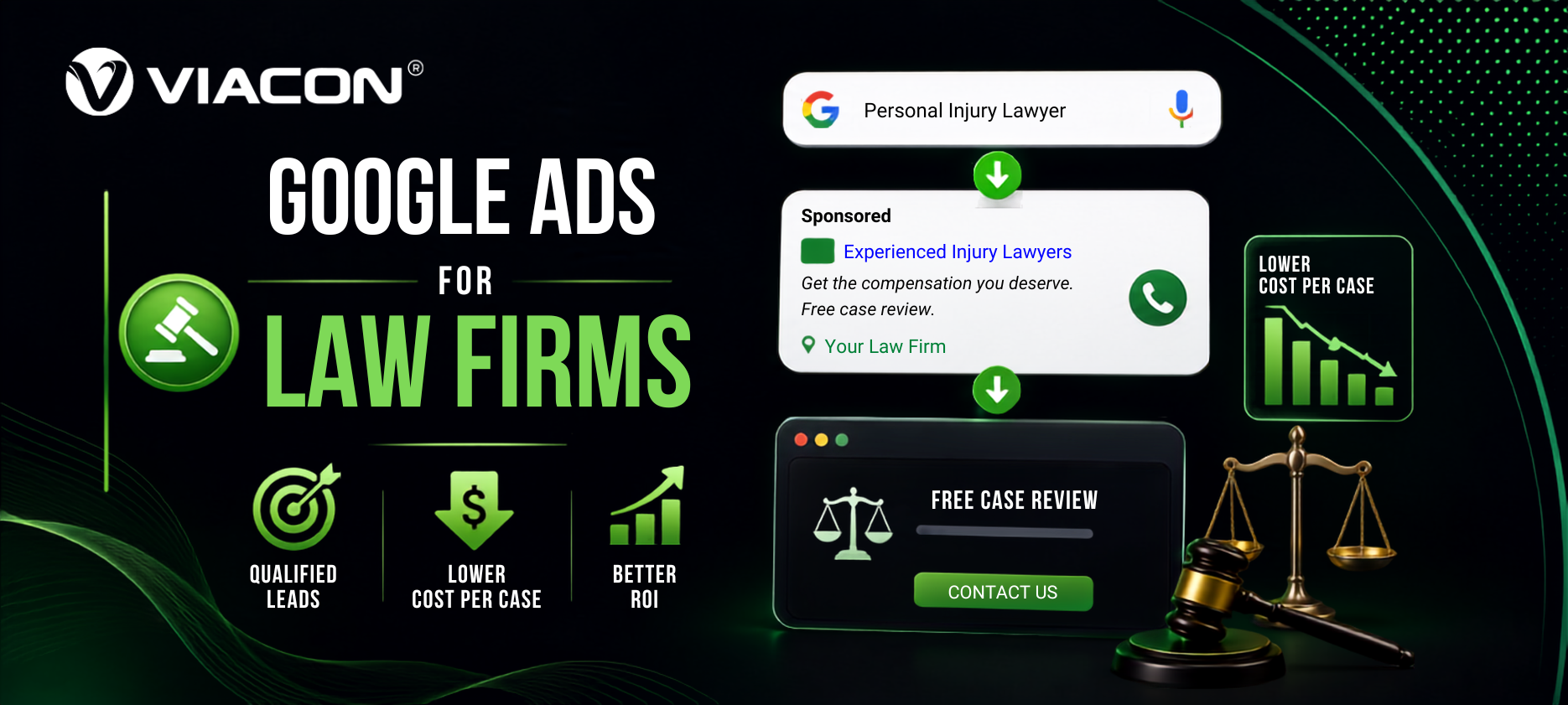
If you’re only looking at cost per click, you’re looking at the wrong number. That’s what we say to almost every law firm we work with:
Most firms running law firm PPC campaigns are paying way too much for leads that quietly disappear somewhere between the first phone call and the signed retainer. The click was cheap. The lead looked fine.
But the case? That’s what actually pays the bills, and that’s the number most dashboards never show you.
Competition in the legal space keeps climbing, CPCs in high-value practice areas keep creeping up, and a lot of accounts are still structured the way they were five years ago.
That combination quietly inflates acquisition costs while everyone’s staring at the wrong metrics.
This post walks through practical, current legal Google Ads strategies for lowering cost per case in 2026, without sacrificing the volume of cases coming in the door.
Why Cost Per Case Is The Only Metric That Actually Matters
Cost per click (CPC) tells you what you paid for attention. Cost per lead (CPL) tells you what you paid for a form fill or a phone call.
Neither one tells you whether that person actually became a client. Cost per case does.
The purpose of any digital campaign (paid ad or organic SEO) is to reach a point. For law firms, it ends with acquiring and retaining clients. But neither CPC nor CPL tells the full story behind the amount spent on ads and the qualified clients gained.
We’ve seen firms proudly report a low cost per lead while their intake team is buried in unqualified calls that go nowhere.
Optimizing for leads alone, without connecting that data back to signed cases, often increases total marketing waste even when the campaign “looks” efficient on the surface.
As CPCs for many legal keywords continue rising in 2026, that gap between cheap leads and expensive cases becomes harder to ignore.
Firms that don’t track all the way through to signed matters are essentially flying blind, and they usually only notice the problem when the budget runs out before the cases do.
Here’s a quick test: pull your last 90 days of Google Ads data and try to answer one question: what did each signed case actually cost, broken out by practice area? Most firms can answer that for cost per lead without blinking. Very few can answer it for cost per case, and that blind spot is usually where the real money leaks out. If you can’t answer it yet, that’s normal; most firms can’t. It’s also exactly the gap our legal services growth strategy is built to close before another dollar goes out the door.
The 2026 Google Ads Landscape For Law Firms
A few shifts are shaping how PPC for law firms works right now.
- Performance Max keeps evolving and pulling in more inventory types.
- AI-driven bidding is doing more of the heavy lifting on auction decisions.
- And privacy changes are affecting how granular your targeting and remarketing can be.
Local Service Ads have also matured into a real channel worth budget, not just a side experiment.
At the same time, national firms and legal tech platforms are bidding up competitive terms. This raises the floor for everyone else relying on Law firm PPC campaigns.
That’s why fully automated campaigns tend to underperform for law firms specifically. So, what’s the way forward then?
A hybrid approach.
Success depends on a strategy with human and automation working hand in hand. The smart automated bidding handles the auction. On the other hand, a human keeps an eye on quality, compliance, and relevance. This hybrid approach consistently does better than either extreme.
And of course, attorney advertising has its own compliance considerations that generic PPC advice doesn’t account for.
The legal verticals often disapprove of ad copy that would fly in ecommerce. So, instead of thinking of legal compliance later, it’s important to consider it from day one.
A few claims get legal ads disapproved, or draw a bar complaint, faster than anything else: unverifiable superlatives, outcome guarantees, and “no win, no fee” language missing its required disclaimer. Rules vary by state; check where the client is, not just where the firm is based.
| What Can’t A Law Firm Say In A Google Ads Headline? Skip guarantees, comparisons to other attorneys, and superlatives without a citable source. Run new copy past whoever handles bar compliance before it goes live, not after Google flags it. |
What Cost Per Case Actually Looks Like By Practice Area?
These are general market ranges, not guarantees, but a useful gut check for whether an account is reasonable or badly off:
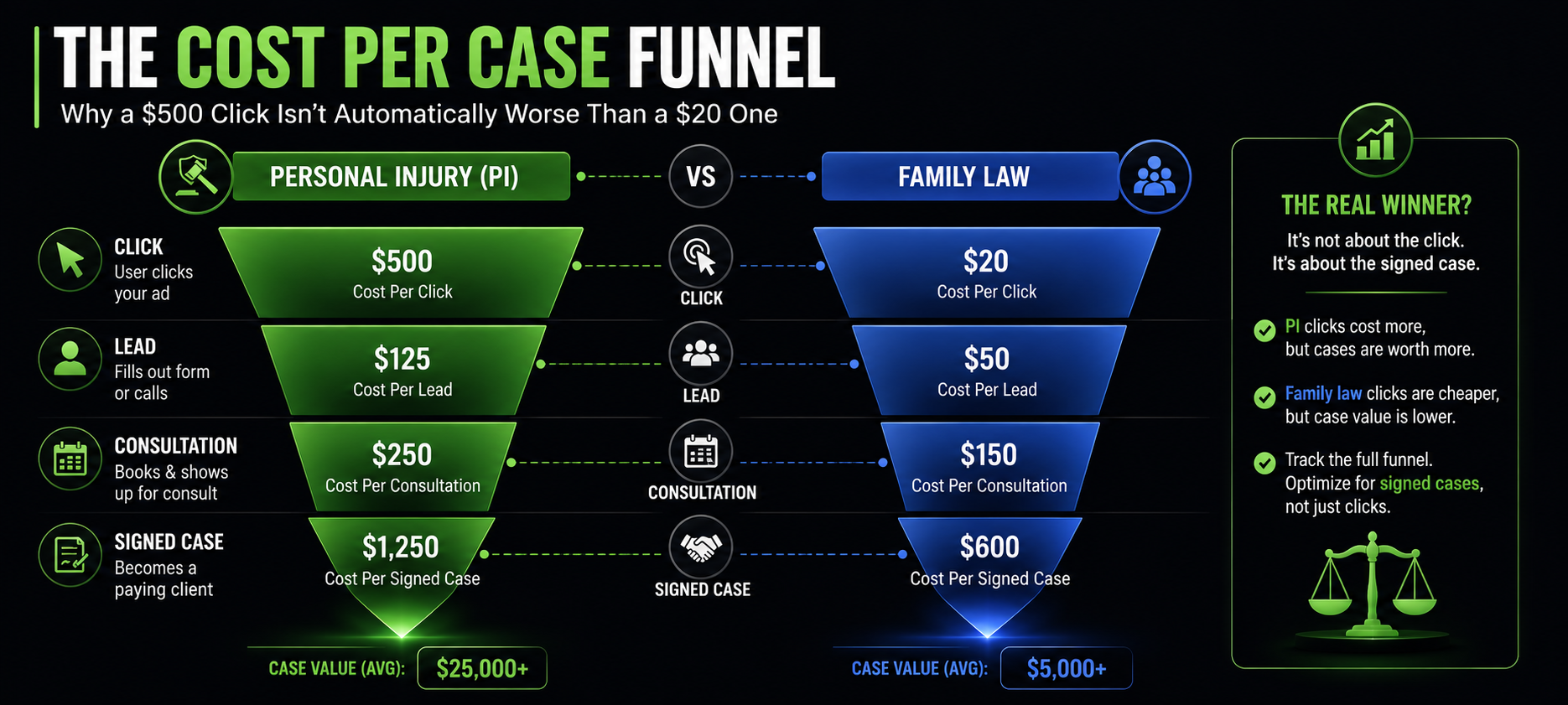
- Personal Injury/Mass Tort: $50–$500+ per click, sometimes more for terms like “truck accident lawyer.” High CPCs are tolerable given the case values.
- Criminal Defense/DUI: $20–$80, skewing urgent and mobile.
- Family Law: $20–$60, with lower lead-to-case conversion; many callers just want free advice.
- Immigration: usually the most affordable vertical, on CPC and lead cost alike.
- Estate Planning: moderate CPC, strong conversion; searchers here are usually already decided.
To find your own ceiling: take average case value, divide by target ROAS (5x–15x for PI, 3x–8x for lower-value matters) for max cost per case, then multiply down through lead-to-case and click-to-lead rates for max CPL and max CPC. Example: a $75,000 PI case at 10x ROAS allows $7,500 per case; at 25% lead-to-case, a $1,875 max CPL; at 8% click-to-lead, roughly $150 max CPC.
| How Much Should A Law Firm Budget For Google Ads? Rough starting points: solo/small firms often begin at $1,500–$5,000/month; mid-size firms (5–20 attorneys) typically run $5,000–$15,000/month; larger PI firms run well past that. Work backwards from the formula above, not a number picked first. |
| What’s A Good Cost Per Case For A Personal Injury Firm? Roughly 5–10% of average case value signals a well-optimized account; above 10–15% suggests underperformance or tracking gaps. |
Run actual numbers through a free ROAS calculator rather than eyeballing it.
Core Law Firm PPC Strategies To Lower Cost Per Case
These are some of the core law firm PPC strategies that help lower cost per case:
(i) Campaign Structure That Actually Reflects Intent
Separate your campaigns by practice area and by intent. Someone searching “car accident lawyer near me” is not in the same headspace as someone researching “what to do after a car accident.”
When you mix those keywords into a single campaign, you are muddying your data and the campaign.
Instead, use Search Performance Max, Demand Gen, and Local Service Ads for what each of these does well.
Also, strengthen your geo-targeting, and prepare ad groups to give your Quality Score a chance to improve instead of fighting itself.
(ii) Keyword And Match Type Discipline
Matching keywords and stuffing them in the content body to rank on Google? Those days are over. The algorithm now understands context, and it rewards intent-driven content over generic posts that include keywords.
Here’s What To Do:
- Prioritize high-intent, conversion-oriented keywords and control your match types instead of letting broad match run wild.
- Negative keyword management isn’t a one-time task; it’s ongoing.
- Pull search term reports regularly and prune what’s not converting.
- Competitor conquesting can work, but it needs to be done thoughtfully and within the platform’s advertising policies.
- Use keywords wisely and know when you’re becoming over-dependent on them.
In 2026, SEO is as much about disciplines and principles as they are about the technicalities. So, make sure law firm PPC campaigns are a product of that.
One negative-keyword source firms consistently underuse: their own intake notes. If the front desk keeps hearing the same disqualifying phrase someone asking about a payment plan the firm doesn’t offer, a case type the firm doesn’t handle, a specific competitor’s name that phrase belongs on the negative list within the week, not at the next quarterly review.
(iii) Ad Copy And Assets That Convert
Benefit-driven, compliance-safe ad copy improves both click-through rate and Quality Score, which lowers CPC as a side effect. Use every relevant extension: sitelinks, callouts, structured snippets, call extensions, and image assets. Stronger ad strength and relevance signals genuinely move the needle on what you pay per click.
Behavior also varies sharply by practice area, and the ad copy should reflect it. Someone searching for a DUI lawyer at 2 a.m. wants to tap-to-call in one move, not fill out a five-field form. Someone researching a car accident claim during the day is more likely to compare two or three firms before picking up the phone. Weight extensions accordingly: click-to-call and location extensions carry more weight for urgent, mobile-heavy searches, while review counts, case results, and attorney bios carry more weight for higher-consideration matters like estate planning or family law.
(iv) Landing Pages That Don’t Waste The Click
This is where a lot of budget quietly leaks out. Build dedicated, message-matched landing pages for each major practice area instead of sending everyone to the homepage. Page speed, mobile experience, visible trust signals, and a clear, low-friction intake path all affect whether that expensive click turns into a qualified lead.
Homepage conversion rates for law firms typically sit in the low single digits, while a tightly matched, single-practice-area landing page can convert two to four times higher. If an ad promises “DUI Lawyer in [City],” the landing page should be about DUI defense only, not a general overview of everything the firm handles. We’ve written a longer breakdown of what actually makes a legal landing page convert if you want to go deeper on this specific piece.
(v) Smarter Bidding And Budget Allocation
Once conversion tracking is solid, move from Maximize Clicks toward Target CPA or Maximize Conversions.
If you can assign relative values to different case types, value-based bidding lets the algorithm chase your best cases, not just any conversion. Then put your budget where it’s already proven to work, both by practice area and by location.
Manual CPC still has a place here, particularly for firms with tight budgets or firms just getting started who want full control while conversion data builds up. But once a campaign has enough signal generally 30 or more conversions in the last 30 days Smart Bidding strategies like Target CPA and Maximize Conversions with a target usually outperform manual control, provided the conversions feeding the algorithm are the right ones (signed cases, not just form fills).
This is where a lot of accounts stall: they switch to automated bidding without fixing what counts as a conversion first, and end up optimizing efficiently toward the wrong outcome. Our performance marketing team usually starts here before touching a single bid strategy.
(vi) Tracking And Attribution That Goes All The Way Through
Track from click to call or form, to consultation, to signed case. Call tracking, offline conversion imports, and CRM integration are what make this possible. Without that full chain, you genuinely don’t know which campaigns are producing cases versus which ones are just producing noise.
In practice, that means at minimum: dynamic call tracking numbers on every landing page and campaign, a CRM (or, honestly, even a disciplined spreadsheet if that’s genuinely where the firm is today) that tags each contact to the exact campaign and keyword that brought them in, and someone accountable for feeding signed-case outcomes back into Google Ads as offline conversions on a regular cadence.
Weekly beats monthly, and monthly beats quarterly firms that only import wins once a quarter are handing Google’s bidding algorithm stale data to optimize against for months at a stretch.
(vii) Protecting Your Budget From Click Fraud And Invalid Clicks
High CPCs make legal one of the more attractive targets for click fraud invalid clicks from bots, click farms, or competitors clicking ads with no intention of converting, purely to drain a rival’s daily budget. Agencies that specialize in monitoring legal accounts commonly flag somewhere between roughly 10% and 25% of paid clicks as invalid once they start watching closely, with personal injury and mass tort running toward the higher end simply because the incentive to sabotage a competitor is strongest where CPCs are highest.
A Few Defenses Actually Move The Needle:
- IP And Device Exclusions for addresses showing repeated, non-converting clicks.
- Geographic Tightening, since a firm serving one metro creates a predictable target; a rival across town knows exactly which ZIP codes and keywords to hit.
- Dedicated Click-fraud Detection Tools, which sit alongside Google Ads and automatically flag or block suspicious IPs closer to real time than a manual weekly review can manage.
- Regular Review Of Google’s Own Invalid Click Reporting, which catches some fraud automatically but not all of it; the gap between what Google filters and what actually happened is where budget quietly disappears.
| Can Competitors Legally Click On My Law Firm’s Google Ads? No. Deliberately clicking a competitor’s ads to drain their budget violates Google’s advertising policies, and depending on the facts, it can also expose the person doing it to liability under state tortious interference law. Proving who did it is the hard part. Google holds data on click sources, but firms often need a subpoena to connect an IP address to a person, so this route is usually worth pursuing only in flagrant, repeated cases rather than every one-off suspicious click. |
Advanced Tactics Worth Testing In 2026
Performance Max can work for law firms, but it needs guardrails: audience signals, asset groups tied to specific practice areas, and regular review of search term insights so it doesn’t drift into irrelevant traffic.
Layer in remarketing audiences to nurture people who visited but didn’t convert on the first pass. Pace your budget around seasonal demand and practice-area-specific cycles. And build a real testing framework so you can isolate what’s actually lowering cost per case instead of guessing.
| Should Law Firms Still Use Google Ads In 2026? For most competitive practice areas, yes. It remains one of the few channels where you can reach someone at the exact moment they’re searching for legal help. The challenge isn’t whether to use it; it’s whether your structure and tracking are good enough to make it profitable. |
| Are Local Service Ads Better Than Regular Google Ads For Attorneys? They’re not a replacement; they’re a complement. LSAs work well for pay-per-lead simplicity, but traditional search campaigns still give you more control and scale for high-intent, high-value cases. |
Getting Verified For Local Service Ads In 2026
Local Service Ads run on a different trust system than standard Search, and that system changed recently. As of October 20, 2025, Google consolidated its old badges, Google Guaranteed, Google Screened, and License Verified by Google, into a single Google Verified badge. The screening didn’t get easier, just simplified into one signal, and the Google Guarantee’s money-back protection was retired with the old badges.
Verification typically covers business registration, the attorney’s state bar license, a background check, and proof of malpractice or liability insurance. The full process often takes a few weeks, so start well before a campaign launch, not the week of.
Once verified, three factors drive LSA ranking: review volume and recency, response speed to leads, and proximity to the searcher. Response speed matters more here than in standard Search; a slow-to-respond firm loses ranking even with strong reviews, which makes LSA a genuinely different discipline, not just a cheaper version of Search.
| How Do I Get The Google Verified Badge For My Law Firm’s Ads? Start in Google’s Local Services Ads sign-up flow and submit business registration, bar license, insurance documentation, and background check consent for the firm and any attorneys handling leads. Keep licenses and insurance current year-round; a lapse can pause the badge and quietly kill LSA visibility. Pairing this with strong local visibility elsewhere, starting with an accurate Google Business Profile, tends to compound the effect. |
Common Mistakes That Quietly Inflate Cost Per Case
A few patterns show up again and again: broad match without strong negatives, sending all traffic to a generic homepage, optimizing for form fills instead of qualified consultations, ignoring Quality Score trends, and running with weak or missing conversion tracking.
Add non-compliant ad copy that gets limited or disapproved, and set-and-forget automation with zero human oversight, and you’ve got a recipe for a budget that disappears fast.
A few more patterns are worth watching, since they don’t show up in a quick glance at CTR: treating Local Service Ads and Search campaigns as either/or instead of complementary, never reviewing invalid click reports, and building one landing page meant to serve every practice area “well enough.” None of these looks alarming on a weekly dashboard. They show up three months later, in a cost-per-case number nobody was tracking closely enough to catch sooner.
Measuring Success Beyond CPC
Keep an eye on cost per qualified lead, cost per consultation, and cost per signed case as your primary KPI. Watch conversion rate at each stage, Quality Score trends over time, and impression share lost to budget or rank. If you can, factor in lifetime value by practice area too, since not every case is worth the same to your firm.
| How Long Before Google Ads Shows Real Results For A Law Firm? Expect a learning curve, not a light switch. Smart Bidding strategies generally need two to four weeks and around 30 conversions to exit Google’s learning phase and start optimizing reliably. Layer the case sales cycle on top of that: a personal injury matter can take weeks between the first click and a signed retainer, and most firms shouldn’t judge a campaign’s true cost per case before 60 to 90 days of clean data. Judging performance at the two-week mark almost always leads to killing a campaign right before it was about to work. |
In-House, Agency, Or Hybrid? Who Should Run This
Someone has to own this day to day, and each option comes with a trade-off. In-house works when a firm has genuine PPC expertise on staff — not a marketing coordinator also running the website, social accounts, and client events, since spreading legal PPC across five other jobs usually shows up as wasted spend within a quarter. A freelancer can work well for a single-location, single-practice-area firm on a modest budget. An agency tends to make sense once a firm runs multiple practice areas, multiple locations, or a budget where a mistake costs more than the management fee.
One detail matters more than most firms realize going in: confirm the Google Ads account is created and owned under the firm’s own name and login, not the provider’s. If that relationship ends, an account owned elsewhere means losing years of conversion history and Quality Score data overnight — restarting the learning phase from zero. It’s a five-minute check that’s saved more than one firm a painful transition.
The other question worth asking upfront: can this person or agency report on cost per signed case, not just clicks and impressions? If not, that’s the gap to fix first.
| Should I Keep Google Ads In-house Or Hire An Agency For My Law Firm? It depends less on firm size than on whether someone in-house genuinely has the bandwidth and specialization to run it properly. PPC as one of six responsibilities usually underperforms regardless of firm size. Unsure which fits? A free digital audit of the current setup is a low-risk way to see where the account stands before committing to a structure. |
Optimize Your Law Firm PPC For What Matters
At the end of the day, lowering cost per case isn’t about chasing cheaper clicks. It comes down to better structure, tighter relevance, stronger conversion paths, and tracking that actually follows the client journey through to a signed case. Firms that treat PPC as a real client acquisition system, not a lead-gen experiment, consistently come out ahead.
If you want a second set of eyes on your current setup, we offer a free Google Ads account audit focused specifically on cost per case, along with a downloadable Legal PPC Optimization Checklist if you’d rather start on your own. Either way, we’re happy to walk through what’s working in your account and what’s quietly costing you money.