More people now ask AI tools legal questions before they call a lawyer. One person types, “Who is the best personal injury lawyer in my city?” Another asks what to check before hiring a divorce attorney. The AI answers in seconds, and some users never open a results page.
That shift is why GEO for lawyers matters. Generative Engine Optimization, or GEO, helps your content become a source that AI tools cite when they write an answer. Traditional SEO still gets you ranked in Google. GEO gets you named in the answer itself.
Most firms don’t appear in these answers yet. Their sites may rank for a few keywords, but the pages often lack clear authorship, structure, and outside proof. This guide shows what AI engines look for, how to close each gap, and how to decide whether GEO deserves a place in your marketing budget.
What Is GEO For Lawyers?
GEO for lawyers means improving your content so generative search tools can understand it, trust it, and cite it. SEO aims for rankings. GEO aims for a place inside the answer.
Answer Engine Optimization (AEO) sits between the two. It targets short, direct answers such as featured snippets and voice results. GEO builds on that work and adds the authority and depth an AI tool needs before it names your firm. Our guide to SEO vs AEO vs GEO shows how the three layers work together on a single page.
| Discipline | Primary Objective | Typical Search Outcome |
|---|---|---|
| SEO | Improve organic rankings | A link in search results |
| AEO | Provide a direct answer | A snippet or short response |
| GEO | Become a trusted source | A citation or recommendation in an AI answer |
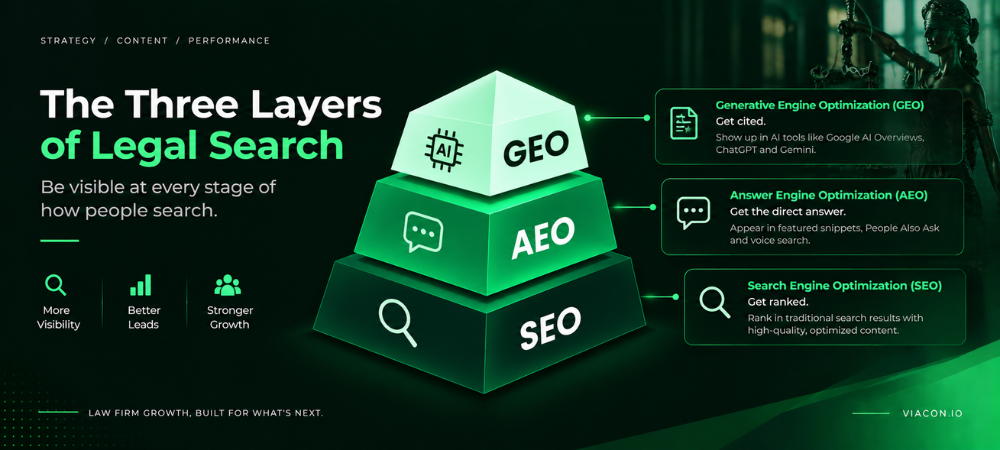
| Does GEO Replace SEO For Law Firms? No. AI tools often pull from pages that already perform well in search, so strong SEO improves your odds. GEO adds citation-ready answers, clear entity signals, and outside proof on top of that base. One well-built page can serve all three goals. |
Why AI Search Changes How Clients Find Lawyers
Legal research habits are changing. Clients once searched, scanned ten links, and opened a few tabs. Now many of them ask an AI tool and read one summary.
Prospective Clients Use AI For Questions Like These:
- Who are the best family lawyers near me?
- What should I ask before hiring an immigration attorney?
- How long does a workers’ compensation claim take?
- Do I need a lawyer after a minor car accident?
Each answer shapes a shortlist. If the AI names your competitor, you lose the chance before the person ever visits your site. Marketers call this zero-click research because people learn, compare, and narrow their options without clicking anything. As a result, visibility inside the answer now matters as much as your position in the results.
How AI Engines Choose Law Firms And Legal Sources
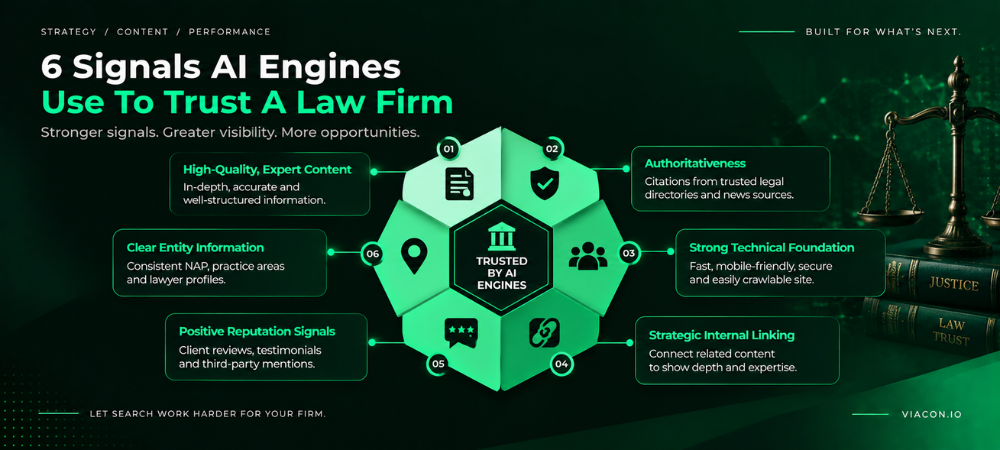
No public formula explains how AI tools pick their sources. Still, six signals appear again and again in the pages they cite. Each one helps the system feel confident about who you are and what you know.
Authority And Trust: Detailed attorney profiles, credentials, bar admissions, and review processes back up your expertise. Together, they support E-E-A-T (experience, expertise, authoritativeness, and trustworthiness).
Structured, Factual Content: Plain definitions, clear headings, tables, and short FAQs make passages easy to pull out.
Original Value: Expert commentary, anonymized case patterns, local court insight, and your own research set you apart from routine summaries.
Entity Consistency: Your firm name, attorney names, locations, and practice areas should match across your website and every outside profile.
External Corroboration: Mentions in legal publications, local organizations, directories, podcasts, and news outlets support your claims.
Freshness And Depth: A current, thorough resource beats a thin page built around one keyword.
Generic content gives an AI tool no reason to cite you. So aim to become the primary source instead of one more page that repeats what everyone already says.
Where The Major AI Platforms Differ?
Each platform builds answers a little differently, so one “GEO tactic” won’t cover them all. The table shows general patterns. They can change as the platforms update.
| Platform | What It Tends To Favour | What To Do |
|---|---|---|
| Google AI Overviews | Pages that already rank well and answer the question plainly near the top | Strengthen organic rankings and open key pages with a direct answer |
| Perplexity | Clear sourcing, recent dates, and a briefing-style tone | Cite sources, show update dates, and skip sales language |
| ChatGPT search | A mix of live web results and its exposure to your brand | Build a consistent presence across your site, directories, and news mentions |
| Copilot and Gemini | The same signals as Bing and Google | Keep technical SEO and authority signals strong |
A firm with weak organic visibility often struggles to earn a citation in Google’s summaries, no matter how well the page reads. Our guide to Google AI Overviews explains how those summaries choose their passages.
| Do Law Firms Really Get Recommended By ChatGPT? Yes, although no placement is guaranteed. Strong entity signals, authoritative content, and credible third-party mentions all improve your odds. ChatGPT tends to draw on several sources, so a consistent presence across your site, directories, and news coverage helps more than one strong page. |
The GEO Playbook For Law Firms
A solid GEO playbook makes your firm easier to understand, trust, and reference. It works in four steps: define your entity, publish citation-ready content, fix your technical base, and earn outside mentions. Our AI search optimization (GEO) services support all four.
Step 1: Build A Recognizable Legal Entity
Effective GEO starts well beyond your blog. Your whole digital footprint should explain who you are, where you work, what you handle, and who provides the legal expertise.
Attorney biographies need more than a short summary. Include education, jurisdictions, bar memberships, practice experience, publications, awards, and clear areas of expertise. Likewise, your About page should connect your firm’s history to its locations, attorneys, and services. Skip broad promotional claims.
These details help search engines and AI tools tie scattered references back to one verified entity. Even small naming differences weaken that link. For example, “Smith & Jones LLP” on one site and “Smith and Jones Law” on another can look like two different firms.
Step 2: Create Content Designed For Citation
Citation-ready content answers real questions with enough context. A page on filing a personal injury claim should explain eligibility, deadlines, evidence, procedural stages, common complications, and state differences. Building this depth takes time, so a dedicated content marketing team can help you plan it around attorney input.
Compare two versions of the same fact. The weak one says, “Personal injury claims have deadlines you must meet.” The strong one says many states set a filing window of two to three years, but the exact deadline depends on the state and the claim type. The second version gives an AI tool a complete, quotable fact.
Structure helps too. Use clear H1 and H2 headings, short definitions, comparison tables, numbered steps, practical examples, key takeaways, and concise FAQs. However, formatting alone doesn’t create authority. The explanation underneath still needs depth.
Add original material as well: anonymized case patterns, attorney observations, local court considerations, survey findings, and commentary on procedural changes. Protect client confidentiality at every step.
Some lawyers ask how to get a law firm cited by ChatGPT and expect a technical trick. Skip the tricks. Publish accurate, quotable, attorney-led resources that answer the who, what, when, where, why, and how of a legal issue.
| Is GEO Ethical And Compliant For Attorneys? Yes, when you follow your bar’s advertising rules. Keep claims accurate, protect client confidentiality, and avoid guarantees or invented credentials. Many state rules follow ABA Model Rule 7.1, which prohibits false or misleading statements about a lawyer’s services. Have an attorney review every page, and check your own state’s rules before you publish. |
Step 3: Strengthen The Technical Framework
Both users and crawlers need easy access to your content. Clean HTML, logical headings, strong mobile performance, fast load times, and descriptive internal links all help retrieval and comprehension. A technical SEO audit shows which gaps to close first.
Schema markup adds clarity. Depending on the page, you might use LegalService, Attorney, Organization, Article, FAQPage, or HowTo markup. Schema can’t rescue weak content. It does, however, remove doubt about authorship, services, locations, and page purpose.
| Here Is A Minimal LegalService And Attorney Pair In JSON-LD: |
|---|
json{ |
Replace the placeholders with your real details, and test the markup before you publish. Then add FAQPage schema to your high-intent pages. That gives AI tools a clean, machine-readable summary of who you are and what you answer.
Build practice-area clusters through your own internal links as well. A cornerstone divorce guide, for instance, can link to pages on custody, mediation, property division, timelines, and local procedures. This structure builds topical authority instead of isolated keyword targets.
Step 4: Earn Credible Mentions Beyond The Website
Off-site authority still counts. Accurate listings, legal association profiles, interviews, community partnerships, podcast appearances, and editorial mentions all help AI tools recognize you as an established entity. Keep attorney names, office addresses, biographies, and practice descriptions identical on every platform. Then prioritize relevant mentions over a high volume of low-quality links.
GEO Vs. Traditional SEO: What Actually Changes?
Traditional SEO still forms the foundation of law firm AI search optimization. Technical health, backlinks, useful content, local relevance, and an accurate Google Business Profile keep influencing discoverability. GEO adds a layer on top.
| What Remains Important | What GEO Adds |
|---|---|
| Crawlable pages and fast performance | Citation-ready answer passages |
| High-quality backlinks | Consistent entity recognition |
| Local listings and reviews | Third-party brand corroboration |
| Keyword and topic relevance | Original insight and quotable expertise |
| Helpful long-form content | Monitoring across AI platforms |
If your resources are limited, follow this order. First, fix technical barriers. Next, strengthen your entity and attorney pages. Then upgrade your high-intent cornerstone content. Finally, pursue authoritative outside mentions.
| Does Local SEO Still Matter For AI Overviews? Yes. Business profiles, location pages, reviews, directories, and local content all shape location-specific legal answers. This matters most for “near me,” city-based, and jurisdiction-specific questions. Our guide to local SEO for law firms covers how to compete in the Map Pack. |
Start With Four Basics:
- Complete your Google Business Profile.
- Keep your name, address, and phone number identical across every directory.
- Choose primary and secondary categories for each practice area.
- Collect recent, specific reviews instead of a handful of old five-star ratings.
Inconsistent details are a common reason local rankings stall, even when the website itself is strong.
Is GEO Worth It For Your Firm Right Now?
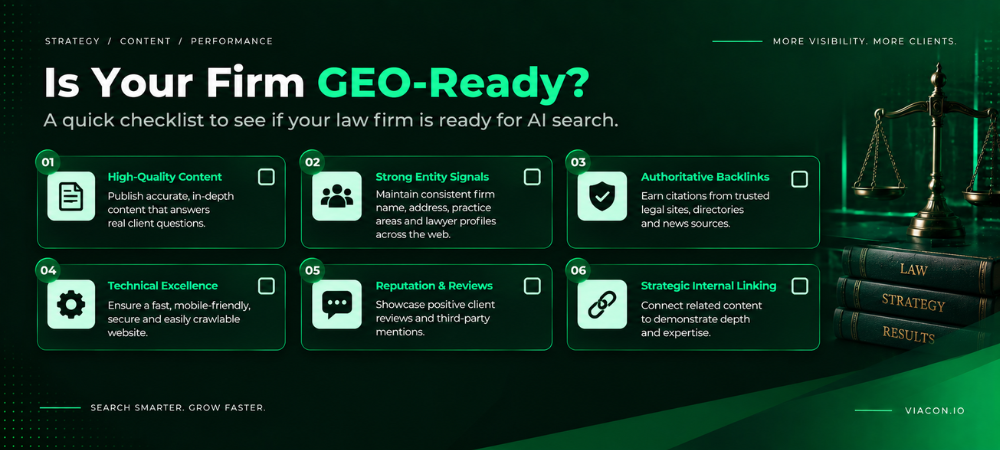
For most firms, yes, but the order matters. GEO builds on SEO, so a weak foundation limits your results. Use this quick check to decide where to start.
Start GEO Now If:
- You already rank on page one for your core practice-area terms.
- Your attorney bios and About page are complete.
- Your directory listings match across the web.
Fix The Basics First If:
- Your site loads slowly or breaks on mobile.
- Your practice-area pages are thin.
- Your firm name or address changes from one directory to the next.
Either way, the work overlaps. Many GEO fixes also improve your traditional SEO, so the effort rarely goes to waste.
Can A Small Law Firm Compete In AI Answers?
Yes. AI tools reward clear expertise, not firm size. A small firm with a focused practice, complete attorney profiles, and strong local proof can earn citations on niche and city-specific questions. Large firms may hold an edge on broad queries, so aim at the specific questions your ideal clients ask.
How Long Does Generative Engine Optimization Take?
Timelines vary by competition and authority. You may notice early changes in visibility within several months, while broader recognition takes longer. GEO is still emerging, so expect gradual movement instead of instant, predictable gains.
Measuring AI Search Visibility
GEO measurement is less standardized than rank tracking. Still, you can watch clear leading indicators: appearances in Google AI Overviews, citations in Perplexity, brand mentions in generative responses, and inclusion in ChatGPT recommendations.
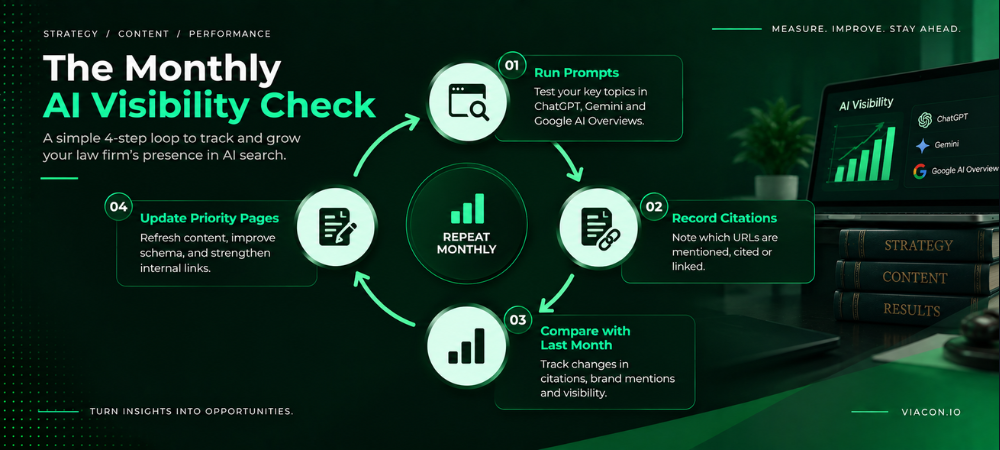
Test the same prompts on the same platforms every month. Record each response and the URLs it cites. Then compare the results over time. Start with prompts like these, and swap in your own city and practice areas:
- “Who are the best [practice area] lawyers in [city]?”
- “What should I look for before hiring a [practice area] attorney?”
- “How much does a [practice area] case typically cost in [state]?”
- “What’s the difference between [practice area A] and [practice area B]?”
A shared spreadsheet works fine for tracking. Some firms add AI brand-monitoring tools that log citations automatically. Perplexity helps here because it lists its sources openly.
Next, connect visibility to business results. Check your referral analytics for traffic from AI platforms, and add a “How did you find us?” field to your intake form. AI referral sessions, consultation requests, qualified leads, branded searches, and assisted conversions tell you more than citation counts alone.
See How SEO Strategy Increased AI Search Visibility for a Law Firm
Download the Vidikarya Case StudyCommon GEO Mistakes Law Firms Make
Thin rewrites remain the biggest problem. Another article that repeats a standard legal definition rarely adds enough value to earn a citation.
Firms Also Weaken Their Results When They:
- Ignore structured data.
- Publish anonymous content.
- Leave attorney profiles incomplete.
- Use inconsistent entity details across the web.
- Publish unedited AI drafts, which risks factual errors and bar advertising violations.
Over-optimizing backfires as well. Stuffed keywords, excessive headings, and mechanical answers make pages harder for people to read. Finally, don’t treat GEO as a one-time project. It needs regular monitoring, content updates, technical care, and steady authority building.
A Practical 90-Day GEO Action Plan
Use this timeline to turn the playbook into a schedule.
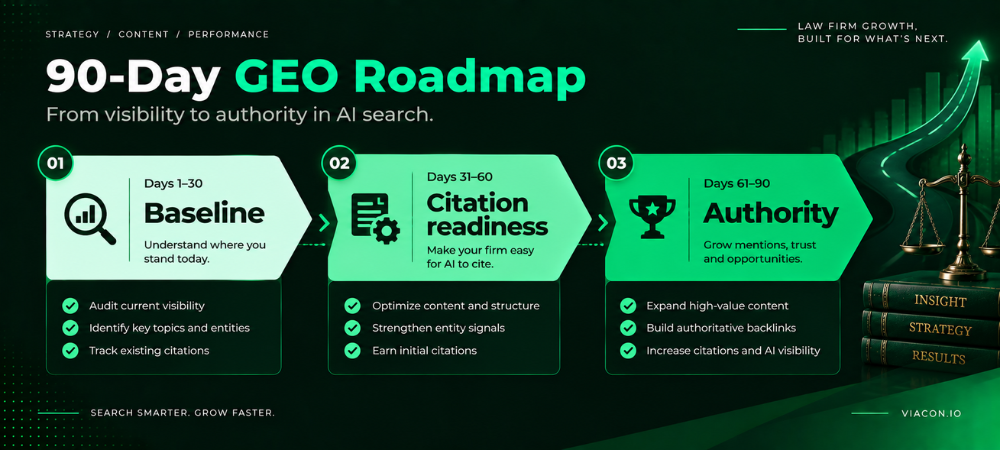
| Timeline | Core Actions | Intended Outcome |
|---|---|---|
| Days 1–30 | Audit AI visibility, technical health, entity signals, attorney profiles, and high-value client questions | Establish a reliable baseline |
| Days 31–60 | Upgrade cornerstone pages, add original insights, improve content structure, and add relevant schema | Increase citation readiness |
| Days 61–90 | Build supporting topic clusters, pursue reputable mentions, test AI prompts, and update priority resources | Expand authority and visibility |
Should You Handle GEO In-House Or Hire An Agency?
An in-house team can manage basic audits, content updates, and prompt testing. Bring in a specialist when you face any of these:
- Technical limits on your website
- Multiple office locations
- Highly competitive practice areas
- No clear way to measure results
If You Hire A GEO Agency For Law Firms, Ask These Questions First:
- Do you have legal-industry experience, including advertising rules?
- How will you measure AI visibility, and how often will you report?
- Who writes the content, and who reviews it for legal accuracy?
- Will you fix entity and technical issues, or only publish articles?
- What results can you show from similar firms?
For a practical example, read Viacon’s law firm SEO case study. It shows the local visibility gains a U.S. firm saw after applying the entity, content, and technical fundamentals in this guide.
Example Of Content That Might Earn An AI Citation
Picture two pages that answer, “When should I contact a car accident attorney?” The first gives a generic answer and pushes a consultation right away. The second explains injury severity, disputed liability, insurance communication, evidence preservation, filing deadlines, and local procedure.
The second page offers far stronger extraction points and more practical value. Now add an experienced attorney who reviews it, with credentials shown on the page. Add mentions of your firm from reputable outside sources. The case for a citation gets much stronger.
Become The Legal Source AI Platforms Trust
Generative search turns legal discovery from a list of options into a single recommendation. So your firm must compete for recognition as a reliable, quotable source, not only for rankings.
Firms that invest in entity foundations, attorney-led content, technical clarity, credible mentions, and steady measurement stand a better chance of appearing in future legal answers. GEO for law firms doesn’t replace SEO. It’s the next layer of your search strategy.
Viacon helps legal practices build that layer through SEO, content strategy, and AI search visibility planning, along with technical optimization and digital authority building. Request a GEO and AI visibility audit to find your citation gaps, rank your best opportunities, and build a practical roadmap for ChatGPT and Google AI Overviews.