When we talk about digital marketing strategies or best practices, the obvious challenge is not the dearth of tactics. Rather, it is quite the opposite; there are too many of them. Whether it is the platforms, dashboards, AI tools, content formats, and supposed growth shortcuts competing for attention.
This raises a more straightforward question: Which digital marketing practices can actually improve visibility, conversions, and customer value?
And the answer rarely involves doing more of everything and becoming niche and focused. The strong marketing programs are becoming narrower, better connected, and considerably more deliberate. It involves using customer data carefully, creating content that both humans and machines can interpret, and removing friction before targeting more traffic.
Yes, they are not flashy, but highly effective.
The Digital Marketing Practices Producing Real Results In 2026
Before diving into the list, it’s worth pinning down the term itself. Digital marketing practices are the specific, repeatable actions a brand runs across search, social, email, paid media, and now AI-driven surfaces to reach buyers, earn trust, and turn attention into revenue. They sit below strategy (which sets direction) and above one-off tactics (which are single executions).
A practice is something a team runs consistently, measures, and refines over time; that consistency is what separates it from a trend a brand tried once and dropped. Viacon’s breakdown of how AI Overviews and GEO are reshaping search is a useful reference point here, since it shows how fast the mechanics behind several of these practices are moving, which is exactly why treating any of them as a fixed, one-time playbook tends to backfire.
| What Are The Most Important Digital Marketing Practices To Start With In 2026? Start with whichever one addresses your biggest measurable gap: CRO and mobile speed if traffic is healthy but revenue is flat, or GEO/AEO and content structure if visibility is the problem. Chasing all eleven practices at once usually dilutes the ones that would have moved the needle fastest. |
Now, let’s focus on the more important question: which are the best practices for digital marketing that are producing real results in 2026?
The best practices listed below are not pulled from a trend report. Most are already influencing how customers discover brands, evaluate choices, complete purchases, and decide whether to return.
A snapshot of what’s working:
| Practice | What Works | What Usually Does Not |
|---|---|---|
| AI personalization | Real-time, behavior-led experiences | Generic automation labelled as personalization |
| GEO and AEO | Clear, citable, entity-rich content | Repackaged SEO copy with extra keywords |
| Short-form content | Immediate hooks and platform-native production | Overproduced corporate videos |
| Omnichannel marketing | Connected high-value touchpoints | Maintaining every channel without purpose |
| CRO | Continuous testing tied to revenue | Sending more traffic into a broken funnel |
| Customer trust | Specific proof and transparent policies | Vague claims about privacy or sustainability |
1. AI-Driven Personalization at Scale
Previously, personalization was mostly cosmetic. It was the first name that appeared in an email subject line, or a returning visitor saw the product they had viewed yesterday.
Useful enough at the time, but hardly personal. In 2026, the definition of personalization shifted. It is now all about adjusting the digital experience as the customer moves through it.
Today, AI models can combine behavioral data, purchase history, transaction values, support interactions, product preferences, and engagement patterns. Based on that, the system then predicts what the person is likely to need next, which in turn influences product recommendations, website content, send times, offers, or the sequence of messages presented across channels.
Still, the impressive demo often hides a rather ordinary problem: messy data. Duplicate records, inconsistent event tracking, missing consent signals, and disconnected tools undermine predictions. AI cannot create a reliable customer view from unreliable inputs. It just makes the confusion move faster.
When the foundation is sound, the payoff can appear across conversion rate, customer acquisition cost, average order value, and retention. Regulated sectors require another layer of caution.
Healthcare marketing in 2026, for example, must treat consent, sensitive data, tracking, and message context as operating constraints rather than compliance paperwork added later. Teams that don’t have the in-house bandwidth to untangle that data layer often bring in AI automation support rather than bolting personalization onto a system that isn’t ready for it.
2. GEO And AEO: Earning Visibility Inside AI Answers
Traditional SEO helps a page become discoverable and competitive in ranked search results. Answer engine optimization, or AEO, makes information easier for a system to extract as a direct response. Generative engine optimization, or GEO, focuses on ensuring a brand, source, or idea is represented in synthesized AI answers.
Now, in modern digital marketing, these disciplines overlap, but in no way are they interchangeable. A page can rank well and never receive an AI citation. On the other hand, a source may be quoted because it provides a clearer definition, a cleaner entity relationship, or a more extractable answer.
Search visibility now spans multiple surfaces. That is the real shift.
So, Useful Actions Here Include The Following:
- Add relevant schema markup to define organizations, authors, articles, products, and FAQs.
- Build consistent associations between the brand and its core topics.
- Structure important sections around real customer questions.
- Directly answer the query and then provide evidence, explanation, and context.
- Review robots.txt rules and crawler permissions instead of assuming every AI system can access the site.
This work is urgent because AI search is changing both discovery and click behavior. The future of SEO is no longer about traditional ranking, as it will not tell the whole story.
An honest caveat, though. Even if SEO trends for 2026 focus on GEO, nobody has completely solved it. Content retrieval methods, citation patterns, and reporting vary by platform. So, it is best to treat GEO as an ongoing visibility program involving technical access, content quality, entity authority, and external mentions. A one-time page rewrite will not do it. Brands weighing where to start can lean on AI search optimization services to audit crawler access and citation gaps before committing budget to a full rebuild.
| How Much Should A Small Business Invest In GEO Right Now? While it is difficult to assign a number, the best way forward is to start with the existing resources. It includes clear, direct answers near the top of key pages, basic schema markup, and an FAQ section built around real customer questions. That covers most of the low-effort, high-impact ground before you need to spend more on anything advanced. How Long Does It Take To See Results From GEO Or AEO Work? Most brands see early signals increased citations or richer search snippets within a few months of structuring content properly, though full authority-building typically takes longer, since it depends on external mentions and entity consistency as much as on-page changes. |
3. Short-Form And Live Content Formats
Content in 2026 is not what it used to be. Today, short-form videos are emerging as the default discovery format, and not just a social media experiment.
Customers use them to find what they are searching for, learn more about specific products/services, compare options, and decide whether a brand is credible.
That’s why Instagram, YouTube, and Facebook have continued consolidating video discovery and paid distribution. TikTok remains culturally influential, but brands are less willing to build an entire content operation around one platform.
At the same time, overproduction can hurt. A video that looks like a television commercial may feel out of place in a feed built around personal, immediate content. But that does not mean careless production. It means removing the layers that make the content feel distant.
Live streaming is also emerging as another avenue, but it serves a different purpose. Its appeal comes from visible uncertainty and direct interaction. Product walkthroughs, expert sessions, live demonstrations, and open Q&A sessions are the classic examples of this format.
The biggest advantage of live streaming is that it helps build trust, as viewers can see how a company responds without the perfect edits. Here, the rough edges are part of the appeal. A social media marketing plan built around a real posting cadence, rather than sporadic bursts, is usually what separates brands that get discovery traction from brands that post occasionally and wonder why nothing moves.
| Is Short-form Video Worth It For B2B Brands, Not Just Consumer Ones? Yes, without a doubt. Even if it looks otherwise, short-format videos for B2B brands work better as the medium for dropping quick insights, behind-the-scenes content, consumer testimonials, and not chasing what’s trending, which is usually the space consumer brands focus on. |
4. Creator Partnerships And User-Generated Content
The next digital marketing best practice to look at in 2026 is creating creator partnerships and user-generated content.
Yes, there is no doubt that celebrity endorsement can bring attention, but what it cannot bring is relevance. Teaming up with micro-creators and genuine customer reviews can often outperform the more established voices, as their recommendations feel closer to an actual buying conversation. Smaller audiences may also be more concentrated around a specific interest, location, profession, or use case.
Operationally, creator marketing works better as a calendar than as a campaign. Brands need a repeatable system for discovering creators, briefing them, reviewing claims, approving usage rights, and repurposing the strongest material. Creative freedom remains important. If every creator reads the same polished script, the partnership loses the authenticity that made it valuable.
User-generated content also requires a collection process. Post-purchase emails, review prompts, community challenges, sampling programs, and customer interviews can produce a steady library of proof. Consent and usage permissions should be explicit. Quietly downloading a customer’s post and turning it into an advertisement is not a strategy.
The ROI extends beyond the first publication. One useful creator video may support organic social posts, product pages, paid advertisements, email campaigns, and sales enablement. That repurposing value changes the economics considerably. This is also where content marketing planning earns its keep, mapping which creator asset feeds which channel before the campaign starts, instead of scrambling to repurpose after the fact.
| Model | Primary Strength | Main Risk | Best Use |
|---|---|---|---|
| Celebrity endorsement | Fast reach | Weak audience fit and high cost | Broad awareness |
| Micro-creator partnership | Niche credibility | Requires more coordination | Consideration and conversion |
| Customer-generated content | Strong social proof | Inconsistent quality | Product pages, ads, and retention |
| Employee or expert content | Subject-matter authority | May appear overly controlled | Complex products and B2B services |
5. Omnichannel Journeys And Social Commerce
The changing landscape of social media and e-commerce is now shifting customer journeys from a funnel drawn in five boxes.
Today, the process is more exhaustive and may not follow a linear and predictable path. In 2026, a buyer may discover a product through a creator, search the brand on Google, read reviews on a marketplace, abandon the cart, ask a question through chat, and complete the purchase after receiving an email.
Social commerce further streamlines this process by bringing product discovery, evaluation, and purchase closer together. The likes of shoppable posts, creator storefronts, in-app catalogues, live shopping, and direct checkout can shorten the distance between interest and action. Also, they work best when product information, inventory, pricing, and fulfilment remain consistent.
Therefore, the more practical starting point is journey mapping. Identify how real customers arrive, where they hesitate, which questions repeatedly interrupt purchase, and which channel restores momentum.
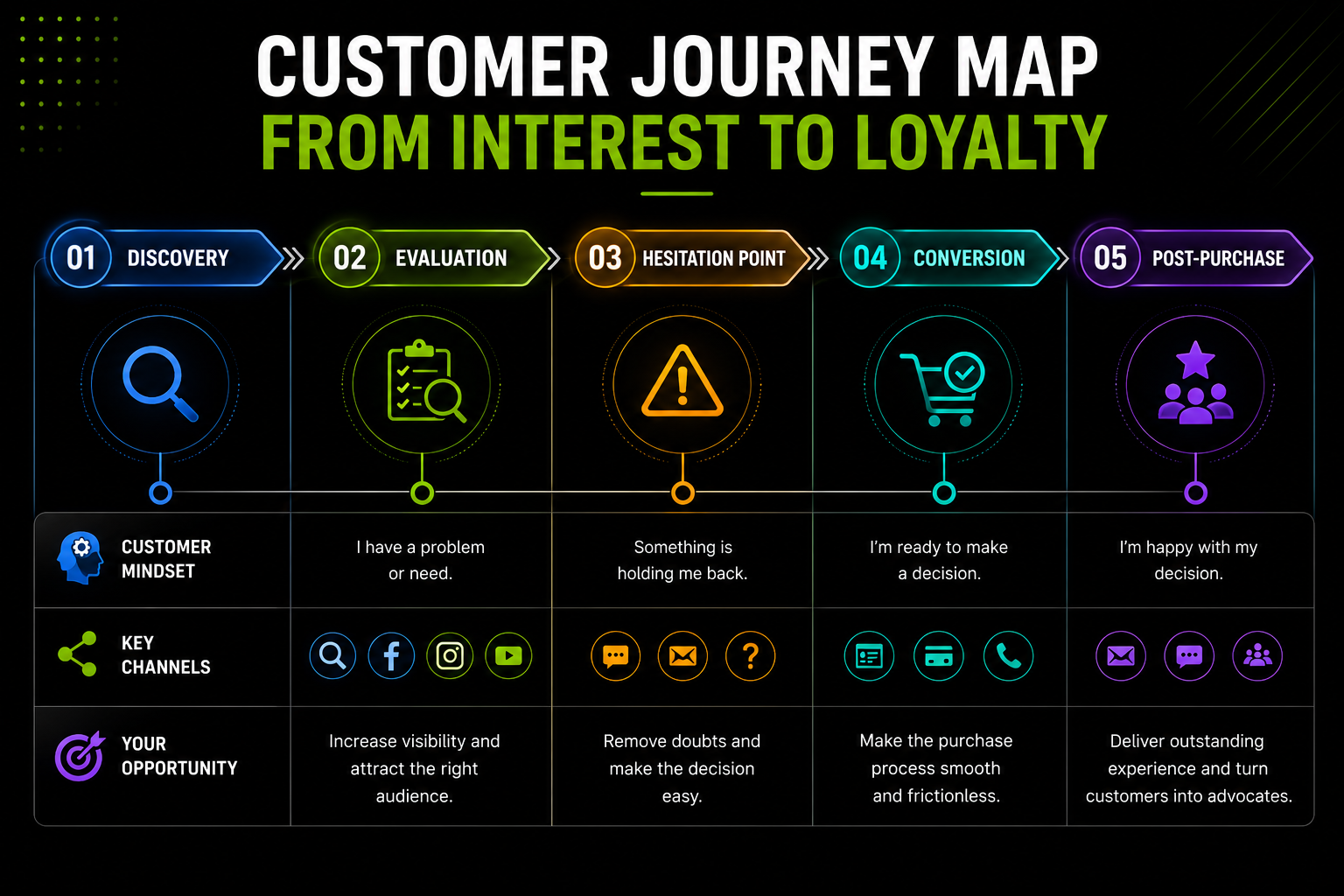
Based on that analysis, fix the biggest friction points first because usually these are ordinary issues such as slow mobile pages, inconsistent offers, missing delivery details, or forms asking for too much information.
Having said that, omnichannel does not mean being everywhere at once. That interpretation creates neglected platforms and fragmented reporting. Rather, it means connecting the smaller set of channels that customers genuinely use, and coordinating performance marketing spend toward the ones that actually move revenue.
6. Data-Driven Optimization And CRO
Next up are data-driven optimization and increased focus on CRO (conversion rate optimization).
Because more traffic never compensates for a weak funnel. Rather, it exposes that weakness to a larger audience. For instance, if a landing page has an unclear offer, a confusing form, or a poor mobile experience, using it to run paid campaigns simply purchases more abandonment.
And conversion rate optimization starts precisely with this observation. Website heatmaps reveal where attention concentrates; session recording shows hesitations, repeated clicks, and navigation failures. Also, funnel reports identify where users leave, and A/B tests then evaluate a specific change rather than a vague redesign.
Additionally, predictive analytics can help prioritize segments or pages with the greatest likely revenue impact.
At the same time, testing discipline matters. Changing a headline, form, colour, price display, and page structure simultaneously may produce a result, but it will not explain the result. That’s why strong CRO and funnel optimization programs isolate meaningful variables and measure downstream business outcomes.
Optimization must also extend beyond the website. Off-page performance has shifted from backlink volume toward contextual trust, editorial relevance, expert mentions, and credible brand associations. So, understanding the connection between on-page and off-page SEO explains why page relevance and external authority now need to reinforce one another.
Furthermore, CRO compounds in a way media spending usually does not. A higher conversion rate improves the return from organic search, paid media, email, creator content, and referrals simultaneously.
And that’s why experts suggest you stop buying advertisements and focus on improving the core journey, with gains continuing across channels.
| What’s The Fastest Way To Improve Conversion Rate Without More Traffic? The best way to improve conversion rate without more traffic is to review the existing funnel data before any additional spending. The likes of session recording and heatmaps usually reveal one or two specific friction points (a confusing checkout step, a slow mobile page, a form asking for too much) that are costing you conversions right now, without needing a single extra visitor. |
7. AI Chatbots And Conversational Support
While the use of chatbots for customer support is not new, it had its limitations. Today, the best of them have moved beyond listed operating hours and the repetition of FAQ answers.
Chatbots in 2026 can guide product selection, clarify specifications, recommend the next step, check availability, collect qualification information, and route complex cases to a human while preserving the conversation context.
The contrast between the old and the new is fairly simple. A helpful retail assistant might ask two or three questions before recommending an appropriate product, whereas an unhelpful one displays the same generic menu regardless of intent.
That’s why you should start with one bounded use case. Product matching, appointment preparation, order tracking, or lead qualification may be enough; at the same time, establish escalation rules, review transcripts, measure resolution quality, and expand only after the first workflow is reliable. None of that works if the chatbot is disconnected from where lead data actually lives. CRM integration is what turns a qualified chat into a follow-up your sales team can act on the same day.
| Do I Need A Chatbot If I Already Have A Support Team? Yes, in 2026 you can have a chatbot even with a support team. But don’t think of it as a replacement for human beings, but as a first layer. A well-configured chatbot can handle repetitive, well-defined questions instantly, freeing your team to focus on the more complex cases where a human genuinely adds value. The mistake most teams make here is expecting a bot to handle everything from day one. |
8. Voice Search And Conversational Queries
Voice search adoption has been steady rather than explosive. That makes it easy to dismiss, which would be a mistake. Why? Well, because the larger significance doesn’t lie with the device but with the spread of conversational search behavior across voice assistants, mobile search, AI chat interfaces, and answer engines.
As you already know, typed queries are usually compressed. Whereas spoken ones are more elaborate, with better context, natural phrasing, and follow-up instructions.
For instance, someone may type “best CRM small business” but ask, “Which CRM is easiest for a small sales team that does not have an administrator?” The second query reveals the operational constraint, not merely the topic.
This is why FAQs remain a relatively low-effort way to address these patterns. However, the questions must be derived from insights gained through sales calls, support transcripts, search data, reviews, and customer interviews.
Also, the answers need to be specific enough to stand on their own while still guiding the reader toward deeper content. Structuring these around a proper SEO services framework, rather than bolting an FAQ onto an existing page as an afterthought, is what actually makes them extractable by both search engines and AI assistants.
This work also supports AEO. Clear questions, concise first responses, and structured supporting detail make a page easier for customers to scan and hassle-free for answer systems to interpret.
9. Trust, Privacy, And Sustainability
Privacy and sustainability were once treated as separate corporate topics. In practice, both now contribute to the same judgment: Does this company behave responsibly when customers are not watching?
Privacy expectations have expanded beyond California’s CCPA. For instance, organizations selling across the United States must account for a growing patchwork of state-level rules, consent requirements, deletion rights, and sensitive-data restrictions. Legal text alone will not create trust. Customers need plain-language explanations of what is collected, why it is collected, and how they can control it.
Sustainability follows the same pattern. Broad claims such as “environmentally friendly” or “good for the planet” carry little weight without a defined boundary. That’s why specific claims are now stronger, and brands must state what changed, which part of the operation was measured, over what period, and according to which standard.
Also, there is an obvious paradox here. Personalization needs data, while customers are increasingly wary of surveillance. Therefore, transparency emerges as the practical solution where you should explain the value exchange, request only what is necessary, and provide meaningful controls.
In sensitive industries, specialists familiar with both customer acquisition and compliance are especially valuable. Viacon’s work in the healthcare industry reflects how those constraints shape digital experiences.
10. Loyalty And Community Building
The next digital marketing practice that needs your attention in 2026 is creating customer loyalty and building a community of trusted users. Obviously, the question is why it is so important?
Because customer acquisition costs are rising, which in turn has moved retention closer to the centre of marketing strategy. A brand that repeatedly replaces lost customers will struggle to create durable economics, no matter how impressive the top-line traffic report looks.
Also, modern loyalty programs must go beyond points for purchases. They should focus on rewarding product usage, referrals, reviews, education, participation, and repeat behaviours that indicate genuine engagement. Gamification can help as well, provided it serves a meaningful customer goal.
Community building, however, is a long-term working plan. It also creates a differentiator that competitors cannot easily copy. Having said that, not every company needs a large public community. A focused customer council, a private expert group, a user forum, or a regular virtual session may deliver more value than a noisy channel with thousands of inactive members.
Depth here beats membership count. Brands unsure whether their retention numbers are actually healthy for their industry can benchmark against the results in Viacon’s case studies before setting a target.
11. Location-Based And Mobile-First Targeting
In 2026, geo-targeting has matured beyond novelty notifications sent when someone walks near a store. It can now support localized inventory, service availability, regional offers, delivery expectations, event promotion, and content tailored to practical geographic needs.
The key here is relevance. Location data should improve the experience rather than create the feeling that a customer is being followed. Brands must also explain when location access is requested, how precise it is, and what the customer receives in return.
Also, in 2026, mobile-first thinking is a baseline reality, not a design preference. Yet many campaigns are still planned on large screens and compressed afterwards. The result is familiar: slow pages, crowded navigation, unstable layouts, unreadable comparison tables, and forms that feel twice as long on a phone.
That’s Why You Must:
- Test real mobile speed, not only the appearance of a responsive layout.
- Design forms, checkout, navigation, and content hierarchy for thumbs first.
- Use location information transparently and only where it improves relevance.
Brands that need these pieces connected can benefit from an integrated partner rather than separate vendors working from separate dashboards. Viacon’s digital marketing services bring SEO, paid media, CRO, content, automation, and go-to-market strategy into a shared growth framework.
How To Split Budget Across These Digital Marketing Practices?
None of the eleven practices above is useful in isolation, and none deserve equal funding by default. A realistic split depends on where the business actually loses money today, not on which channel is easiest to buy.
As A Starting Framework:
- Early-Stage Or Budget-Constrained Teams: put the majority of spend into fixing the funnel (CRO, mobile speed, checkout friction) and structuring existing content for GEO/AEO. Both are largely execution cost, not media spend, and both compound.
- Growth-Stage Teams With Steady Traffic: shift weighting toward creator partnerships, short-form content, and social commerce, since the audience already exists and the gap is usually engagement, not reach.
- Established Brands With Rising Acquisition Costs: redirect a meaningful share from new-customer acquisition into loyalty, community, and personalization, where the marginal dollar tends to go further.
This only works if the current numbers are accurate. A free digital audit is a reasonable first step before reallocating anything, since it’s difficult to fund the right practice without first knowing which one is actually underperforming.
| Should I Hire An In-house Team Or Work With An Agency For These Practices? It depends on how many of the eleven practices need to run at once. A single practice, like CRO, can often be managed in-house with the right tools. Running several together personalization, GEO, creator partnerships, and loyalty usually calls for dedicated specialist support rather than stretching a generalist team across all of them. |
Mistakes That Quietly Undo These Digital Marketing Practices
Most of the practices above fail for the same handful of reasons, regardless of industry or budget:
- Running A Practice Once And Calling It Done: GEO, CRO, and loyalty programs all compound over months, not a single sprint.
- Personalizing On Top Of Bad Data: No AI model fixes duplicate records or missing consent signals; it just repeats the error faster.
- Treating Omnichannel As “Be Everywhere”: Spreading a small team across ten channels usually produces ten mediocre ones.
- Skipping The Definition Step: Publishing an FAQ without structuring it for extraction, or claiming “sustainable” without a measured standard behind it, both undercut the trust these practices are meant to build.
- Scaling Content Without Checking Whether It’s Actually Needed: Programmatic approaches can produce volume fast, but only pay off when the underlying programmatic SEO structure targets real search demand rather than every possible keyword variation.
- Measuring Activity Instead Of Outcome: Posting frequency, campaign count, and impressions are not the same as revenue, retention, or conversion rate.
Specificity, Not Channel Volume, Will Define The Stronger Marketing Strategy
The obvious temptation is to turn these 11 practices into 11 new initiatives. But resist it. A stretched team operating every channel badly will usually lose to a focused team solving two or three meaningful customer problems properly.
That’s why start with the largest gaps. If discovery is weakening, examine GEO, AEO, creator content, and conversational queries. But if the traffic is healthy but revenue is flat, prioritize CRO, mobile experience, and purchase guidance. Similarly, when acquisition costs are rising, focus on loyalty, community, personalization, and post-purchase communication.
Then make the work measurable. Assign one commercial outcome to each practice. Clarify which data it needs, which team owns it, and what would justify continued investment and stop treating activity as evidence of progress.
| Do Small Businesses Need All 11 Practices, Or Just A Few? Just a few, and usually the ones tied to the clearest revenue gap. Most small businesses get more from doing three practices well typically CRO, local/mobile targeting, and basic GEO than from spreading a thin budget across all eleven. |
Therefore, to sum up, the defining advantage in 2026 is specificity: specific audiences, specific questions, specific friction points, and specific proof. A broad digital presence may create the appearance of momentum, but precise execution delivers results.
Viacon helps businesses identify high-impact gaps and connect strategy with practical execution across search, content, paid media, conversion, and customer experience. If your marketing operation is active but not compounding, contact Viacon to build a more focused digital growth roadmap.