Property discovery has changed. Buyers still browse portals and call agents, sure. But they also scroll neighborhood videos late at night, save home tours to watch again, and quietly size up an agent’s credibility before ever sending a message. Many home shoppers now check an agent’s social profiles before reaching out, which means the feed does part of the vetting long before the phone rings.
That shift makes real estate social media marketing part visibility engine, part trust system, and part lead-generation channel.
Posting another listing with a generic caption won’t move the needle anymore. Effective promotion blends Instagram, TikTok, and YouTube with local expertise, useful education, and a conversion path someone can actually follow. The content has to answer questions before it asks for business.
What Is Real Estate Social Media Marketing?
Real estate social media marketing means using social platforms to attract, educate, engage, and convert potential buyers or sellers. It draws on organic content, personal branding, community interaction, property promotion, and structured lead generation, and it works best as one piece of a broader real estate marketing plan rather than a standalone tactic.
Its influence stretches across the buyer’s journey. A neighborhood Reel creates initial awareness. A market explainer builds consideration. A property walkthrough or buyer guide often prompts a direct message from someone who’s actually close to deciding.
| Is Social Media Marketing Effective For Real Estate? Yes, provided agents treat it as a relationship channel rather than an automated listing feed. Results build up over time, through accumulated recognition and credibility. One viral post rarely changes a business on its own. |
Why Social Media Marketing Matters for Real Estate Agents
Real estate decisions involve real money, tight timing, and a fair amount of second-guessing. Prospects research the person behind the profile before they start a conversation, and a useful online presence removes some of that uncertainty before it ever becomes an objection.
Strong social media marketing helps agents build local visibility, demonstrate expertise, showcase properties, reach buyers and sellers, generate inbound inquiries, and stay connected with past clients. It keeps an agent top of mind between transactions, which matters in a business where the average buyer only moves every several years.
Traditional real estate marketing leans on inventory. Social media for realtors should reveal something inventory can’t: market knowledge, communication style, neighborhood familiarity, and problem-solving ability. Trust comes first. Listings support it afterward.
Set Up Your Profile Before You Post
Content only works if the profile behind it looks credible. Before publishing a single Reel, an agent’s bio should state the market served, include a direct way to make contact, and link to one clear destination: a booking page, a landing page, or a resource download. A blurry headshot, an inconsistent handle across platforms, or a bio with no location signal quietly undercuts everything posted afterwards.
A few habits make the biggest difference: use the same profile photo and handle everywhere so people recognize the brand across platforms, pin a short video introduction to the top of the grid, and update the bio link whenever a new campaign or listing goes live. This sounds basic, and it is, but agents skip it constantly, then wonder why a well-produced video underperforms.
Which Social Media Platforms Are Best For Real Estate?
No platform wins every job. The right channel depends on the audience, the market, the content strengths available, and the stage of the customer journey.
| Platform | Primary Opportunity | Best Content |
|---|---|---|
| Property discovery and personal branding | Reels, carousels, Stories | |
| TikTok | Reach and short-form discovery | Hooks, tips, quick tours |
| YouTube | Search, authority, and detailed tours | Guides, walkthroughs, updates |
| Local communities and existing audiences | Groups, updates, community posts |
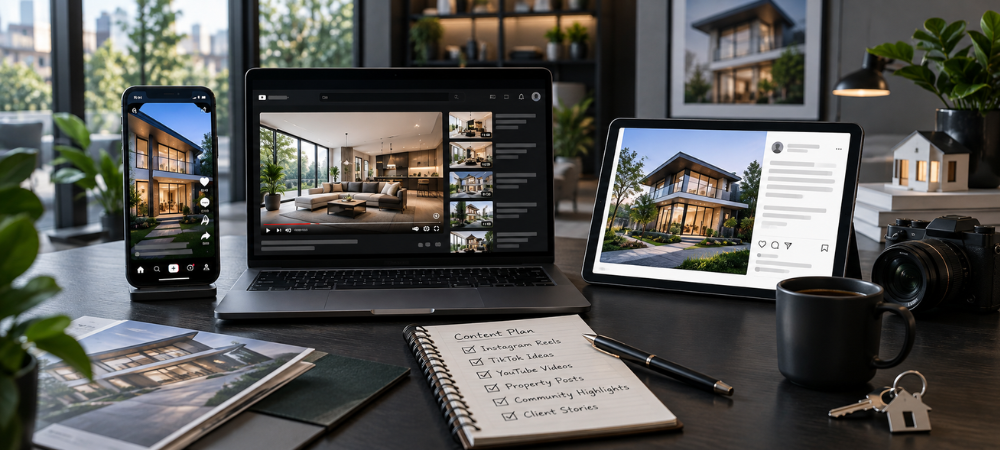
| What Social Media Platform Is Best For Real Estate Agents? Instagram offers the most balanced starting point, TikTok supports discovery, and YouTube builds long-term search visibility. Platform fit matters more than platform popularity. A fast-growing suburban market often gets more from Facebook groups than from chasing TikTok trends. |
| Should Realtors Post The Same Content On Every Platform? No. Core ideas can be repurposed, but format, pacing, captions, and calls to action should reflect each platform’s audience behavior. A caption that works on Instagram usually reads too polished for TikTok, and a TikTok hook feels rushed if it’s pasted straight into a YouTube description. |
Instagram Marketing For Real Estate
Good Instagram marketing combines visual appeal with real decision-making value. Attractive homes capture attention, but useful context is what keeps people watching, saving, and coming back.
Property Reels and carousels remain useful, especially when they explain layout, price positioning, renovation potential, or neighborhood access. Effective Instagram marketing also includes neighborhood content, market updates, buyer and seller tips, testimonials, Stories, polls, and Q&A sessions.
A healthier content mix might run a fast property Reel highlighting one standout feature, a carousel that breaks down closing costs, a spotlight on a neighborhood café or park, a seller testimonial with specific context, and a Story answering a common financing question.
Reels need a clear promise. “What $500K buys in [City]” creates immediate context. “Three mistakes first-time buyers make” addresses a worry people already carry around. Quick property tours, family-focused neighborhood guides, and before-and-after staging videos work because viewers understand the value almost instantly.
TikTok Marketing For Real Estate
TikTok extends reach beyond an agent’s existing network. Short-form video rewards clarity, relevance, and an opening line that earns another few seconds of attention; glossy production helps far less than most agents assume.
Useful TikTok topics for real estate include property tours, real estate myths, buyer mistakes, local market insights, seller misconceptions, neighborhood comparisons, and behind-the-scenes clips. The strongest videos focus on one question instead of cramming an entire seminar into forty seconds.
Start with a direct hook, such as “Before buying a condo in Miami, check this.” Address one topic, add readable captions, connect the advice to a local market, and close with a simple call to action. “Message for the checklist” usually lands better than a hard sales pitch.
YouTube Marketing For Real Estate
YouTube supports deeper explanation, which suits property walkthroughs, neighborhood guides, market updates, first-time buyer education, buying-versus-renting discussions, and local cost-of-living videos.
Unlike disposable posts, useful real estate YouTube content keeps attracting viewers through search months after it is published, which makes the platform particularly valuable for authority-building and location-based discovery. That same search behaviour is exactly what a well-built real estate SEO strategy targets, so the two efforts reinforce each other rather than compete for attention.
Titles should combine location and search intent: “Downtown Austin Condo Tour Under $400K” outperforms “New Listing!” almost every time. Thumbnails need one clear visual idea, not clutter. Descriptions should summarize the subject in the first two lines, chapters should make longer videos easy to navigate, and lead-generation calls to action should point viewers to a relevant resource, form, or consultation.
Facebook And LinkedIn: The Platforms Agents Underuse
Instagram and TikTok get most of the attention, but Facebook still does heavy lifting for local reach. Community groups, neighborhood pages, and local buy-and-sell forums put an agent in front of people who are already discussing the exact market being targeted. Facebook also rewards longer-form updates and event posts better than Instagram does, which makes it a natural home for open house announcements, market recap posts, and client Q&A sessions that don’t fit a 30-second video.
LinkedIn plays a different role entirely. It won’t generate many buyer leads, but it builds referral relationships with other agents, mortgage brokers, attorneys, and past clients who might send business an agent’s way. A short post recapping a closed deal or a market trend, written without the polish of a sales pitch, tends to perform better here than anywhere else.
| Do Real Estate Agents Need A Presence On Every Platform? No. Spreading thin across five platforms usually produces worse content than doing two platforms well. Most agents get further by picking one platform built for reach and one built for trust, then giving each the attention it needs. |
Should Realtors Use Paid Social Media Ads?
Organic content builds the trust engine, but paid distribution stretches its reach. The agents who get the most out of a limited ad budget don’t run cold ads from scratch; they identify the two or three organic posts that already performed well and put a small daily budget behind them to reach a hyperlocal audience. Boosting proven content beats guessing with fresh creative every time, and it costs far less than most agents expect.
A simple approach works for most budgets: run geo-targeted boosts around listings and open houses, retarget people who watched a video past the halfway mark, and route every ad toward a single next step: a DM, a form, or a booked call. Viacon’s social media marketing services build this kind of paid-organic pairing for real estate clients who want the ad spend to actually convert instead of just generating views.
7 Real Estate Social Media Content Pillars
A practical content strategy needs enough variety to stay useful without becoming scattered. Seven pillars cover most of what a real estate feed needs:
- Properties (tours, features, staging, listing context)
- Education (financing, negotiation, timelines, paperwork)
- Neighborhoods (amenities, commute options, local character)
- Market Insights (inventory, demand, pricing, trends)
- Personal Branding (working style, expertise, professional perspective)
- Client Success Stories (challenges, decisions, outcomes)
- Community And Lifestyle (events, local businesses, attractions, routines)
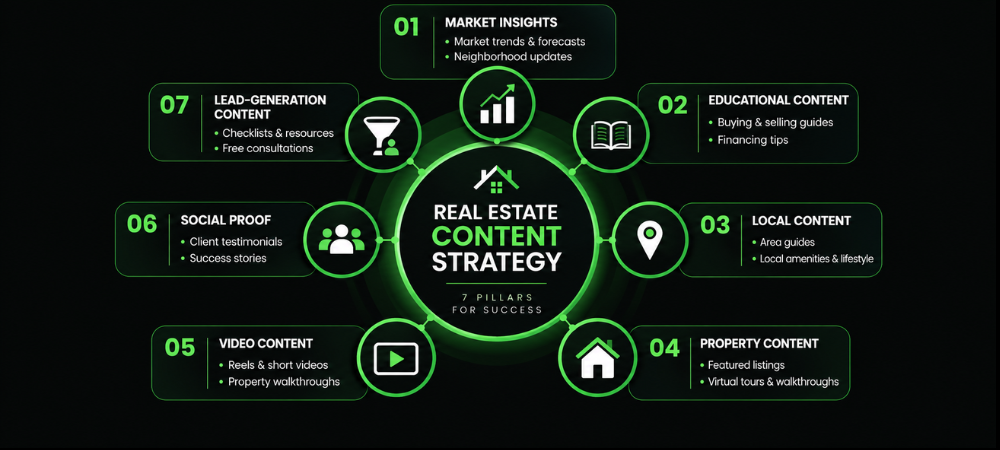
Together, these pillars keep real estate social media content from turning into an endless stream of promotional listings. Prospects see not only what an agent sells, but how that agent thinks.
Should Real Estate Agents Use AI For Social Media Content?
Yes, with limits. AI tools speed up ideation, help brainstorm a month’s worth of content topics, and produce workable first drafts of captions and scripts. Where agents run into trouble is publishing that first draft untouched; generic AI phrasing reads the same across a thousand accounts, and it strips out the local detail that makes real estate content work in the first place.
The better workflow uses AI for the first 70 to 80 percent of the work outlines, research, caption variations and leaves the final pass to the agent or their content team, adding the specific street name, the actual client detail, the local reference an algorithm can’t invent. Agencies that specialize in content marketing typically build a tone-of-voice framework first, so AI-assisted drafts already sound like the agent rather than like a template that needs heavy editing later.
How To Turn Social Media Followers Into Real Estate Leads
Followers are not leads until they take an identifiable action. Therefore, content should –
- Address buyer or seller problems
- Include clear calls to action
- Encourage direct messages
- Offer relevant resources such as checklists or market guides.
The conversion path should remain simple:
Content → Engagement → DM/Form → Qualification → CRM → Follow-up → Appointment
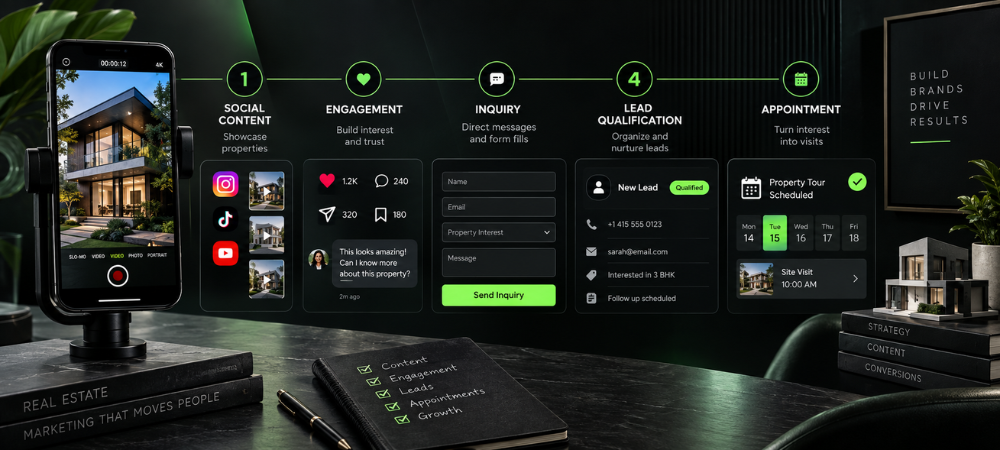
The conversion path should stay simple: content leads to engagement, engagement leads to a DM or form, the form leads to qualification, qualification feeds into the CRM, and the CRM triggers follow-up that turns into an appointment. Some agents automate the first step of that chain with a DM-automation tool that delivers a resource the moment someone comments a keyword, which keeps a hot lead from going cold while the agent is busy showing a house.
| How Do Real Estate Agents Get Leads From Social Media? They connect high-intent content to dedicated landing pages, collect essential information, move contacts into a CRM, and follow up promptly. Lead generation depends less on audience size and more on relevance, timing, and process. |
Local Social Media Marketing For Realtors
Broad real estate content faces broad competition. Local marketing creates a tighter, more defensible position: an agent can become associated with a city, a suburb, a zip code, or even a cluster of neighborhoods that a bigger competitor never bothers to target directly.
Neighborhood-specific posts, local keywords, business spotlights, market updates, “Living in [City]” videos, and neighborhood comparisons all build geographic authority. Social media for realtors becomes more commercially useful once it attracts people who are actually interested in the market the agent serves, rather than a broad, undifferentiated audience.
| Do Real Estate Agents Need Professional Video Equipment? Not necessarily. A modern smartphone, clear sound, stable framing, useful information, and adequate lighting cover most platforms’ needs. Production value matters less than most agents assume; a shaky but genuinely useful video usually outperforms a polished one with nothing to say. |
How Often Should Realtors Post On Social Media?
Publishing frequency should support quality, not replace it. A sustainable schedule beats an ambitious calendar that collapses after two weeks.
| Content Type | Suggested Frequency |
|---|---|
| Short-form video | 2 to 4 per week |
| Educational content | 1 to 2 per week |
| Stories | 3 to 5 per week |
| Property content | Based on available listings |
| YouTube videos | 2 to 4 per month |
An 80/20 split gives most agents a useful gut check: roughly 80 percent of posts should inform, entertain, or inspire, and about 20 percent should sell directly. If a feed starts feeling like a wall of listings, that ratio has usually slipped.
Consistency and relevance matter more than hitting a number. If every post feels rushed or repetitive, the fix is rarely to post more; it’s to slow down and produce fewer posts that people actually want to see.
How To Measure Real Estate Social Media Marketing ROI?
Measurement should move from attention to commercial impact. Reach, engagement, and profile visits help diagnose content performance, but DMs, leads, qualified leads, appointments, cost per lead, closed deals, and attributed revenue reveal actual business value.
This is where real estate social media marketing becomes accountable. Follower counts and views are vanity metrics in isolation. Business metrics show whether the content attracts suitable prospects and moves them toward an appointment.
| How Much Does Real Estate Social Media Marketing Cost? Costs range widely. An agent posting and editing content solo spends time rather than money, aside from occasional ad boosts of $5 to $20 a day. Hiring a freelancer or small agency for content production and management typically runs from a few hundred to a few thousand dollars a month, depending on video volume and whether paid ads are included. |
| How Long Does Social Media Take To Generate Real Estate Leads? Timelines vary, but consistent local content, clear calls to action, and prompt follow-up usually start producing qualified inquiries within several months. Agents expecting results in the first few weeks are usually the ones who quit before the strategy has time to work. |
Common Real Estate Social Media Marketing Mistakes
Several mistakes repeatedly weaken otherwise promising accounts. Agents often post only listings, copy competitors, chase followers, ignore local content, open videos with weak hooks, and publish identical material across every platform.
Other problems sit deeper in the funnel: posts with no call to action, no conversion tracking, and slow replies to inquiries. Even strong content can’t compensate for a broken follow-up process. Attention has a short shelf life, and a lead who doesn’t hear back within a few hours often moves on to the next agent in their feed.
A 30-Day Real Estate Social Media Marketing Plan
| Week | Primary Focus | Practical Actions |
|---|---|---|
| Week 1 | Foundation | Refine profiles, define the audience, and select content pillars |
| Week 2 | Production | Publish property, educational, and local content |
| Week 3 | Conversion | Increase engagement, test CTAs, and introduce lead resources |
| Week 4 | Optimization | Review analytics, identify winning themes, and repurpose content |
This plan gives agents enough structure without making the calendar rigid. After thirty days, high-performing topics tend to become recurring series across whichever platform suits them best.
COO Insight: A Solution-First Social Strategy “Ask what problem your brand can solve better than anyone else. Then build social content around that query. […]”
— Ejaz Ahmad, COO, Viacon
Recognition, Trust, And Timely Action Win The Market
The goal isn’t to become the most-followed realtor in a market. It’s to become the professional that market recognizes, trusts, and contacts the moment someone’s ready to buy or sell.
Done carefully, real estate social media marketing connects local expertise with consistent education and a clear conversion process. For agents and property businesses that need a sharper strategy, Viacon develops platform-specific content, strengthens digital positioning, and builds campaigns designed around measurable growth.
For example, Viacon helped Birla Tyres improve its digital presence through a mobile-first website, stronger product discovery, and SEO-led optimization. User engagement rose 30 percent, organic inquiries increased by 40 percent, and the bounce rate dropped 20 percent a clear example of how integrated digital execution turns visibility into measurable action.
Contact Viacon to turn scattered postings into an integrated real estate marketing system.