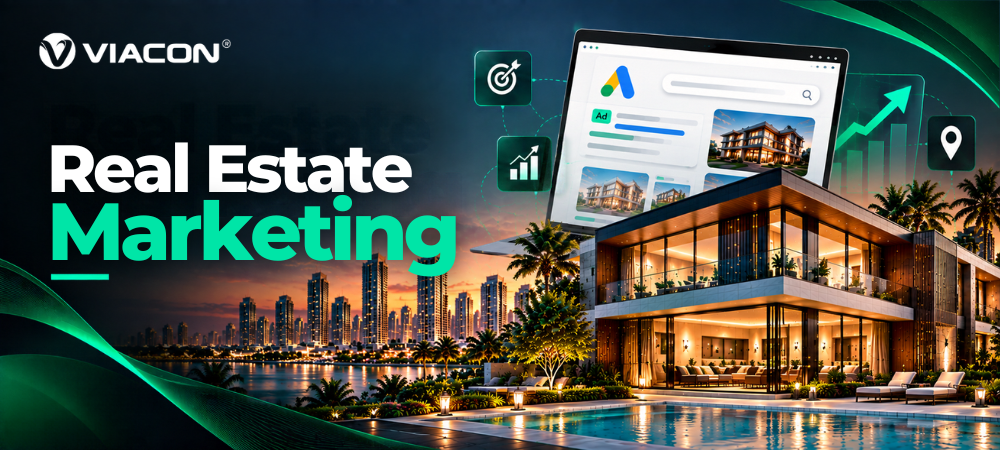
Real estate marketing has evolved over the years. Open house flyers and a post on Instagram quoting “Just Listed” might have worked a few years ago.
But that’s just the bare minimum of what you can do as a marketer. Buyers and sellers expect more in 2026.
Real estate marketing has taken a video-first approach in terms of discovery. Buyers love exploring properties virtually through immersive video. They also turn to AI tools like ChatGPT and Gemini for house-buying requirements.
Therefore, marketing is becoming a challenge due to changing buyer-seller behavior and evolving algorithms for real estate agents and brokerages.
At Viacon, we have spotted this behavioral and algorithmic transition. Marketing for the real estate industry simply doesn’t rely on hard work.
It relies on insight and strategy. Let us help you understand what a buyer sees, clicks, and eventually signs for in 2026 in this comprehensive guide.
1. The New Landscape Of Real Estate Marketing In 2026
Discovery itself works differently now. Buyers no longer wait for a listing to land in their inbox; they find agents through video feeds, AI assistants, and social platforms long before they ever visit a website. Reaching them where they already spend their time, through a genuine social media presence, matters more than it ever has, because it’s often the very first touchpoint a buyer gets with an agent.
From Passive Listings To Immersive Digital Experiences
There was a time when listing your property on a platform used to mean everything. And a few flyers here and there were enough to command attention.
Now, attention lies in the palms of your target audience’s hands.
Discoverability Is Now Dependent On:
- Immersive visual technology
- Social-first content
- Artificial intelligence
Around 42% of buyers connect with their real estate agent through the internet, and listings with a video generate around 403% more inquiries.
If your property marketing strategy doesn’t check those boxes, people will scroll past even the most well-staged property.
People want to feel like they’re already walking through the front door before they ever book a showing. That’s the feeling you must focus on creating as a real estate agent or a brokerage.
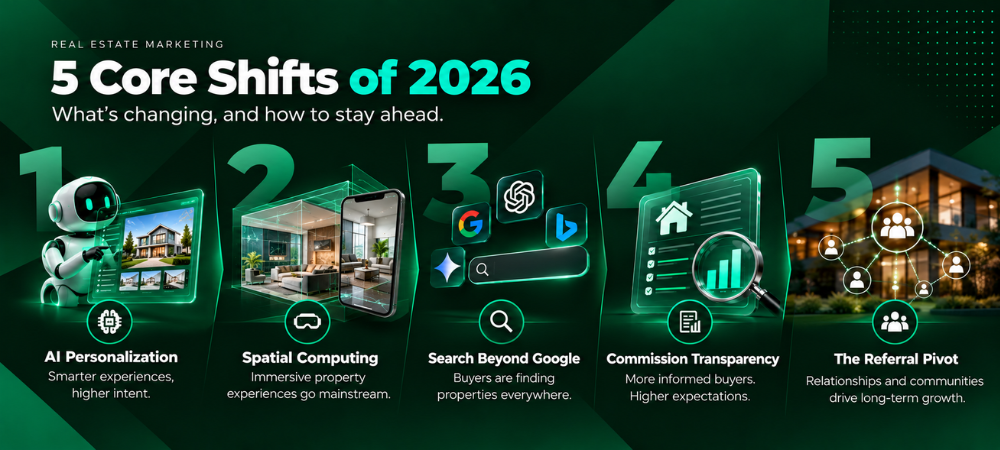
Core Shift 1: AI-Driven Personalization
The biggest change in real estate marketing is the integration of artificial intelligence, or AI. 68% of real estate professionals have adopted AI for their marketing efforts.
In 2026, a listed property or a digital presence with a website is considered more passive as far as marketing is concerned. Smart real estate agents are using buyer intent data to identify what they want even before they search for something on the internet. They are tailoring responses, optimizing their property listings, and websites to slide into a buyer’s AI chatbox.
In 2026, AI-powered real estate marketing and personalization for AI is more than about hopping on trends. It’s a marker of trust.
Core Shift 2: Spatial Computing & Virtual Staging
Take your phone out, click some pictures, and upload them to your real estate Instagram channel.
That used to be a good strategy around 2020. But not now. Flat photography no longer wins over your audience. Marketers are investing in 3D walkthroughs, spatial computing tours, and instant AI virtual staging in 2026.
The intention? It’s to let buyers picture themselves in a space almost immediately. We’ll admit, the first time we saw a raw, empty room get virtually staged in minutes, it changed how we thought about listing prep entirely.
Core Shift 3: Search Beyond Google
Search itself has changed shape. How do buyers search for homes in 2026? Buyers are asking AI tools and voice assistants things like “best neighbourhoods for families near downtown” instead of typing a keyword into Google.
Buyers consider neighborhood-level social signals when considering a property before they buy one. Do you solve that by repeating the location or city name on your web pages? Certainly not. AI models are looking for specific details like school zones, park walkability scores, transit routes, and local community features.
So, how to market your property on AI as a real estate agent or brokerage? We’d recommend optimizing for AI voice search queries, providing location-specific context, and publishing content on earned media.
AI citations heavily depend on local press, forums, and review platforms. Of course, your self-published content matters. But brand citations across earned media pay off in real AI visibility beyond traditional guest posts with backlinks.
That means Generative Engine Optimization, or GEO, matters just as much as traditional SEO now, especially at the neighborhood level.
Core Shift 4: Commission Transparency And The Trust Economy
Marketing doesn’t happen in a vacuum, and the biggest structural change in the industry over the past two years has nothing to do with algorithms. The NAR commission settlement, which took effect on August 17, 2024, pulled buyer-agent compensation off the MLS entirely. Buyers now sign a written agreement before an agent can show them a single home, and as of January 1, 2026, updated Code of Ethics language reflects that agents negotiate cooperative compensation deal by deal instead of offering it upfront.
None of that changes what commissions actually are. Sellers can still choose to cover a buyer’s agent fee, and rates remain fully negotiable, exactly as they always were. What changed is who has to explain the math, and when. A buyer who once assumed representation was “free” now has to sign something that spells out exactly what they’re paying for, often within the first few minutes of working with an agent.
That shift turns marketing into the explanation. Buyer consultation one-pagers, short videos that walk through what a buyer-agency agreement covers, and FAQ pages that answer the “why do I pay you” question before a prospect has to ask it out loud all do double duty now: they inform, and they build the trust buyers used to take for granted. Agents who ignore this and keep marketing the way they did in 2022 are handing that trust-building moment to whoever explains it better.
| Do Buyers Still Pay Real Estate Agent Commissions In 2026? Yes, in most transactions. Sellers can still offer to cover the buyer’s agent fee, and many do, but the offer no longer appears inside MLS listings. Buyers now negotiate and sign off on their agent’s compensation directly, in writing, before any home tour. |
Core Shift 5: Referrals Reclaim The Top Spot
Ask agents what they’re chasing in 2026 and the answer has quietly changed. Referral growth now outranks new lead generation as the top priority in recent industry surveys, a reversal from the year before.
Call it a flight to safety: paid lead generation got more expensive and less predictable, and at the same time buyer-agent agreements made every new lead a longer, more deliberate sales cycle. Relationships an agent already has, meanwhile, convert faster and cost nothing to acquire.
This doesn’t mean paid ads stop working. It means the agents pulling ahead treat their sphere of influence like a funded channel with its own budget line, not an afterthought. A quarterly market update sent to 300 past clients, a handwritten note on a home purchase anniversary, or a small client-appreciation event costs a fraction of what a single competitive Google Ads click runs, and it tends to close faster too.
If you’re weighing where a limited budget should go first, our breakdown of real estate lead generation strategies walks through how referral-building and paid channels actually compare over a full year, not just per lead.
2. Blueprinting Your 2026 Real Estate Marketing Strategy
A real estate marketing strategy needs actual goals attached to it, not vague hopes of “more visibility.”
(i) Set Intent-driven Goals
Tie your campaigns to numbers that matter to your business: lead velocity, listing conversion rate, and cost per acquired client. Vanity numbers won’t pay the bills.
(ii) Map Your Personas Using Real Behaviour
Luxury buyers, first-time investors, relocation clients, and downsizing sellers don’t respond to the same messaging. We’ve seen some of our clients make this mistake in their early campaigns, and they sent the same generic email to everyone on a list, and the results were, well, mediocre at best.
(iii) Build A Connected Real Estate Marketing Plan
Your organic content should feed your paid retargeting, which should feed your email sequences. When these pieces work in isolation, you’re leaving money on the table.
(iv) Set Your Marketing Budget
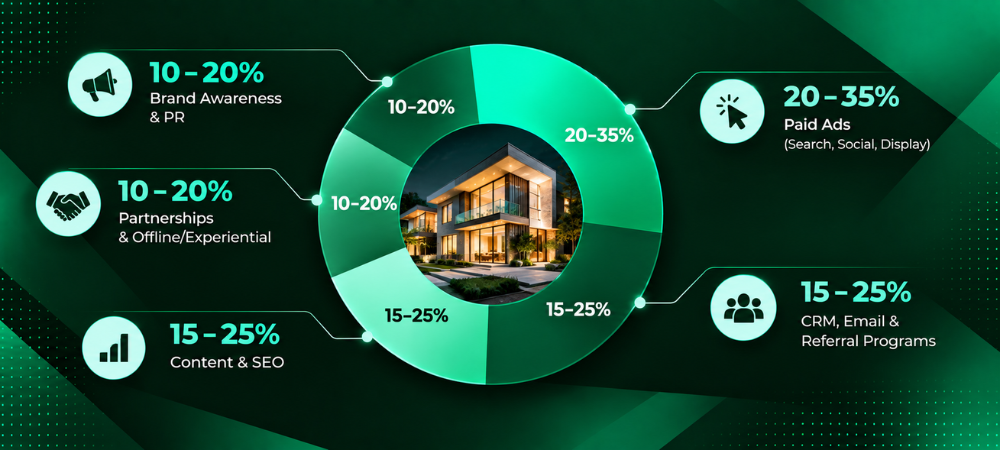
A strategy without a number attached to it is a wish list. Most solo agents and small teams do well allocating 7% to 10% of gross commission income (GCI) to marketing, with an agent earning $300,000 in GCI landing somewhere between $21,000 and $30,000 a year, or roughly $2,000 to $2,500 a month.
That range moves in both directions. New agents without a referral base yet often need to push closer to 15% to 20% to buy the momentum a longer-tenured agent gets for free from repeat and referral business. Boutique or low-volume operations leaning heavily on organic content and their sphere of influence can often run lean, closer to 3% to 5%, and still hold their pipeline steady.
| Budget Priority | Typical Share Of Marketing Spend | What It Covers |
|---|---|---|
| Visual content & staging | 15–20% | Professional photography, video, 3D tours, virtual staging |
| Paid lead generation | 25–35% | Google, Meta, Local Services Ads |
| SEO, GEO & content | 15–20% | Website, blog, neighborhood pages, AI visibility |
| Retention & referrals | 15–25% | Past-client touches, events, referral incentives |
| Tools & software | 10–15% | CRM, automation, design, analytics |
If you’re not sure where your current dollars are actually going, running a free digital audit first will tell you more than another quarter of guessing.
| What Percentage Of Income Should Real Estate Agents Spend On Marketing? Most agents budget 7% to 10% of gross commission income for marketing, adjusting up to 15–20% when they’re new to the business or competing in a crowded market, and down to 3–5% once referrals carry a bigger share of the pipeline. |
3. Core Pillars Of Next-Gen Real Estate Digital Marketing
The following are the core pillars of next-gen real estate digital marketing that brokerages and agents should consider:
Hyper-Local SEO & Generative Engine Optimization
How can a real estate agent appear in AI-generated search results? This starts with your Google Business Profile, earned media citations, and optimizing service info. Keep it updated with location-specific service info, client Q&As, and geo-tagged photos or videos.
From there, build neighborhood landing pages designed to actually get pulled into AI-generated search summaries, not just rank on page one of a traditional results page.
If this part feels overwhelming, it’s worth exploring programmatic SEO services that can scale neighborhood pages without your team drowning in manual content work.
Third-Party Listing Platforms: Zillow, Realtor.com & Beyond
Most buyers still start their search on a portal, not a brokerage website, which makes portal visibility a distribution question rather than a nice-to-have. Zillow logged roughly 228 million monthly visits in 2026, well ahead of Realtor.com’s roughly 82 million, Redfin’s 58 million, and Homes.com’s 32 million, according to recent Semrush traffic estimates.
Homes.com is the one worth watching. Backed by more than a billion dollars in investment from parent company CoStar, it briefly overtook Realtor.com and Redfin in portal traffic on the strength of a “your listing, your lead” model, where an inquiry goes to the listing agent instead of the highest bidder in that ZIP code. CoStar has since said it will pull back that spending through 2030, so treat it as a supplemental channel rather than a replacement for Zillow.
What Actually Moves The Needle On These Platforms
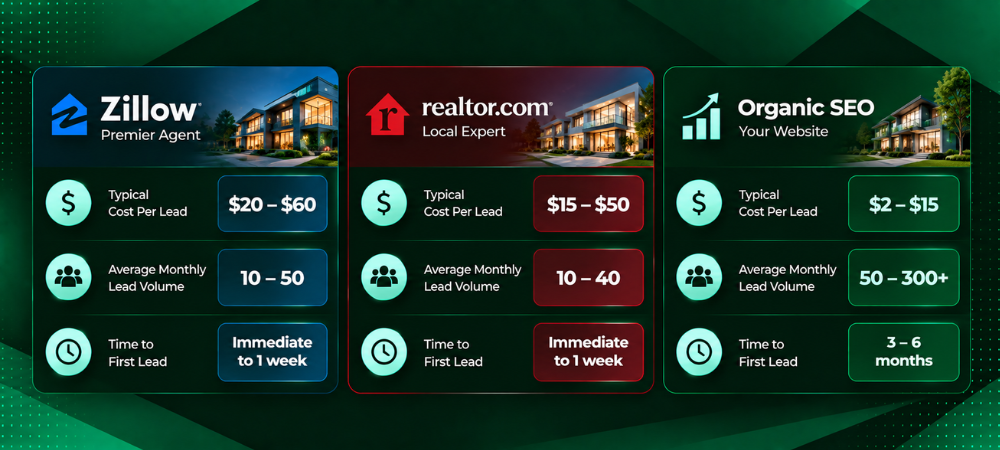
- Zillow Premier Agent buys placement in the “Contact Agent” panel for chosen ZIP codes. Pricing shifts with local competition, typically $250 to $1,000-plus per month per ZIP code, and busier areas cost more simply because more agents are bidding on the same buyer attention.
- Realtor.com’s Local Expert program works similarly and generally runs $200 to $800 a month per ZIP code, with lower volume than Zillow but often a lower cost per lead as a trade-off.
- Complete listing profiles with full photo sets, floor plans, 3D tours, and detailed descriptions get pulled into a portal’s own display algorithm more often than bare-bones ones, so the enhancement itself is close to free lead generation.
- Portal leads are shared. Several agents frequently receive the same inquiry, so a fast, specific reply referencing the actual property beats a generic “I can help you find a home” message every time.
Coordinating this spend with your broader paid channels keeps a buyer from seeing three disconnected pitches from the same agent. A dedicated real estate PPC strategy ties portal advertising, Google Ads, and retargeting together so the message stays consistent no matter where someone runs into your name.
| Is Zillow Premier Agent Worth The Cost For Every Agent? Not automatically. It tends to pay off fastest for agents in moderately competitive ZIP codes who can respond within minutes and have a real system for following up on shared leads. In already-saturated ZIP codes, cost per lead can climb high enough that organic SEO and referral business deliver a better return for the same dollars. |
Email Marketing And Nurture Sequences That Actually Get Opened
Email gets treated like an afterthought in a lot of real estate marketing plans. That’s a mistake. A buyer’s decision cycle often runs six to twelve months, and email is the one channel built to stay in front of someone for that long without feeling like a nuisance.
A few sequences worth building once and running on autopilot:
- Buyer Nurture: a welcome message with a short intake on what they’re looking for, then a spaced drip covering neighborhood matches, current rate and inventory context, and listings that fit their stated criteria. Weekly beats a single blast, and pausing the sequence when someone goes quiet keeps the list from feeling like spam.
- Seller Nurture: a free home-value estimate up front, followed by “what nearby homes actually sold for,” prep and staging tips, and a comparative market analysis offer once they’ve opened two or three prior emails.
Newsletters And Post-Close Touches That Keep You Top Of Mind
- Sphere-of-influence newsletter: a short monthly note with local market stats, a couple of recent sales, and one genuinely useful piece of information. Skip the version that’s just “here are my new listings” — past clients already know you sell houses.
- Post-close touches: a thank-you, a short list of local service providers, and a check-in near the one-year mark. Most homeowners move again within five to seven years, and the agent they remember is the one who stayed useful after closing, not the one who disappeared once the commission cleared.
None of this replaces a solid content marketing strategy built around your blog and social posts. It just gives that content a direct line into someone’s inbox instead of hoping they scroll past it a second time.
| How Often Should Real Estate Agents Send Marketing Emails? Once a month is the floor for a general sphere-of-influence newsletter. Active buyer and seller leads should sit in a tighter, automated sequence roughly weekly until they either convert or explicitly ask for less contact. |
Short-Form Video And The Platform-By-Platform Playbook
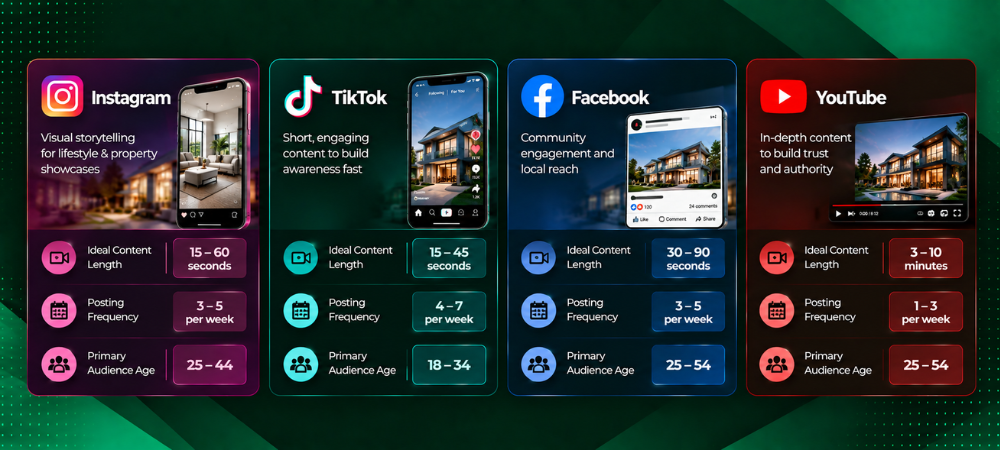
Micro-tours on Instagram Reels, YouTube Shorts, and TikTok are doing a lot of heavy lifting right now. But each platform rewards a slightly different version of the same footage.
- Instagram: Carousel posts of eight to ten photos still outperform single images for saves and shares. Reels between fifteen and thirty seconds pair well with Stories for behind-the-scenes content and quick buyer Q&As.
- TikTok: Buyers under forty increasingly start their search here. A price-point hook, “what $500K buys in this neighborhood,” or a quick buying tip outperforms a polished listing tour, since the algorithm rewards watch time over production value.
- Facebook: Still the strongest platform for reaching buyers over 45 and for community-group visibility. Facebook Events remain one of the more reliable ways to promote an open house to people who genuinely live nearby.
- YouTube: The natural home for longer walkthroughs, market update videos, and neighborhood guides. It also doubles as a search engine; a well-titled market update video can keep ranking in Google results for years after you publish it.
“Day in the Life” neighborhood guides sell the lifestyle around a home, not just the square footage. We’ve found that people remember the coffee shop on the corner longer than they remember the kitchen countertops.
A broader social media marketing strategy that ties these clips back into a content calendar, instead of posting whenever inspiration strikes, is what separates an agent who’s “on social media” from one whose social presence actually produces leads.
Immersive Property Showcasing
360-degree interactive floor plans and digital twin simulations are becoming standard for higher-end listings.
Pair that with AI virtual staging, and buyers can visualize layout, scale, and even renovation possibilities in seconds instead of relying on their imagination alone.
Luxury Real Estate Marketing: A Different Playbook For $1M+ Listings
Everything above still applies to a luxury listing, but a $1.5 million home doesn’t sell on the same budget or timeline as a $350,000 starter home, and marketing it that way undersells the property.
- Cinematic property films with drone footage and professional narration typically run $2,000 to $10,000 — well above a standard listing video, and buyers at this price point expect that polish before booking a private showing.
- A dedicated single-property website with its own short domain, high-resolution galleries, a floor plan, and a private-showing request form signals exclusivity that a shared portal listing simply can’t.
- Income-based ad targeting on Meta and Google, aimed at top-tier ZIP codes or household income brackets, keeps luxury ad spend from getting diluted across buyers who were never going to qualify.
- Print still earns its keep here. A heavy-stock brochure or a placement in a regional lifestyle magazine reaches an audience that still reads them, even in 2026.
- International syndication through platforms like Sotheby’s International Realty or Luxury Portfolio International matters in markets that regularly draw overseas buyers.
Getting found for these searches takes its own neighborhood-level SEO strategy, since “luxury homes for sale in [city]” behaves like a different keyword universe than the volume terms a starter-home listing chases.
| How Much Does It Cost To Market A Luxury Home? Budget $5,000 to $25,000 or more per listing once photography, video, a single-property website, and targeted advertising are accounted for, scaling with the property’s price point and how far the realistic buyer pool extends geographically. |
Fair Housing Compliance In The Age Of AI-Generated Copy
There’s a wrinkle in all this AI-assisted content creation worth flagging directly: AI writing tools are built to persuade, and persuasion naturally drifts toward describing the ideal buyer instead of the property itself.
That’s exactly the line the Fair Housing Act draws at 42 U.S.C. § 3604(c), which prohibits any advertisement that states a preference or limitation based on a protected class. The federal list covers race, colour, religion, sex, disability, familial status, and national origin, and plenty of states and cities add more on top, commonly age, marital status, sexual orientation, and source of income.
The old advice was to avoid a list of forbidden words. That list is outdated and was never quite right to begin with. “Master bedroom” and “walking distance to downtown” describe the home and pass fine. “Perfect for a growing family” or “ideal for empty nesters” describe the buyer, and that’s the actual violation.
| Can I Say A Home Is “Perfect For A Family” In A Listing Description? No. That phrase signals a familial-status preference under the Fair Housing Act, even though it reads as a harmless compliment. Describe the feature instead of the buyer: a large fenced backyard and a finished playroom say the same thing without naming who should be living there. |
4. Data-Driven Real Estate Advertising & Paid Lead Acquisition
Organic marketing through content, earned media publishing, and AI virtual staging sets the foundation. Brokerages and real estate agents must leverage that foundation to go strong on advertising.
Hyper-Targeted Meta & Social Ad Campaigns
The key is in understanding the audience, their intent, and the most critical question: “Will they convert?” Data-driven audience mapping helps here.
Behavioral lookalike audiences and dynamic carousel ads let you show the right property to the right person. This way, you don’t risk wasting ad spend on people who were never going to convert.
Google Search & Local Services Ads
Searches like “sell my home in [city]” or “best listing agent near me” are high-intent gold. These are people ready to act, not just browsing.
Retargeting Infrastructure
Someone visited your site and didn’t convert? That’s not a lost lead; that’s an opportunity.
Re-engage them across display and social with matching property types and fresh market updates.
You can get this right by taking a mix of channels working together. This is why so many teams lean on established digital marketing best practices rather than guessing their way through it.
If Google Ads feels like a black box to you, you’re not alone. A clear Google Ads strategy can be the difference between burning budget and actually filling your pipeline.
Turning Leads Into Signed Clients
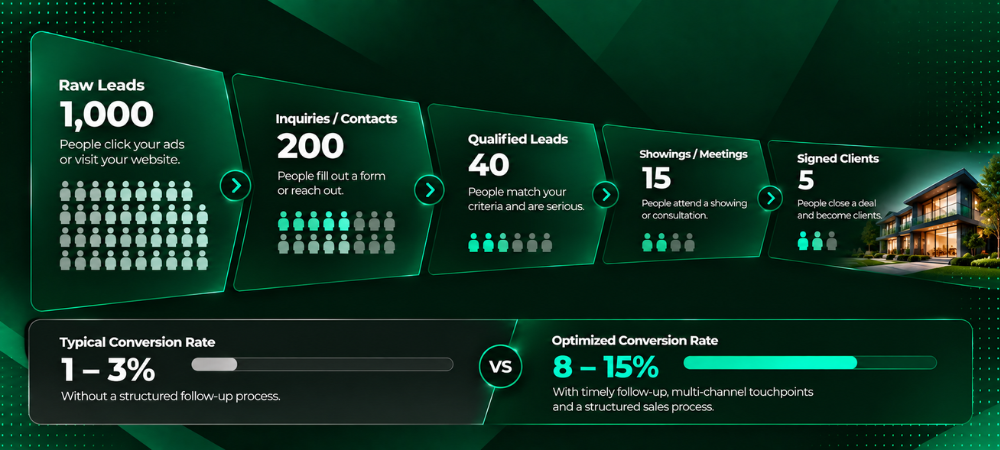
Generating a lead is the easy half. Real estate has a wide gap between agents who convert only 1 to 3% of their leads and top producers who close 8 to 15% of that same raw pipeline, and the difference usually isn’t talent. It’s process.
- Ask qualifying questions early: timeline, financing status, must-haves, so you’re not spending equal energy on someone six months from moving and someone ready to tour this weekend.
- Lead with value instead of a pitch. A market update or a neighborhood guide converts better over time than “are you ready to buy yet?” repeated every two weeks.
- Expect it to take somewhere between eight and twelve touches, spread across email, text, and the occasional call, before a cold lead books a showing. Giving up after touch three throws away leads that were never actually dead, just not ready yet.
None of this replaces proven lead generation tactics for filling the top of the funnel. It’s what keeps that funnel from leaking out the bottom.
| How Many Touchpoints Does It Take To Convert A Real Estate Lead? Plan on eight to twelve touches on average, spread across email, text, and phone calls over several weeks. Giving up after two or three follow-ups is one of the most common reasons a workable lead never converts. |
5. Creative Real Estate Marketing Ideas For Agents & Brokerages
Sometimes the best real estate marketing ideas aren’t the flashiest ones. The following ideas bring real creativity to your real estate marketing.
The Open House Marketing Timeline That Actually Fills The Room
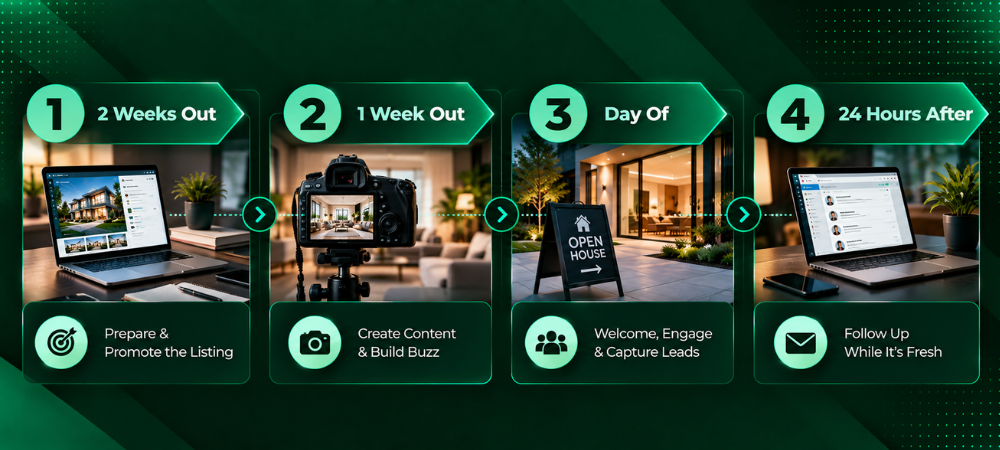
An open house with five visitors and one with fifty aren’t different because of the house. They’re different because of the two weeks before it. Treat the promotion like its own mini-campaign instead of an afterthought tacked onto the listing.
- Two Weeks Out: build a simple landing page with an RSVP form, then launch targeted Google and Facebook ad campaigns and post the date across your own social channels.
- One Week Out: email your buyer database and sphere of influence directly, order directional signage (roughly ten to fifteen signs cover a two-mile radius), and start posting daily countdown content.
Day-Of Execution And The Follow-Up That Actually Converts
- Day Of: put signs up at least two hours early, offer sign-in by paper and QR code, and make sure the home is staged and lit before the first car pulls up.
- Within 24 Hours After: follow up personally with every attendee, referencing something specific they mentioned rather than sending a form response, and log them in your CRM with notes while the conversation is still fresh.
| Do Open Houses Still Generate Real Buyer Leads In 2026? Yes, but mostly when the promotion starts two weeks out rather than two days out. An open house advertised only with a yard sign the morning of the event draws neighbours and curious browsers; one promoted through targeted ads, email, and social media in advance draws people who are actually shopping. |
- Community And Local Business Spotlights: Partner with local businesses on co-branded video series. It builds organic authority and, frankly, it’s just more fun to make than another listing video.
- Micro-market Reports: Ditch the generic quarterly newsletter. Interactive, neighborhood-specific pricing analysis gets opened and actually read.
- Off-market And pre-listing Teasers: Gated property preview pages paired with targeted SMS alerts create buzz before a home even officially hits the market.
Sphere-of-influence touch campaigns: Segment your database by how recently someone became a client and set a standing cadence around it: a call at the first home anniversary, a handwritten note at year three, an invite to a client-only event every fall. It’s less exciting to plan than a new ad campaign, and it’s usually the highest-converting channel an agent has.
None of this works without solid writing behind it. Good content marketing strategies are what turn a decent idea into something people actually engage with.
6. Building An Integrated Real Estate Online Marketing Tech Stack
Your tools need to talk to each other, or you’re just creating more busywork.
Predictive lead scoring and CRM integration rank incoming leads automatically, so agents spend their energy on the buyers who are actually ready to move, not the ones who are six months out from even thinking about it.
Choosing A CRM That Matches Your Volume
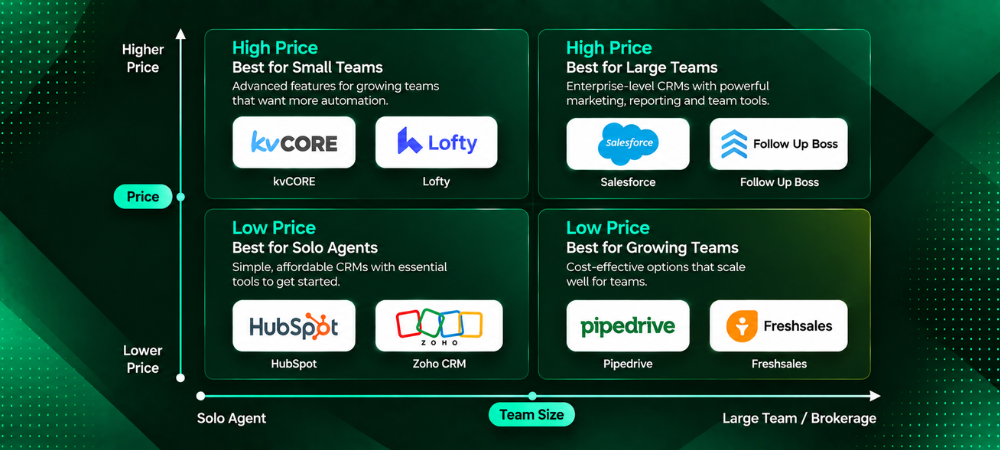
Not every brokerage needs the same tool. A solo agent and a 100-agent team have completely different requirements, and the price tags reflect that:
| CRM | Best For | Starting Price | Standout Feature |
|---|---|---|---|
| Follow Up Boss | Speed-to-lead, solo agents & small teams | ~$69/user/month | Automatic lead routing with source tracking |
| kvCORE | Brokerage-wide rollouts | ~$399+/month | Built-in IDX site and marketing suite |
| LionDesk | Budget-conscious automation | ~$25/user/month | Text and email drip campaigns |
| BoomTown | High lead-volume teams | $1,000+/month | Predictive analytics and team-wide lead routing |
Pricing shifts often enough that these figures are worth treating as a starting point for a sales call rather than a locked-in number. The feature that matters most across all four is the same one: an automatic, immediate response the moment a lead comes in, before a human ever picks up the phone.
| Which CRM Is Best For A Solo Real Estate Agent? Follow Up Boss and LionDesk are usually the strongest starting points for a solo agent, since both are affordable and Follow Up Boss in particular is built specifically around getting a fast, automatic response to a new lead. |
Automated omnichannel nurturing triggers personalized email and SMS follow-ups based on how someone interacts with a specific listing. It feels attentive without requiring an agent to manually track every click.
Centralized analytics dashboards let you follow the full path from someone’s first visit to your site all the way to a signed contract. Without this, you’re mostly just guessing what’s working.
Consent Rules For Retargeting, Email, And Text
Retargeting works, but the follow-up channels built on top of it carry rules that are easy to overlook in a rush to automate. The Telephone Consumer Protection Act requires prior express written consent before you text or auto-dial a lead, which matters a great deal if your CRM fires off an automatic “thanks for your interest” text the moment a Zillow or Facebook lead comes in.
CAN-SPAM requires a working unsubscribe link and your physical business address on every marketing email, no exceptions. Most state real estate commissions layer on their own advertising rules too, often requiring your brokerage name and license number to appear on paid ads and even some social posts.
None of this should slow down a good nurture sequence. It just means the opt-in checkbox on your lead forms needs to say what it actually authorizes, and your CRM’s autoresponder settings deserve a second look before you scale them across a bigger ad budget.
| Is It Legal To Text A Lead Who Just Filled Out A Form On Zillow Or Facebook? Only if the form clearly disclosed that submitting it counts as consent to receive texts, and your outreach follows your state’s real estate advertising disclosure rules on top of that. A vague “contact me” checkbox usually isn’t enough on its own. |
AI Chat And Speed-to-Lead
Response time still decides more deals than people like to admit. Contacting a lead within five minutes produces dramatically higher conversion rates than waiting half an hour, and most agents simply aren’t at a desk every time someone submits a form at 9 p.m. An AI chat assistant that answers instantly, asks the right qualifying questions, and routes the lead to the right agent closes that gap without anyone pulling an all-nighter.
Worth building in from day one: an occasional audit of what your AI tools are actually doing with behavioral and demographic data before you plug it into ad targeting or lead scoring. Personalization that quietly proxies for a protected class, using zip code as a stand-in for race, for instance, creates the same fair housing exposure as writing it into an ad by hand. Keep segments built around geography, price band, and buying timeline, and the tools stay useful without creating a compliance headache down the line.
7. Measuring Success: Real Estate Marketing Metrics That Matter
Not every number deserves your attention. Views and impressions look nice in a report, but they don’t close deals.
Focus on cost per lead, site visit bookings, and closed listings instead. Here’s a rough benchmark for where digital channels tend to land in 2026: social ads typically run $5 to $20 per lead, Local Services Ads land around $10 to $30, and competitive Google Search keywords can climb past $40 in a hot market.
Keep in mind these numbers shift depending on your market, so use them as a starting point rather than gospel.
The Formulas Behind The Numbers
The metrics above only mean something once you can put a number next to them.
Three Formulas Cover Most Of What Matters:
- Cost per lead = Total spend on a channel ÷ number of leads it generated.
- Cost per closed transaction = Total marketing spend ÷ number of deals that closed.
- Return on ad spend (ROAS) = Revenue generated ÷ amount spent on ads
Run those numbers by channel, not just in aggregate, and the picture usually gets uncomfortable in an instructive way. Facebook and Instagram ads often land in the $5 to $20 per lead range when the targeting is tight. Google Local Services Ads typically run $10 to $30. Google Search ads chasing competitive seller keywords can climb past $40 a lead in a hot market.
Sphere-of-influence referrals cost nothing but time, which is exactly why the shift back toward relationship marketing described earlier in this guide keeps paying off.
If the top of your funnel looks healthy, clicks are coming in, cost per lead is reasonable, but deals aren’t closing, the leak is rarely the ad. It’s usually the follow-up sequence or the landing page itself, and that’s where conversion rate optimization work tends to find 20% to 30% gains without spending another dollar on media.
| What’s A Good Cost Per Lead In Real Estate Marketing? It depends heavily on the channel: expect $5 to $20 on well-targeted social ads, $10 to $30 on Local Services Ads, and $30 to $50 or more on competitive Google Search keywords. Judge a channel by cost per closed transaction, not cost per lead alone, since a cheap lead that never converts is more expensive than a costly one that does. |
The 30-Day Implementation Action Plan
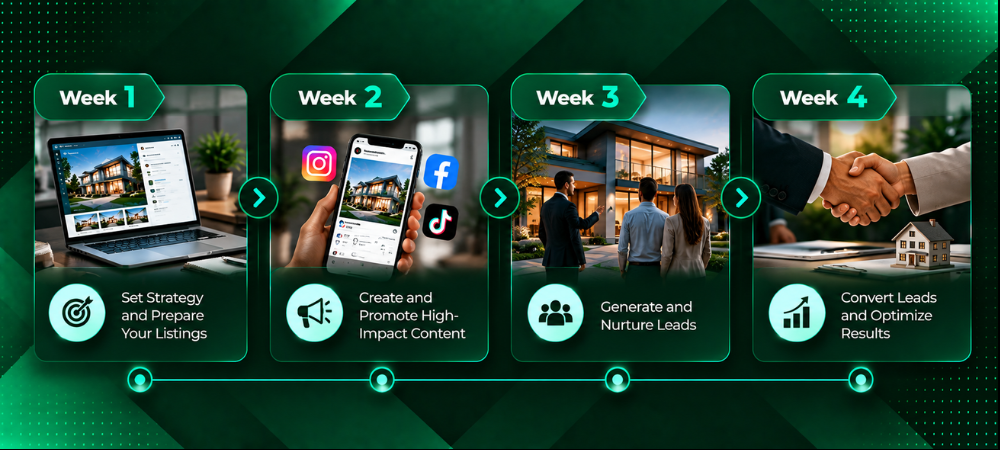
A strong focus on real estate marketing is essential. But it cannot happen overnight. The comprehensive guide we’ve laid out before you should give you the groundwork you need to develop an action plan. But if we were to break down the process into a phased operation, this is how we’ll proceed:
- Week 1: Audit your Google Business Profile, your active listing visuals, and your current CRM lead routing. You’ll probably find a few easy wins right away.
- Week 2: Upgrade your property media to short-form video and AI-enhanced virtual staging.
- Week 3: Launch localized paid ad campaigns paired with automated, behavior-triggered follow-ups.
- Week 4: Look at your early lead quality metrics and adjust your targeting for long-term growth.
Common Pitfall To Avoid
Agents who stall out after week two almost always skipped the audit in week one and jumped straight to posting content. A rushed foundation costs more time to fix later than a careful one costs to build now. If you want to see how this phased approach plays out with an actual budget and timeline behind it, our client case studies walk through a few real examples start to finish.
Need Professional Help?
Real estate marketing in 2026 isn’t about chasing every new trend. It’s about connecting the pieces you already have into something that actually works together. However, if you’d rather not figure this out alone, speak with our marketing experts, and we’ll help you build a plan that fits your market and your goals.