A law firm website might be beautiful at the outset. However, if it does not rank or convert, it is merely an expensive digital brochure. For instance, it may look polished in a presentation. It may even impress the partners for a week.
However, the website is not doing its job if prospective clients cannot find it, understand it, or contact the firm without friction.
Many legal websites suffer from the same quiet problems: pages load slowly, mobile navigation feels awkward, calls to action hide near the footer, practice-area content says very little, and attorney profiles read like résumés written for other attorneys. As a result, visitors leave before establishing trust.
Essentially, effective law firm website design treats the website as a complete acquisition system. It is not merely an isolated creative project.
In this case, design, user experience, search visibility, content quality, and conversion paths must work together. None of these elements will rescue a site when the others fail. Therefore, read on to get a practical framework for building a high-converting law firm website.
What “High-Converting” Actually Means
A high-converting legal website attracts relevant visitors. Then, it moves a meaningful portion of them toward contacting the firm.
To be honest, traffic alone tells an incomplete story. Thousands of informational visits mean little when those visitors never reach a service page, schedule a consultation, or become suitable cases.
Therefore, measurement should follow the entire client-acquisition journey. Of course, organic visits to priority pages matter. So do calls, form submissions, consultation attendance, and signed matters.
When paid media is involved, cost per qualified lead becomes equally important.
| Pretty Website | Performing Website |
|---|---|
| Prioritizes visual trends | Prioritizes client decisions |
| Uses broad brand messaging | Addresses specific legal problems |
| Measures traffic | Measures qualified inquiries and cases |
| Adds SEO after development | Integrates SEO into architecture |
| Offers one generic contact page | Creates clear conversion paths throughout |
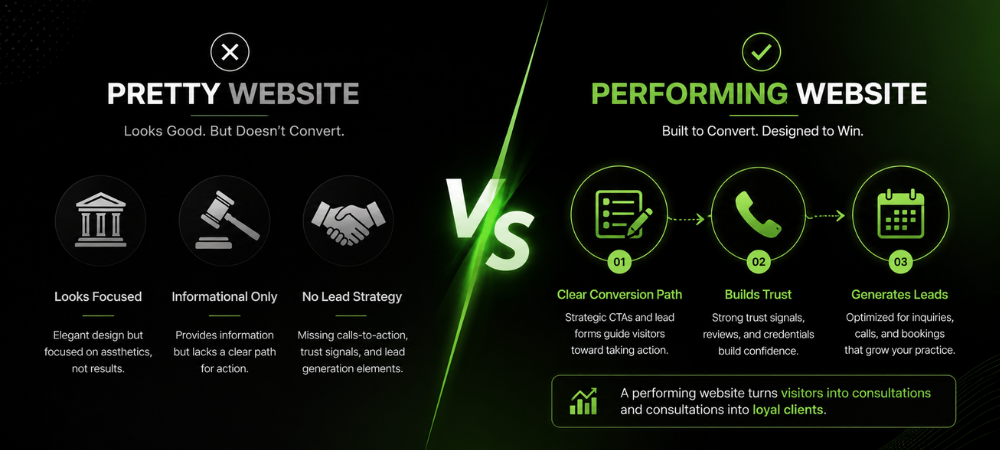
So, always plan rankings and conversions together. For instance, a page built only for keywords may attract traffic yet feel robotic. Meanwhile, a persuasive page with weak crawlability may remain invisible.
Basically, a law firm website that ranks must satisfy search intent while guiding a worried visitor toward a sensible next step.
This is not theoretical. One full-service U.S. law firm had strong offline trust and experienced attorneys, yet its site ranked for keywords with no legal buying intent and produced almost no consultations. A structured overhaul of intent, technical health, and content authority doubled the firm’s qualified leads within months, which is the kind of outcome “performing” design is supposed to produce.
Core Principles Of Effective Legal Website Design
Of course, clarity should beat cleverness. In general, visitors arrive with a problem instead of an interest in decoding slogans.
1. Clarity
The first screen should explain whom the firm helps, what it handles, where it operates, and how someone can request assistance.
2. Mobile-First
The experience must also be mobile-first, with comfortable button spacing, forms that ask for minimal typing, and phone numbers that support click-to-call functionality. Likewise, optimized images, clean code, stable hosting, and restrained scripts all help pages load quickly.
3. Trust-Building
Trust deserves deliberate treatment. Real attorney photography, readable typography, recognizable affiliations, carefully framed results, and specific client reviews can all build credibility without making the site feel boastful.
4. Accessibility
Accessibility matters too, especially because legal visitors may be stressed, distracted, older, or using assistive technology.
Finally, legal website design must account for professional advertising rules, privacy obligations, disclaimers, cookie practices, and accessibility requirements. Compliance should shape the build early. Adding it as a last-minute footer exercise usually creates gaps.
5. E-E-A-T Signals, Because Legal Content Is YMYL
Google treats legal information as Your-Money-Or-Your-Life content, so a law firm site earns scrutiny that a hobby blog never faces. Trust-Building and Accessibility above cover the surface; E-E-A-T governs whether Google believes the site enough to rank it for competitive terms.
In practice, that means attorney bios carry bar admissions and years in practice, published content names its author, case results include the honest context around them, and the firm’s contact information matches public records exactly. Thin, anonymous, or unverifiable pages struggle here even when the design looks sharp. A firm auditing its own site against the E-E-A-T framework usually finds the gaps sit in authorship and sourcing, not in visual polish.
| Does E-E-A-T Apply To Law Firm Websites? Yes, and more heavily than most industries. Legal advice affects someone’s finances, freedom, or family, so Google leans on trust and expertise signals named authors, credentials, and verifiable sourcing before ranking a page for competitive legal terms. |
Essential Pages And Their Jobs
Every page should have a defined purpose. Otherwise, websites grow into loose collections of content. Those content pieces compete for attention and leave visitors wondering where to go.
| Page | Primary Job |
|---|---|
| Homepage | Establish relevance, introduce practice areas, present proof, and direct visitors toward contact |
| Practice-area page | Match a specific legal need, answer concerns, demonstrate experience, and prompt an inquiry |
| Attorney biography | Convert credentials into credibility, recognition, and human connection |
| Location or contact page | Provide forms, phone details, office information, maps, and consistent name, address, and phone data |
| About page | Explain the firm’s story, working philosophy, and client experience |
| Results page | Present outcomes accurately, ethically, and with suitable disclaimers |
| Blog or resources | Capture informational searches, build topical authority, and nurture undecided visitors |
| Reviews section | Reduce uncertainty through relevant, appropriately presented client experiences |
In most cases, practice-area pages carry the heaviest commercial responsibility. Each major service deserves a dedicated page rather than a brief mention inside one crowded services page.
In addition, location pages should contain genuinely local information. Do not clone paragraphs by swapping out city names.
| Should Every Practice Area Have Its Own Page? Yes, when the service is commercially important. Dedicated pages improve relevance, internal linking, user comprehension, and targeting for specific searches, rather than folding several services into one page that ranks for none of them well. |
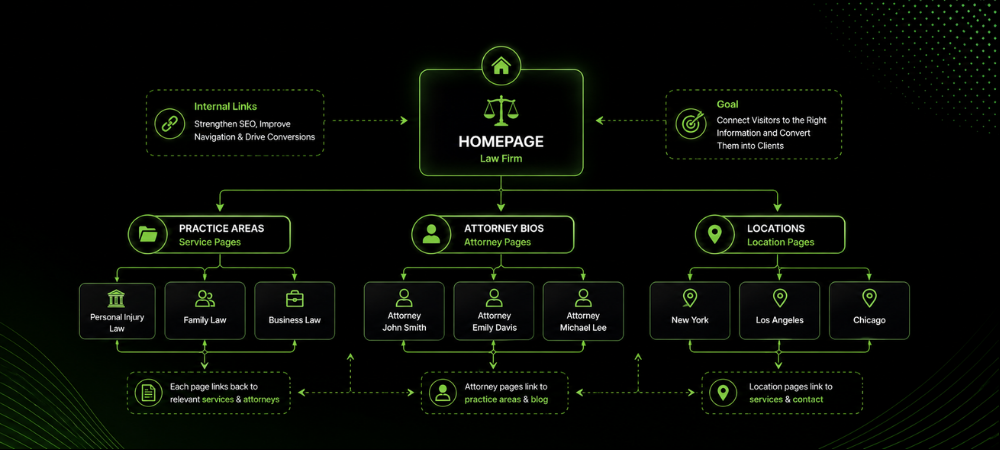
Treat each practice-area page as the start of a content cluster rather than a standalone entry. A page on family law, for example, can branch into custody, alimony, and mediation content that all link back to the core service page. Firms that build practice-area content this way tend to rank and convert better than firms publishing one dense page and calling it finished.
Attorney Website Design Best Practices
When designing a website for a law firm or an attorney, focus on a few crucial factors. The following are the best practices:
1. Structure And Navigation
Strong attorney website design best practices begin with a menu based on client needs. At the outset, practice areas, attorney information, locations, resources, and contact should all be visible without digging. Internal links should then connect related services, attorney profiles, resources, and locations in a logical hierarchy.
On mobile devices, keep contact options accessible through a sticky call button or compact action bar. However, too many persistent buttons create visual noise. Usually, one primary action and one reasonable alternative provide enough choice.
2. Visual Trust And Conversion Elements
In general, professional photography communicates more credibility than generic images of gavels, columns, handshakes, or anonymous people in suits. In addition, typography, contrast, spacing, and colour should support reading rather than simply expressing a brand mood.
Meanwhile, calls to action belong above the fold, within longer sections. They must be near the end of the page. Forms should ask only for information required to evaluate or route an inquiry. Depending on the firm, alternatives to a form may include calling, secure messaging, click-to-text, live chat, or scheduling directly.
Microcopy near forms might reduce hesitation. Phrases such as “Confidential consultation,” “Response within one business day,” or ethically permissible fee information clarify what happens next.
Still, promises must reflect the firm’s actual intake process.
3. Technical And SEO Foundations
Technical performance belongs inside law firm website design rather than in a post-launch repair list. Responsive layouts, compressed media, strong Core Web Vitals, HTTPS, crawlable navigation, logical headings, canonical tags, and clean indexation all influence discoverability and usability.
When the visible content supports them, schema opportunities may include attorney, legal service, local business, review, breadcrumb, and FAQ markup.
Local signals also require consistent business information and accurate location pages. Embedded maps and links to relevant profiles are also important.
4. Local Citations, Directories, And NAP Consistency
Technical SEO gets a site crawlable; citations get it trusted for “near me” searches. Google cross-checks a firm’s name, address, and phone number against legal directories such as Avvo, FindLaw, Justia, and the relevant state bar listing. Mismatched suite numbers or an old phone number on even one of these sites can quietly cap map-pack visibility, no matter how strong the on-site design is.
Reviews sit alongside citations as a ranking and trust factor. A firm that actively earns and responds to reviews, rather than hoping they accumulate on their own, tends to outperform competitors with a stronger site but a thinner review profile. Firms serious about this should treat it as an ongoing program rather than a launch checklist item managing reviews systematically pays off longer than any single design change.
| How Important Are Online Directories For Law Firm SEO? They matter as much as on-site optimization for local visibility. Google uses directory consistency as a trust signal, and prospective clients often check Avvo or FindLaw profiles before calling, so inconsistent details cost both rankings and credibility. |
Content That Ranks And Converts
Content should serve clients first and search engines second. That does not mean ignoring keywords. Rather, it means answering the questions behind those keywords with enough clarity and specificity. Also, there must be enough professional judgment to help someone decide.
Basically, a strong practice-area page explains the legal issue, common scenarios, potential stakes, the firm’s approach, likely next steps, and reasons to seek advice.
Also, there must be clear headings and measured bullet lists where they genuinely aid scanning. Short, substantial paragraphs and useful visuals make detailed material easier to navigate.
The Need To Maintain Content
Content also needs maintenance. It is important to review priority service pages for outdated statutes, stale claims, broken links, changing terminology, and mismatched search intent.
Meanwhile, internal linking should direct readers from educational resources toward relevant commercial pages. However, they must do so without forcing the transition.
| Does A Law Firm Need A Blog? A blog helps when it answers genuine client questions and supports priority services. Publishing thin, repetitive articles merely creates maintenance work without moving rankings or leads. |
A Practice-Area Example: Personal Injury Content
General advice is easier to apply with a concrete case. Personal injury pages tend to convert well when they cover claim timelines, comparative negligence rules for the firm’s state, and what a typical settlement process looks like, rather than a generic overview of “why you need a lawyer.”
The same specificity that helps a visitor decide also gives Google clearer signals about what the page actually answers. Firms building this kind of page benefit from looking at how personal injury lawyer marketing differs from general practice-area marketing, since the search intent, urgency, and objections are distinct from something like business formation.
| How Long Should A Practice-area Page Be? There is no fixed word count. The page should be long enough to answer the scenarios, stakes, process, and next steps a real client would ask about often 800 to 1,500 words for a competitive practice area, shorter for a narrow, low-competition service. |
Optimizing For AI Overviews and Answer Engines (GEO)
Search results now often lead with an AI-generated summary before any blue links appear, and legal questions are a common trigger for this. A page written only to rank in the traditional ten blue links can miss this visibility layer entirely.
Content earns a place in these summaries by answering a specific question in a self-contained way near the top of the section, using plain terminology alongside the correct legal term, and backing claims with named sources such as state statutes or court rules.
This overlaps with the schema and FAQ structure covered earlier, but it goes further: the goal is a passage that could be lifted and quoted accurately on its own. Firms investing in this now, through AI search optimization, are positioning themselves before it becomes standard practice across the legal sector.
| How Do Law Firms Appear In Google AI Overviews? Mainly through clear, well-structured answers to specific questions, supported by schema markup and credible sourcing. Pages that state an answer plainly in the first sentence or two of a section, rather than building up to it, are more likely to get pulled into a summary. |
Lawyer Website Conversion Optimization
Lawyer website conversion optimization starts with evidence. Heatmaps, session recordings, form analytics, call tracking, and user testing all reveal where visitors hesitate or drop off. However, these tools should use appropriate consent and privacy controls.
Focus On High-Impact Variables
Testing should focus first on high-impact variables: headlines, page speed, CTA wording, form length, mobile usability, and proof placement.
In addition, landing pages should match the promise made in search results or advertisements. Message mismatch sends qualified visitors straight back.
Moreover, speed-to-lead matters after submission. Automated acknowledgements, reliable routing, intake notifications, and clear ownership help the firm respond while intent remains high.
Basically, the goal is not merely more inquiries. Rather, it is more qualified inquiries without weakening screening standards.
| What Is A Good Conversion Rate For A Lawyer Website? No universal benchmark fits every practice. Instead, track qualified inquiries by traffic source, page type, device, case value, and signed-client outcomes, since a “good” rate for a personal injury page looks nothing like one for business formation. |
Organic Leads, Not Just Paid Traffic
Testing and speed-to-lead matter regardless of channel, but it is worth separating organic from paid performance when reviewing results. A firm that relies mostly on paid ads for inquiries is renting visibility; organic rankings keep producing consultations long after a campaign budget runs out. Firms wanting to shift that balance can look at what actually moves organic lead volume for law firms rather than assuming more blog posts alone will do it.
| Can Law Firms Generate Leads Without Paid Ads? Yes, though it takes longer to build. Strong organic rankings, complete Google Business Profiles, and consistent reviews generate consultations without a per-click cost, but the results compound over months rather than appearing immediately like paid campaigns. |
Common Mistakes That Quietly Kill Leads
Several recurring mistakes undermine law firm website lead generation, including firm-centered homepage copy, hidden phone numbers, slow mobile pages, generic photography, thin service content, dense legal language, and unclear next steps. Too many competing actions cause similar damage.
Another common failure appears during approval. For instance, a design may look excellent as a static desktop mockup yet perform poorly with real content and real users. Therefore, firms should test forms, menus, buttons, reading flow, accessibility, and page speed across devices before launch.
Signs a Redesign Is Overdue
Not every fix requires a full rebuild, and treating every problem as a redesign wastes budget that could go toward content or SEO instead. A rebuild becomes the right call when the site cannot be updated without a developer for basic tasks, when mobile bounce rates run far above desktop, when the platform cannot support schema or fast-loading images, or when the firm has added practice areas the current architecture cannot represent cleanly.
Short of that, targeted fixes to speed, copy, and CTAs usually solve more than a full rebuild would. A quick way to find out which situation applies is to talk to a team that can assess the site against both technical and conversion criteria before committing to a rebuild.
| How Often Should A Law Firm Redesign Its Website? Most firms benefit from a full redesign every three to five years, with smaller updates in between. A site that is fast, accessible, and easy to update rarely needs a full rebuild on that schedule alone; outdated design or a broken CMS is what usually forces the timeline forward. |
A Step-by-Step Build Or Rebuild Process
To start the build or rebuild process, follow the steps below:
- Discovery And Strategy: Define the target audiences, priority practice matters, service locations, business goals, competitors, ethical constraints, and the intake process before any design work begins.
- Architecture And Wireframing: Before visual design begins, map out the pages, navigation, internal links, content hierarchy, and conversion routes.
- Content Development: Write alongside wireframing so that design supports real explanations rather than convenient placeholder text.
- Design And Development: Always build for responsiveness, accessibility, speed, search visibility, trust, and measurable conversions.
- Pre-launch Review: Test forms, mobile layouts, redirects, tracking, metadata, schema, security, proofreading, analytics, and crawlability before the site goes live.
- Launch And Optimization: Monitor indexation, rankings, page behavior, call quality, form completion, and technical errors on a regular cadence after launch.
Costs vary widely based on scope, so treat any flat number with suspicion. A single-location firm refreshing an existing site sits at a very different budget than a multi-state firm building jurisdiction-specific pages for a dozen practice areas. What matters more than the number itself is whether the build includes the architecture, content, and technical foundation covered in this guide.
A cheap site missing those elements usually costs more later in lost leads than it saved upfront. Firms weighing this trade-off can get a clearer picture from a web development team that scopes against actual goals rather than a generic package.
| How Much Should A Law Firm Spend On A New Website? Cost depends on scope, content, integrations, locations, and technical requirements, so evaluate expected client value, maintainability, and measurable acquisition goals rather than comparing sticker prices alone. |
A Practical 90-Day Improvement Plan
| Period | Priority Actions |
|---|---|
| Days 1–30 | Audit UX, content, conversion paths, technical SEO, mobile performance, analytics, call tracking, and intake routing. Rank fixes by impact and effort. |
| Days 31–60 | Improve top service pages, speed, forms, headlines, CTA visibility, trust signals, mobile navigation, and contact options. |
| Days 61–90 | Expand priority content, strengthen internal links, refine local pages, launch structured testing, and establish monthly reporting. |
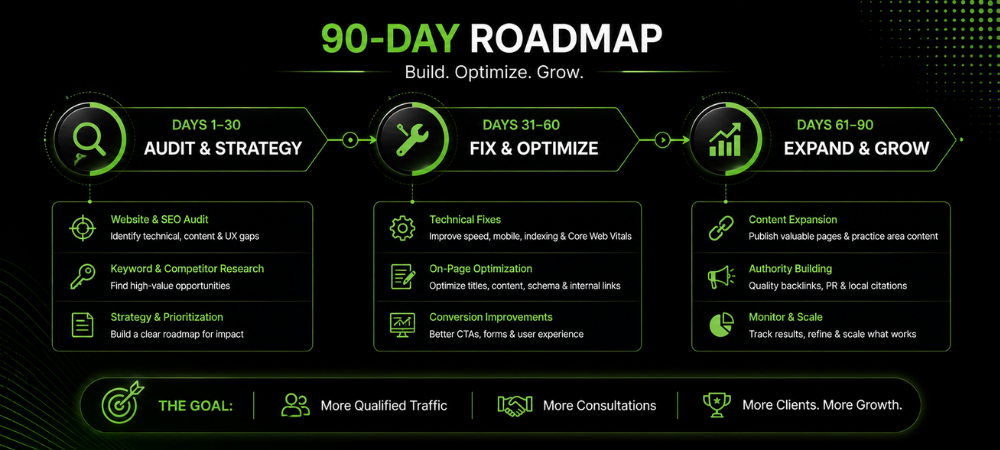
Straightforward improvements include rewriting a headline or simplifying a form, and these may work in-house. Usually, complex migrations, tracking problems, technical SEO, accessibility remediation, and multi-location architecture justify bringing in a specialized legal marketing partner instead.
Measuring Success
A useful dashboard connects visibility with revenue rather than celebrating disconnected metrics. It should track organic sessions to priority pages alongside engagement, calls, forms, conversion rate, cost per lead where applicable, consultation attendance, signed matters, and acquisition source.
Rankings for priority practice-area and local terms remain useful directional signals. However, they should sit beside lead quality and signed-case data.
Meanwhile, technical indicators such as Core Web Vitals, crawl errors, indexation, uptime, and form failures help explain performance changes before they become expensive.
| Should A Law Firm Track Rankings Or Leads? Both, but leads decide the outcome. Rankings show whether the site is visible; consultation and signed-case data show whether that visibility is actually worth anything. A firm ranking well with few conversions has a page or intake problem, not a visibility problem. |
| How Long Does It Take For A New Law Firm Website To Rank? Timelines vary by competition, authority, location, content quality, and technical health. Typically, meaningful organic growth requires consistent work over several months rather than weeks. |
Quick-Start Checklist
- State the client problem and service clearly above the fold.
- Give each major practice area a dedicated, substantial page.
- Keep calling and form submission easy on mobile.
- Always use authentic proof, readable layouts, and consistent local information.
- Test speed, forms, tracking, security, schema, and accessibility.
- Measure qualified consultations and signed cases, not traffic alone.
To be honest, a typical before-and-after improvement isn’t much: a vague homepage becomes problem-focused, contact buttons move into view, a seven-field form becomes shorter, and shallow practice pages gain useful explanations. Together, those small corrections mostly remove the resistance that was suppressing inquiries.
Clarity, Speed, And Trust Turn Legal Traffic Into Qualified Leads
A successful legal website comes from intentional choices serving search engines and people who need legal help. Start with clarity, technical stability, credible proof, and a frictionless next step. Then, improve the experience using real behavioral and intake data.
Ultimately, strategic law firm website design should create a dependable connection between search visibility and business development.
Viacon can audit your current website and identify conversion and SEO gaps. Also, they prioritize the improvements most likely to strengthen qualified lead flow. So, contact Viacon to request a conversion-focused website audit or consultation.