Personal injury remains one of the toughest and most expensive legal markets to compete in. High case values attract local firms, national advertisers, and lead sellers, and all three groups run aggressive digital campaigns. As a result, launching a website isn’t enough anymore, and buying a few search ads no longer creates predictable growth on its own.
In 2026, personal injury lawyer marketing requires something tighter: organic visibility working alongside controlled paid acquisition, strong reputation signals, and a responsive intake operation. Skip any one of those pieces and rising click costs, or a shift in search behavior, can quickly turn a promising campaign into an expensive mess.
The real objective isn’t generating more inquiries; it’s generating qualified opportunities that become signed, financially viable cases. That distinction matters more than almost anything else in this article. Effective personal injury SEO attracts relevant prospects over time, paid channels capture immediate demand, reviews establish trust, and the intake system converts attention into action. Each piece supports the others.
The 2026 Personal Injury Marketing Landscape
Search behavior has become more specific and urgent. Prospective clients now search by location, accident type, and injury. And immediate concern, looking for a lawyer “near me,”. Researching what to do after a collision or trying to figure out whether their injury even justifies a claim. Visibility alone doesn’t win the case, though.
What Searchers Actually Look For?
Before making contact, most searchers quietly compare reviews, attorney credentials, case experience, response times, and overall website quality. Modern personal injury attorney marketing strategies need to reduce that uncertainty quickly, because vague claims and generic promises rarely build enough confidence to earn the call.
Referrals still matter, of course, but leaning on them too heavily limits growth. A firm can’t control referral volume, geography, or case mix the way it can control a marketing program. A broader acquisition model blends search visibility, educational content, paid campaigns, Local Service Ads, reputation management, remarketing, and efficient intake into one system.
How AI Overviews Are Reshaping The First Search
One shift belongs in this picture more than any other. Google now shows an AI-generated summary above the organic results for a large share of legal searches, and personal injury queries trigger these AI Overviews more often than almost any other topic. A prospective client can ask a broad question, “What should I do after a car accident?” and get a full answer without clicking a single website.
That changes what “ranking” means. A firm can hold a strong position on page one and still disappear from the AI-generated answer above it. If the page doesn’t hand over a direct, extractable answer near the top. A clear definition, credentialed authorship, and business details that match everywhere else online.
Firms that want the fuller playbook schema, entity signals, and how ChatGPT, Perplexity. And Google each pull their answers differently can start with Viacon’s guide to GEO for law firms.
This isn’t a replacement for the search visibility work described throughout this guide. It sits on top of it; a page can’t earn an AI citation if it doesn’t first earn a solid ranking.
| Does An AI Overview Replace The Need For A Personal Injury Lawyer’s Website? No. AI Overviews summarize information and often name a firm, but the prospective client still researches, compares, and eventually clicks through or calls before hiring anyone. A firm absent from those summaries simply starts the race further behind. |
Personal Injury SEO Strategies That Generate Cases
SEO begins with architecture, not blog volume. A firm’s website should organize content around practice areas, injury types, locations, and client questions, with pages like car accident, truck accident, premises liability, and wrongful death holding clear, findable positions rather than sitting buried in a cluttered services menu.
Technical performance supports that structure underneath the surface. Fast loading, mobile usability, strong Core Web Vitals, legal-service schema, clean navigation, and secure browsing all affect both accessibility and search performance.
While internal links should connect practice pages with location pages, injury resources, attorney profiles, and relevant educational articles. Get this foundation right and personal injury lawyer marketing becomes a genuinely searchable content system, rather than a set of pages quietly competing against each other for the same terms.
Building A Search-Led Content Hierarchy
A useful way to think about this structure is by layer. Since each type of page serves a different stage of the search:
| Content Layer | Primary Purpose | Typical Search Intent |
|---|---|---|
| Practice-area pages | Capture valuable case demand | “Car accident lawyer” |
| Injury-specific pages | Address precise client needs | “Brain injury attorney” |
| Location pages | Compete in local markets | “Injury lawyer near me” |
| Educational resources | Reach early-stage prospects | “What to do after an accident” |
High-intent pages deserve the most commercial focus, and they should explain eligibility. The claims process, common complications, potential costs, and the next practical step clearly enough that a prospect doesn’t have to guess. Supporting articles can then handle earlier research questions case value, insurance communication, evidence preservation, accident reporting without competing for the same commercial keywords.
Car accident lawyer marketing shouldn’t rely on one broad service page either. A stronger cluster covers intersection crashes, rideshare accidents, uninsured motorists, hit-and-run claims, passenger injuries, and city-specific collision concerns as long as every page has a distinct purpose. Publishing near-duplicate pages just to pad the count creates noise instead of authority.
Local visibility rounds this out: an optimized Google Business Profile, consistent business information across the web, genuine location relevance, and ongoing review generation. Reviews influence rankings, but they matter just as much for conversion. Prospects want evidence that the firm communicates clearly and handles cases professionally before they ever pick up the phone.
Authority goes beyond a biography page, too. Attorney-reviewed resources, transparent credentials, and ethical case-result presentation. And well-explained legal processes all strengthen trust, and conversion-focused pages should also spell out what happens next, how consultations work, and what information a prospect should have ready.
Add Video And Visual Proof
Written content builds trust slowly. Video accelerates it. A short clip of the attorney explaining what to do in the first 24 hours after a crash, walking through the claims timeline, or answering a common question on camera gives prospects a face and a voice before they ever call. Firms that publish this kind of content consistently.
Even a handful of short videos tied to high-intent pages tend to see longer time-on-page and stronger consultation booking rates, because video does something a paragraph can’t. It lets an injured, anxious person judge tone and trustworthiness in under a minute.
Build A Structured Review-Generation System
A page or two of testimonials isn’t a review strategy. A repeatable process is: asking every satisfied client at a consistent point in the case, routing the request by text or email, and monitoring velocity, not just total count. A firm sitting at a few dozen reviews from three years ago reads very differently to a searcher than one adding fresh five-star reviews every month.
For a full breakdown of ask timing, response templates, and how to handle a negative review without breaching client confidentiality. Viacon’s guide to law firm review management covers the mechanics in more depth. Google Business Profile optimization ties both of these together, since reviews, citations, and location relevance all feed directly into map pack rankings.
| How Long Does Personal Injury SEO Take To Generate Cases? Early improvements may appear within several months, particularly for less competitive locations or injury types. Competitive metro markets usually require sustained technical, content, local, and authority-building work before rankings translate into a steady flow of signed cases. |
Personal Injury Lawyer Google Ads And Paid Strategies
Effective personal injury lawyer Google Ads campaigns separate accident categories, locations, and intent levels rather than combining every service into one campaign. This weakens budget control and makes performance nearly impossible to diagnose. Instead, car accidents, truck accidents, premises claims, and other case types each need their own campaign structure.
Search campaigns capture direct intent; Local Service Ads can support visibility and calls in eligible markets. And Performance Max may assist broader coverage once a campaign has reliable conversion data feeding it. Automated reach still needs guardrails, though geographic settings, audience signals, exclusions, scheduling, and budget limits all require human oversight, not just a “set it and let the algorithm run” mindset.
Controlling cost per case starts with disciplined keyword selection and negative keyword management, since terms related to jobs, research papers, free legal forms, unrelated locations, or non-service inquiries can quietly consume budget without ever creating a viable case.
Ad copy should reflect the case type, location, consultation process, and any legitimate differentiator the firm actually has, and landing pages should match the ad closely. Sending paid traffic to a general homepage forces visitors to go searching for relevant information themselves, which reliably weakens conversion.
Paid Channel Comparison
| Channel | Best Use | Main Risk |
|---|---|---|
| Search Ads | Capturing immediate, high-intent demand | Expensive irrelevant clicks |
| Local Service Ads | Generating local calls and trust | Limited control and variable volume |
| Performance Max | Extending reach across Google properties | Weak transparency without clean data |
| Remarketing | Re-engaging previous visitors | Overspending on low-intent audiences |
Bidding should optimize toward qualified consultations and signed cases, not the cheapest form completion. This means call tracking, CRM integration, and offline conversion imports. And intake disposition data all become essential, or the platform will happily favour inexpensive leads that never actually qualify.
Remarketing reconnects with visitors and form abandoners, and works well as long as the messaging stays appropriate and compliant. From there, budget allocation between Search and Local Service Ads should follow the actual cost per signed case, not the lead totals a platform reports on its own dashboard.
| What Is A Good Cost Per Case For Personal Injury Google Ads? A good cost remains profitable after accounting for qualification rates, signed-case rates, operating expenses, resolution timelines, and expected legal fees. There’s no single universal number. A firm has to weigh cost per lead against its own case-acceptance rate and average case value rather than comparing raw lead costs across markets. |
Where Local Services Ads Really Fit
Local Services Ads work differently from standard search campaigns, and that difference is worth spelling out. LSAs run on a pay-per-lead model rather than pay-per-click, they appear above both organic results and regular paid ads, and an eligible, vetted firm displays a “Google Screened” badge that carries real weight with someone comparing several law firms at once.
Google’s own algorithm decides which firms get shown and how often, weighing review volume, review recency, response time, and booking rate rather than bid amount alone. That means a firm can actually improve its LSA performance without spending more. Simply by answering faster and closing the loop on every lead.
Cost per lead also varies widely by market and case type. So it’s worth tracking as a firm-specific number rather than trusting an industry average. For a fuller breakdown of budget allocation across Search, LSA, and Performance Max, Viacon’s guide to Google Ads for law firms walks through how to lower cost per case without cutting corners on lead quality.
| Do Local Service Ads Work For Personal Injury Attorneys? Generally, yes, LSAs generate valuable local calls, though results depend on eligibility, reviews, responsiveness, location, competition, and disciplined lead tracking. Eligibility and competition also vary by market and practice area: LSAs tend to perform best for high-volume categories like car accidents, while lower-volume, higher-value cases such as medical malpractice often rely more heavily on Search and organic visibility. |
Integrating SEO And Ads For Better Lead Generation
The strongest personal injury lawyer lead generation model connects paid and organic insights instead of running them as separate efforts. Search-term data from ad campaigns reveals wording, concerns, and case categories that deserve stronger organic pages. While SEO performance shows where ads may no longer need to carry the full acquisition burden. For a deeper look at how firms combine organic and paid channels into one repeatable pipeline. Viacon’s guide to law firm lead generation breaks down the underlying process.
Paid visibility also reinforces branded search, and remarketing keeps the firm present during what’s often a long, anxious decision process. This integrated approach works because each channel contributes to a single acquisition path. Rather than living in its own dashboard disconnected from the others.
Unified attribution matters here: tracking needs to connect the first visit through later interactions, phone calls, consultations, and signed cases, with clear rules for deduplicating leads across organic search, advertisements, and Local Service Ads. Without those controls, multiple channels can end up claiming credit for the same case.
| Is SEO Or Google Ads Better For Car Accident Lawyers? Neither wins outright; they solve different problems. SEO supports durable, compounding visibility, while Google Ads captures immediate demand from people searching right now. Most growth-focused firms benefit from combining both channels under unified tracking rather than picking one. |
| What Can An Integrated SEO And Ads Campaign Achieve? Done well, it improves qualified traffic, reduces dependence on any single channel, reveals which case categories are actually profitable, strengthens remarketing, and gives a much clearer picture of true cost-per-case than either channel measured alone. |
Deciding Which Channel Leads At Each Stage
Knowing which channel should carry the weight at a given moment makes the integration above work in practice. A brand-new location or practice page has no organic history, so ads (or LSAs) reasonably cover most of the demand while content builds up. Eighteen months later, once a firm’s cluster of practice-area, injury-specific, and location pages has matured, organic traffic can carry more of the volume, and ad spend can shift toward defending branded terms and filling seasonal gaps.
| Should A Personal Injury Firm Start With SEO Or Google Ads? Most firms need both eventually, but a new or newly rebuilt website usually leans on paid channels first, since organic rankings take months to build. Budget shifts toward SEO as rankings mature and cost per organic visit drops toward zero. |
Advertising Compliance And Ethical Guardrails
Personal injury advertising sits under more scrutiny than most legal marketing, and for good reason: the clients are often in crisis, the financial stakes are high, and state bars regulate attorney advertising more closely than general consumer marketing. None of the strategies above matter much if a campaign creates a compliance problem.
A few guardrails apply almost everywhere, though the specifics still vary by state, so firms should confirm current rules with their own bar association before launching a campaign. Every claim needs substantiation. Settlement figures, win rates, and “results” language should be verifiable and paired with a disclaimer that past results don’t guarantee a future outcome.
Client confidentiality in testimonials and case studies deserves real protection: explicit consent before publishing a review. And enough altered detail that an anonymized story doesn’t still identify the client. Guarantee language is worth avoiding entirely, since phrases implying a certain payout or a guaranteed win. Or “no risk” draws bar complaints and platform ad disapprovals faster than almost anything else.
AI-assisted content should be disclosed honestly and reviewed by an attorney before it goes live under their byline. Since an unreviewed draft risks both factual errors and advertising-rule violations. And ad copy should match bar-approved language on the landing page itself. Case results, fee structures like “no fee unless we win,” and any comparison to other firms all need to stay consistent from click to page.
| Does Every State Regulate Personal Injury Advertising The Same Way? No. Rules on testimonials, guarantees, and disclaimers differ by state bar. And some states have tightened requirements further in recent years. Firms operating across multiple states should build compliance review into the content and ad approval process rather than treating it as a one-time check. |
Conversion And Intake Optimization
Many firms lose prospects right after paying to acquire them. Slow callbacks, complicated forms, unanswered calls, and inconsistent follow-up create friction at the worst possible moment, and speed-to-lead becomes a real practical advantage. Injury prospects mostly contact several firms within a short window of each other. Mobile pages should offer clear tap-to-call options, short forms, accessible live chat, and straightforward next steps.
And while qualification questions do protect attorney time, asking too much too early can suppress inquiries before they even start. The goal is useful screening, not interrogation. Follow-up should also continue when qualified prospects hesitate.
Thoughtful texts, emails, and scheduled calls can answer lingering concerns without ever feeling like pressure. And that kind of consistent communication is often what actually turns a consultation into a signed case.
Why The First Five Minutes Decide So Much?
Speed-to-lead deserves a number, not just a warning. An injured person searching at 9 p.m. on a Tuesday is often calling the second or third firm on their list within minutes of the first one going unanswered. Firms that answer or call back within five minutes consistently book more consultations than firms that wait even thirty minutes, because the prospect has usually already reached someone else by then.
After-hours coverage matters just as much as speed during business hours, since accidents don’t wait for office hours. A monitored chat widget or an AI-assisted intake bot that captures a name, contact details, and a brief incident summary overnight gives the intake team a warm list to work first thing in the morning, instead of a pile of missed calls. SMS follow-up tends to outperform email for this audience too; people in pain check a text message faster than an inbox.
None of this replaces a human conversation; it just makes sure one happens before a competitor’s does. Firms unsure where their own funnel leaks from abandonment, missed calls, or a slow first response can run a conversion rate optimization review to find the exact point prospects drop off.
| How Fast Should A Personal Injury Firm Respond To A New Inquiry? Within five minutes when possible, and within an hour at the latest. Response speed is one of the few variables a firm controls completely, regardless of how much it spends on ads or SEO. |
Measuring What Matters
Traffic, rankings, impressions, and click-through rates indicate direction, but they don’t prove profitability on their own. The core metrics for personal injury law firm advertising are cost per qualified consultation. Cost per signed case, expected case value, revenue, and return on marketing investment, along with rankings, conversion rate, and call quality.
Cost per lead acts as a leading indicator, and signed cases, fees, revenue, and case lifetime value act as the lagging ones that confirm whether the strategy actually worked. A useful dashboard connects both groups, so marketing teams can spot problems before a revenue report shows up months later and confirms them the hard way.
| How Much Should A Personal Injury Firm Spend On Marketing? The right budget depends on market competition, target case value, geographic reach, conversion performance, and the firm’s capacity to handle new clients; there’s no fixed figure that applies across every market. |
What Realistic Benchmarks Look Like
Benchmarks help teams sanity-check their own numbers, even though every market is different. Monthly personal injury marketing investment commonly runs from the low five figures for a single-location firm to well over $40,000 for firms competing in dense metro markets across several practice pages and locations.
Cost per lead also swings by case type: a routine car accident inquiry typically costs less to generate than a medical malpractice or catastrophic injury lead, simply because fewer firms compete hard for the latter and each click costs more.
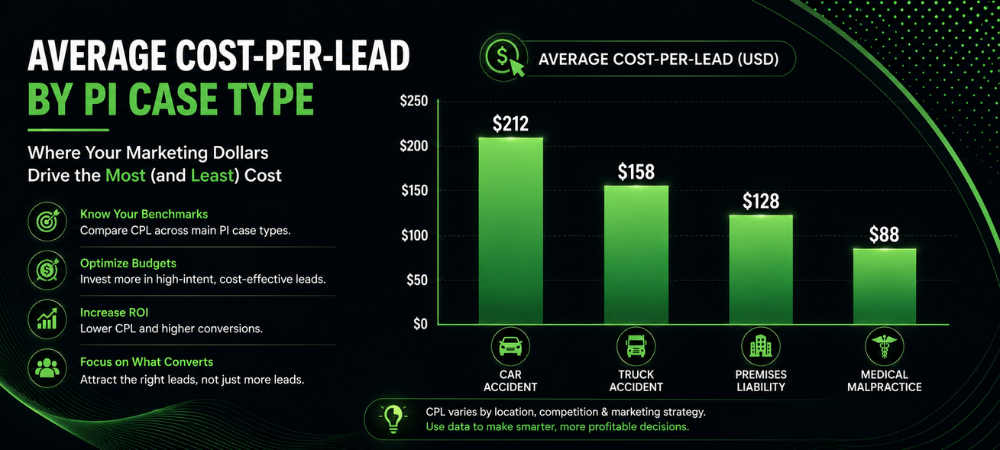
None of this matters without a target. Most firms that track profitability closely aim to keep total acquisition cost, from first click to signed retainer, within roughly 15% to 30% of the expected value of a case. A firm spending more than that on acquisition is often subsidizing growth rather than earning it, unless the goal is deliberate market entry.
An SEO services audit is usually the fastest way to see whether current spend lines up with actual case value, or whether budget is quietly propping up a channel that isn’t pulling its weight.
| What’s A Healthy Cost-per-signed-case For A Personal Injury Firm? It depends heavily on case type and settlement value, but many firms treat 15% to 30% of expected case value as a working ceiling for total acquisition cost. Anything consistently above that range is worth investigating before increasing spend further. |
Common Marketing Mistakes To Avoid
A handful of problems repeatedly weaken performance across firms of every size: chasing broad informational traffic that rarely produces viable cases, sending every paid visitor to the homepage instead of a matched landing page, ignoring reviews and response speed while focusing only on rankings, depending on a single acquisition channel, running generic or non-compliant messaging, and measuring leads without ever tracking signed cases and case value.
These mistakes all share one flaw. They treat traffic generation as the finished job, when acquisition really continues until the firm qualifies, nurtures, and signs the right client.
A few more mistakes show up often enough in 2026 audits to call out separately. Treating a Google Business Profile and local citations as a set-it-and-forget-it task is a common one. Map Pack rankings shift as competitors add reviews and posts, and a profile nobody has touched in months quietly loses ground; Viacon’s guide to local SEO for law firms covers what an active local presence actually requires.
Publishing AI-generated content without attorney review is another: it’s faster, but unreviewed drafts risk factual errors, generic advice that doesn’t reflect the state’s actual law, and the compliance issues covered earlier. And optimizing only for traditional rankings while ignoring AI Overview and answer-engine visibility means a page can rank well and still be invisible inside the summary a prospect actually reads.
Real Results: A Quick Case Study
Frameworks are easier to trust with an example behind them. A multi-state U.S. law firm came to Viacon with a familiar problem: strong offline reputation, experienced attorneys, and years of community trust, none of which showed up in search. Most of its traffic came from broad, low-intent keywords that never turned into signed cases.
The fix wasn’t more content for its own sake. Viacon rebuilt the keyword strategy around jurisdiction-specific, high-intent terms, restructured internal linking around practice-area and location clusters, and cleaned up the technical foundation so Google could crawl and index the site efficiently.
The result was a two-times increase in qualified leads, driven by strategic visibility rather than inflated traffic numbers. The full breakdown of how Viacon rebuilt the firm’s keyword and content architecture is in Viacon’s law firm SEO case study.
The takeaway for a personal injury practice specifically: authority built offline, through experienced attorneys and satisfied clients, doesn’t automatically transfer online. Turning it into visibility takes structure, content, and technical fundamentals that a search engine and increasingly, an AI system can actually read.
A 90-Day Personal Injury Marketing Action Plan
| Period | Priority Actions |
|---|---|
| Days 1–30 | Audit SEO, paid campaigns, conversion paths, tracking, negative keywords, and intake response |
| Days 31–60 | Rebuild priority service pages, restructure campaigns, strengthen reviews, and improve local signals |
| Days 61–90 | Expand supporting content, refine bids, improve nurture, and redirect budgets toward profitable cases |
Firms with established marketing teams may well handle content, intake reporting, and reputation workflows internally. Specialized partners tend to add the most value where the work goes deeper: technical SEO, paid media restructuring, conversion tracking, and multi-location execution are the areas where outside expertise usually pays for itself fastest.
Rebuilding priority pages in the Days 31–60 window is usually where firms lose the most time, since it means more than swapping in new copy. For a practical walkthrough of the structure, proof elements, and calls-to-action that make a legal service page convert, see Viacon’s guide to high-converting law firm website content.
A Connected Acquisition System Wins More Valuable Cases
Winning in 2026 requires strong organic foundations, controlled media buying, trusted authority signals, and an intake process designed around urgency. Personal injury lawyer marketing works best as one coordinated case-acquisition system, not a collection of disconnected tactics running in parallel.
Viacon can audit SEO, paid campaigns, landing pages, attribution, and conversion workflows to help uncover wasted spending and missed opportunities. Request a personal injury marketing audit or schedule a strategy call to start building a more measurable, case-focused growth program.
If you’d rather talk through your specific market, caseload goals, and current numbers before committing to a plan, contact Viacon’s team directly and we’ll walk through where the fastest wins likely sit.