
Let’s imagine a scenario: A prospective client searches for a lawyer. Three firms appear in the local results where one has 18 reviews and a 4.1 rating, another has 73 reviews and sits at 4.7, and the third looks polished but has almost no public feedback.
Most people make the shortlist right there, before visiting a website or reading an attorney bio. And that’s the uncomfortable reality of law firm reviews. They operate as quick evidence when people feel uncertain, stressed, or pressed for time. Prospective clients examine them to judge responsiveness, professionalism, and whether a firm seems dependable. As a result, the website sometimes comes second, or not at all.
Yet many firms still treat reviews as random applause. No one defines a request process, sets response rules, or takes responsibility for the matter.
A serious attorney review strategy, therefore, works differently. It creates a repeatable system for earning feedback, answering it carefully, learning from criticism, and connecting reputation activity with local visibility. While it is not exciting work, its results compound over time.
Why Law Firm Reviews Influence Rankings And Client Decisions?
Google does not evaluate local relevance through a single signal. A complete profile, geographic relevance, website authority, engagement, and review activity all factor in. Law firm reviews strengthen that broader local footprint because they show that a practice is active, recognized, and still serving real clients.
Then comes the conversion effect. A high local position may earn attention, but the review profile helps justify the click. Clients usually scan the average rating, total volume, recent comments, and the firm’s responses and then try to establish a pattern. They check whether calls were returned. Did the attorney explain difficult issues clearly? Did the staff behave with empathy?
And this is precisely where online reviews and law firm SEO become more than a ranking exercise.
Reviews rarely operate alone, either. They sit beside citations, on-page content, and technical health as part of a wider law firm SEO strategy. Firms that treat review generation as an isolated task usually see slower, shakier gains than firms that connect it to the rest of their search presence.
Visibility creates opportunities, and reputation helps convert them; this cycle continues and feeds itself when you manage it actively. The momentum it creates helps the business establish credibility even before the first client call, which also establishes the central point: digital trust is often formed before direct contact.
| How Many Google Reviews Does A Law Firm Need To Rank Well? There is no universal threshold for the number of reviews a law firm needs to rank well. The count usually changes by location and area of practice. Here, you can compare the firms in your actual Map Pack, including volume, recency, ratings, and response habits. The practical goal is steady, authentic growth rather than chasing an arbitrary number. |
What Makes A Law Firm Review Persuasive To Prospective Clients
Not every five-star review carries the same weight. A one-line comment saying “great lawyer” tells a stranger almost nothing, while a review describing a specific worry and how the firm addressed it does real persuasive work.
Prospective clients researching an attorney usually carry the same handful of concerns. They wonder whether the lawyer will act in their interest or stretch the case out to increase fees. They wonder whether the attorney genuinely understands the relevant area of law. And they wonder whether the firm will treat them like a person rather than a file number, and whether the fees will match what was promised at the start.
A persuasive review answers one or more of these questions without needing to be prompted into doing so. It might mention that the attorney explained a confusing filing step in plain terms, that the fee structure never changed midway, or that a stressful call got returned the same day. None of that requires legal detail or confidential information, just a clear account of the experience.
| What Should A Strong Law Firm Review Include? A strong review names a specific concern the client had going in, describes how the attorney or staff addressed it, and states the outcome in plain language. Firms cannot script this, but they can create the kind of service experience worth describing, and they can gently remind clients that specifics help other people more than a generic rating does. |
The Foundations Of Effective Law Firm Reputation Management
Strong law firm reputation management always starts with shortlisting priorities, not the tool.
For instance, Google Business Profile is often at the centre of this conversation because it actively helps shape branded searches, Maps visibility, and local discovery. On the other hand, platforms like Avvo may matter for legal research.
Similarly, Facebook, Yelp, and reputable legal directories can support wider validation, depending on the practice area and local market.
| Platform | Primary Role | Management Priority |
|---|---|---|
| Google Business Profile | Local discovery and initial trust | Highest |
| Avvo | Attorney-specific credibility | High for consumer practices |
| Community validation | Moderate | |
| Yelp | Local comparison behaviour | Market dependent |
| Legal directories | Authority and citation consistency | Supporting |
Ethics must be part of the process from day one. A legal services firm should never buy reviews, pressure clients, write feedback on their behalf, or conceal incentives. Review-gating is risky too, as sending only satisfied clients toward public platforms can conflict with platform rules and distort the feedback process. Since state bar requirements also vary, the local professional-conduct rules deserve a proper check before moving ahead.
Additionally, ownership matters just as much. You must assign one person to monitor platforms, route sensitive comments, and track responses, and then establish standards for tone, response time, confidentiality, and escalation.
Otherwise, law firm reviews become everybody’s responsibility, which usually means nobody is watching.
| Do Reviews On Avvo Or Facebook Help With Google Rankings? Yes, they indirectly support a law firm’s Google rankings. While these platforms may not carry the same direct local-search weight as a Google Business Profile, they support broader reputation validation, branded search coverage, and citation consistency. So, their importance depends on where prospective clients research attorneys and how visible each platform is within the local market. |
| Is It Ethical For Attorneys To Ask For Reviews? Yes, it is ethical for attorneys to ask for honest feedback, but they must also follow applicable bar rules and platform policies. This means the request should not involve pressure, misleading language, purchased reviews, undisclosed incentives, or confidentiality violations. Firms should review relevant jurisdictional requirements before standardizing any solicitation process. |
State Bar Rules and ABA Model Rule 7.1: What Attorneys Need To Know
Most legal marketing rules trace back to ABA Model Rule 7.1, which bars false or misleading communications about a lawyer’s services. Individual state bars build on that baseline, and the details vary enough that a policy written for one jurisdiction rarely works cleanly in another.
Some states require a disclaimer near client testimonials, noting that results depend on the specific facts of each case and that past outcomes do not guarantee future results. Others restrict the word “specialist” or limit comparative claims such as “best” or “top-rated” unless a firm can substantiate them. A handful still treat client testimonials with extra caution, since a review can accidentally imply a specific case outcome to someone with a similar, but legally distinct, situation.
Before a firm standardizes any review request template, a quick check against the relevant state bar’s advertising rules saves a great deal of trouble later. Many state bar websites publish these rules directly, and some legal marketing vendors keep jurisdiction-specific summaries on hand. A firm operating across multiple states should build separate disclaimer language for each one instead of applying a single national template.
A Practical Attorney Review Strategy For More 5-Star Feedback
Attaining 5-star reviews is never about ‘sheer luck’; it requires a strategic local SEO framework that works behind the scenes and ensures your business gets the visibility it needs. Here is how things transpire:
(i) Build A Systematic Review Request Process
The best request usually follows a meaningful moment. For instance, a legal matter has been resolved, a complicated filing is done, or a client has thanked the team following a useful consultation. In such cases where the experience is positive and fresh, asking for a review does not feel bolted on.
Now, according to experts, if a firm wants to get more 5-star reviews, attorney teams should not ask clients to leave a five-star rating specifically. Instead, they should ask for honest feedback; the goal is not to manufacture praise, but to make participation easy for clients who genuinely want to share their experience.
Here, A Workable Sequence Is Simple:
- The attorney or staff member mentions the request personally.
- An email or text arrives within 24 to 48 hours.
- The message includes one direct, mobile-friendly review link.
- One polite reminder follows if the client does not respond.
- The sequence stops immediately after submission or an opt-out.
One thing to remember here is that different channels suit different clients. While text can work well when communication has already happened by phone, email offers more context, and an in-person request can feel sincere, but the digital link should follow quickly.
(ii) Review Request Templates For Different Moments
A single template rarely fits every situation. A client who just finished a straightforward matter needs a different message than one who has been with the firm through a long, difficult case.
For a quick, transactional matter, a short text works well: “Thank you for choosing [Firm Name] for your recent matter. If you have a moment, we’d appreciate your honest feedback here: [link].” For a longer relationship, email allows more warmth: “It has been a privilege working with you through this process. If you’re willing, sharing your experience would help other people going through something similar find the right support.” For clients reached primarily by phone, a verbal request followed immediately by a text with the link tends to convert better than either channel alone.
Firms handling sensitive practice areas, such as family law or immigration, should keep the language especially neutral and avoid any wording that implies a particular outcome or emotional state, since clients in those areas often carry specific privacy concerns.
(iii) Remove Friction Without Making The Request Robotic
Next, the focus should be on eliminating friction. Here, while the templates help, they must not make things too obvious. You should focus on mentioning the matter in a nonconfidential way, use the client’s name, and explain why feedback matters.
For instance, a basic request here might say: “Thank you for trusting our team. If you are comfortable sharing your experience, this link will take you directly to our Google review page. Your feedback helps us improve and helps others make a more informed decision.”
Now, this is enough. There is no need to suggest keywords or coach the rating. Remember, detailed law firm reviews are more persuasive when the client chooses what to emphasize naturally.
Create An Experience People Want To Describe
Review generation cannot account for bad client experience. The operational basics still win:
- Providing updates before clients chase them.
- Explaining everything in plain language.
- Setting realistic expectations.
- Creating respectful billing communication.
- A clear closing conversation.
The review program should also feed service improvement. If several clients mention delays in providing updates, then it is not just a reputational issue; it is a workflow problem. Similarly, if clients repeatedly praise one paralegal’s clarity, study what that person does differently and turn it into a team standard.
Review Statistics Every Law Firm Should Know In 2026
Numbers help firms calibrate effort, and a few figures explain why review management earns a dedicated budget line rather than an occasional afternoon task.
According to FindLaw’s Consumer Legal Needs Survey, the large majority of people who researched an attorney online said they used reviews as part of that research, and a substantial share called reviews one of the most influential factors in their final decision.
Separate research from BrightLocal found that most consumers pay closest attention to reviews written within the past month, which explains why a firm with only old reviews can lose ground even while holding a strong average rating. Legal-consumer surveys also consistently show that a large majority of prospective clients treat reviews from former clients as a key piece of information alongside a lawyer’s credentials.
| How Many Reviews Does A Typical Law Firm Need Before It Starts Converting? There is no fixed number, but firms that reach a visible, recent cluster of reviews, generally in the double digits with steady monthly additions, tend to see a noticeable lift in call volume compared to firms with only a handful of scattered, dated reviews. |
How To Respond To Lawyer Reviews Without Creating New Risk?
Knowing how to respond to lawyer reviews requires restraint. Positive replies should be warm but general, starting with a simple thank you, without assuming whether the person was a client, identifying the matter, or adding details that were not already public.
For example: “Thank you for taking the time to share your feedback. Our team appreciates your kind words and remains committed to clear, responsive service.”
Negative feedback calls for an even cooler head. Here, the strategy is not to build an argument, using facts to support it and prove the reviewer wrong. Instead, the aim should be to create a response that addresses the concern, states the firm’s service standard, and invites private contact.
Here, you can go with a response like: “We take concerns about communication seriously. Confidentiality limits what we can discuss publicly, but we welcome a direct conversation so the matter can be reviewed appropriately.”
| Review Type | Best Response | What to Avoid |
|---|---|---|
| Positive | Brief thanks and service commitment | Repeating case details |
| Mixed | Acknowledge both praise and concern | Defensive explanations |
| Negative | Calm reply and offline invitation | Public argument or disclosure |
| Suspected fake | Document and report through the platform | Threats or personal accusations |
Every response also creates a public record of the firm’s judgment. In a strange way, a measured answer to criticism may reveal more character than another glowing review.
Handling Fake, Malicious, Or Suspicious Reviews
Every firm eventually gets a review that does not match any real client, sometimes from a disgruntled opposing party, a competitor, or someone who confused the firm with another business with a similar name.
The first step is documentation, not argument. Screenshot the review, note the date, and check whether the reviewer’s profile shows any connection to an actual matter. Google, Yelp, and most directories let firms flag a review for removal when it violates content policies, and platforms generally respond faster to a report that includes specific reasons than to a vague complaint.
Public arguments rarely help, even when a firm is clearly right. A calm, brief response inviting the reviewer to contact the office directly signals good faith to anyone else reading the thread, while the platform report runs in parallel. Legal action against a reviewer rarely pays off unless the content is clearly defamatory and the firm can show real, quantifiable harm; most bar associations and marketing consultants treat this as a last resort rather than a first response.
Firms serious about their online reputation build a standing process for this before the first fake review arrives, rather than improvising one under pressure.
| What Happens If A Law Firm Ignores A Fake Review? An unaddressed fake review stays visible indefinitely and can quietly drag down the average rating, since most platforms do not remove content automatically. Reporting it, documenting it, and adding a brief calm response all reduce the damage while the report sits under review. |
Reviews As A Local SEO Lever
Review performance has several dimensions: volume, rating, recency, response activity, platform diversity, and the substance of the comments. One burst of law firm reviews followed by six silent months looks less healthy than a steady pattern produced by completed client journeys.
Natural language inside reviews may also reinforce service and location relevance. A client might mention an immigration matter, an estate-planning consultation, or a neighborhood office without being prompted. Firms should never script those references. They can, however, deliver an experience specific enough to be remembered.
With permission, selected feedback may be used on practice-area pages, attorney profiles, or case-study content. This connects reputation with the website experience and brings online visibility, client communication, content, website experience, and reputation management under one roof to deliver stronger and more impactful results.
Want to See the Results Behind the Strategy?
Download the Free Law Firm SEO Case StudyReview Schema Markup: Making Reviews Machine-Readable
Reviews do more than persuade a human reader. Structured data, specifically Review and AggregateRating schema, tells search engines exactly what a rating represents, which platform it came from, and how many reviews back it up.
Google restricts self-serving review schema on a firm’s own service pages in most cases, so third-party review aggregation, shown through a verified widget or plugin pulling from Google Business Profile, tends to be the safer, compliant route. When implemented correctly, this markup can contribute to rich result eligibility and gives search engines a structured signal that complements the broader set of SEO ranking factors a firm’s site already competes on.
A technical audit should confirm that the schema validates cleanly, that it matches the visible review count on the page, and that it does not duplicate or conflict with markup pulled in through a third-party widget. Mismatched numbers between structured data and visible page content are a common cause of lost rich-result eligibility.
| Do Law Firms Need Review Schema Markup? It is not mandatory, but it gives search engines a clearer, machine-readable signal about review volume and rating, which supports rich results and consistency across the firm’s local search presence. |
How AI Overviews And ChatGPT Use Law Firm Reviews?
Search behavior has shifted enough that reviews now feed more than the Map Pack. When someone asks an AI assistant to recommend a personal injury attorney nearby, the assistant often pulls from the same signals search engines have always used: review volume, recency, and sentiment, alongside site content and citations.
A firm with a thin, dated review profile gives generative engines less to work with, and thinner data tends to produce more generic or less confident recommendations. A firm with a steady, recent set of detailed reviews gives the same systems specific language to draw from, whether that shows up as a summarized recommendation or a direct citation.
This connects review management directly to Generative Engine Optimization work, since the same detailed, honest reviews that persuade a human reader also give AI systems clearer material to summarize accurately.
| Can ChatGPT Or AI Overviews Cite My Law Firm’s Reviews? They can reference review sentiment and volume when forming a recommendation, though they typically summarize patterns across sources rather than quoting a single review directly. Firms with detailed, recent reviews give these systems more accurate material to work from. |
Tools And Systems For Scalable Review Management
A small firm may need only Google Business Profile notifications, a spreadsheet, and a clear owner. Whereas larger practices often benefit from CRM triggers, centralized monitoring, approval workflows, and dashboards across several offices.
Moreover, automation should handle logistics, not empathy. It can send a link after a matter reaches the correct stage, flag unanswered law firm reviews, or alert a partner about a serious complaint. The message itself should still feel connected to the client’s relationship with the firm.
So, your job is to at least track these fields: platform, office, practice area, rating, review date, response date, sentiment, and source request. This makes the system auditable and shows whether reviews come from broad client participation or only one energetic attorney.
Displaying Reviews On Your Law Firm Website
A review sitting only on Google still helps local rankings, but it stops working the moment a visitor lands on the firm’s own site. Pulling reviews onto practice-area pages, attorney bios, and the homepage keeps that trust signal visible exactly where a prospective client is deciding whether to call.
A simple, honest widget showing live Google reviews works better than a curated testimonial page with hand-picked quotes, since visitors increasingly recognize the difference and trust the former more. Video testimonials, where a client agrees on camera to describe their experience in general terms, add another layer of credibility, though firms should keep the same confidentiality and consent standards that apply to written reviews.
Placement matters as much as the reviews themselves. A rating badge near a call-to-action button, or a short review carousel above the fold on a practice-area page, tends to influence behaviour more than the same content buried in a footer. Firms building this out alongside their broader reputation management work usually see the website and the review profile reinforce each other instead of operating as two separate projects.
Measuring Review Management Performance
Do not obsess over the rating alone. Because a 4.9 profile with very few reviews may be less persuasive than a deep, current profile with thoughtful firm responses. The more useful dashboard, therefore, combines reputation, operations, and client-acquisition indicators.
| Metric | What It Reveals |
|---|---|
| Average rating and total volume | Overall public confidence |
| New reviews per month | Consistency and recency |
| Response rate and response time | Operational discipline |
| Sentiment themes | Service strengths and recurring friction |
| Calls and consultation requests | Commercial impact |
| Local visibility by office | Relationship with search performance |
Compare trends over time, and if law firm reviews increase while calls remain flat, inspect ranking positions, profile engagement, offer clarity, and intake performance.
| What Does A Well-handled Negative Review Look Like? A well-handled negative review is one where the firm replies without debating case details, apologizes for the frustration, states its communication standard, and offers a private contact route. Internally, it finds a handoff problem and changes the process. The response protects confidentiality while the feedback improves operations. |
| How Should Lawyers Respond To Negative Reviews? Lawyers must respond to negative reviews calmly. They should acknowledge the concern without confirming a client relationship and avoid discussing confidential facts. Invite the reviewer to continue the conversation privately. If the comment appears fraudulent or violates platform rules, preserve evidence and use the platform’s reporting process rather than starting a public dispute. |
Common Review Management Mistakes
The usual mistakes are not mysterious; they include:
- Asking too late
- Burying the review link
- Copying the same response everywhere
- Ignoring criticism
- Pushing staff to chase ratings without improving services
Another common error is focusing entirely on Google reviews for lawyers while leaving inaccurate or neglected profiles elsewhere.
The bigger failure here is inconsistency. A campaign runs for three weeks, produces a few reviews, and quietly disappears. Whereas effective law firm reputation management is routine operational work. It needs an owner, documented triggers, staff training, and a monthly review of what clients are actually saying.
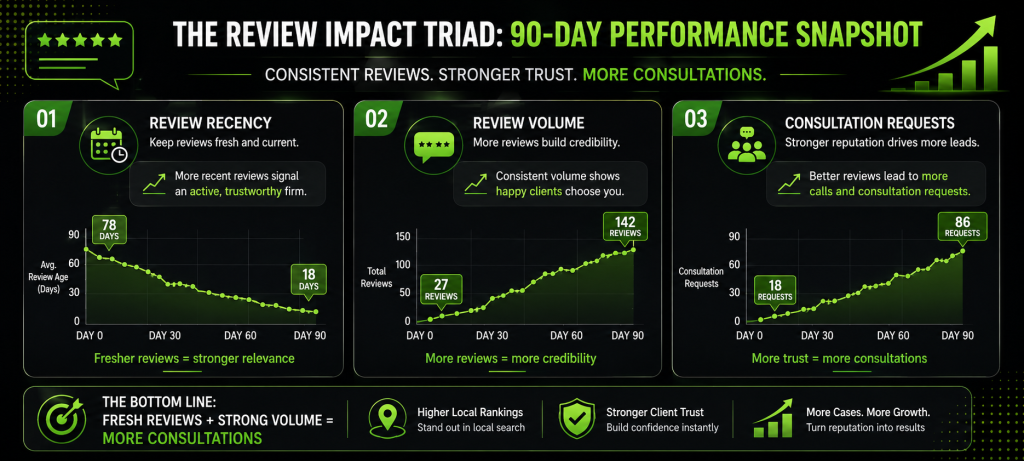
| How Long Does It Take To Improve A Law Firm’s Review Profile? While it is difficult to assign a timeline, early movement in the review profile is visible within a few weeks once requests become consistent. A credible transformation generally takes longer because authentic reviews should follow real client interactions. Over 90 days, firms can establish the process, improve response discipline, identify sentiment patterns, and begin building sustainable review velocity. |
A 90-Day Review Management Action Plan
| Period | Priority Actions |
|---|---|
| Days 1 to 30 | Audit profiles, correct information, define ownership, create response rules, and build direct links |
| Days 31 to 60 | Train staff, launch requests, monitor daily, and respond consistently |
| Days 61 to 90 | Review sentiment, refine timing, add secondary platforms, and connect feedback with process changes |
In-house review management is realistic when the volume is moderate, and someone has protected time. Multi-office firms, sensitive complaint patterns, or inconsistent local visibility may justify outside support. Either way, the system should remain transparent. No mystery workflows. No vanity reporting.
A Consistent Review System Turns Trust Into Local Visibility
Law firm reviews are among the few assets that support discovery, credibility, conversion, and service improvement at the same time. They do not replace technical SEO, strong content, or disciplined intake; they make those investments easier to trust.
The firms that move ahead usually do ordinary things unusually well. They earn the experience, ask at the right moment, respond with judgment, and keep going after the first month. That consistency turns the attorney review strategy into a lasting local advantage.
Viacon can help law firms connect review management with the wider search ecosystem, including Google Business Profile optimization, local SEO services, reputation monitoring, content strategy, and conversion-focused digital marketing. The objective is not simply to collect more positive feedback. It is to build a credible local presence that prospective clients can discover, evaluate, and trust before the first consultation.
Request a free review and reputation audit from Viacon, then build a practical 90-day system for stronger local visibility, better client feedback, and more qualified consultations.