Most law firms we talk to still lean on referrals as their main growth engine. A happy client tells a friend; that friend calls the office, and everyone feels grateful for the business. Nothing wrong there. Referrals build genuine trust, and they close faster than almost any other lead source.
The trouble starts when referrals are the only channel a firm has. Competing firms now run several marketing channels at once and fill their calendars, while a referral-only firm waits by the phone. Waiting is no longer a strategy.
Quick answer: the strongest law firm marketing approach in 2026 blends local search visibility, content that AI tools actually cite, a review and reputation system, and paid channels that catch high-intent searchers, all backed by an intake process that turns contacts into signed clients. Referrals still matter. They just can’t carry a firm’s growth by themselves anymore.
This guide covers what changed, 18 strategies worth your budget, the compliance rules that apply, what marketing actually costs, and how to measure whether any of it is working.
What Has Actually Changed In Law Firm Marketing
The number of legal cases keeps growing, and so does the competition for them. What changed is the terrain marketers now operate on.
New firms enter the market every year, which means more competitors chasing the same searches and the same referral sources. At the same time, the audience itself behaves differently. People who used to type a legal question into Google now ask an AI assistant instead, and they often get an answer without visiting a single website.
That shift toward zero-click search makes direct website traffic harder to earn. Free, plain-language explanations of legal problems sit everywhere online, so plenty of potential clients try to self-diagnose before they ever call an attorney. Both AI systems and human readers also treat a firm without visible credibility, reviews, and third-party validation with a bit of suspicion. A faceless solo practice or an established firm with a thin online footprint falls behind, no matter how good the actual legal work is.
Firms that want a real law firm lead generation system, rather than a trickle of referrals, need to treat this shift as the new baseline. What worked in 2020 barely moves the needle today. We’ve watched firms with excellent reputations lose ground simply because their digital presence never caught up with their real-world quality.
Why A Multi-Channel Approach Beats Referrals Alone In 2026
Referral-only growth still works. It’s just incomplete. A firm relying on referrals alone is betting its entire pipeline on the goodwill of past clients, and that pipeline dries up the moment referral volume dips.
Clients now expect a fast, mobile-friendly site, visible reviews, useful content, and communication that feels personal instead of generic. They compare a local firm against national firms with bigger budgets and against legal tech platforms promising instant answers. They also respond well to firms that reach out first, rather than firms that only show up once someone already knows to search for them by name.
Local search signals and review volume still carry enormous weight in whether a prospective client even sees a firm, let alone calls it. Firms pulling ahead treat marketing as an ongoing system, not a once-a-year brochure refresh. That mindset shift matters more than any single tactic on this page.
| Is Referral Marketing Enough On Its Own For A Law Firm? Referrals remain valuable, but relying on them exclusively leaves a firm vulnerable to any dip in that single channel. A multi-channel approach layering search visibility, content, and paid channels on top of referrals produces steadier, more predictable growth. |
The Law Firm Marketing Framework (Four Categories That Actually Move the Needle)
Eighteen tactics can feel like a lot without structure. We group them into four categories, roughly in the order a firm should build them:
- Foundation & Visibility – The technical and local groundwork that determines whether people can find the firm at all.
- Content & Authority – The material that builds trust and answers questions before the first call.
- Conversion & Relationship – The systems that turn attention into signed clients, and signed clients into repeat business.
- Advanced & Emerging – The tactics that compound once the basics are already solid.
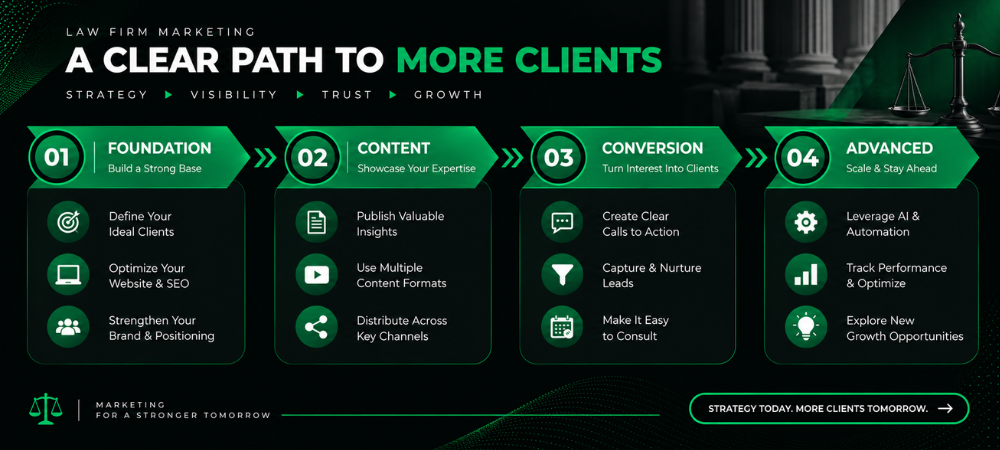
The table below maps all 18 strategies at a glance. Use it to jump straight to what matters most for your firm right now.
| Strategy | Category | Typical Cost | Time to Results |
| Local SEO & Google Business Profile | Foundation | $ | 2–4 months |
| Practice-area content hubs | Foundation | $$ | 6–12 months |
| Technical website performance | Foundation | $$ | Fast fix, slower ranking lift |
| Generative engine optimization (GEO) | Foundation | $$ | 3–6 months |
| Review generation & reputation | Foundation | $ | 30–60 days |
| Google Ads & Local Service Ads | Foundation | $$$ | Days to weeks |
| Educational content & thought leadership | Content | $$ | 6–12 months |
| Video marketing | Content | $$ | 2–6 months |
| Email nurture & newsletters | Content | $ | Ongoing |
| Webinars, workshops & events | Content | $$ | 1–3 months |
| Podcast guesting & owned podcast | Content | $$ | 6–12 months |
| Landing pages & intake optimization | Conversion | $$ | Fast |
| Retargeting & remarketing | Conversion | $$ | Weeks |
| Partnerships & referral networks | Conversion | $ | 6–12 months |
| Client experience & retention | Conversion | $ | Ongoing |
| AI-assisted marketing & automation | Advanced | $$ | 1–3 months |
| Social proof & case study marketing | Advanced | $ | 1–3 months |
| Data-driven attribution & optimization | Advanced | $$ | Ongoing |
Now let’s break each category down.
Foundation & Visibility Strategies
Get this layer right first. Nothing else on this list performs well if people can’t find the firm or trust it once they do.
1. Local SEO And Google Business Profile Optimization
Owning the map pack matters for every “near me” search happening in a firm’s city. A complete, active Google Business Profile with regular posts, accurate categories, and prompt answers to questions gives a firm a real shot at that map pack spot.
Simply claiming the profile doesn’t solve visibility on its own. Citations need to stay consistent across directories, and rankings need regular monitoring exactly where an agency earns its keep for firms without a dedicated in-house team.
2. Practice-Area SEO Content Hubs
A single generic “personal injury” page rarely competes. Build hubs around the specific, high-intent searches people actually type, like “car accident lawyer” plus a city name, or a question about a particular injury type. A firm running personal injury lawyer marketing already knows how competitive that niche gets, and content hubs are one of the few ways to carve out a defensible position in it.
This is slow-burn work. It compounds over months, not days, which makes it one of the most durable client acquisition strategies on this list.
3. Technical Website Performance And Core Web Vitals
Technical optimization is more than a hygiene checklist. Done well, it becomes a marketing asset in its own right. A fast, well-built law firm website gives a firm an edge with search engines and with the humans reading it.
Site speed, mobile experience, Core Web Vitals scores, and proper schema markup (LegalService, Attorney, FAQ) all influence whether Google trusts a site enough to show it prominently. A slow site loses a prospective client before they ever read an attorney’s bio. Treat technical performance as a core marketing tactic, not an afterthought a firm revisits once a year.
4. Generative Engine Optimization: Getting Cited Inside AI Answers
Search behavior keeps splitting between traditional results and AI-generated answers. When someone asks an AI assistant “how much does a divorce cost in my state” or “what should I do after a car accident,” the tool synthesizes an answer from a handful of sources and may or may not mention a firm by name.
Generative engine optimization is the practice of structuring content so AI tools are more likely to pull from it and cite it. That means clear, direct answers near the top of a page, structured data, consistent author and firm information across the web, and content that reads as genuinely authoritative rather than thin and templated. Firms that ignore this piece are optimizing for a search world that’s already smaller than the one their prospective clients actually use.
| What Is Generative Engine Optimization For Lawyers? Generative engine optimization, or GEO, is the practice of structuring a firm’s content so AI tools like Google’s AI Overviews, ChatGPT, and Perplexity are more likely to cite it when answering a legal question. It overlaps with traditional SEO but places extra weight on clear, direct answers and consistent, verifiable information across the web. |
5. Strategic Review Generation And Reputation Management
Set up a simple, repeatable system for asking satisfied clients to leave a review, and have a real protocol for responding to every single one, good or bad. Reviews function as trust signals for Google’s algorithm and for the human reading them side by side with a competitor’s profile.
A firm that responds thoughtfully to a negative review often earns more trust than a firm with a perfect five-star record and zero public replies. Silence reads as indifference.
6. Google Ads And Local Service Ads (LSAs)
Paid traffic works only when a firm targets it tightly and tracks it properly. Without call tracking and conversion data on each campaign, a firm is just guessing at what actually works, and guessing gets expensive fast in competitive practice areas.
Google Ads for law firms and Local Service Ads both deserve a place in the mix, particularly for practice areas like personal injury or family law, where intent is high, and the buying window is short. Treat paid spend as a lever to pull once the foundation above is solid, not a substitute for it.
Legal Advertising Rules That Shape Every Campaign
Most marketing guides skip this part, and they shouldn’t. Every tactic above operates inside a set of professional conduct rules, and getting this wrong creates real risk for the firm. Note that this section describes general patterns across states. It isn’t legal advice, and rules vary by jurisdiction, so confirm specifics with your own state bar or ethics counsel before a campaign goes live.
The Baseline: “Not False Or Misleading”
Most states base their advertising rules on the ABA Model Rules of Professional Conduct, particularly Rule 7.1. The core standard prohibits any communication that is false or misleading, including a statement that’s technically true but omits something necessary to keep it from creating the wrong impression. Rule 7.2 generally permits advertising through any medium, provided the ad includes the name and contact information of at least one responsible attorney or firm.
Testimonials, Reviews, And Case Results
Most states permit testimonials, but many require a disclaimer alongside them, and results-based claims draw extra scrutiny almost everywhere. A satisfied client describing a large settlement tells the truth about their own case, yet it can imply something unsupported about a reader’s very different situation. New York, for example, requires specific disclaimer language on result-based testimonials. Never guarantee or predict an outcome in marketing copy, full stop.
Practice Area And Specialization Claims
A firm can generally state which areas it practices in. Claiming a “certification” or “specialization,” though, usually requires accreditation from a body the state bar actually recognizes. Loose language here is one of the fastest ways to draw a bar complaint over otherwise harmless marketing copy.
What To Check Before A Campaign Goes Live
- Confirm which state’s rules apply, especially for firms advertising across state lines.
- Check whether the jurisdiction requires filing the ad or retaining a copy for a set period.
- Add required disclaimers to testimonials, reviews, and any result-based claims.
- Route new ad concepts through ethics counsel before launch, not after.
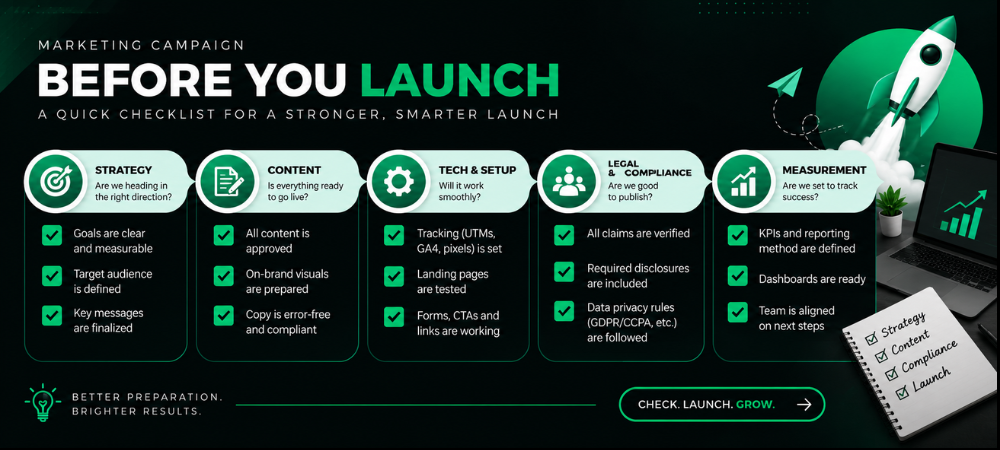
None of this should discourage a firm from marketing aggressively. It should just happen inside the rules, with a real process behind it rather than a hope that nobody checks.
Content & Authority Strategies
Foundation work makes a firm easy to find. Content makes a firm easy to trust before the phone even rings.
7. Educational Content Marketing And Thought Leadership
Blogs, guides, and explainer videos that answer the exact questions people type into a search bar build trust well before someone picks up the phone. This is also the raw material that fuels both local SEO and generative engine optimization, so it earns a spot near the top of any content plan.
8. Video Marketing
YouTube explainers and short-form content on TikTok or Reels reach younger demographics who’d never think to search a law firm directory. A two-minute video answering “what happens at a deposition” often earns more trust than a page of dense legal text ever could.
9. Email Nurture Sequences And Client Newsletters
Staying visible to past and prospective clients through email keeps a firm top of mind for the next legal need, or the next referral they send a friend’s way. This channel costs almost nothing, and most firms ignore it anyway.
10. Webinars, Workshops, And Virtual Events
Few firms actually execute this one well, which makes it a real differentiator for the ones that do. A webinar or workshop lets a firm demonstrate expertise live, in real time, and it captures warm leads in the process. Attendees who show up voluntarily to learn about estate planning or employment law are already halfway to becoming clients.
11. Podcast Guesting And An Owned Podcast
Podcasts reach entirely new audiences and build authority in a format that feels more personal than a blog post. Guesting on an established show costs nothing but time and gets a firm in front of a built-in audience; an owned podcast takes longer to build but compounds the same way a content hub does.
Conversion & Relationship Strategies
Visibility and content only matter if they turn into signed clients. This category closes that loop.
12. High-Converting Landing Pages And Intake Optimization
A beautiful website means nothing if visitors bounce before booking a call. Give each practice area its own dedicated page, strip friction out of the intake form, and turn far more browsers into real consultations. Our guide on high-converting law firm website content walks through the specific page elements that move that needle.
13. Retargeting And Remarketing Campaigns
Almost nobody converts on a first visit. That’s just how it works, especially for a decision as high-stakes as hiring an attorney. Retargeting keeps a firm in front of the people who clicked away, so when they’re finally ready to act, the firm is the name they remember instead of a competitor three tabs back.
14. Strategic Partnerships And Referral Networks
Don’t lean only on the usual referral sources. Accountants, financial advisors, and attorneys in complementary practice areas can become some of the steadiest lead sources a firm has, once a firm builds those relationships deliberately instead of leaving them to chance.
15. Client Experience And Retention Marketing
A simple follow-up sequence after a case closes goes further than most firms realize. Clients who feel remembered are the ones who leave glowing reviews and mention a firm to their friends unprompted.
Advanced and Emerging Strategies
These tactics work best once the foundation, content, and conversion layers already function. Skip straight to this stage, and the results underwhelm.
16. AI-Assisted Marketing And Internal Automation
AI tools can speed up content drafts, run intake chatbots, and flag which leads deserve a callback first, as long as a firm uses them thoughtfully. None of that replaces a lawyer’s judgment, and nobody serious is suggesting it should, but it saves a surprising amount of staff time on repetitive work.
17. Social Proof Amplification And Case Study Marketing
Nothing builds trust like a real result a client describes honestly. Anonymized case studies and short video testimonials often do more heavy lifting than an entire paid ad campaign, and they cost far less to produce.
18. Data-Driven Attribution And Continuous Optimization
Figure out which channels actually turn into signed clients, not just clicks or form fills. This is where a lot of marketing budget quietly disappears without anyone noticing, and it’s the single strategy that makes every other one on this list measurable.
What Law Firm Marketing Actually Costs
Ranges vary a lot by firm size, practice area, and how competitive the local market is, but a few consistent benchmarks show up across recent industry surveys.
Budget Benchmarks by Firm Size
| Firm Type | Typical % of Revenue | Monthly Spend (rough) |
| Solo practitioner | 10–15% | $1,000–$3,000 |
| Small firm (2–10 attorneys) | 7–12% | $3,000–$10,000 |
| Mid-size firm (10–50 attorneys) | 5–10% | $10,000–$50,000 |
| Established firm, strong referrals | 2–5% | Varies widely |
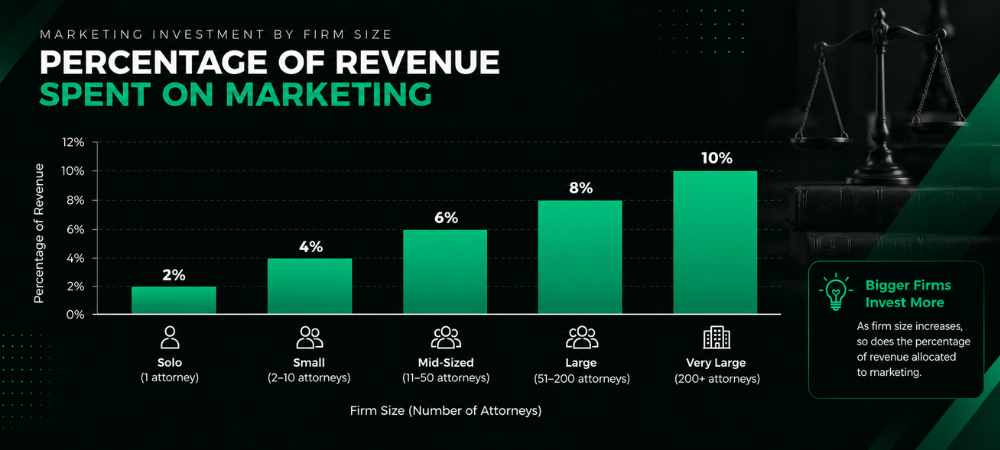
These figures fall within the 2 to 15 percent of gross revenue range most legal marketing benchmarks converge on, with newer firms and highly competitive practice areas like personal injury sitting toward the higher end. A mature firm with a strong referral base can often operate closer to the low end, provided it still tracks where its business actually comes from.
| How Much Should A Law Firm Spend On Marketing? Most legal marketing benchmarks land between 2 and 15 percent of gross revenue, depending on firm size and growth goals. Newer firms and competitive practice areas like personal injury typically sit toward the higher end, while established firms with strong referral networks can often operate closer to the low end. |
Where The Money Should Go First
Spend the first dollars on the foundation layer: local SEO, a functional website, and a review system. These tend to deliver the strongest long-term return relative to spend, and they make every other channel more effective once they’re in place. Paid ads without a foundation underneath them tend to produce expensive clicks and a disappointing conversion rate.
How Long Until Results Show Up
Set expectations early, because mismatched expectations kill more marketing budgets than bad strategy does.
Reviews, retargeting, and paid ads can show movement within days or weeks. Local SEO usually needs two to four months before rankings stabilize. Content hubs, thought leadership, and generative engine optimization take longer still, often six to twelve months before they compound into a reliable stream of inquiries. None of that means the slower tactics matter less. It means a firm needs the fast wins running alongside the slow ones, so the pipeline doesn’t run dry while the compounding work builds.
| How Long Does Law Firm SEO Take To Show Results? Local SEO usually takes two to four months to stabilize. Broader content and authority-building work, including generative engine optimization, generally takes six to twelve months to compound into a steady stream of inquiries. |
DIY, Hybrid, Or Agency: Choosing The Right Setup
A firm with the time and a staff member willing to own it can handle local SEO and review generation in-house without much trouble. Content at scale, paid ad management, and serious attribution tracking are usually where a specialist earns their fee, because those disciplines shift constantly and punish anyone learning on the job with real budget.
A good legal marketing agency brings real strategy, compliance-aware creative, honest reporting, and tracking that actually holds up under scrutiny. Watch for vague reporting, no visibility into which leads became paying clients, or templated content that could belong to any firm in any city.
What we see more of now is a hybrid setup: relationships and reviews stay in-house, while content, paid media, and analytics get outside support. That split plays to each side’s strengths.
| Does A Law Firm Need A Marketing Agency, Or Can This Work In-house? It depends on staff bandwidth and in-house expertise. Local SEO and review generation are manageable in-house for many firms. Content at scale, paid media management, and attribution tracking usually benefit from outside expertise, since those disciplines shift constantly. |
How To Measure Law Firm Marketing Success
Track the early signals first: organic traffic, local pack rankings, form fills, call volume, and cost per lead. Then follow each of those through to what actually matters.
| Metric Type | Examples | Why It Matters |
|---|---|---|
| Leading indicators | Traffic, rankings, form fills, calls | Shows whether visibility efforts are working |
| Lagging indicators | Signed cases, cost per acquisition, lifetime value | Shows whether marketing actually pays for itself |
| Relationship indicators | Referral rate, review volume, repeat clients | Shows whether the client experience holds up |
A solid tech stack CRM, call tracking, analytics, and attribution tools working together makes this whole process far less of a headache. Without it, a firm ends up reporting on activity instead of results.
Common Mistakes That Waste Marketing Budget
- Chasing impressions and traffic instead of signed cases.
- Ignoring how the site performs on mobile devices, where most legal searches now start.
- Running paid ads without call tracking or conversion data.
- Publishing generic content that could belong to any firm in any city.
- Never following up with leads that didn’t convert on the first contact.
- Treating marketing as a once-a-year project instead of an ongoing system.
Every one of these is fixable, and a firm usually catches most of them the moment it starts tracking traffic through to signed cases instead of stopping at the click.
| What’s The Biggest Mistake Firms Make With Legal Marketing? The biggest mistake is treating it as a one-time project rather than an ongoing system, and tracking clicks instead of signed cases. Both mistakes waste budget in ways that don’t show up until months later. |
A Simple 90-Day Roadmap To Get Started
- Days 1–30: Audit the Google Business Profile, fix obvious technical issues on the website, and set up call tracking.
- Days 31–60: Launch a review request system, publish the first practice-area content hub, and start one paid campaign with tight targeting.
- Days 61–90: Review the data, cut what isn’t converting, and double down on whichever channel produced the best cost per signed case.
Ninety days won’t finish the job. It will tell a firm exactly where to put the next ninety.
Where To Start
Law firm marketing works best in 2026 when it operates as a system, not a grab-bag of disconnected tactics. Start with the foundation, layer in content and conversion work, and let the advanced tactics compound once the basics hold steady.
Most firms don’t fail because they picked the wrong tactic. They fail because they tried five at once, half-finished each one, and never tracked which was working. Find the foundation row your firm scores worst on in the table above, fix only that for the next 30 days, then follow the 90-day roadmap to add one channel at a time.
Ready to move on this? Book a free marketing audit with the Viacon.io team, or grab the checklist and infographic from this guide to map out your own 90-day plan.