A buyer in Mumbai scrolls through Dubai Marina apartments on Instagram at midnight. A procurement manager in Abu Dhabi checks a contractor’s LinkedIn page before returning a call. Neither has spoken to a single agent yet, but both have already formed an opinion.
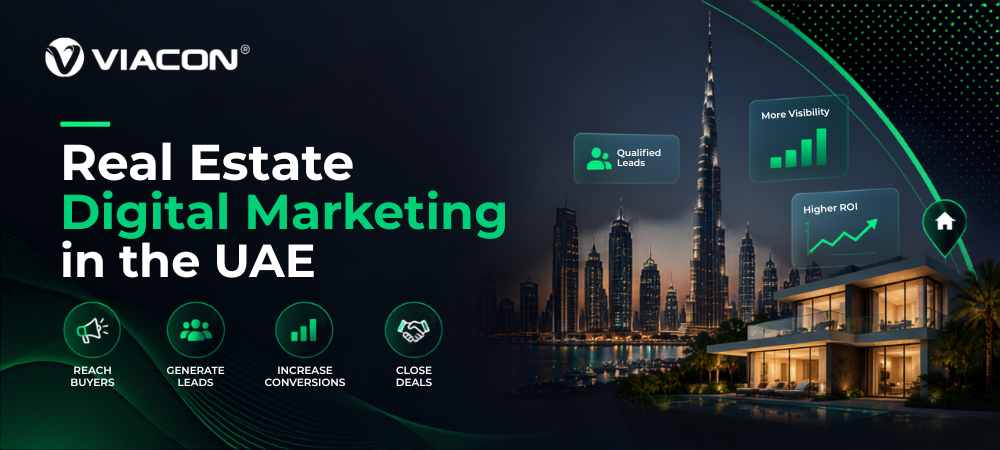
That is real estate digital marketing at work in the UAE today: every SEO ranking, social post, portal listing, and WhatsApp reply that shapes a buyer’s decision before a human conversation even starts. This guide is about digital visibility for real estate businesses across the UAE, not isolated tactics borrowed from a US or UK playbook that never mentions Bayut, Trakheesi, or WhatsApp.
We cover what actually moves the needle in digital marketing for real estate UAE businesses developers, brokerages, agencies, and contracting firms across Dubai, Abu Dhabi, and the wider Emirates including the compliance rules most marketing guides skip entirely. By the end, you will have a working framework, not just theory.
What Real Estate Digital Marketing Means In The UAE Right Now?
Real estate digital marketing covers every online activity that helps a property business get found, get trusted, and get contacted: SEO, paid search, social media, portal listings, content, and the website that ties it all together. In most markets, the definition stops there. In the UAE, it stretches further.
The country has one of the highest rates of internet and social media use anywhere in the world, so a large share of the buyer journey plays out online before an inquiry ever reaches an inbox. Investors compare projects on Instagram, expats read community reviews on YouTube, and commercial buyers check a contractor’s digital footprint the way they once checked references.
That shift matters just as much to a boutique brokerage in Sharjah as it does to a master developer in Abu Dhabi. If you want a clear picture of where your own digital marketing currently stands against competitors, an audit is usually the fastest way to see the gaps.
| Quick Answer: Real estate digital marketing in the UAE combines SEO, paid ads, property portals (Bayut, Property Finder, Dubizzle), social media, and fast WhatsApp follow-up into one connected system, so buyers find and trust a business before they ever pick up the phone. |
What Is Real Estate Digital Marketing?
Real estate digital marketing is the use of online channels SEO, paid ads, social media, property portals, and content to help a property business get found by buyers and generate qualified leads. In the UAE, it also includes WhatsApp follow-up and compliance with RERA advertising rules, since both directly affect whether a lead converts.
How The UAE Property Buyer’s Journey Has Changed
Ten years ago, most property deals in the UAE started with a phone call or a walk-in. Today, the sequence runs almost in reverse.
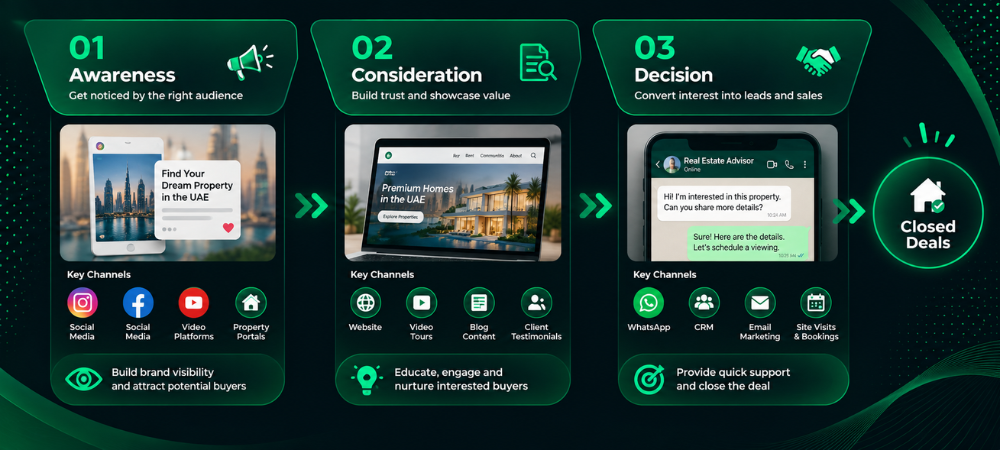
Buyers move through three loose stages, and each one now happens mostly on a screen.
- Awareness – They see a project through a reel, a portal ad, or a friend’s share, often before they know the developer’s name.
- Consideration – They compare listings, watch walkthrough videos, and read reviews across two or three portals at once.
- Decision – By the time they message an agent, they usually already have a shortlist and a rough budget in mind.
The same pattern shows up on the commercial side. A contractor bidding for a project in Abu Dhabi is often shortlisted based on their LinkedIn presence and past project documentation, sometimes weeks before a tender is issued. Buyers and procurement teams do their homework early, so a business with no digital presence gets excluded from opportunities it never even knew existed.
Property Portals: Bayut, Property Finder, And Dubizzle
No UAE strategy works without property portals, and this is the single biggest gap in most digital marketing advice written for other markets.
Bayut generally draws the widest audience and performs across almost every price point. Property Finder tends to attract more international and premium buyers, which suits higher-ticket listings. Dubizzle remains strong for rentals and budget-conscious tenants, and it shares ownership with Bayut, so bundled packages are common.
None of these portals replaces a website. They generate inbound interest that still needs somewhere to land, and a listing without fast follow-up wastes the lead, regardless of which portal sent it.
A Few Things Worth Remembering:
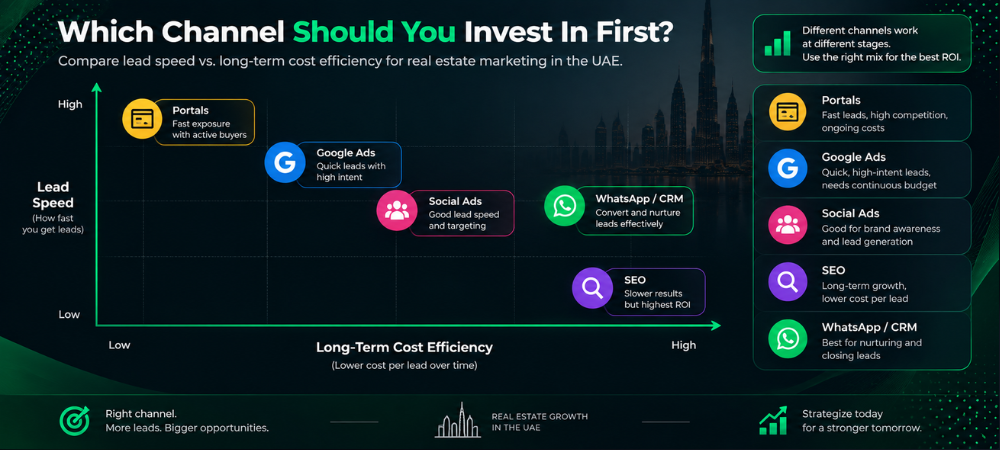
- Portal leads arrive quickly and go cold even faster, often within minutes.
- Featured or premium placements cost more but usually shorten time-to-lead.
- Off-plan projects often need a developer’s no-objection certificate before an agent can advertise them, which ties portal strategy directly to the compliance rules covered later in this guide.
Treat portals as one channel inside a bigger system, not the whole strategy.
| How Important Are Property Portals Like Bayut And Property Finder? Very important for inbound visibility, but they work best alongside a website and CRM rather than as a standalone strategy. Portal leads convert fastest when a business follows up within minutes, usually over WhatsApp. |
SEO for Real Estate: Ranking for Property And Location Searches
SEO for real estate works differently from most industries, mainly because searches are hyper-local. Someone searching “2 bedroom apartment Dubai Marina” wants something very different from someone searching “off-plan investment Yas Island,” even though both sit under the same broad keyword theme.
Ranking for these searches takes more than a homepage and a handful of service pages.
Effective Real Estate SEO Usually Needs:
- Location and community pages built around real search intent (Business Bay, JVC, Al Reem Island, Saadiyat Island).
- Fast page speed, since most UAE property traffic happens on mobile.
- Structured data on listings, so search engines and AI tools read prices, bedrooms, and locations correctly.
- Regularly refreshed content, because stale listings and outdated prices damage trust and rankings together.
Businesses that skip this step end up paying for every visitor through ads, which gets expensive fast in a market this competitive. Solid SEO for real estate closes that gap and keeps bringing in buyers long after a campaign budget runs out.
| Do Real Estate Businesses Need SEO If They Already Advertise On Portals? Yes. Portals put a listing in front of buyers already browsing that portal, but SEO brings in buyers searching directly on Google, builds long-term brand visibility, and reduces dependence on paid placements that stop working the moment the budget stops. |
Programmatic Landing Pages for Every Project And Community
Developers and large brokerages face a specific problem: dozens or hundreds of active listings, each needing its own page to rank well. Writing every page by hand simply does not scale.
Programmatic SEO solves this. Instead of one generic “properties” page, a structured template pulls in data for each community, project, or unit type and builds a unique, indexable page automatically. A developer with towers across a dozen communities can end up with hundreds of targeted pages instead of one page trying to rank for everything at once.
Done well, this approach avoids the thin, duplicate-sounding pages that hurt rankings instead of helping them. Done poorly, it creates exactly that problem; the difference comes down to how the templates are built and how accurate the underlying data is. Programmatic SEO built specifically for real estate listings scales this without the usual duplicate-content risk.
Social Media Marketing For Real Estate In The UAE
Real estate social media marketing in the UAE runs on a few platforms, each doing a different job.
LinkedIn works best for developers, contractors, and commercial brokers. Decision-makers respond to people, not logos, so a founder or sales director posting regularly often outperforms a branded company page.
Instagram and Facebook carry the visual weight: reels of finished units, drone footage of a project’s progress, and short client testimonials. Property is a visual product, and buyers scroll through options the way they scroll through anything else, so content needs to earn attention within the first two seconds.
TikTok is growing quickly among younger buyers and renters, especially for area guides and everyday-life content that portals cannot replicate.
Posting frequency matters more than most agencies admit. Three well-produced posts a week beat one polished post a month, because algorithms and buyer memory both reward consistency over occasional bursts.
One caution: every property-specific post, including paid social ads, still has to follow the same advertising rules as a portal listing. A striking reel means nothing if it breaches RERA’s requirements. A social media strategy built specifically for real estate keeps that balance between creative and compliant.
| Which Social Media Platform Works Best For Real Estate Marketing In The UAE? LinkedIn tends to work best for developers, contractors, and commercial real estate, since decision-makers respond to individual professionals more than brand pages. Instagram and Facebook perform best for residential listings and off-plan projects because of their strength in video and image content. |
Paid Advertising and Portal Placements That Convert Budget Into Leads
Paid media does the heavy lifting when a business needs leads now rather than in six months.
Google Search ads catch buyers who already know what they want, which is why they tend to produce the highest-intent leads, even at a higher cost per click. Meta lead ads work well earlier in the funnel, while buyers are still browsing rather than actively searching. Retargeting brings back the large share of visitors who look once and leave in real estate, which can be the majority of total traffic.
Portal placements deserve their own line item in the budget. Featured listings on Bayut or Property Finder cost more than standard ones, but they usually shorten the time a unit sits unsold, which often makes up the difference.
International buyers add another layer worth budgeting for separately. Geo-targeted campaigns aimed at source markets such as India, the UK, or the wider GCC often reach investors earlier in their decision process than campaigns aimed only at the UAE.
None of this works without tracking which channel actually produced a signed deal, not just a click. Real estate lead generation UAE campaigns succeed or fail on that follow-through. Performance marketing built around real conversions, not just cost per lead, separates a profitable campaign from an expensive one.
| What Is The Fastest Way To Generate Real Estate Leads In The UAE? A combination of Google Search ads for high-intent buyers, premium portal placements, and instant WhatsApp follow-up typically produces the fastest results. SEO and content take longer to build but produce more sustainable, lower-cost leads over time. |
Content, Video, And Virtual Tours That Build Buyer Trust
A brochure PDF no longer counts as content marketing. Buyers expect video walkthroughs, drone footage, and honest area guides before they will even request a viewing.
Blog content still earns its place, particularly for long-tail searches such as “best areas to invest in Abu Dhabi” or “off-plan versus ready property in Dubai.” These searches rarely convert on the first visit, but they build the kind of ongoing traffic that paid ads cannot sustain alone.
Virtual 3D tours matter most for off-plan and international buyers, since many commit to a viewing schedule or even a reservation before setting foot in the country. A tour that lets someone walk through a show apartment from a phone in London or Mumbai removes a real barrier to booking a flight.
Case studies and client testimonials do quieter but equally important work. They hand a hesitant buyer, or a procurement committee, the third-party proof that a company’s own marketing cannot provide by itself. Structured content marketing built around these formats keeps a real estate brand visible through that longer research process.
WhatsApp, CRM, And Fixing The Follow-Up Gap
Most real estate businesses in the UAE lose leads not because their marketing failed, but because their follow-up did.
WhatsApp is the default communication channel for buyers and tenants here, often ahead of email or even phone calls. A portal lead that gets a WhatsApp reply within minutes converts at a far higher rate than one that waits until the next morning.
The bigger issue is fragmentation. Leads arrive from Bayut, Property Finder, Dubizzle, the website, Meta ads, and referrals, often landing in five different inboxes managed by five different people. Without a shared system, duplicate follow-ups and missed leads become routine rather than occasional.
A CRM that pulls every source into one pipeline, flags duplicates, and triggers instant WhatsApp replies fixes most of this without adding headcount. It also gives management something most agencies never see clearly: which channel actually produces closed deals, not just inquiries. CRM integration that connects portals, ads, and WhatsApp into one workflow is usually the highest-return fix available to a real estate business, and the most overlooked one.
Websites and Landing Pages That Convert Visitors Into Leads
A slow website loses buyers before they see a single listing, and in the UAE, where most property research happens on a phone, page speed matters more than almost any design decision.
Beyond speed, a handful of elements consistently separate websites that generate leads from ones that just display listings:
- One clear call to action per page, instead of five competing buttons.
- Trust signals visible above the fold: RERA registration, developer partnerships, or completed project numbers.
- Search and filter tools that work properly on mobile, not just on desktop.
- A form that asks for the minimum information needed, since every extra field costs a percentage of completions.
Small changes here often outperform an entire ad budget increase. Moving a form into a sticky position, for example, can lift completion rates without spending an extra dirham on traffic. Conversion rate optimisation applied to a property website usually pays for itself faster than most other marketing investments.
RERA, DLD, and Advertising Compliance Every Marketer Needs to Know
This is the part most real estate marketing guides skip entirely, and it is often the part that gets an ad pulled down.
In Dubai, every advertisement for a specific property on a portal, Instagram, YouTube, or even WhatsApp needs a valid Trakheesi permit number. The Dubai Land Department issues these permits, and the Real Estate Regulatory Agency (RERA) supervises the system. Since 2024, many ads must also carry a Madmoun QR code that lets a buyer verify the listing is genuine. RERA treats advertising without a valid permit as a violation, and reported fines start at around AED 50,000 per offence real financial exposure, not a technicality.
A Few Practical Implications For Anyone Running Campaigns:
- Off-plan units generally need a no-objection certificate from the developer before an agent can advertise them.
- Resale listings usually require Form A, the marketing agreement between the seller and the brokerage.
- A permit number ties to one specific property and must match the advert exactly, so a single ad template cannot cover multiple units.
Abu Dhabi runs a comparable system through the Abu Dhabi Real Estate Centre, which introduced its own Madhmoun permit requirement for mainland advertising in 2025. Rules across the Emirates change periodically, so confirm current requirements directly with the relevant land department before launching a campaign, rather than relying on last year’s process.
Building compliance into a campaign from the start costs far less than pulling one down after launch.
| Do I Need A Permit To Advertise Property In Dubai? Yes. Every advertisement for a specific property in Dubai needs a valid Trakheesi permit number issued through the Dubai Land Department and supervised by RERA, and many ads also require a Madmoun QR code. RERA treats advertising without one as a violation, with reported fines starting around AED 50,000. |
Real Estate Marketing In Abu Dhabi vs. Dubai: What Actually Differs
Abu Dhabi and Dubai get lumped together constantly, but real estate marketing in Abu Dhabi behaves differently in a few important ways.
Dubai’s market moves fast and rewards speed: quick portal turnarounds, aggressive retargeting, and campaigns built around off-plan launches with tight payment plans. Buyer behaviour skews toward investment, and a large share of leads come from outside the UAE entirely.
Abu Dhabi tends to move at a steadier pace. A larger share of buyers are end-users rather than pure investors, government-linked developers play a bigger role in the market, and communities like Yas Island, Saadiyat Island, and Al Reem Island each carry a distinct lifestyle positioning that generic Dubai-style ads tend to miss. Messaging built around flipping and quick returns often falls flat here, while messaging built around lifestyle, family amenities, and long-term value tends to perform better.
In practice, a real estate marketing Abu Dhabi campaign usually needs its own content, its own community targeting, and often its own timeline, rather than a Dubai strategy with the city name swapped out. We have seen this play out directly in client work, some of it documented in our case studies, where a single “one UAE strategy” approach consistently underperformed two properly localised ones.
| Is Real Estate Marketing In Abu Dhabi Different From Dubai? Yes, noticeably. Abu Dhabi buyers skew more toward end-users than investors, government-linked developers play a larger role, and messaging built around lifestyle and long-term value tends to outperform the investment-focused messaging common in Dubai campaigns. |
Budgets And KPIs: What Real Estate Digital Marketing Should Cost And Deliver
Budgets vary enormously by business size and property segment, but a few patterns hold across the market.
A small brokerage handling a handful of listings a month can run a functional presence portals, basic social media, and light paid ads on a modest monthly budget. A developer launching a tower operates at a different scale entirely, often running paid campaigns, portal premium packages, video production, and PR together around a launch date, which pushes spend far higher for that period.
Rather Than Fixating On Total Spend, Track What That Spend Actually Produces:
- Cost per lead, broken down by channel, not blended into one number.
- Lead-to-viewing rate, since a cheap lead that never books a viewing is not actually cheap.
- Lead-to-close rate, the number that ultimately matters to a business owner.
- Time-to-first-response, since speed affects conversion more than almost any creative decision.
A campaign producing plenty of cheap leads but few closed deals is not working, regardless of how good the cost-per-click looks on a report. A free audit usually surfaces where spend is actually leaking within a day or two, rather than months of guessing.
| How Much Does Real Estate Digital Marketing Cost In The UAE? Costs vary by property segment and business size: a small brokerage running portals and light social ads spends far less than a developer launching a tower with paid media, portal premium packages, and video production running together. Cost per closed deal matters more than total monthly spend. |
Preparing For AI-Powered Property Search
Buyers already ask AI tools questions that used to go straight to an agent: “best area for a young family in Dubai,” “is off-plan safer than ready property in Abu Dhabi,” and similar open-ended queries. These tools answer using whatever content they can find, understand, and trust.
That shift changes what “ranking” means. It is no longer only about a blue link on a results page; it is about whether an AI answer engine mentions a brand at all when it summarises an answer for a buyer.
Businesses most likely to show up in those answers are the ones with clear, well-structured content that directly answers real buyer questions, rather than generic sales copy. FAQs, comparison content, and straightforward area guides tend to perform well here, partly because AI tools prefer to pull from exactly that format.
Getting found inside an AI-generated answer is still a new discipline, and it rewards businesses that start early rather than those waiting until it becomes the obvious next channel. AI search optimisation is how that groundwork gets laid now, while most competitors are still catching up.
| How Long Does It Take To See Results From Real Estate Digital Marketing? Paid ads and portal placements can produce leads within days. SEO, content, and social media typically take two to four months to build meaningful traction, though the leads they eventually produce tend to cost less and convert at a higher rate. |
A 90-Day Framework To Build Digital Visibility For A Real Estate Business
Most of this becomes far more useful with a rough sequence attached to it.
Days 1–30: Foundation– Audit the current website, portal listings, and social profiles. Fix compliance basics: RERA registration details, permit numbers, and Google Business Profile listings. Set up a single CRM pipeline for every lead source.
Days 31–60: Visibility – Launch or refresh community and project landing pages. Start a consistent posting schedule across LinkedIn and Instagram. Begin one paid campaign focused on a single high-intent audience rather than everyone at once.
Days 61–90: Optimisation – Review which channels produced actual viewings and closed deals, not just leads. Cut what is not working, and put that budget behind whatever channel is already proving itself. Add video content and, if listing volume justifies it, start building programmatic pages for additional communities.
None of this needs to happen perfectly on day one. It needs to happen in the right order, with someone checking the numbers every two weeks rather than at the end of the quarter.
How Viacon Helps Real Estate Businesses In The UAE Turn Visibility Into Deals
Viacon works with developers, brokerages, and contracting firms across the UAE to build the kind of digital presence this guide describes not as separate services bolted together, but as one connected system covering SEO, paid media, social content, website performance, and AI search visibility.
That approach matters because these channels rarely work in isolation. A beautifully designed website with no SEO behind it sits unseen. A strong social presence paired with a slow-loading landing page loses the leads it generates. Businesses that win in this market treat visibility as one system, not five separate vendors working from different playbooks.
If your current marketing feels scattered across a few agencies and a few in-house efforts, that is usually the first thing worth fixing before spending another dirham on ads. Get in touch for a straightforward look at where your current digital visibility stands.
Visibility in this market rarely comes down to one channel getting lucky. It comes from a website, a portal presence, a social strategy, and a follow-up system all pointed at the same buyer at the same time, built correctly, and built to stay compliant with the rules that govern every ad shown here.