
A software company we’ve watched operate published two blog posts a week for most of a year. Traffic climbed steadily. Rankings improved for a decent list of keywords. And then someone in a leadership meeting asked the obvious question: how many of those readers turned into leads? Nobody had a good answer, because nobody had connected the content to anything the business actually needed.
That’s the trap. Publishing consistently feels like progress, and it isn’t nothing, but it’s not a strategy either. A content marketing strategy is what decides which problems get written about, for whom, and what happens after someone reads the piece. Without that decision made up front, a company ends up with a blog that’s busy but not particularly useful to the business behind it.
This article walks through what a real content marketing strategy looks like. Which approaches tend to work, where AI genuinely fits into the process, and how to build a plan without guessing.
What Is A Content Marketing Strategy?
A content marketing strategy is the reasoning behind a company’s content, not the content itself. And not the calendar that schedules it. It answers a handful of questions before a single piece gets written: Who are we writing for? What outcome are we trying to influence? Which topics actually matter to that audience? Where will this content live, and how will we know if it worked?
A publishing calendar, by contrast, just tells you what’s going out and when. Plenty of companies have a detailed calendar and no real strategy behind it. They know Tuesday’s post is about pricing and Thursday’s is a customer story. But nobody could tell you why those two topics were chosen over the dozen others sitting in a spreadsheet.
The strategy sits above the calendar. It covers the audience you’re writing for, the goals that content is meant to support. The topics that earn a place on the calendar in the first place. How that content gets distributed once it’s live, and how you’ll measure whether any of it worked. Skip that layer, and the calendar just becomes a to-do list with no clear reason behind it.
| A Question Worth Clearing Up Here: |
|---|
| How Is This Different From An SEO Strategy? SEO is one input into a content strategy, not the whole thing. SEO tells you what people are searching for and how discoverable a page is; the strategy decides which of those topics are worth the effort and what should happen after someone finds the page. |
Why Content Marketing Still Matters?
Content doesn’t do one job; it does a different job depending on where someone is in their decision. Someone who just realized they have a problem needs something different from someone comparing three vendors. And both need something different from a customer who already bought and is trying to get more value out of the purchase.
Early on, in the awareness stage, people are searching to understand a problem, not to find a vendor. Educational content, guides, and honest breakdowns of a trend do the heavy lifting here; trying to sell at this stage usually backfires, because the reader isn’t ready and the pitch feels premature.
By the consideration stage, the reader knows the problem is real and is weighing approaches. This is where comparison content, frameworks, and case studies earn their keep. They help someone form a point of view about what “good” looks like before they start evaluating specific companies.
At the decision stage, the reader has usually narrowed things down and needs practical detail. Pricing structure, implementation timelines, what could go wrong. And after the sale, retention content, tutorials, deeper resources, and onboarding material keep the relationship going.
It’s easy to stop writing once someone becomes a customer, and that’s usually a mistake. Retained customers are often the cheapest source of future revenue a company has. What counts as “useful” at each stage keeps shifting too. Which is worth tracking through pieces like this rundown of content marketing trends rather than assuming last year’s playbook still applies.
The Most Effective Content Marketing Strategies
Some approaches consistently outperform others, regardless of industry. None of these is secrets; most are just harder to execute consistently than they sound.
Start With the Right Foundation
Start From Customer Problems, Not Keyword Lists: Keyword research tells you what people are typing into a search box. It doesn’t tell you why they’re typing it. The strongest content starts with a real problem a customer described in a sales call. A support ticket, a review and then works backwards to the keywords that map to it. Do it the other way around, and you end up with technically optimized content that doesn’t actually resonate with anyone.
Build Topic Clusters Instead Of Isolated Posts: A single article on “email deliverability” competes with thousands of others saying roughly the same thing. A cluster of interconnected articles covering deliverability basics. Common mistakes, tools, and troubleshooting signals depth to both readers and search engines in a way one article never will. At scale, this is close to what programmatic SEO is built for. Though a handful of well-connected articles can achieve the same effect on a smaller site. This is also where a business starts to look like it actually knows the subject, rather than having gotten lucky with one good post.
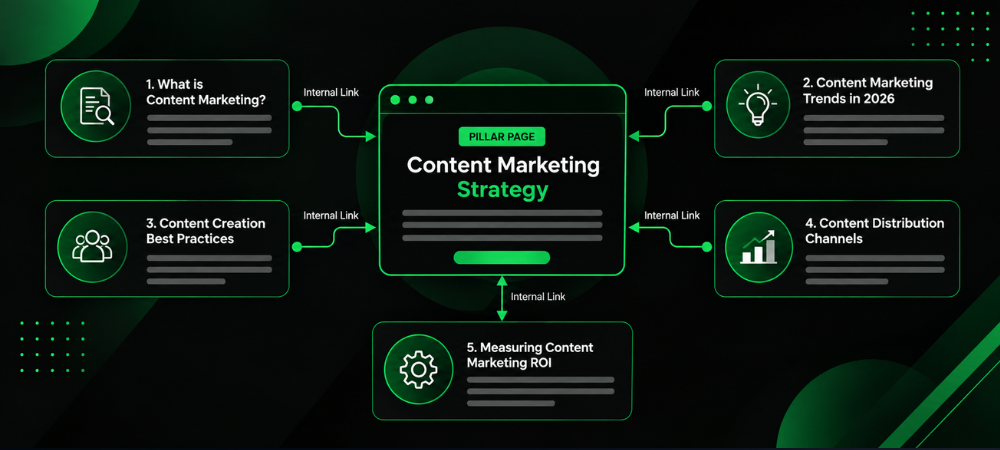
Write For Every Stage Of The Buying Journey, Not Just The Top: Plenty of blogs are stacked with awareness content and almost nothing for someone who’s already decided the problem is worth solving. That’s a missed opportunity: comparison pages, implementation guides, and pricing breakdowns often convert far better than the broad educational posts that get all the attention.
Keep Content Fresh And Trustworthy
Use Original Research And First-hand Experience Where You Can: A survey of your own customers, a breakdown of results from your own work. Or even a strong opinion backed by real experience will outlast generic advice that’s been rewritten a hundred times across the web. This doesn’t need to be elaborate; even a short internal data point can make a piece genuinely useful instead of interchangeable.
Go Back And Fix What’s Already Declining: Older content quietly loses rankings as competitors publish better versions and the original goes stale. Refresh an existing page by updating examples and tightening the structure. Adding what’s missing is often faster and cheaper than writing something new from scratch, and it tends to recover lost ground quickly.
Build Comparison And Decision-stage Content Honestly: “X vs. Y” pages and alternative-to pages get real search volume because people genuinely want that comparison before they buy. The honest version of this content one that admits where a competitor is actually a better fit builds more trust than a page that’s obviously tilted.
Make Content Work Harder
Go Industry-specific Where It’s Genuinely Relevant: Generic advice reads as generic. A guide written for the actual constraints of, say, healthcare marketing or e-commerce reads as something the writer actually understands. And it tends to rank better for the more specific searches that industry runs.
Repurpose Your Strongest Pieces Instead Of Always Starting Fresh: A well-researched article can usually become a LinkedIn post, a short video script, or an email sequence without much extra effort. Repurposing isn’t cutting corners. It’s making sure a good idea reaches people who wouldn’t have found it on the blog anyway.
Build Content Your Sales Team Will Actually Use: Ask a salesperson what questions come up most often in deals that stall, and you’ll usually get a short, specific list. Content built to answer those exact objections gets used in real conversations. Which is a very different outcome than content that just sits on the blog collecting views.
Structure For Discovery
Answer Specific Questions Directly Rather Than Dancing Around Them: If someone searches “how long does a website migration take,” give them a real answer near the top of the page. Readers and, increasingly, AI systems summarizing the page reward content that gets to the point instead of building up to it over six paragraphs.
Link Between Your Own Pages With Intent: Internal links help readers find related material and help search engines understand how your content connects. They work best when they’re added because a reader would genuinely benefit from the link, not because a page needed one more link pointing at it.
Create The Kind Of Content People Actually Want To Reference: Original frameworks, useful data, and genuinely well-organised guides earn backlinks naturally over time. Content built purely to attract links rarely works; the incentive shows, and other sites can tell.
AI In Content Marketing
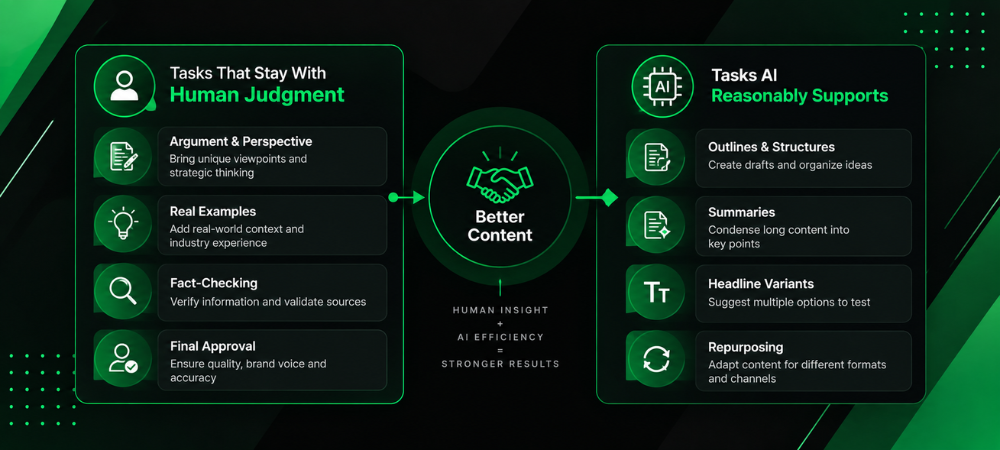
AI shows up somewhere in almost every content workflow now, and the honest take is more useful than the hype. It’s a genuinely good research and drafting assistant, and a poor substitute for judgment.
Where it earns its place: pulling together a first-pass outline from a messy set of notes, summarizing a long report before a writer digs into it. Generating variations of a headline or a subject line to test. And flagging structural or readability issues before a piece goes live. It’s also decent at repurposing, turning a long article into a set of social posts or an email draft. Which used to eat up a surprising amount of time.
Where it falls short: it doesn’t know your customers, it doesn’t have opinions worth trusting on its own. And it can state something confidently wrong without any signal that it’s wrong. This is where many teams go wrong. They let AI produce a full draft and publish it with light editing. And the result reads competently while saying almost nothing that couldn’t have come from any competitor’s blog.
A workflow that actually works keeps a person accountable for the parts that create differentiation: the argument, the specific examples, the claims that need to hold up. AI can draft around that core, but someone with real expertise needs to write or heavily shape it, and someone else needs to fact-check the output before it ships.
Skipping that review step is how factual errors and generic advice end up published under a company’s name. The same discipline applies to AI search optimization more broadly. It’s a research and structuring aid, not a replacement for someone who actually understands the topic.
Content Marketing For SEO And AI Search
Search behavior has changed enough that it’s worth addressing directly, without overselling what’s actually knowable. Nobody can reliably guarantee a page will get cited inside a chatbot’s answer anyone who claims otherwise is guessing. What’s more useful is understanding the underlying signals that tend to help across both traditional search and AI-generated answers.
The Signals That Still Matter Most
Topical Authority still matters. A site that covers a subject thoroughly, across multiple connected pages, tends to be treated as more credible on that subject than a site with one article and nothing else nearby.
Search Intent understanding whether someone wants a definition, a comparison, or a how-to — decides whether a page satisfies the person who lands on it. Ranking for a keyword and satisfying the intent behind it aren’t automatically the same thing.
Entity Relationships matter more than they used to. Search systems increasingly understand concepts and how they connect to each other, not just the exact words on a page. Writing clearly about how ideas relate — rather than just repeating a keyword — tends to help here.
What Makes Content Worth Citing
Genuinely Helpful, Answer-focused Writing performs better than content padded to hit a word count. Getting to the point, then adding depth, beats building up to an answer over several screens.
First-hand Expertise shows up in specifics that a generic writer couldn’t produce: a real example, a number that came from actual experience, a caveat that only comes from having done the work. That kind of detail is hard to fake and easy to notice.
Internal Linking And Structured Information: clear headings, direct answers, well-organized lists where they genuinely help make it easier for both readers and machines to extract the useful part of a page quickly.
None of this requires chasing a moving target. Writing something genuinely useful, organizing it clearly, and being specific instead of vague tends to hold up regardless of which system is doing the reading. If you want a deeper breakdown of how these signals interact in practice, this guide to modern SEO goes further into the mechanics.
Content Marketing By Funnel Stage
It helps to see the funnel stages laid out against the content types that tend to fit each one:
- Awareness: educational guides, original research, trend commentary content aimed at someone who’s just noticed a problem exists.
- Consideration: comparison articles, alternatives pages, case studies content for someone weighing different approaches.
- Decision: service pages, pricing information, implementation guides content for someone close to choosing a provider.
- Retention: tutorials, deeper resources, customer education content for someone who already bought and needs to get value out of it.
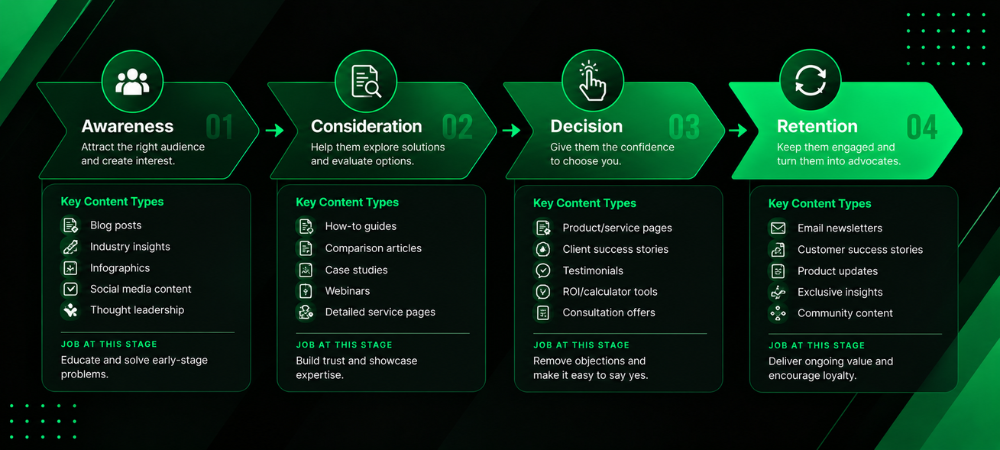
The mistake most companies make isn’t picking the wrong content for a stage; it’s ignoring the stages that don’t feel exciting to write about. Pricing pages and implementation guides rarely win awards, but they often do more commercial work than the flashiest awareness piece on the site.
Content Marketing By Industry
The right strategy shifts depending on who’s buying and how long that decision takes.
B2B
B2B buying usually involves multiple people and a longer research window, which makes authority-building content and detailed sales-enablement material worth the investment; a single decision-maker rarely acts alone.
SaaS
SaaS companies tend to benefit heavily from product-led content: tutorials, integration guides, and comparison pages that speak directly to a technical evaluator, alongside pricing clarity that reduces friction before a trial signup. Teams building out a SaaS product alongside its content usually find the two feed each other — feature documentation becomes content, and content questions become the product roadmap.
Healthcare
Healthcare content carries more scrutiny than most categories — accuracy and clear sourcing matter more here than almost anywhere else, and content that oversimplifies medical claims can do real damage to trust, not just rankings.
Real Estate
Real estate buyers are often local and emotionally invested, so location-specific guides and honest market commentary tend to outperform generic advice about the industry as a whole. This local SEO guide for real estate agents covers how that plays out in practice for a single market.
Legal
Legal content faces some of the same scrutiny as healthcare: readers want precision, not marketing language, and vague claims stand out as red flags in a category where readers are already cautious.
E-commerce
E-commerce content leans hard on product-adjacent guides, comparison content, and buying advice, since the path from “researching an idea” to “adding something to a cart” is often much shorter than in other industries. That short path is also why e-commerce development decisions page speed, checkout friction end up affecting content performance just as much as the writing does.
None of this means one industry needs a completely different playbook; it means the mix of strategies from earlier in this article should lean differently depending on how that specific audience actually buys.
How To Build A Content Marketing Strategy Step By Step
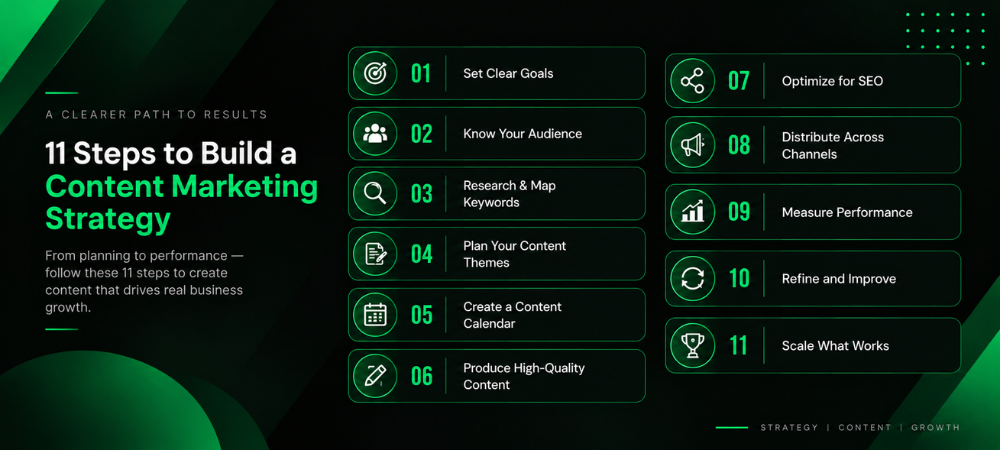
- Define The Business Objective: Decide what the content actually needs to move pipeline, retention, or category awareness before choosing a single topic.
- Identify The Target Audience: Get specific about who you’re writing for, beyond a generic job title.
- Research The Questions Your Customers Actually Ask: Sales calls, support tickets, and reviews usually reveal more than a keyword tool on its own.
- Analyze What Competitors Are Already Doing: Not to copy it, but to see what’s already covered well and where a real gap exists.
- Map Keywords To Intent: Match search terms to what someone actually wants when they type them, not just to search volume.
- Build Topic Clusters Around Your Core Subjects: Group related questions together instead of treating every piece as a standalone.
- Choose Formats Deliberately: Some topics work as articles, others as videos or tools; pick based on the job the content needs to do, not habit.
- Build An Editorial Calendar Around The Clusters: The calendar should follow the strategy, not the other way around.
- Publish And Distribute With Intent: Writing the piece is half the work; getting it in front of the right audience is the other half.
- Measure Performance Against The Original Objective: Go back to step one and check whether the content is actually doing what it was meant to do.
- Update And Improve What’s Already Published: A strategy isn’t a one-time project; older content needs regular attention as the market and the competition shift.
| How Often Should The Strategy Itself Get Revisited, Versus Just The Content? Most teams benefit from a proper review every couple of quarters enough time to see real results, but not so long that a stale approach keeps running on autopilot. Smaller check-ins on performance can happen monthly without needing a full strategy overhaul each time. |
How To Measure Content Marketing Success?
Traffic is the easiest thing to measure and, on its own, one of the least useful. A page can pull in thousands of visitors who never fit the customer profile at all, while a quieter page influences a handful of high-value deals. Both numbers deserve attention, but they answer different questions.
Worth tracking on the visibility side: organic clicks, impressions, rankings for the terms that actually matter, and click-through rate on the pages meant to draw people in. On the engagement side: how long people actually stay, and whether they move toward another page instead of leaving immediately. Most of this lives in the analytics setup a company already has, and if that setup is shaky (a common issue since the GA4 migration), the content numbers won’t mean much no matter how good the writing is.
But the numbers that connect to the business are the ones worth protecting time for: leads generated, conversion rate on the pages designed to convert, assisted conversions where content played a supporting role rather than the final one, and where it’s trackable, qualified leads and revenue that content had a hand in influencing.
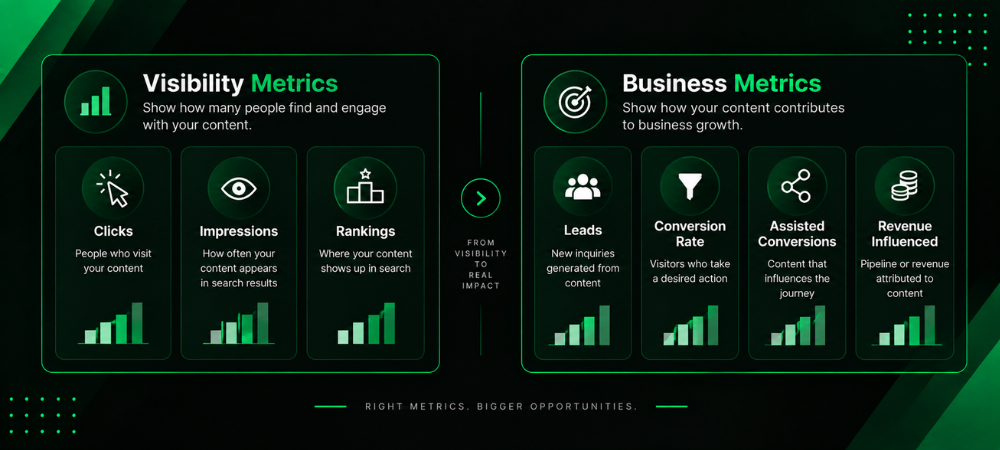
The honest caveat: attribution in content marketing is messy. Someone might read three articles over two months before ever filling out a form, and most tools will only credit the last one. That’s not a reason to ignore the data; it’s a reason to look at patterns over time rather than treating any single number as the full picture.
Common Content Marketing Mistakes
A handful of mistakes show up again and again, across companies that otherwise know what they’re doing:
- Publishing without a strategy behind it, just to keep the calendar full.
- Targeting a keyword without understanding what the searcher actually wants.
- Writing almost exclusively for the top of the funnel and ignoring decision-stage content.
- Publishing generic AI-written articles with no real editorial input.
- Ignoring existing content and letting it decay instead of updating it.
- Skipping internal links between related pages.
- Focusing on traffic as the only success metric.
- Publishing for volume instead of usefulness.
- Writing content and never actually promoting it anywhere.
- Building content that never connects back to a commercial page a reader could act on.
Most of these aren’t dramatic failures; they’re small habits that compound over a year into a content library that looks busy but doesn’t do much for the business.
How Much Should A Business Invest In Content Marketing?
There’s no universal percentage that applies across companies, and anyone offering one is oversimplifying. What a business should spend depends on its business model, how competitive its category is, how much content authority it already has, and how much internal capacity exists to actually execute a plan.
The real costs go beyond writing: research time, subject-matter expert input, design for anything visual, distribution effort, and ongoing optimization of what’s already published. A company that only budgets for “someone to write blog posts” usually ends up with content that never gets promoted, measured, or updated — which quietly wastes the writing budget too.
If you’re unsure whether your current content is even worth building on, a content and SEO audit is usually a faster way to find out than guessing at a budget number first.
Content marketing tends to make sense when a business has a defined audience, a sales cycle long enough for research to matter, and someone accountable for quality rather than just output. It may not be the first priority for a company that needs immediate pipeline this quarter; paid acquisition can produce faster results in the short term, even if it stops the moment spend stops. Content is closer to a long-term asset than a lever you pull for a quick win, and it’s worth being honest about that timeline before committing budget to it.
| Does This Require A Full Department, Or Can A Small Team Run It? A small team can run a real strategy well if it stays focused. Two or three strategy types executed consistently will outperform five done half-heartedly. The constraint is usually attention, not headcount. |
Content Marketing Strategy Example
Take a hypothetical mid-sized accounting software company. It has decent product-market fit but a blog that hasn’t moved the needle in over a year.
The team starts by talking to sales and support, not by opening a keyword tool. They learn that prospects consistently confuse two pricing tiers and don’t understand how the software handles multi-currency invoicing, a detail that comes up in nearly every lost deal. That’s a real, specific problem, not a guess.
From there, they build a cluster: a plain-language guide to the pricing tiers, a detailed breakdown of multi-currency invoicing, a comparison against two named competitors on that exact feature, and a short implementation guide for switching over. Each piece links to the others, and each one maps to a different point in the buying decision: understanding the problem, comparing options, and getting ready to switch.
They publish over six weeks instead of all at once, send the guide to their existing email list, and hand the comparison page directly to sales to use in active deals. Three months later, organic traffic on that cluster is modest, but the sales team reports the comparison page coming up unprompted in calls; prospects had already read it. That’s a smaller, more honest outcome than “we tripled our leads,” but it’s the kind of result a real strategy actually produces, similar in spirit to what shows up in case studies like this one.
Where This Leaves You
None of this is complicated in concept: solve a real problem for a specific person, do it consistently, and pay attention to whether it’s working. The difficulty is almost entirely in the discipline: sticking to a strategy instead of chasing whatever a competitor published last week, and being willing to fix or retire content that isn’t pulling its weight anymore.
If you’re rebuilding a content approach from scratch or trying to figure out why an existing one isn’t converting, Viacon’s content marketing team works through this kind of strategy with businesses regularly — but the ideas in this article will get you most of the way there on your own.