Cold calling and open houses still have a place, but they no longer build a pipeline you can count on. What works in 2026 is a mix: showing up in local search, publishing content people actually want to read, running offers that match what a visitor is looking for, qualifying fast, and following up like you mean it.
Buyers and sellers rarely start with an agent. They start with Google, Maps, a few TikToks, some reviews, maybe a question typed into ChatGPT. By the time they reach out, they’ve already formed opinions, which means racking up inquiries from people who were never going to buy is close to worthless.
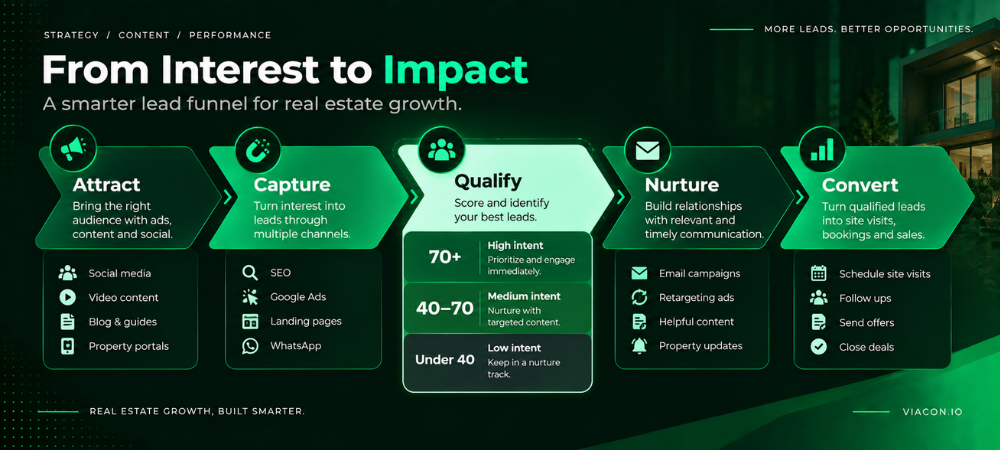
The shape of a working system looks like this: Attract → Capture → Qualify → Nurture → Convert.
What Is Real Estate Lead Generation?
At its core, real estate lead generation means attracting potential buyers or sellers, collecting their contact information, figuring out how serious they actually are, and moving the serious ones toward an appointment or a closed deal.
A lead could be a first-time buyer who downloaded a neighborhood guide. It could be a homeowner who typed their address into a valuation tool at midnight. It could be an investor scanning listings in three different zip codes. Buyers and sellers need completely different messages; their timelines, worries, and reasons for reaching out don’t overlap much.
Some leads come from search, ads, video, email, or social. Others come from referrals, open houses, signage, or a neighbour who mentioned your name. Either way, twenty people who are actually ready to move usually beat two hundred form submissions from people who were just curious.
Our full guide to real estate marketing covers how these channels fit together beyond lead gen alone.
| How Do Real Estate Agents Generate Leads In 2026? Mostly by combining local search visibility, content built around real questions, short- and long-form video, paid search for the people ready to move now, and a follow-up system that doesn’t drop the ball. Agents relying on just one channel tend to plateau fast. |
Real Estate Lead Generation Benchmarks
Numbers help you tell the difference between a campaign that’s working and one that’s just running. These shift by market and price point, but they’re a decent starting reference:
| Metric | Typical Range |
|---|---|
| Cost per lead (organic/SEO) | $15–$60 |
| Cost per lead (paid search) | $30–$120, higher in competitive metros |
| Cost per lead (social ads) | $10–$45 |
| Lead-to-appointment rate | 8%–20% |
| Appointment-to-client rate | 25%–45% |
| Response time for highest conversion | Under 5 minutes |
| Lead-to-closed-deal rate (all sources combined) | 1%–3% |
If a campaign is producing cheap leads but still falling short on appointments and conversions, that’s usually a qualification problem, not a traffic problem. Cost per qualified lead tells a very different story than plain cost per lead worth tracking both.
How Real Estate Prospecting Has Changed In 2026
The buyer journey has splintered into a dozen small research steps most agents never see happen.
Buyers Research Long Before They Call: Google, Maps, neighborhood videos, social profiles, an AI chatbot question or two by the time an agent shows up, the prospect already has opinions about pricing and which streets feel safe.
Local Authority Is Doing A Lot Of The Deciding: Reviews, neighborhood pages, honest market commentary, and a Google Business Profile that’s actually filled out these build trust before anyone picks up the phone. An agent who clearly knows a specific block beats one publishing the same generic advice as everyone else.
Speed Matters More Than People Think: Most prospects contact three or four agents at once. A quick automated reply buys you time while the CRM quietly assigns the inquiry, logs where it came from, and kicks off the right sequence. The software handles the momentum; the agent still has to bring the judgment.
Nobody Wants A One-size-fits-all Inbox: Send a buyer browsing starter homes the luxury-investment newsletter, and you’ve lost them. Segment by location, budget, property type, timeline, and intent, and the messages stop feeling like spam.
Ejaz Ahmad, Viacon’s COO, put it this way: “The competitive advantage right now is not simply acquiring more contacts. Instead, build a faster, more personalized path from inquiry to qualified conversation.”
10 Real Estate Lead Generation Strategies To Use In 2026
1. Dominate Local SEO For High-Intent Searches
“Agent near me,” “homes for sale in Austin,” “best neighborhoods in Tampa” these searches carry real location and buying intent. Skip the generic template and build:
- City pages, neighborhood pages, and local market reports.
- Internal links tying those pages together in a way that actually makes sense.
- A Google Business Profile that’s complete, accurate, and full of detailed reviews.
You’re not just trying to rank when someone’s ready today. You want to be there while they’re still comparing neighborhoods, months before they’ve decided anything.
See our guide to real estate SEO for a deeper walkthrough of ranking factors specific to this industry.
| Can Local SEO Generate Consistent Leads On Its own? It can, but only when the profile, neighborhood pages, reviews, and content work together. A polished Google Business Profile sitting on top of a thin website plateaus fast. |
2. Turn The Website Into A Lead-Generation Engine
A brochure site with pretty listings and one lonely contact page won’t cut it. You need separate paths for buyers and sellers, neighborhood pages, property search, valuation tools, consultation prompts, short forms, and trust signals people can actually see.
| What Should A High-converting Landing Page Include? A specific headline, local relevance, one clear benefit, and proof that isn’t made up. Keep the page uncluttered; every extra choice on it is one more excuse to leave. |
Viacon builds these around focused landing pages, local relevance, trust signals, short forms, and clear calls to action.
3. Create Content Around Real Buyer And Seller Questions
The best-performing content answers whatever agents already get asked in person: affordability worries, which neighborhoods work for families, mistakes first-time buyers make, the ownership costs nobody warns you about. On the seller side pricing logic, prepping a house for market, seasonal timing, what a realistic timeline looks like.
Stop posting “just listed” updates and calling it content. Every question a client has asked twice is worth turning into an actual page.
4. Use Google Business Profile To Capture Local Leads
Beyond rankings, a complete profile puts proximity, reputation, contact info, and directions all in one place someone can scan in ten seconds. Keep it alive with fresh photos, regular posts, answered questions, and reviews that get a real response. For a local agent, that little block on Google Maps can pull in leads that never touch your website at all.
5. Use Short-Form Video to Generate Inquiries
Reels, TikToks, YouTube Shorts, quick property tours, neighborhood walk-throughs, price comparisons, the odd behind-the-scenes clip. Views by themselves don’t pay the bills, so build an actual path behind them:
Video → Profile → Landing Page → Lead Magnet → CRM → Follow-Up
A neighbourhood video sends someone to a relocation guide. They fill out the form, the CRM kicks off a nurture sequence built for that area, and now the video has done real work instead of just collecting likes.
| Do Views Actually Turn Into Clients? Only with a path behind them. Viacon routes viewers from a video toward a specific offer, a landing page, and a follow-up sequence, never toward views as the finish line. |
Our guide to real estate social media marketing covers platform-specific tactics in more depth.
6. Build A YouTube Search Strategy
Long-form video pulls in a different kind of viewer one who wants depth, not a quick scroll. Think relocation guides, cost-of-living breakdowns, area comparisons, market updates, first-time buyer walkthroughs. A well-made video keeps pulling in views for years, and it shows off how you communicate before anyone’s ever met you.
7. Use Paid Search For High-Intent Prospects
Google Search Ads can bring in demand fast, but the results hinge on tight geographic targeting and matching intent, not just outbidding everyone. Negative keywords, dedicated landing pages, and clean conversion tracking matter just as much as the bid itself.
| Search Query | Likely Intent | Recommended Approach |
|---|---|---|
| “Real estate agent in Miami” | High commercial intent | Bid selectively, use a Miami-specific page |
| “Sell my house in Phoenix” | Strong seller intent | Lead with a valuation or consultation offer |
| “Real estate tips” | Broad informational intent | Address through organic content first |
Spend needs to follow intent, or you’ll end up with cheap clicks and clients who cost a fortune.
| SEO Or Paid Ads: Which One? Not either/or. Viacon typically runs paid search for immediate demand alongside SEO for the long game, so growth doesn’t stop the moment ad spend does. |
8. Create Lead Magnets For Buyers And Sellers
For buyers: a first-time buyer checklist, a mortgage prep guide, a neighbourhood handbook, an affordability calculator. For sellers: a valuation tool, a prep checklist, a local market report. Match the offer to whatever’s actually on the visitor’s mind — a generic newsletter loses every time to something built for one specific question.
| What Makes A Lead Magnet Actually Work? Specificity, mostly. “Home-buying guide” underperforms “a first-time buyer’s guide to closing costs in Denver” because the second one sounds like it was written for this exact person, not copied from a template somewhere. |
9. Build An Automated Lead Nurturing System
Most prospects aren’t ready to act the day they inquire. Segment them by buyer/seller status, location, budget, and timeline, then run something like:
| Day | Action |
|---|---|
| Day 0 | Immediate acknowledgement, set expectations |
| Day 1 | Relevant guide or checklist |
| Day 3 | Matching property or market info |
| Day 7 | A useful local insight |
| Day 14 | Personal follow-up from the agent |
What separates a good message from a form-letter one: reference something the person actually searched for, keep it short, end with one clear next step instead of three vague ones. Something like
“Thanks for reaching out about homes in Riverdale. I’ll send a few matching options within the hour; happy to hop on a quick call whenever works for you” beats a template every time.
Let an inquiry sit in a spreadsheet for a week, and the ad spend that brought it in has already gone half to waste.
| How Fast Should An Agent Respond? Immediately, at least with an automated note, then real, personal outreach as soon as humanly possible. When someone’s contacted three agents at once, speed alone can decide who they pick. |
10. Turn Past Clients And Referrals Into A Lead Channel
A past client vouches for you in a way no ad ever will. Ask for reviews at the right moment, run a light referral program, send a note on the home-purchase anniversary, share market updates that actually matter to homeowners. Partnering with lenders, inspectors, attorneys, and relocation specialists widens this further as long as it stays relationship-driven and doesn’t turn into a constant ask for introductions.
Where Should You Actually Put Your Effort?
| Goal | Recommended Strategy |
|---|---|
| Fast leads | Google Ads |
| Long-term growth | Local SEO |
| Buyer inquiries | SEO, content, and paid search |
| Seller inquiries | Valuation funnel and local SEO |
| Brand awareness | Instagram and TikTok |
| Trust building | YouTube |
| Repeat and referral business | Past-client marketing |
| Better conversion | CRM and lead nurturing |
No channel does everything. What you prioritize depends on your market, budget, team size, and the kind of lead you’re actually chasing.
Show Up In AI-Generated Answers: GEO For Real Estate
A growing slice of research happens inside AI answers now, not search results. Someone asks ChatGPT or an AI Overview “best neighborhoods for families in Denver” and gets one written answer instead of ten blue links to click through.
Generative Engine Optimization (GEO) is about making sure your content is the thing that gets pulled into that answer.
Three Things Matter Most Here:
- A Consistent Identity – The same agent name, brokerage, and service areas repeated across your site, Google Business Profile, LinkedIn, and any press mentions
- Writing That Answers Actual Questions – A page that plainly answers “what’s it like to live in this neighborhood” gets cited more often than one stuffed for keyword density
- Genuine Local Knowledge – Specific streets, school zones, and original commentary carry more weight with AI systems than advice that could apply to any city in the country
| Does AI Search Actually Change Lead Generation, Or Is This Overblown? It’s real, and it’s already shifting where research happens. Agents who aren’t showing up in those AI answers still rank somewhere further down, but they’ve lost the first impression the moment a buyer forms an opinion about a neighborhood before ever clicking a link. |
Viacon’s AI search optimization (GEO) services build this into a site’s content and technical setup, so real estate brands get cited instead of just crawled.
Real Estate Keyword Strategy: Matching Intent To The Right Page
Keyword research works a lot better tied to a specific page and offer than treated as a spreadsheet exercise:
- Buyer-intent: “homes for sale in [city],” “first-time home buyer [city],” “best neighborhoods for families in [city]”
- Seller-intent: “sell my house fast in [city],” “home value estimate [city],” “how to price my house”
- Neighborhood: “[neighborhood] homes for sale,” “living in [neighborhood]”
- Property-type: “condos for sale in [city],” “waterfront homes [city],” “new construction homes [city]”
Someone typing a buying-intent keyword should land on a page with a form or a valuation offer. Someone typing a research keyword should land on a guide with a softer CTA further down. Send “how does escrow work” to a hard-sell page and watch the bounce rate spike.
Buyer vs. Seller Lead Funnels
One contact form asking buyers and sellers identical questions serves neither one well. Split them:
- Buyer Funnel: neighborhood guide or calculator → property alerts → qualify on budget, location, financing → agent introduction
- Seller Funnel: valuation tool → pricing and prep guide → qualify on timeline, reason for selling, mortgage status → listing consultation
| How Do You Specifically Get More Seller Leads? Valuation tools win here; they answer the question every seller actually has, which is what their house is worth. Follow it with a short local market report and a prep checklist, then drop them into a seller-specific sequence instead of a generic newsletter everyone gets. |
A Lead-Scoring Framework You Can Use Today
Not every inquiry deserves the same amount of your time. A rough 0–100 model helps sort them:
| Signal | Points |
|---|---|
| Pre-approved or proof of funds | 25 |
| Timeline under 3 months | 20 |
| Requested a valuation or showing | 15 |
| Budget matches available inventory | 15 |
| Named a specific location | 10 |
| Repeat visits or opened emails | 10 |
| Referral or past client | 5 |
Anything scoring above 70 gets a phone call, not an email. The 40–70 range goes into a faster nurture track. Below that, standard drip until their behavior says otherwise.
The Real Estate Technology Stack Behind Consistent Lead Flow
None of this works without the tools underneath it talking to each other:
- CRM to track every inquiry, source, and stage
- Website and forms built around separate buyer and seller paths
- Email/SMS automation to run sequences without someone doing it by hand
- Call tracking to see which channel is actually driving phone calls
- GA4 for traffic and behaviour
- Google Ads for paid campaigns
- A dashboard that pulls it all together into one attribution picture
Skip the integration work, and leads get double-counted, follow-up slips through the cracks, and attribution turns into a guessing game. Viacon’s CRM/ERP integration work connects these pieces so lead data actually flows instead of sitting in three different spreadsheets nobody updates.
Budget Allocation Examples
Spend should match the mix of channels you’re running, not just some round number:
- $1,000/month: Local SEO basics, a filled-out Google Business Profile, one lead magnet, simple email nurture, little or no paid ads
- $3,000/month: Local SEO plus targeted Google Ads in a couple of service areas, short-form video, buyer and seller funnels, CRM automation
- $5,000+/month: Full local SEO and content program, paid search across several areas, YouTube, an active referral program, real lead scoring, and multi-channel attribution
As the budget climbs, the mix usually shifts from mostly SEO and content toward something closer to even with paid media, since paid channels need volume before they start optimizing well.
Troubleshooting Common Lead-Quality Problems
| Symptom | Likely Cause | Fix |
|---|---|---|
| High traffic, low leads | Weak or missing CTA, cluttered page | Strip the page down to one clear offer |
| High leads, low quality | Broad targeting, no qualifying questions | Add a short qualifying form, tighten ad targeting |
| High leads, low appointments | Slow or inconsistent follow-up | Automate the Day 0 response, add call tracking |
| High appointments, low clients | Agent-prospect mismatch, weak listing fit | Review qualification data before the call |
A free digital audit is usually the fastest way to find out which of these is actually the problem, rather than guessing.
Attribution and Tracking: Connecting Spend to Closed Deals
Clicks and form fills tell you about activity. Revenue tells you whether any of it worked. A workable setup includes GA4 for traffic, UTM parameters used consistently on every campaign link, call tracking tied to specific channels, CRM events marking when a lead turns into an appointment and then a client, and revenue attribution linking each closed deal back to where it started.
Without that chain, a channel throwing off a pile of cheap leads can look like your best performer while quietly closing the fewest deals.
Compliance And Privacy
Lead generation touches personal data and advertising rules, and getting either wrong has real consequences:
- Get clear consent before adding anyone to email or SMS sequences, and honour opt-outs right away
- Follow fair housing rules in both ad targeting and copy
- Store lead data securely, and only for as long as you need it
- Tell people upfront how their contact info will be used
A valuation form that skips the disclosure, or an ad targeted in a way that brushes up against fair housing law, is a legal problem — not just a marketing one.
Why Location Changes The Playbook
What works in a fast-moving suburban US market doesn’t transfer cleanly to a luxury market in the Gulf or a dense urban market with its own buyer psychology. Property values, competition, local search habits, and whether buyers or sellers currently hold the upper hand all reshuffle the priority between SEO, paid search, and content.
Our breakdown of real estate digital marketing in the UAE shows how the same core framework bends to fit a different market.
How To Build A Real Estate Lead Generation Funnel
A working system connects acquisition to conversion across six stages:
- Attract — SEO, Google Business Profile, ads, social, and YouTube bring people in
- Capture — landing pages, forms, valuations, and guides trade value for contact info
- Qualify — a few good questions reveal budget, location, timeframe, and intent
- Nurture — email, SMS, CRM workflows, and retargeting keep things relevant
- Convert — consultation, showing, then the offer and transaction
- Multiply — reviews and referrals mean you rely less on paid acquisition over time
Viacon ties these together through search strategy, paid media, content, landing pages, and conversion planning, so the individual pieces start acting like one system instead of six separate projects.
How To Qualify Leads Before Spending Time On Them
A prospect worth chasing has the right intent, timing, need, and actual ability to move forward. A short qualifying conversation should surface:
- Buying or selling
- Where they’re looking
- Roughly what budget
- Their timeframe
- Lender status
- Whether they’re ready to actually talk to an agent
Keep it short pile on too many form fields and people just leave. Lead scoring then helps sort urgent inquiries from early-stage ones without ignoring either: the hot leads get a call fast, the rest sit in nurture until their behavior says they’re ready.
| What Actually Separates A Lead From A Qualified Prospect? Location, budget, financing, property needs, timeline, and engagement, looked at together not any one of those on its own. |
How To Measure Performance
Raw lead count doesn’t tell you much by itself. Track qualified leads, cost per lead, cost per qualified lead, lead-to-appointment rate, appointment-to-client rate, conversion rate, customer acquisition cost, revenue by channel, and referral rate.
A hundred cheap inquiries can perform worse than twenty qualified ones that actually close. Tie campaign data back to CRM outcomes: clicks tell you what happened, revenue tells you if it mattered.
Mistakes That Waste Marketing Budgets
Buying contact lists without checking their quality. Relying only on listings. Skipping local SEO. Sending every visitor to the same generic form. Responding slowly. Following up inconsistently, or not at all. Measuring clicks instead of clients, and betting everything on one acquisition channel, both cost more in the long run than they seem to at first. Spreading the risk across channels and keeping attribution clean makes it obvious which one’s actually earning its keep.
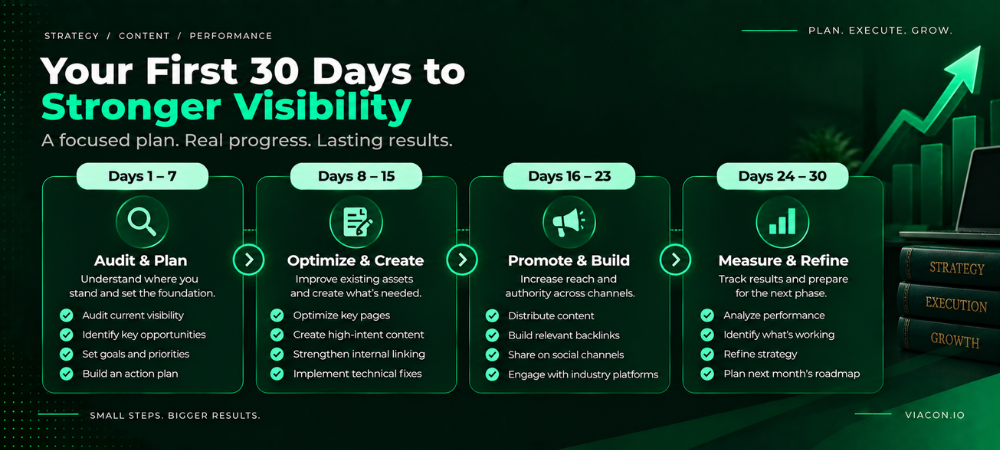
A 30-Day Action Plan
| Period | Priority Actions |
|---|---|
| Days 1–7 | Define audiences, pick locations, optimize Google Business Profile, set up the CRM, build buyer and seller landing pages |
| Days 8–15 | Build local pages, publish buyer and seller content, improve existing pages, launch one intent-matched lead magnet |
| Days 16–23 | Start Google Ads, publish short-form video, release searchable YouTube content, begin referral outreach |
| Days 24–30 | Review sources, check lead quality, look at conversion rates, improve landing pages, refine follow-up |
This gives you a working foundation without lighting up every channel at once, and it surfaces the weak spots before a bigger ad budget makes them expensive.
The Future Of Lead Acquisition Will Be More Personal, Not More Mechanical
AI-assisted qualification is going to help teams sort inquiries, summarize behavior, and flag next steps. AI search is already changing how people find local information, which makes real expertise and well-built content matter more, not less.
First-party data, local search, video, automated nurturing, and genuine personalization will keep shaping how people find an agent. But automation should make you faster to respond; it shouldn’t try to pass as a relationship. Trust is still what closes the big, complicated decisions.
Better Leads Come From Better-Connected Systems
Winning at real estate lead generation in 2026 isn’t about being everywhere. It’s about matching the right channel to the right message and offer, backed by follow-up that actually respects what the prospect was looking for in the first place.
Viacon connects SEO, content, paid acquisition, website experience, and conversion workflows into one system. Our work with BKS shows what a stronger web experience does for engagement better structure, better mobile usability, better performance. The same lesson applies to real estate: a clear path keeps someone moving instead of leaving them stuck between “interested” and “inquiry.”
Contact the Viacon team to build a lead generation system around qualified opportunities instead of traffic that looks good on a dashboard but never converts.