Visibility is a problem most law firms struggle to crack on the web. What happens with most of them is:
The website ranks well, but the phone barely rings.
Or, the content is persuasive and warm, but nobody ever finds it.
Either way, the firm loses. The websites that actually grow a practice do both at once. They show up in search, and once someone lands on the page, they actually stick around and reach out.
The problem usually comes down to the law firm website content. It’s too generic, and often lacks enough heart to impress the person who’s scared, confused, and Googling at midnight after getting served papers or being in a car accident.
That kind of content doesn’t build trust. It doesn’t answer the questions people actually have. And it definitely doesn’t move anyone to pick up the phone.
We want to walk you through a practical approach to law firm content marketing, one that treats your website as a real client acquisition tool rather than a digital brochure.
By the end, you’ll have a framework you can use for practice area pages, blog posts, and everything in between.
Why Law Firm Website Content Is A High-Leverage Asset
Your content isn’t just something that sits on your site waiting to be read. It’s the foundation everything else gets built on. Here’s why your website content is a lead-generating engine rather than simply words published to rank:
(i) Content is ‘Still King’
Your law firm website content builds the foundation for your SEO efforts to work. Your paid ads send traffic to it, and your email campaigns link back to it. Even AI tools that summarise search results are starting to draw on it. If the content is weak, every other marketing channel has to work twice as hard to make up for it.
(ii) Weak Content Affects Visibility & Lead Generation
And weak content has a real cost. It looks like:
- High bounce rates.
- Visitors who leave without ever seeing your contact form.
- Wasted ad spend on clicks that never convert.
This is true for all the firms that are pouring money into paid search only to send that traffic to a page that reads like a legal memo. No wonder the leads never showed up.
(iii) Clients Are Searching For Credibility
Client expectations have shifted too. People don’t want legalese anymore. They want clear answers, a sense that someone understands what they’re going through, and some kind of proof that this firm can actually help them.
(iv) The Numbers Behind Content-Led Growth
The economics back this up too. Content marketing generally costs far less than traditional advertising while producing more qualified leads over time, because a well-built page keeps working long after a paid ad stops running. A blog post you publish this year can still be answering a stranger’s question and sending that stranger to your contact form three years from now. Compare that to a billboard or a radio spot, which stops earning the moment you stop paying for it.
For law firms specifically, this compounding effect matters more than most industries realise. Legal services are a considered purchase; people research before they call. Our guide on why SEO has become a non-negotiable growth channel for law firms breaks down how firms that treat their website as owned media, rather than a static brochure, consistently out-acquire competitors who rely only on referrals and paid ads.
The Core Principles Of High-Converting Legal Content
A few things separate content that performs from content that just exists.
Here Are A Few Core Things To Get Your Law Firm Website Content Right:
- Clarity outshines complexity every time. Therefore, write for the person hiring you, not the attorney down the street who might read it and judge your grammar.
- Make law-related information the base of your content. But learn to balance empathy with authority. You want to sound like someone who gets it, not someone reciting statutes and legal jargon. Be specific.
- Vague promises don’t convert, but a clear explanation of your process does. Structure the page so it naturally leads someone toward taking action.
- Stay compliance-aware, since legal marketing has real rules around this, but that doesn’t mean the writing has to be boring.
- Create content that stays aligned with Google’s E-E-A-T principles.
- And weave in trust signals throughout, things like experience, credentials, and real results, so Google and readers both see you as credible.
Understanding E-E-A-T: Why Google And Readers Both Vet Legal Content Harder
Google treats legal content as “Your Money or Your Life” material, the same bucket as medical and financial advice. Bad information in this category can cost someone their case, their custody arrangement, or their savings, so the algorithm holds it to a higher bar than it holds a recipe blog or a product review. That bar has a name: E-E-A-T, short for Experience, Expertise, Authoritativeness, and Trustworthiness.
Here’s What Each Piece Actually Looks Like On A Law Firm Site, Not In The Abstract:
- Experience shows up when an attorney writes, or is credited for reviewing, content based on cases they’ve actually handled, not textbook summaries. A personal injury page that mentions how insurance adjusters typically respond to a specific type of claim reads differently than one that just defines “personal injury.”
- Expertise means the byline matters. Pages should name the attorney behind them, link to a real bio, and reference bar admissions, years of practice, and any relevant certifications. Anonymous, unattributed articles are a liability here, not a shortcut.
- Authoritativeness is built outside your own site as much as on it. Mentions in local news, citations from legal directories, guest contributions to respected publications, and speaking engagements all signal that other credible sources vouch for your firm. For a deeper look at how these signals stack up across a full ranking checklist, see our breakdown of essential SEO ranking factors.
- Trustworthiness comes down to the basics people skip: a working phone number, a real office address, HTTPS, an accessible privacy policy, and case results that come with honest context instead of inflated promises.
| Does E-E-A-T Apply To Every Page On A Law Firm’s Website, Or Just The Blog? Every page. Practice area pages, attorney bios, and even the contact page contribute to how Google and readers assess trustworthiness. A polished blog sitting on top of a thin, anonymous practice area page won’t move the needle much, because the weakest pages on a YMYL site still shape how the whole domain gets evaluated. |
Types Of High-Impact Law Firm Website Content
Here are different types of high-impact business content:
(i) Practice Area Pages
Practice area pages are usually your highest-converting real estate. A good one recognizes the visitor’s problem right away, walks through what the process looks like, explains why your firm specifically is the right choice, answers common questions, and closes with a CTA that doesn’t feel buried.
These pages need to rank for competitive terms while still reading like something a real person wrote for another real person.
| How Long Should Practice Area Pages Be? Long enough to answer real questions and build trust, usually somewhere between 800 and 1,500 words, though depth matters more than hitting a number. |
(ii) Location Or City Pages
Location or city pages matter if you serve multiple areas, but they’re risky. Too many firms build these pages by swapping out a city name and calling it done. That’s thin content, and search engines notice. If you’re going to build them, give each one something genuinely local and useful.
(iii) Google Business Profile: The Listing That Decides Whether You Show Up Locally
Technically, your Google Business Profile isn’t website content. Practically, it’s the piece of digital real estate most likely to get a searcher to call you first, especially for “near me” and city-specific searches, where the Local Pack sits above the organic results entirely. A firm can have gorgeous practice area pages and still lose the click to a competitor with a fully filled-out profile, recent reviews, and accurate categories.
Keep your name, address, and phone number identical across your website, your profile, and every legal directory you’re listed in. Small mismatches, a suite number here, a missing middle initial there, quietly erode the trust signals Google uses to confirm you’re a real, established business. Our guide to local SEO for law firms covers how to structure location pages and profile categories so they reinforce each other instead of competing for the same search.
| Does My Google Business Profile Actually Affect My Website’s Content Strategy? Yes. Search engines cross-reference the two. A profile that lists “Personal Injury Law” but links to a homepage that never mentions personal injury sends a mixed signal, and mixed signals rarely rank well. |
(iv) Attorney Bio And About Pages
Attorney bio and about pages get overlooked constantly. Most are just résumés. Turn them into something that builds an emotional connection instead: your story, your values, why you do this work.
(v) Blog And Resource Content
Blog and resource content does the heavy lifting for awareness and nurturing. This is where law firm blog content ideas come in: think pillar pages that cover a topic thoroughly, supported by smaller articles that answer specific questions people are actually searching for.
(vi) Video Content
Text is not the only format that ranks and converts anymore. Short explainer videos on common questions (“What happens at a car accident deposition?”), attorney introduction videos, and even simple screen-recorded walkthroughs of a process can sit on the same page as your written content and hold visitors longer. Longer time on page is one of the clearest engagement signals a page can send, and video is one of the easiest ways to earn it without asking someone to read another thousand words.
You don’t need a production budget to start. A well-lit video shot on a phone, with clean audio and a script that answers one specific question, will outperform a polished video that rambles. Transcribe it, and that transcript becomes another piece of indexable text on the same page.
(vii) Supporting content
Supporting content rounds it out: FAQs, checklists, case results presented ethically, and even video scripts. These smaller pieces often punch above their weight for conversions.
Step-by-Step Process For Creating Content That Ranks And Converts
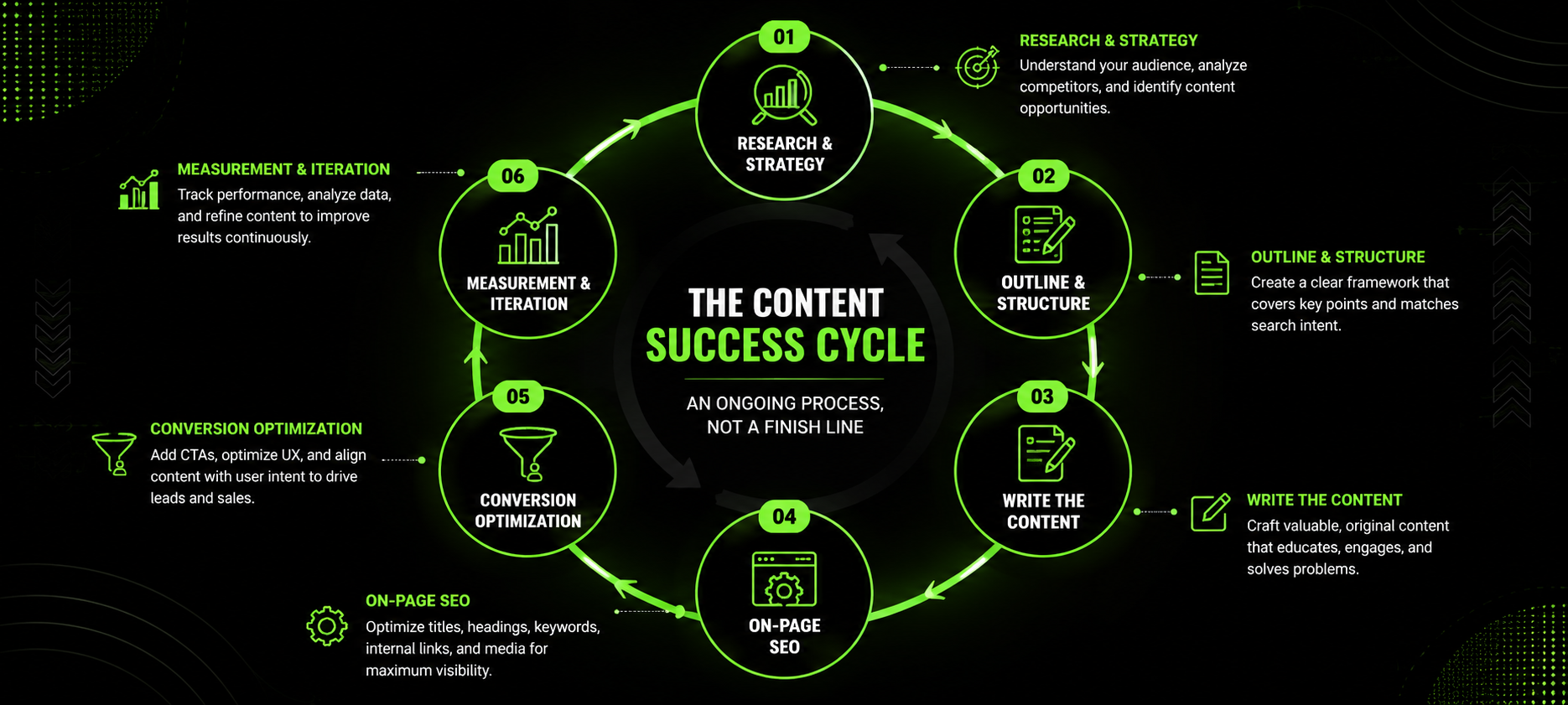
Create content that converts your law firm website traffic into paying customers with the following steps:
Step 1: Research And Strategy
Start with keyword research that’s focused on client intent, not just search volume. Look at what competitors are missing. Map your content to where someone is in their journey and which practice area they need.
Step 2: Outline And Structure
Build a conversion-focused outline before you write a single sentence. Use scannable formats, clear headings, short paragraphs, bullet points where they help.
Step 3: Write The Content
This is where voice matters most. Explain complex legal ideas simply without sacrificing accuracy. Weave in trust signals and whatever makes your firm different. Place your CTAs strategically throughout the page, not just at the very bottom where nobody scrolls anymore.
Step 4: On-Page SEO
Nail your title tags, meta descriptions, and headings. These are the basics of on-page optimization. Link internally between related pages. Also, optimize images. Look at schema opportunities specific to legal content. And keep keyword use natural; readability always wins over stuffing.
Step 5: Conversion Optimization
Make sure your above-the-fold section says exactly what you do and what to do next. Add trust elements like reviews and process transparency. Reduce friction wherever you can: a shorter contact form, a click-to-call button, live chat.
Step 6: Measurement And Iteration
Track organic traffic, time on page, scroll depth, and conversion rate. Then go back and improve whatever’s underperforming. Content isn’t a one-and-done project.
Optimizing Law Firm Content For AI Overviews And Generative Search
Search itself has split in two. There’s still the ranked list of blue links, and now there’s the AI-generated summary sitting above it, or the answer someone gets from ChatGPT or Perplexity without visiting a website at all. A page can rank well in traditional search and still get skipped entirely by these generated answers if it isn’t built to be quoted.
The content itself needs to change shape slightly for this. Instead of building up to an answer, lead with it: state the deadline, the requirement, or the definition in the first sentence or two, then explain the nuance underneath. A passage that says “most personal injury claims must be filed within two to three years of the injury, though the exact window depends on the state and claim type” gives an AI system something concrete to cite. A passage that says “personal injury claims have deadlines you should be aware of” doesn’t.
Structured data helps too. Adding LegalService, Attorney, and FAQPage schema to relevant pages doesn’t rewrite your content, but it does hand search engines and AI crawlers a clean, machine-readable summary of who wrote the page, what the firm does, and which questions it answers. Schema won’t save thin content, but it does remove a layer of ambiguity from content that’s already strong.
| Do Law Firms Need To Optimize Content For AI Overviews And Tools Like ChatGPT? Increasingly, yes. Prospective clients are starting to ask AI tools who the best divorce attorney in their city is, or what to consider before hiring one, and getting a synthesized answer instead of a list of links. We cover the full mechanics of this, including which signals each AI platform weighs differently, in our dedicated guide to Generative Engine Optimization for lawyers. |
Content Calendar And Production System
How often should a law firm publish blog content? It depends on your firm’s size and bandwidth. Consistency matters more than volume. Once or twice a month, done well, beats weekly posts that add little value.
A solo practice might manage one solid post a month. A larger firm with a marketing team can do more. Whatever the cadence, repurpose everything: turn a blog post into social captions, an email, maybe a short video.
As for who writes it, that’s usually a mix of attorneys providing accuracy and expertise, and writers who know how to shape that into something readable. Either way, accuracy and compliance can’t slip as you scale.
| Can AI Be Used To Create Legal Website Content? It can help with drafts and research, but legal accuracy and firm-specific voice still need a human, ideally an attorney, reviewing every word. |
Getting Your Content Found: Distribution, Promotion, And Backlinks
Publishing a page is the beginning of its life, not the end. A guide that never gets shared, linked to, or mentioned anywhere else on the internet has a much harder time ranking, no matter how well it’s written, because search engines still weight external validation heavily.
Start close to home. Share new content through your firm’s email newsletter, LinkedIn page, and any referral partners you work with. Then look outward: guest contributions to legal publications, interviews with local journalists, and profiles on reputable legal directories all earn the kind of backlinks that traditional advertising can’t buy. These links tell Google that people outside your firm find the content credible enough to point to.
Avoid the shortcut of buying links or trading them in bulk with unrelated sites. Search engines penalize link schemes, and a handful of relevant, earned links from legal or local publications will outperform hundreds of low-quality ones anyway. If distribution isn’t something your team has bandwidth for, it’s often the first piece firms hand off to a content marketing partner, since writing content and promoting it are genuinely two different skill sets.
| Do Backlinks Still Matter For Law Firm SEO? Yes, though quality has replaced quantity as the deciding factor. One mention from a respected legal publication or local news outlet carries more weight than dozens of generic directory listings. |
Common Content Mistakes That Kill Rankings Or Conversions
We see the same mistakes again and again, and this is what failure on most law firm websites looks like:
- Writing like a legal brief instead of a helpful guide.
- Practice area pages that are basically duplicates of each other.
- CTAs that are weak or buried at the bottom.
- Ignoring what people are actually searching for.
- Cramming in keywords until the writing sounds unnatural.
- Letting old content sit untouched for years.
- And failing to explain what actually makes your firm different from the one three blocks away.
When creating content for your law firm website, it’s important to notice if you’re making these mistakes or not.
Compliance And Ethics Rules That Shape Law Firm Content
Law firm content lives under rules that a typical business blog never has to think about. Every U.S. state bases its advertising rules on some version of the ABA Model Rules of Professional Conduct, and Rule 7.1 sets the baseline: a lawyer can’t make a false or misleading communication about their services. In practice, that means a case result page can’t imply that every client gets the same outcome.
This is why you’ll see disclaimers like “prior results do not guarantee a similar outcome” attached to case results and testimonials on well-run law firm sites. Several states, including New York, require that exact language, and some require it to sit visibly on the page rather than buried in a footer. A few states also require an “Attorney Advertising” label on marketing pages. These specifics vary by jurisdiction, so treat this as a starting point for a conversation with your firm’s ethics counsel or state bar, not a substitute for one.
Client testimonials fall under similar scrutiny. Truthful testimonials are generally acceptable, but presenting them in a way that implies a guaranteed outcome can cross the same line as an unqualified case result. Reviews add real trust value to a site, and they’re worth handling deliberately rather than just embedding whatever comes in. Our guide to law firm review management covers how to collect and display reviews in a way that builds credibility without running into advertising rule issues.
| Can A Law Firm Publish Client Testimonials And Case Results On Its Website? Generally yes, with the right disclaimers and without implying the outcome is typical or guaranteed. Requirements differ by state, so confirm the exact language your bar association expects before publishing. |
Turning Website Visitors Into Signed Clients
Getting someone to your practice area page is only half the job. The other half happens in the first few seconds after they land, and most law firm sites lose people right there.
The above-the-fold section needs to answer three things almost instantly: what you do, who you do it for, and what to do next. A visitor scanning a car accident page shouldn’t have to scroll to find a phone number or figure out whether your firm handles cases like theirs. Put the call-to-action where the eyes already are, not just at the bottom of a long page nobody finishes reading.
Friction kills conversions quietly. A five-field contact form converts worse than a two-field one. A phone number that isn’t clickable on mobile costs you calls from people driving or multitasking. Live chat, when staffed and monitored, catches visitors who want an answer but aren’t ready to call yet. None of these changes requires new content; they just remove obstacles between the content you already have and the action you want someone to take.
Trust elements do real work here too: displayed reviews, bar association badges, “no fee unless we win” language where accurate, and a clear photo of the attorney rather than a stock image. People hiring a lawyer are often stressed and comparing several firms in the same browsing session, and small trust signals can be the tiebreaker.
| What’s A Reasonable Conversion Rate To Aim For On A Law Firm Website? It varies widely by practice area and traffic source, but most firms should treat anything under 2 to 3 percent of practice area page visitors submitting a form or calling as a sign that something upstream- the page’s clarity, load speed, or trust signals- needs attention. Our breakdown of why websites get traffic but no sales walks through the most common culprits. |
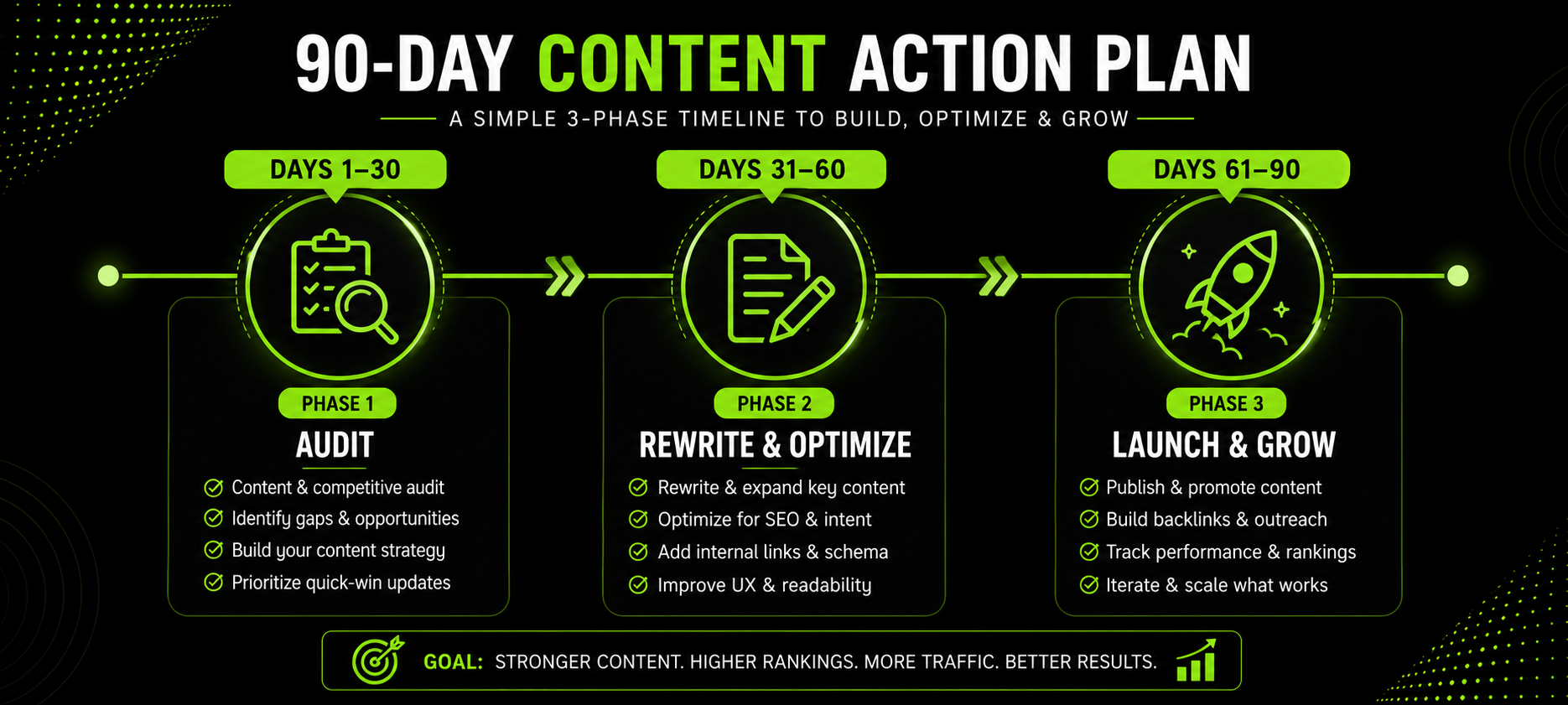
90-Day Content Action Plan
Days 1 to 30: Audit your existing content and prioritize the pages with the highest potential impact, usually your practice area and key service pages.
Days 31 to 60: Rewrite and optimize those priority pages using the framework above. Strengthen your CTAs and add trust signals where they’re missing.
Days 61 to 90: Launch supporting blog and resource content, build out internal linking between pages, and put a measurement system in place so you’re not flying blind.
From there, you’ll need to decide whether to build this out internally or bring in specialists in SEO content for law firms. Both can work; it really depends on your team’s bandwidth and expertise.
If you’re weighing that decision, our comparison of in-house teams versus specialist agencies breaks down the trade-offs in cost, speed, and expertise so you can make the call with real numbers instead of guesswork.
Rank With Purpose, And Convert With Ease
High-converting law firm website content isn’t only about ranking. It’s about ranking with pages that actually persuade the right people to take action. The firms that treat their content as a core client acquisition asset, not an afterthought, are the ones pulling ahead.
If you want help figuring out where your site stands, we offer a free website content audit focused on both rankings and conversions. We’ve also put together a downloadable Practice Area Page Content Checklist if you’d rather start on your own. Or, if you want to talk it through, we’re happy to hop on a strategy call about your attorney website content strategy.