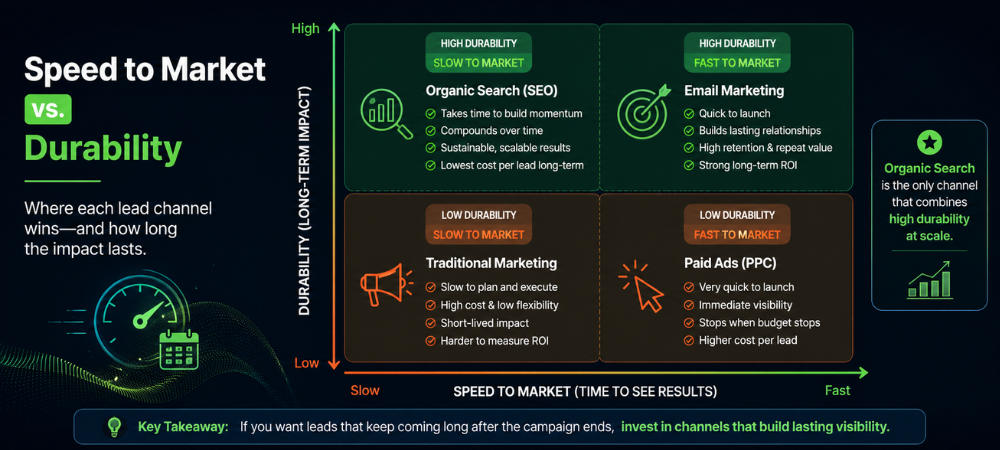
Paid ad campaigns are an excellent way to improve a law firm’s lead generation efforts. It’s easy as well. You just start the campaign, fund it, and the calls start coming in. But it has an obvious limitation: once you stop investing, you stop getting results.
So, in the long run, this strategy is not feasible for most legal firms. That’s why leading businesses in this domain focus on something durable that takes time to build but keeps delivering results over the long term without draining the marketing budget. It is called law firm lead generation through organic search, where useful pages continue attracting potential clients long after publication.
Why Organic Search Is One Of The Highest-Quality Lead Sources For Law Firms
Legal searches often carry urgency. Someone looking up “employment attorney for wrongful termination in Boston” is not casually browsing. The problem already exists, the location is clear, and the service is understood.
That intent gives law firm lead generation through search an advantage over channels that interrupt people before a need has fully formed.
Organic visibility also behaves differently from advertising. Paid traffic is rented, but organic assets, when maintained, can keep drawing visitors without charging the firm for every click. For instance, strong practice-area pages accumulate authority, links, engagement, and relevance. The resulting law firm SEO leads can therefore become more efficient over time, while advertising costs reset with every new campaign.
Trust also matters here. Prospective clients tend to examine more than one result, read attorney profiles, review past outcomes, and look for signs that the firm understands their particular situation. Organic search supports that research process and influences decision-making.
A legal firm’s organic presence also complements its referrals and paid media efforts. Even when someone receives a referral or sees an ad, they will Google the firm before calling. So, even though the channels overlap, the organic presence created through the website represents the brand’s credibility and attracts visitors.
The cost curve is where the two channels diverge most sharply, and it’s worth understanding before a firm sets its budget. A firm running both paid search and organic content side by side will notice paid spend stays flat or climbs as competitors bid up the same terms, while a well-built practice-area page keeps producing calls months after the invoice for writing it was paid.
Viacon’s legal services page breaks down how this plays out across different practice areas, since a family law firm and a mass-tort practice rarely see the same payback timeline.
| Lead Channel | Speed to Market | Durability | Typical Intent | Primary Limitation |
|---|---|---|---|---|
| Organic search | Gradual | High | Moderate to very high | Requires sustained optimization |
| Paid Search | Fast | Low | High | Visibility ends when spending stops |
| Referrals | Variable | Moderate | Usually high | Difficult to scale predictably |
| Social media | Moderate | Moderate | Usually lower | Users may not have an immediate legal need |
Legal Advertising Rules Your Lead Generation Pages Must Follow
A gap that trips up many law firm SEO plans: ranking pages and generating forms means nothing if the pages themselves create a bar compliance problem. Law firm websites, landing pages, and even blog content count as attorney advertising in most states, and firms remain responsible for that content even when an outside agency writes it.
ABA Model Rules 7.1 through 7.3 set the baseline that most states build on. Communications cannot be false or misleading, cannot create unjustified expectations about outcomes, and cannot imply a guaranteed result.
Practically, that means a personal injury page discussing past case values needs a disclaimer that results vary and past performance does not predict future outcomes. A page featuring a client testimonial needs language clarifying the experience described is not representative of every client’s case.
State-level rules add further requirements on top of that baseline. Some states require a named, licensed attorney and a physical office location to appear on the page.
A handful require advertising to be filed with the state bar within a set window after publication. California’s SB 37, effective from January 2026, tightened disclosure requirements specifically for websites, landing pages, and third-party lead generation, and it is a useful example of how quickly this area of law can shift.
| Do Law Firm Landing Pages Need A Legal Disclaimer? Most do. Any page referencing case results, client testimonials, or a specific outcome should carry a disclaimer that results vary by case and jurisdiction. Firms operating in multiple states should check each relevant bar’s advertising rules rather than assuming one disclaimer covers every jurisdiction, since requirements differ on wording, placement, and filing. |
Understanding Qualified And Unqualified Legal Leads
A lead being “qualified” has nothing to do with how the form was submitted and everything to do with whether the person behind it actually fits a case the firm can take. The sections below cover what qualification looks like in practice and how to tell if the traffic reaching those forms is any good.
What Makes A Lead “Qualified” For A Law Firm
Organic efforts play a key role in improving traffic to the website, but that does not solve much. Plenty of firms rank for broad legal terms, attract thousands of visitors, and receive inquiries they would never accept. So, the metrics look healthy, but the actual outcome is not.
This is where the concept of qualified and unqualified leads enters the discussion. A qualified lead is not merely a person who submitted a form. Qualification varies by practice area. For instance, a personal injury firm may consider accident dates, liability, injury severity, and jurisdiction. Similarly, a business law practice may examine company size, issue complexity, urgency, and likely matter value. Anything outside this scope will fall into the category of unqualified traffic.
Therefore, good law firm lead generation starts with these acceptance rules, not a keyword tool.
Spotting Low-Quality Traffic And Measuring What Matters
Now, low-quality traffic usually comes from predictable gaps. Broad informational keywords attract students, researchers, job seekers, and people outside the service area. Also, national visibility may sound impressive for a local practice, yet it can flood intake with unusable inquiries.
Qualified leads for law firms, therefore, appear more consistently when search topics mirror real case criteria: matter type, location, timing, stakes, and client profile.
Additionally, tracking must continue after the form submission. You need to keep a keen eye on the consultation booking rate, show rate, attorney acceptance rate, signed-matter rate, and expected case value reveal whether SEO is feeding the business or only the analytics dashboard.
For instance, a page generating 20 inquiries and two viable matters may be weaker than a page producing six inquiries and four signed clients.
| How Long Does It Take To Generate Leads From Organic Search? It is almost impossible to set a timeline for how long it will take to generate leads from organic search. However, the trends show that initial improvements may become visible within a few months, especially when a firm already has authority, rankings, or underperforming pages. In competitive markets, it usually requires a longer horizon. Additionally, technical health, location, practice area, content quality, and local prominence all influence timing. So, a better question is whether qualified impressions, inquiries, and consultations are trending upward together. |
| What Is A Good Conversion Rate For A Law Firm Website? There is no universal conversion rate that applies to every law firm. Practice area, traffic source, location, device, and consultation model change the benchmark considerably. That’s why firms should establish conversion rates by landing page and matter type, then compare form submissions and calls with qualified consultations. A lower rate can still be healthier if lead quality improves. |
What Organic Lead Generation Costs And Whether To Hire An Agency
Budget conversations around organic SEO tend to stall because firms compare it to paid media instead of judging it on its own terms. The two sections below cover what a realistic spend looks like and how to decide who should actually run the work.
How Much Organic Lead Generation Actually Costs?
Cost is usually the first question a managing partner asks, and it deserves a direct answer rather than a vague range. Organic lead generation is a labor investment more than a media-spend investment. The money goes toward research, writing, technical fixes, and ongoing measurement rather than toward an ad auction, so the monthly cost tends to stay flatter than a comparable paid-search budget once the site reaches a stable publishing rhythm.
A small local practice with one or two priority practice areas can often start with a narrower engagement focused on technical fixes and the highest-value pages first. A multi-location or multi-practice firm generally needs a broader retainer that covers content production, local landing pages for each office, and a testing cycle for calls to action. Either way, the fair way to judge cost is against the value of a single signed matter, not against the sticker price of a monthly invoice.
In-House Team Or Agency: Which Fits Your Firm
The in-house-versus-agency decision usually comes down to capacity and specialization rather than raw cost. A firm with a marketing coordinator who already understands legal search intent can manage some of this internally. Firms without that bandwidth, or those competing in dense markets where every competitor already runs organized content, tend to move faster with a specialist team handling the audit, execution, and reporting together. A free digital audit is usually the fastest way to see which side of that line a firm actually sits on before committing to a retainer.
| Is An In-house Marketer Or An Agency Cheaper For Law Firm SEO? It depends on scope. An in-house hire is a fixed salary regardless of output, which suits firms with steady, predictable content needs. An agency scales up or down with the work and brings tools, competitor data, and legal-specific experience a single in-house hire rarely has time to build alone. Many firms land on a hybrid: an in-house point of contact who manages intake and attorney input, paired with outside specialists for the technical and content execution. |
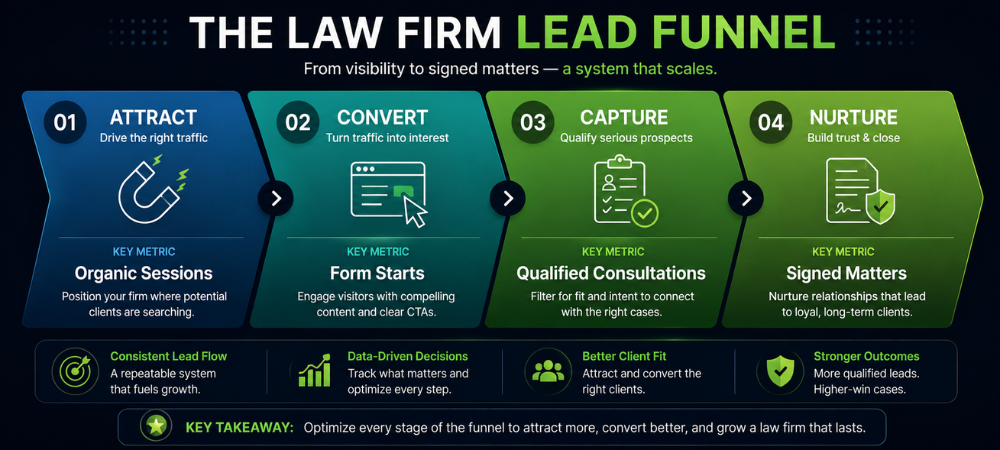
The Organic Lead Generation Framework for Law Firms
Organic lead generation for lawyers is not a single strategy; it is a combination that works seamlessly together to bring in qualified enquiries that drive business growth. Here is how the framework looks:
Attract The Right Traffic
The first pillar of this framework is finding the right traffic, which means selecting the right keywords with the proper commercial intent.
A great starting point is practice-area and location combinations, then map related problem searches, procedural questions, and comparison terms. Law firm lead generation improves when each page owns a particular search need instead of several pages competing for the same broad phrase.
Technical foundations matter because search engines and prospective clients encounter the same site architecture. Therefore, pages must be crawlable, fast, mobile-friendly, and logically connected. Local firms also need an accurate Google Business Profile, consistent business information, relevant categories, local landing pages, and a sensible review process. While this work is less glamorous, attorney organic traffic often stalls without it.
Content should then cover different stages of the decision. A guide may introduce the legal issue; a detailed service page should explain who the firm helps, what circumstances qualify, what the process involves, and what happens after contact. Viacon’s organic SEO services build that keyword-to-page mapping as a standing part of the engagement, so new practice-area content and technical fixes ship on the same roadmap instead of competing for priority.
Convert Traffic Into Leads
A ranking page is not automatically a conversion page, and your SEO strategy must reflect that distinction.
High-intent visitors need immediate orientation. They should understand whether the firm handles their issue, serves their location, and offers an appropriate next step without digging through dense legal commentary. And effective law firm lead generation pages make those answers visible early, then strengthen the decision with attorney credentials, recent client reviews, relevant outcomes, process explanations, and carefully worded disclaimers.
The calls to action (CTAs) should reflect the visitor’s readiness. While “Request a case review” suits urgent matters, “Discuss your business dispute” may fit commercial law. Click-to-call controls also matter on mobile phones. While the shorter CTAs can reduce friction, the longer ones improve qualification, but only when every field earns its place.
Therefore, a sound digital marketing services suite will always include organic SEO, conversion optimization, content marketing, and marketing automation, capabilities that naturally support a connected acquisition model.
Capture And Qualify Efficiently
The next part of this framework is gathering critical information using the lead generation forms on the website. These forms should gather enough information to route the inquiry without turning the intake process into an interrogation. Legal SEO lead generation works better when ease of contact and internal screening operate together.
Name, contact details, location, category, urgency, and a concise description often provide an effective starting point. At this stage, sensitive information should not be requested unnecessarily.
Additionally, call tracking can connect organic landing pages to phone inquiries, but the implementation should preserve website usability and consistent business information.
On top of these, scheduling tools, carefully managed chat, and after-hours response options help capture prospects who search outside office hours. For earlier-stage visitors, checklists and practical guides can support law firm inbound leads without forcing an immediate consultation.
Nurture and Convert Leads into Clients
Lastly, the legal services marketing framework has to make space for converting the leads into clients. However, this is also the part where many firms fail.
A prospective client fills out a form, receives no immediate acknowledgement and subsequently contacts a different firm.
That’s why the response protocols should define ownership, expected response time, escalation rules, and follow-up frequency. This operational layer is part of law firm lead generation, even though it rarely appears in an SEO proposal.
Automated email or text messages can confirm receipt and explain the next step, but the communication should still feel personal. A CRM then records contact attempts, qualification status, consultation outcomes, and signed matters. Therefore, no more mystery pile of spreadsheets, or lead sitting unnoticed in a shared inbox for four days.
Content Strategy That Drives Qualified Organic Leads
Content marketing strategies are also an important part of driving organic leads for legal firms. Here, the practice-area pages are the primary conversion engines, which is why they deserve more depth than a generic description of the law.
In this case, a useful page is the one that addresses eligibility, common scenarios, jurisdiction, process, timing, potential complications, and reasons a prospect might or might not need representation. This is where law firm lead generation connects subject-matter credibility with commercial intent.
At the same time, the supporting articles help capture earlier questions and move readers toward the appropriate service, and FAQs and “what to expect” resources can prequalify prospects before intake gets involved.
Furthermore, the existing pages with stable impressions should also be refreshed rather than abandoned. Better examples, clearer location signals, stronger internal links, and more direct conversion paths can turn established attorney organic traffic into viable consultations. Our guide on writing law firm website content that converts covers the structure and tone that keeps a practice-area page from reading like a legal brief.
| Which Practice Areas Get The Best Organic Leads? According to the existing data, practice areas with urgent, clearly defined problems often produce strong organic intent, including personal injury, criminal defense, employment disputes, family law, estate matters, and certain business conflicts. However, the competition here can be intense, which is why the “best” area is the one where search demand, geographic reach, case economics, attorney capacity, and acceptance criteria align. |
| Should Law Firms Focus On Traffic Or Conversions First? Conversions should shape the strategy from the beginning, but a firm still needs relevant visibility before conversion optimization can work. That’s why a legal business should start by identifying commercially valuable searches and the pages intended to serve them. Then improve both acquisition and conversion together, as increasing unqualified traffic first usually creates larger reports, not a stronger pipeline. |
Winning The Map Pack and AI Answers For Legal Searches
Two areas get skipped in most organic lead generation guides for law firms, and both now decide who gets the call before a prospect ever scrolls past the first screen.
Why The Map Pack Decides Who Gets The Call
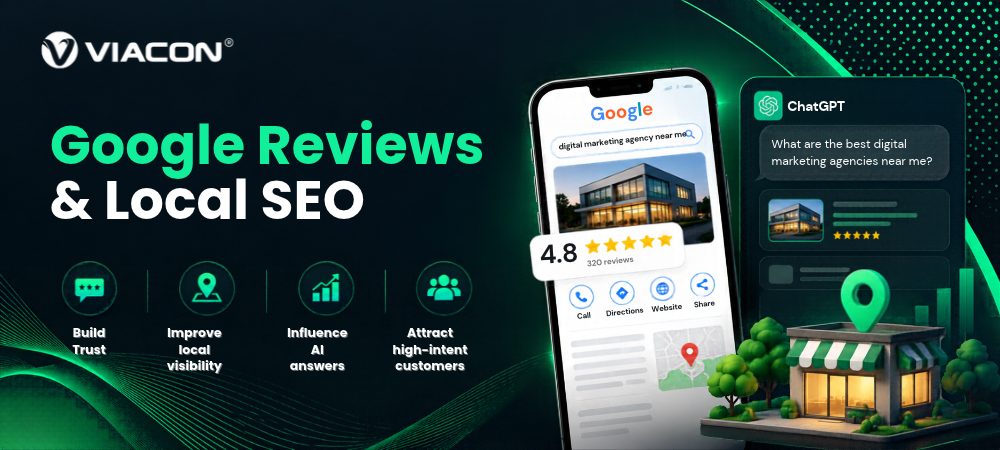
For most local practice areas, especially personal injury, family law, criminal defence, and estate planning, the three-listing map pack that appears above standard organic results captures a disproportionate share of clicks and calls. Ranking there depends on a partially different signal set than general organic rankings: proximity to the searcher, Google Business Profile completeness and activity, review volume and recency, and consistent name, address, and phone details across the web.
A firm can hold a strong position in organic results and still be missing from the map pack, so the two need coordinated but distinct attention. Our full guide to dominating the map pack breaks down Google Business Profile setup, citation building, and the review cadence that moves a firm from position four to the top three.
Showing Up When Clients Ask AI Instead Of Google
A growing share of legal research now happens inside AI chat tools and Google’s AI-generated answers rather than through a traditional list of blue links. Those systems favour sources that reduce uncertainty: pages with clear structure, identifiable attorney authorship, and specific answers rather than vague marketing language.
A page that plainly states who qualifies, what the deadlines are, and what the process involves tends to get cited more often than a page built mainly to promote a consultation. Viacon’s AI search optimization services build that structure into new and existing practice-area pages so they surface in AI answers, not just traditional search.
| Does Generative Engine Optimization Replace Traditional SEO For Law Firms? No. Traditional technical health, backlinks, and useful content still form the foundation AI systems draw from when selecting sources. Generative engine optimization builds on that foundation with clearer structure and stronger authorship signals rather than replacing the underlying SEO work. |
Measurement: Tracking Real Law Firm SEO Leads
Traffic and rankings are leading indicators of SEO in 2026 for every legal firm, and signed cases are the actual business outcomes.
So, a useful measurement system connects organic sessions and inquiries with consultation bookings, attendance, qualification, signed-matter rate, and estimated value. That connection shows which pages generate law firm SEO leads that attorneys actually want.
| Measurement Level | Representative Metrics | Question Answered |
|---|---|---|
| Visibility | Impressions, rankings, local visibility | Are prospects finding the firm? |
| Engagement | Qualified sessions, calls, form starts | Are the right visitors interested? |
| Intake | Bookings, show rate, acceptance rate | Are inquiries commercially viable? |
| Revenue | Signed matters, case value, acquisition cost | Is organic search producing growth? |
Now, Google Analytics and Search Console can identify landing pages and queries, while call tracking and CRM records reveal downstream outcomes. Attribution will also remain imperfect because legal decisions involve repeat visits, referrals, offline conversations, and multiple devices.
Practical reporting should therefore examine assisted conversions and landing-page cohorts, not pretend every signed matter followed a clean, single-click journey.
Common Mistakes That Limit Organic Lead Volume And Quality
Failures here are not always mysterious. As legal firms chase broad traffic, bury contact options, ignore mobile performance, or publish near-identical location pages, they start counting every form fill-up as a win.
Now, this indicates the same pattern: law firm lead generation gets reduced to visibility, while qualification and intake remain disconnected.
Therefore, The Most Damaging Issues Usually Include:
- Targeting informational terms with no realistic path to legal services.
- Using vague calls to action that give visitors no clear next step.
- Allowing mobile forms, slow pages, or confusing navigation to create friction.
- Neglecting local search signals and Google Business Profile activity.
- Measuring inquiry volume without consultation and signed-case outcomes.
None of these problems can be fixed by publishing another generic blog every week. The firm needs alignment. Search strategy, page experience, intake criteria, and follow-up must describe the same ideal client.
| How Do Organic Leads Compare With Paid Leads In Quality? Organic leads fare very well with paid leads in terms of quality, as both channels can generate high-intent prospects when targeting and landing pages are well managed. Even though paid search creates faster visibility and offers tighter campaign controls, organic search supports research, credibility, and compounding discovery. Lead quality, therefore, should be compared through consultation attendance, qualification, signed-matter rate, and value, not through cost per form submission alone. |
| Should A Law Firm Run Paid Ads Alongside Organic SEO? For many firms, yes, especially in the early months while organic content is still gaining authority, or for urgent, high-value case types where immediate visibility justifies the spend. The two channels work best as a pair rather than a substitute for each other. Our guide to Google Ads for law firms covers how to keep cost per case under control while that organic base builds. |
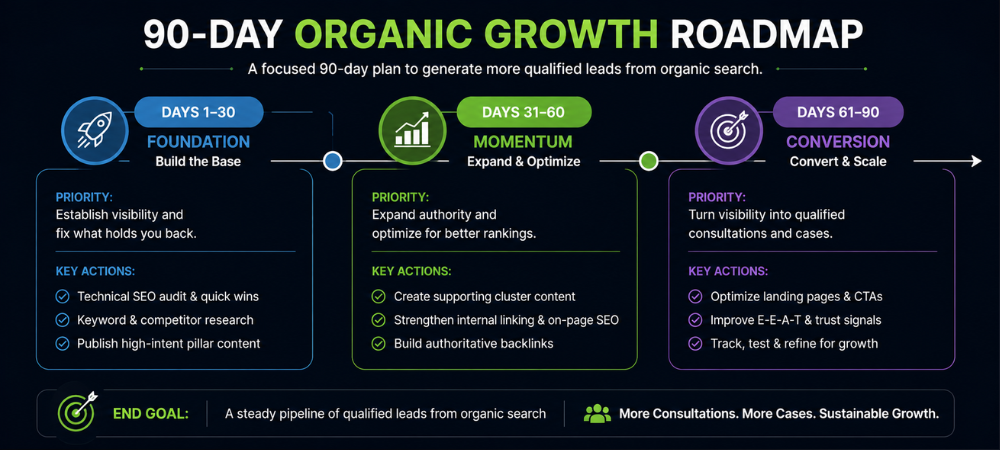
A 90-Day Action Plan For Increasing Qualified Organic Leads
| Period | Priority | Key Actions |
|---|---|---|
| Days 1–30 | Diagnose | Audit queries, landing pages, technical issues, intake data, local visibility, and conversion paths. Identify pages already close to producing qualified demand. |
| Days 31–60 | Rebuild | Improve priority practice-area pages, local signals, trust elements, forms, mobile calls to action, and internal linking. Align copy with case acceptance criteria. |
| Days 61–90 | Expand | Publish supporting content, strengthen follow-up, connect analytics with CRM outcomes, and establish monthly review cycles. |
Internal teams can own execution when they have SEO, legal editorial, development, analytics, and intake capacity. Many firms do not. In that case, specialists in legal SEO lead generation can coordinate the work, but the firm must still supply real acceptance criteria, attorney insight, and intake feedback. Outsourcing does not remove the need for participation. It just gives the process a more disciplined centre.
Example: How One Firm Could Increase Qualified Consultations By 64%
Consider a hypothetical firm that rebuilds two high-traffic practice pages, adds location and eligibility cues, simplifies mobile contact, and introduces a same-day intake protocol. Qualified consultations rise by 64% over six months without a comparable traffic increase. The lesson is not the percentage itself. Better alignment and follow-up can outperform raw visitor growth.
Organic Growth Becomes Predictable When The Entire Pipeline Works
Sustainable law firm lead generation does not come from ranking alone. It comes from attracting the right visitors, showing them a credible reason to contact the firm, filtering inquiries responsibly, and responding before intent fades. Firms that manage organic search as a complete inbound system tend to build stronger pipelines than those that report traffic and stop there.
Viacon can help legal practices examine that full system, including search visibility, content, conversion paths, website experience, and lead follow-up. Request a free digital audit or schedule a strategy conversation to identify where qualified demand is leaking. Start with the pages already receiving attention. Then turn that attention into consultations and signed matters.
Talk To Viacon About Your Firm’s Organic Growth
If your firm’s website is producing traffic but not enough signed matters, a short conversation usually surfaces where the pipeline is leaking faster than an audit report can. Get in touch with Viacon’s team to walk through your current visibility, intake process, and the fastest path to qualified consultations.