
Patients nowadays usually start their search for healthcare services on their phones, often at night, already anxious about a symptom they just typed into Google. While increased accessibility has no doubt been revolutionary, it has also prompted healthcare professionals and service providers to rethink their marketing strategies because, after the initial search, what a person sees in the next 10 seconds determines whether they call your practice or the one three listings down.
This surge in online activities is reason enough to take medical website designseriously. Creating an online presence that accurately captures the ethos of the service or business not only improves its prospects but also strengthens its reputation and plays a critical role in patient acquisition, trust, compliance, and operational efficiency.
However, designing a medical website is not like designing one for ecommerce services. Medical websites must comply with strict privacy regulations, ensure exceptional accessibility, rank well in search engines, and provide a seamless user experience.
So, let’s explore what medical website design looks like in 2026 and how to go about the job.
What Makes Medical Website Design Different From Any Other Industry?
Swap “book a consultation” for “buy now” and most web design advice holds up fine for a SaaS company or a restaurant. But when it comes to the healthcare sector, this approach falls flat.
This failure primarily comes down to three factors:
- The Content Is YMYL
Google classifies medical information as “Your Money or Your Life” content. And more importantly, this is the category that the search engines hold to the highest quality benchmark in their entire Quality Rater Guidelines.
It means thin, anonymous, or generically written health content gets filtered out of results regardless of how well it’s optimized, because bad medical information carries real-world consequences that a bad blog post about kitchen gadgets doesn’t.
- The Compliance Surface Is Wider Than People Assume
HIPAA governs more than just patient portals. It touches contact forms, appointment widgets, live chat, and the analytics tags most marketing teams install without thinking twice. ADA and WCAG obligations sit alongside it, and for organizations that accept federal funding, a hard compliance deadline already applies.
- The User Is A Worse Version Of A Typical Shopper
Here, the user is often the worst kind of shopper. How? Well, they are mostly unwell, worried, or in pain during the search, which means decision fatigue sets in faster.
This is precisely why jargon that one will tolerate on a SaaS website becomes a roadblock when someone is searching for relief from pain.
So, it is important to remember that every extra click or unclear label costs you more in healthcare than it would be almost anywhere else.
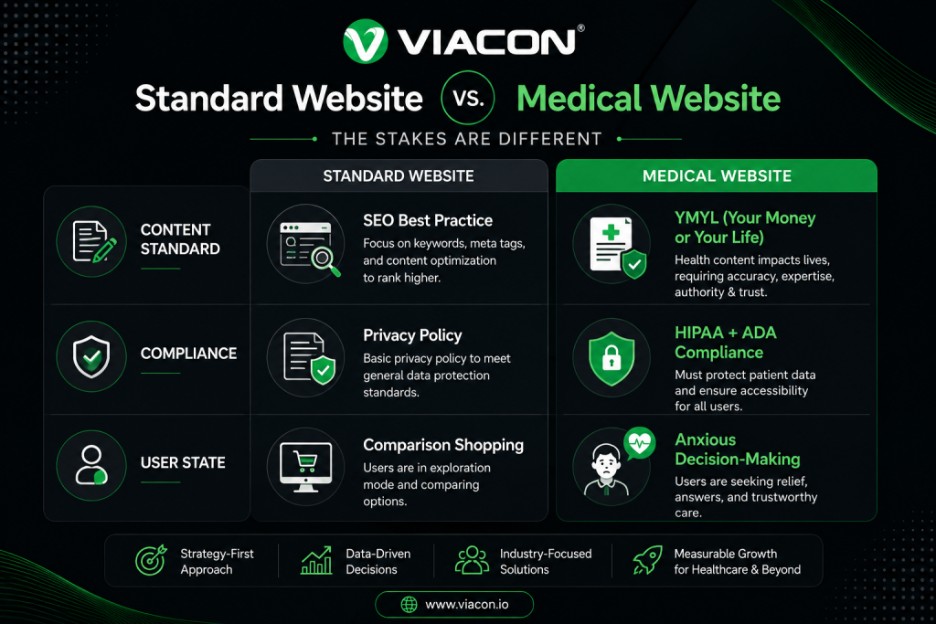
Moving on, designing a website for the healthcare industry is very different from designing one for other industries. The reasons are simple. Healthcare organizations operate in a highly regulated environment, which means their websites must do much more than showcase services.
Here Are The Key Factors That Set Medical Website Design Apart From Other Industries:
- Patient Privacy And Data Security: Unlike most business websites, medical websites often collect sensitive personal and health-related information. This makes robust website security essential through secured hosting, encrypted data transmission, strong authentication, and privacy-focused form handling.
- Regulatory Compliance: Given the industry’s sensitive nature, medical websites must comply with local regulations. For instance, in the USA, such websites must adhere to HIPAA. These regulations influence everything from how patient data is collected and stored to how third-party tools and integrations are implemented.
- Accessibility For Everyone: Accessibility ensures that the site is usable by everyone, including people with visual, hearing, cognitive, or motor impairments. Using accessible design features such as keyboard navigation, screen reader compatibility, sufficient color contrast, and descriptive alternative text guarantees that all patients can access healthcare information and services without unnecessary barriers.
- Higher Standards For Trust And Accuracy: Healthcare websites help people make important life decisions. So, an outdated website with inaccurate and misleading information can undermine confidence and even affect patient outcomes. Therefore, medical websites should present clear, evidence-based content, highlight provider credentials, and keep service information up to date to establish credibility and trust.
| Does Every Page Of A Medical Website Need To Be HIPAA Compliant? No, not every page of a medical website needs to be HIPAA compliant. Public pages that don’t collect or disclose protected health information may not be subject to HIPAA in the same way. However, pages involving appointments, patient portals, forms, or telehealth should be carefully designed with these regulations in mind. Viacon helps healthcare providers identify compliance risks across their entire website, not just on obvious pages. |
Core Design Principles That Actually Move The Needle
Medical website designis not always straightforward, so let’s skip the jargon, and here are five factors that must drive your website design decisions:
(i) Website Navigation Is Built Around Three Tasks, Not Ten
A medical search has a simple philosophy: find the provider, book an appointment, or visit the clinic directly. When you bury these under complicated menu layouts, you lose an individual who is already in a hurry. For websites in this segment, navigation must allow patients to reach critical information within 3 clicks from any page.
(ii) Plain Language Over Clinical Accuracy for Its Own Sake
On average, the regular internet user reads at a seventh- to eighth-grade level. That’s why, when website content is written in a way that makes a physician talk to a colleague, it excludes a large share of the people it’s meant to serve. The easiest way to tackle this is to read the content out loud and see whether it sounds too complicated. And, if it does, rewrite it.
(iii) Speed And Mobile Performance As A Trust Signal, Not A Technical Afterthought
Speed and mobile performance are non-negotiable in modern website design, regardless of the industry. So, a healthcare website should also apply the same principle and load quickly and properly across devices to offer a superior experience. In this regard, Google Core Web Vitals function as both a ranking factor and a proxy for how competent your organization looks on first contact.
(iv) Credibility Markers Placed Where Decisions Actually Happen
The next core design principle for healthcare websites is to place credibility markers at points of decision-making. So, you need to provide photos and other credentials near the booking CTA, so they’re easier to locate and not buried behind the ‘About us’ page, which is three clicks deep. It is important to remember that trust and conversion coexist, so design for them accordingly.
(v) A Booking Path That Survives On A Phone, One-handed, In Under Five Minutes
Healthcare websites are usually visited out of need. So, any information that they need must remain easily accessible and within a few clicks. So if your website has a long services section or the CTAs are hard to find or read, customers will leave.
These five are real conversion issues that double up as design issues worth treating as their own workstream. That’s why understanding the concept of conversion rate optimization is crucial, rather than something a visual refresh alone fixes.
| Does Having An SSL Certificate Mean The Website Is HIPAA Compliant? No, just having an SSL certificate doesn’t make the website HIPAA compliant. An SSL certificate only encrypts data in transit, but HIPAA compliance requires secure hosting, access controls, compliant vendors, audit logs, and proper handling of PHI. So, the SSL certificate is one part of the puzzle, and Viacon helps you to complete the entire picture of security and compliance from the beginning. |
Healthcare UX Design: Why Standard UX Rules Don’t Apply?
Healthcare UX designborrows from the playbook of regular UX design, including journey maps and usability testing. However, the underlying principles change, and for obvious reasons, the industry is different.
Regular UX planning optimizes for efficiency; the same applies to the healthcare industry, prioritizing safety, clarity, and trust first, with efficiency as a secondary goal.
Now, This Distinction Matters As The Healthcare Audience Serves Three Conflicting Ideas On The Same Platform:
- Patient-facing UX: The public site, portals, symptom checkers, and booking flows a prospective or existing patient touches.
- Provider-facing UX: Scheduling dashboards, referral tools, and internal systems clinicians use, where efficiency and error-reduction matter more than persuasion.
- Administrative UX: Billing, intake, and coordination tools for front-desk and operations staff.
In most cases, the practices focus only on the first category, but even then, the standard heuristics need adjustment. For instance, a patient waiting for the lab results, evaluating a new diagnosis, or navigating an unfamiliar telehealth tool for the first time is operating with less cognitive bandwidth than a typical e-commerce shopper.
That’s why good healthcare UX design directly compensates for that. It reveals complex or high-consideration information gradually instead of front-loading it, keeps terminology consistent across every page so a returning visitor doesn’t have to relearn navigation, and puts support FAQs, a phone number, and live chat within reach rather than assuming a confident, self-service visitor.
So, the healthcare organization getting this right treats privacy transparency as a UX element, not just a legal one. When you inform the user about how their information will be used right where they are asked to enter it, it measurably reduces abandonment on intake and booking forms by clearing any confusion before it arises.
HIPAA Compliance Is A Liability Surface, Not A Checkbox
‘Make the website HIPAA compliant’: when it comes to medical website development, this is often one of the most overused statements in 2026. But at the same time, it is highly vague and incomplete.
In reality, most healthcare providers fail to identify where their biggest compliance risk exists. While contact forms receive the most attention, they are rarely the primary source of exposure. More often than not, the biggest risks come from the website’s analytics and marketing technology stack.
Third-party Tracking Tools: The Hidden Risks
Tools like Meta Pixel and Google Analytics are standard installations on most business websites. However, healthcare websites need a much higher level of scrutiny.
Now, Google does not offer a Business Associate Agreement (BAA) for Google Analytics. Also, its own paperwork warns against transmitting Protected Health Information (PHI) via platforms on HIPAA-regulated websites. Meta Pixels also present similar concerns.
Despite these limitations, both tools continue to be widely deployed on medical websites, often through Google Tag Manager. But this doesn’t clear the confusion of what information is being collected or shared.
The Legal Consequences Are Real
Here are some examples of where healthcare organizations had to pay a hefty price for their improper handling of tracking facilities:
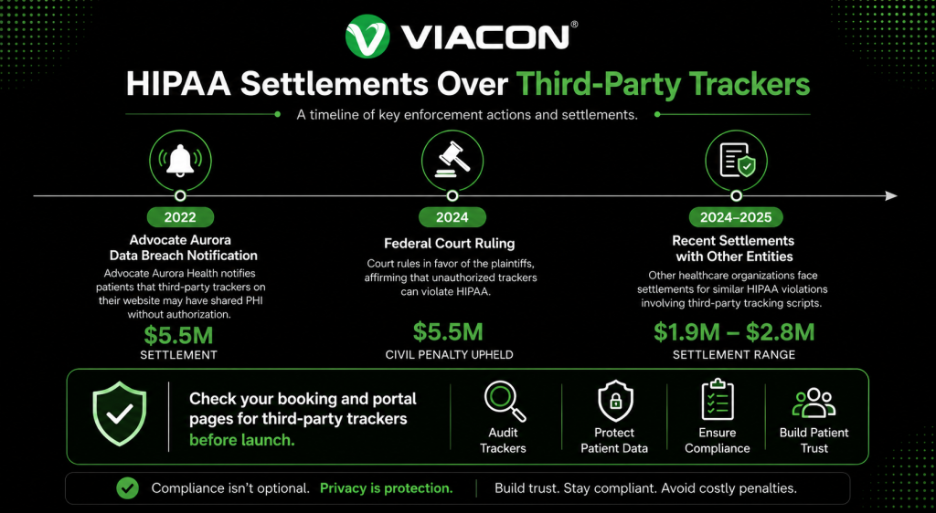
- Advocate Aurora Health had to pay $12.25 million in settlement following the allegations that Google Analytics and similar tracking tools captured patient portal URLs and IP addresses.
- Novant Health had to pay $6.6 million to resolve a claim involving tracking technologies on patient-facing web pages.
- New York-Presbyterian Hospital paid $300,000 over similar HIPAA-related tracking concerns.
Apart from these, between 2023 and 2025, at least 19 U.S. health systems collectively paid more than $100 million to settle lawsuits involving tracking pixels and patient data.
Now, these cases are prime examples of how compliance failures are not theoretical. They can actually lead to substantial financial penalties, legal exposure, and reputational damage.
Recent Legal Development
A 2024 federal court ruling narrowed part of the U.S Department of Health and Human Services’ guidance regarding online tracking technologies. In general, collecting an IP address alone on publicly accessible, non-patient pages may not automatically constitute protected health information.
However, the ruling did not eliminate HIPAA obligations for pages where patients interact with healthcare services. The tracking technologies used on patient portals, appointment scheduling pages, online intake forms, or other areas where health-related information is exchanged remain subject to significant compliance considerations.
| Can Patient Contact Form Submission Go Directly To My Practice Email? Yes, it is possible to send the patient contact form directly to your practice email, but it will also create a compliance risk if the email is not configured to meet HIPAA requirements. Instead, opting for secure form processing or a protected communication channel is more effective, and Viacon helps implement secure patient inquiry workflows without compromising usability. |
What This Means For Your Website Redesign?
Before focusing on layouts, colors, or user experience, it is crucial to review the technologies running behind your website. A HIPAA-conscious design must include:
Audit every third-party script or appointment-booking page, patient portal, intake form, and any page that may contain confidential health information.
Stop relying on cookie consent banners, as they only satisfy privacy regulations like GDPR or CCPA but don’t comply with HIPAA requirements. That’s why if PHI is shared with a vendor that hasn’t signed a Business Associate Agreement, a consent banner doesn’t solve the problem.
Select the analytics platform carefully and consider solutions that will sign a BAA where appropriate, or a user-privacy-focused, self-hosted analytics platform that keeps patient data under your organization’s control.
Vet every third-party integration, which includes scheduling software, live chat tools, patient messaging platforms, review widgets, and similar services may become business associates if they handle protected health information. Also, ensure they meet your compliance requirements before integrating them into your website.
Accessibility Is Now a Legal Deadline, Not a Best Practice
Accessibility advice in most medical website designcontent stops at “follow WCAG guidelines,” a vague best practice. As of 2026, it’s more concrete for a significant part of the industry.
Under HHS’s Section 504 rule, organizations receiving federal financial assistance most hospitals and health systems accepting Medicare or Medicaid had to bring their websites and apps into WCAG 2.1 AA conformance by May 11, 2026.
That deadline has passed, and if your organization falls under it and hasn’t addressed accessibility, exposure now runs through federal funding compliance, not just litigation.
For everyone else, litigation risk is smaller than assumed but worth planning around. Healthcare accounts for roughly 2–3% of ADA digital-accessibility lawsuits; e-commerce dominates by far, though its share is trending upward as plaintiff firms broaden beyond retail.
That’s why, when sued, healthcare defense and settlement costs typically run $10,000–$200,000, including legal fees, and nearly half of 2025 filings targeted companies already sued once that had made only surface-level fixes.
That point matters more than the headline number: nearly a quarter of 2025 filings targeted sites using accessibility overlay widgets and bolt-on plugins marketed as instant compliance. They’re a documented red flag for plaintiff firms, not a shield. Also, real accessibility gets built into markup, contrast, keyboard navigation, and form labeling at design time, not patched over after launch.
Baseline WCAG 2.1 AA Items Worth Designing For From Day One:
- Sufficient color contrast on CTAs and form fields; don’t let brand colour override legibility.
- Full keyboard navigability; no functionality that depends on a mouse or touch alone
- Descriptive alt text on every clinically relevant image, not just decorative ones.
- Form fields with programmatically associated labels, not placeholder text as a label.
- Captions or transcripts on provider or educational video content.
The Content Side: E-E-A-T And Why Google Doesn’t Trust Anonymous Medical Content
This is the section that is often overlooked, and it’s a mistake, because the information architecture decisions made during design directly determine whether your content can meet Google’s bar.
Google’s Quality Rater Guidelines apply the strictest E-E-A-T (Experience, Expertise, Authoritativeness, Trustworthiness) standard to YMYL content, and medical information sits at the top of that hierarchy.
In Practice, That Means:
- Every clinical article needs a visible, named author, not “Staff Writer”, linked to a bio page listing their degree, board certifications, and practice history.
- Content reviewed by a specialist should carry a visible “medically reviewed by” credit, with the reviewer’s credentials linked, not just named.
- Your about page needs more than a paragraphbecause it’s one of the first things a human quality rater checks, and it should clearly establish who runs the site and why they’re qualified to publish what’s on it.
- Clinical claims need citations to CDC, NIH, or relevant specialty board guidance, not unsupported assertions.
- Dates matter; a page carrying a 2021 timestamp with unrevised guidance signals neglect. Review and visibly update YMYL content on a regular cadence.
Now, none of this is copywriting work bolted on after launch. It requires a CMS structure that supports author profiles, reviewer bylines, and visible last-updated dates from the start, which is a design and information-architecture decision, not an afterthought for the content team.
We cover the ranking side of this in more detail in our healthcare SEO guide.
Designing For AI Search: Schema Markup And Structured Answers
When rich snippets first arrived on the scene, structured data was a nice-to-have. But fast-forward to 2026, it is almost a prerequisite to appear in AI-generated overviews and conversational search results. Also, it has to be planned into the site’s information architecture, not added as a plugin after the fact.
Schema.org maintains a full medical vocabulary built specifically for this: MedicalOrganization for the practice itself, Physician for individual provider pages, MedicalCondition and MedicalProcedure for service and education content, and FAQPage for patient-education Q&A formats.
Implemented consistently in JSON-LD and kept in sync with what’s actually visible on the page, this markup gives search engines and AI systems a direct, unambiguous read on what each page represents: a provider, a condition, a procedure, a location, rather than forcing them to infer it from unstructured text.
The payoff also shows up in citation behavior, not just rankings. Content structured with clear headings, concise definitions, and explicit answer blocks gets cited by AI search engines at roughly 2.7 times the rate of unstructured competitor content, according to recent analysis of dental and medical service pages.
That’s a strong argument for making service and condition pages direct: answer first, then elaborate. This is its own specialty now; see our AI search optimization services if your current setup doesn’t account for it.
| How Can I Optimize A Medical Website For AI Search Engines Or AI Overviews? To optimize a medical website for AI search, start by publishing accurate, expert-reviewed content, use structured data, answer patient questions directly, and demonstrate medical expertise through author bios and citations. Also, website architecture, responsiveness, and speed contribute to it. Viacon combines technical SEO with AI-ready content strategies to improve visibility in modern search experiences. |
Dental Website Design: Why Anxiety, Not Aesthetics, Should Drive The Layout?
The website design for dental practices should be treated as a separate subject because it needs to move from the notion of “use calming colors”. Anxiety due to dental issues is common enough to warrant treating it as a primary design constraint rather than a footnote.
That Reframes Decisions A General Medical Site Wouldn’t Need To Make The Same Way:
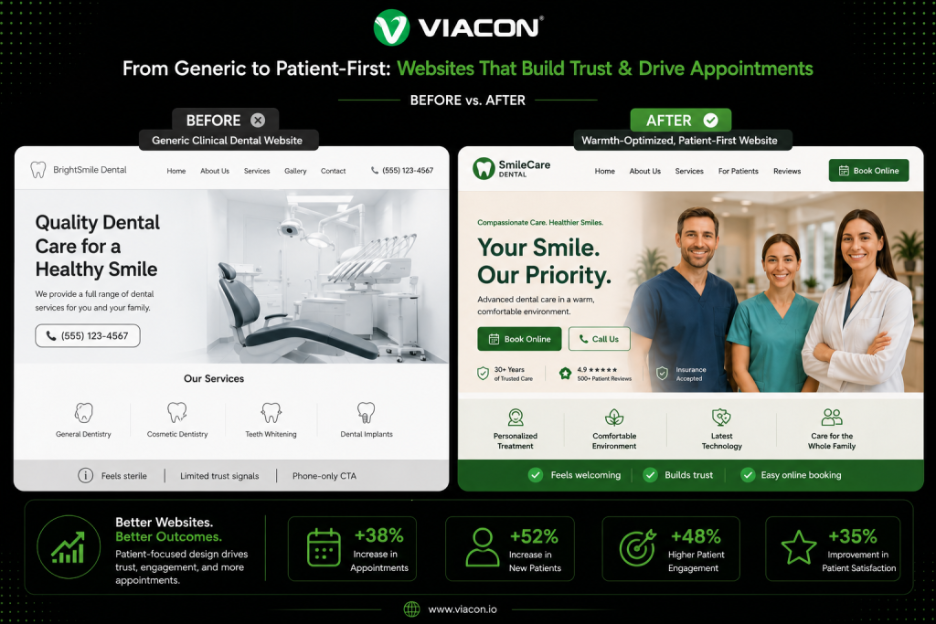
- Color And Imagery Do Real Work, Not Decorative Work: Soft blues, warm neutrals, whitespace, and rounded corners measurably reduce the clinical harshness that triggers avoidance. Now, stock photography undermines this, as real photos of the actual office and team build trust that generic imagery can’t.
- Procedure Pages Benefit From Showing, Not Just Describing: Short explainer animations for implants, veneers, or aligners reduce the fear of not knowing what to expect, often a bigger barrier to booking than price.
- The Booking Path Should Feel Like The Lowest-anxiety Option: The appointment booking system should not feel like a struggle. Online scheduling that skips the phone call converts anxious patients quickly, and a “call to book” CTA quietly loses.
- Reviews Work Better When Distributed Than Concentrated: A single testimonials page can be easily overlooked, but when reviews are woven into service pages and near booking CTAs, they get noticed easily.
The numbers back this up: well-optimized dental sites in competitive markets convert in the 8% to 12% range, well above a generic template site. Budget varies by approach; a template build on Webflow or WordPress runs roughly $500 to $5,000, while a custom build from a specialized agency starts higher and scales with the number of locations and integrations.
Medical Website Development: Choosing The Right Platform And Tech Stack
Design and development decisions get made together, whether or not a team plans it that way because the platform you choose determines what’s actually buildable. Five options dominate the market right now, each with a genuinely different risk and cost profile.
| Platform type | Typical cost | Best fit | Watch out for |
| Website builder (Wix, Squarespace) | $300–$700/year | Solo practitioners needing a fast, simple presence | Not built for HIPAA-sensitive forms; limited EHR/portal integration |
| Self-managed WordPress | ~$1,000–$2,000/year hosting + maintenance | Practices wanting content control without full custom development | Requires ongoing security patching; HIPAA-compliant hosting is a separate line item |
| Healthcare-specific platforms (e.g., PatientPop, Tebra-style SaaS) | $300–$1,200/month | Practices wanting compliance and marketing bundled in | Less design flexibility; harder to fully own or migrate your build later |
| Custom agency build | $8,000–$50,000+ | Multi-location groups, specialty practices, anyone needing EHR/portal integration | Wider cost range means scope needs to be nailed down in writing before signing |
| Enterprise/hospital systems | $50,000–$300,000+ | Hospital networks, telehealth platforms | Long build timelines; requires dedicated compliance and security review |
The decision that matters most isn’t “which platform looks best”; most of them can produce a visually competent site. It’s the one that supports the integrations your practice actually needs: EHR connectivity, HIPAA-compliant hosting, secure form handling, and a content structure that meets the E-E-A-T requirements covered earlier.
Therefore, choosing a healthcare website design company that can’t support a physician bio schema or a BAA-covered analytics setup creates opportunities for rework later, ultimately costing more in the long run.
What Medical Website Design Actually Costs In 2026?
The actual cost of a medical website varies depending on what your business needs. But most of the cost is genuinely explainable once you separate it by project scope rather than treating “medical website” as one category.
| Practice type | Realistic 2026 range | What drives the cost |
| Solo practitioner, template-based | $2,000 – $8,000 | Pre-built theme, light customization, stock content |
| Small-to-mid practice, custom design | $8,000 – $20,000 | Custom UX, original photography, on-page SEO foundation |
| Multi-location or specialty group | $20,000 – $50,000 | Location-specific pages, provider directories, more complex IA |
| Hospital system, telehealth, or EHR-integrated platform | $50,000 – $150,000+ | Portal integration, security review, accessibility audit, multi-team stakeholder process |
On top of the build cost, budget for HIPAA-compliant hosting, ongoing maintenance, and content updates as recurring line items. These costs are frequently omitted from the headline quote and then show up later as a surprise.
Ask any agency you’re evaluating to itemize hosting, maintenance, and analytics setup separately from the design-and-build fee, so you’re comparing like for like across proposals.
Now, it is important to note here that none of this includes paid acquisition. So, budgeting for that is a separate exercise, covered in our healthcare PPC guide.
| How Does Website Accessibility Affect Patient UX And Conversion Rate? Accessibility is a critical UX factor because such websites are easier for everyone to use and not just for people with disabilities. Clear navigation, readable text, keyboard accessibility, and accessible forms reduce frustration, improve trust, and increase appointment bookings. Viacon can help build WCAG-conscious healthcare websites that deliver a better patient experience while supporting compliance and business growth. |
How To Choose A Healthcare Website Design Company?
Every agency that writes this kind of content, including this one, has an obvious incentive to make the vetting process favor itself. The way around that isn’t to ignore agency advice; it’s to ask questions specific enough that a generalist agency can’t fake the answer.
- Start with HIPAA, not portfolio: Ask directly: how do you prevent PHI from reaching Google Analytics or Meta Pixel on booking and portal pages? If you get a vague answer, “we use secure hosting” is a red flag. However, a more specific answer will mention BAAs, server-side tracking, or analytics tools built for regulated industries.
- Ask for live healthcare sites you can actually test: Check the agency’s previous work by asking for the actual live websites, not just screenshots. You should review them yourself on a phone and see how many taps does it takes to book an appointment. Does the site pass a basic accessibility check (try navigating with keyboard-only tab presses), and how fast does it load across devices and browsers?
- Ask how they handle E-E-A-T and content authorship: Check whether they build CMS structures that support author bios, medical-reviewer credits, and visible update dates, or is that left entirely to you after launch?
- Ask what happens to your site if you leave: Platform lock-in is common with bundled healthcare marketing platforms. Confirm that you own your domain, content, and data outright, and understand what migration entails before you sign.
Nowa basic private-practice site sits in a very different budget and complexity category than a hospital network building portal integrations. So, before starting, be very clear about what you actually want to avoid comparing proposals that were never solving your real issue.
Mistakes That Quietly Cost Practices Patients
Moving on, a few patterns recur on underperforming medical websites, which include:
- Google Analytics or Meta Pixel installed on booking, portal, or intake pages without a BAA or PHI-filtering in place is the single most expensive mistake on this list.
- An accessibility overlay widget standing in for real remediation is a documented target for litigation, not a fix.
- Contact information buried below the fold or behind a “Contact Us” click means a patient in distress has to search for a phone number.
- Booking forms with more fields than the decision warrants create a bottleneck, with every additional required field becoming a drop-off point on mobile.
- No named authors or reviewers on clinical content is quietly capping how well that content can ever rank.
- Stock photography standing in for real providers and offices erodes trust that’s easy to underestimate until you see the bounce-rate difference.
- Treating slow page speed as a “later” fix costs actual bookings, not just the site’s appearance on a technical spec sheet.
Most of these are booking-funnel problems as much as design problems; see Healthcare Lead Generation: Proven Ways to Increase Appointments and Revenue for the marketing side of the same issue.
The Decisions Nobody Treated As Decisions
Go back to that $12.25 million settlement for a second. Nobody on that hospital’s marketing team set out to violate HIPAA; they installed the same analytics tag that’s on a few hundred thousand other practice sites right now, because nobody had flagged it as a design decision rather than a marketing formality.
That’s the pattern that costs practices the most, but it rarely looks like bad design. They look like decisions nobody treated as decisions: the tracking script nobody audited, the accessibility overlay bought instead of built, the clinical page published with no named author, the agency hired on portfolio alone.
None of that makes this a risk-avoidance pitch dressed up as a design article. A site that’s fast, plainly written, accessible by default, and structured for the signals Google actually checks converts better than one built only to look good in a pitch deck. Trust and performance turn out to be the same design problem, worked from two angles.
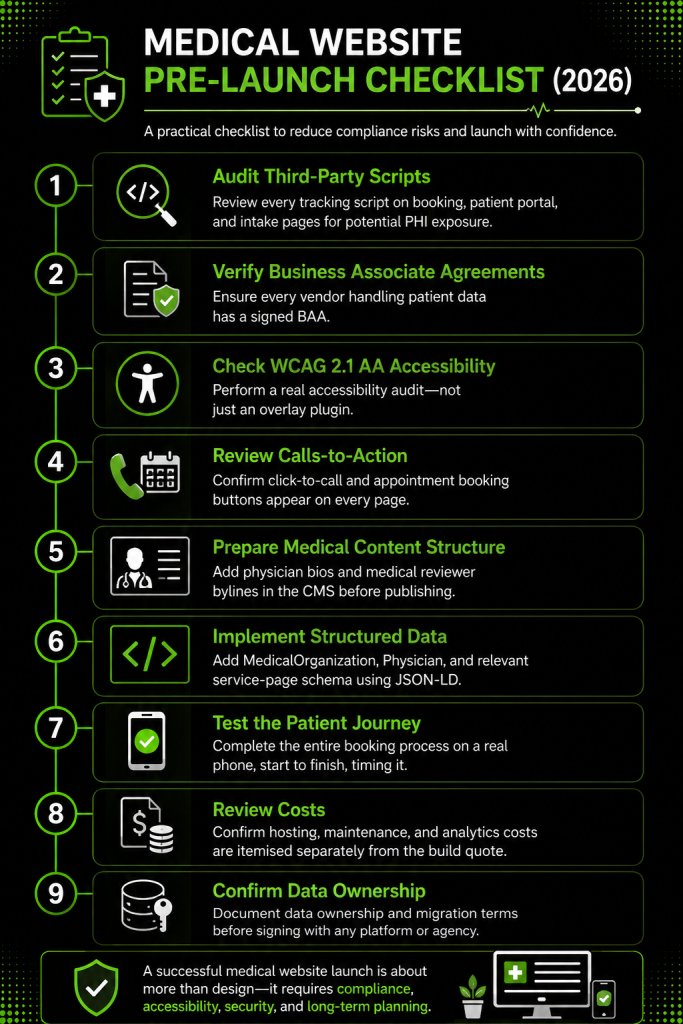
Take the pre-launch checklist above, run it against your current site this week, and see what’s breaking. Before sanctioning a redesign, you will find that most issues are easier to fix and can be resolved within a few days.
But the issues that touch platform choice, EHR integration, or a full compliance audit are worth a second opinion before you commit budget to them. A free audit will tell you where your current site actually stands before that conversation turns into a redesign.