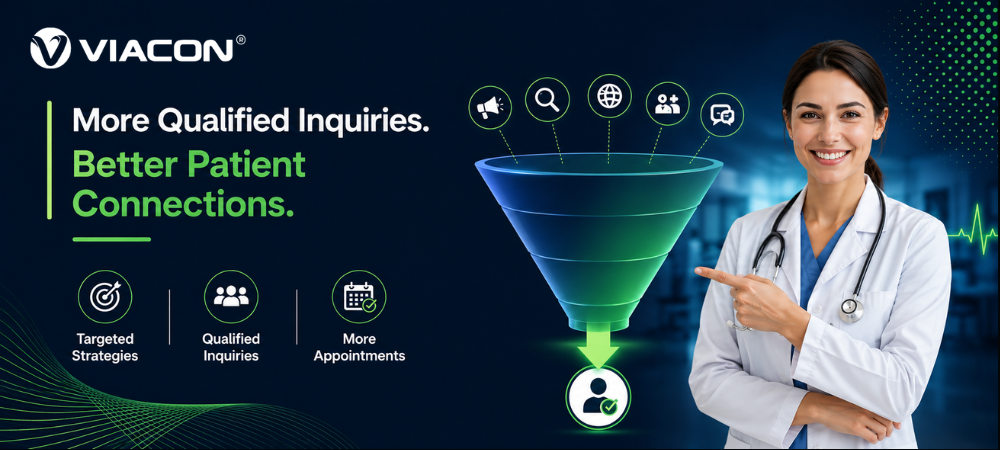
It feels reassuring to look at traffic on a monthly report. In fact, having more impressions, clicks, and sessions looks great.
Still, none of them automatically fills an appointment calendar. Effective healthcare lead generation focuses on attracting people who need relevant care, who meet the practice’s basic criteria, and who feel ready to contact a provider.
That distinction matters because healthcare decisions rarely follow a neat path. Patients research symptoms and compare specialists. They review and check insurance coverage. Sometimes they leave a website twice before returning, and increasingly, they never land on a website at all during that research phase they get a synthesized answer from an AI Overview or a chatbot first, and decide who to call from there.
Therefore, the strategy cannot stop at discovery. It has to make the next step feel clear, safe, and worth taking.
What Is Healthcare Lead Generation?
Healthcare lead generation is the process of attracting prospective patients, capturing their interest, and guiding them toward a meaningful action, such as requesting an appointment, calling a clinic, submitting an insurance question, or booking an initial consultation. It’s one specific function inside a broader healthcare marketing strategy, and it tends to underperform when built in isolation from the rest of that strategy.
Still, every form submission should not count as an equally valuable lead. Someone downloading a general wellness guide has different intent from someone searching for an orthopedic consultation nearby. Consequently, healthcare marketers must separate casual interest from genuine care-seeking behavior.
Why Qualified Leads Matter
Large lead volumes tend to hide weak marketing. The front desk spends more time filtering than scheduling when inquiries come from unsupported locations, unsuitable conditions, or patients expecting services the provider doesn’t offer.
In contrast, qualified patient leads generally match the provider’s services, location, availability, and basic eligibility requirements, and they show recognizable intent. As a result, fewer inquiries go nowhere, staff members waste less time, and acquisition reporting becomes far more honest.
Quality also affects the patient experience. When marketing promises align with operational reality, people get relevant answers faster. When an advertisement overpromises availability or treatment suitability, frustration starts before the first clinical interaction.
The Compliance Layer Most Guides Skip
Here’s the part that decides whether a campaign survives contact with legal, and it’s the part most healthcare marketing content leaves out entirely: the moment someone submits an inquiry referencing a symptom, condition, or treatment interest, that submission can become protected health information. That single fact changes how forms, ad pixels, chatbots, CRMs, and follow-up texts all need to work.
Business Associate Agreements Come First
A few ground rules are worth building into the plan before the first ad goes live. Every vendor that touches lead data needs a signed Business Associate Agreement. The CRM, the marketing automation platform, the call-tracking service, and any AI chatbot handling intake conversations. Standard consumer-grade tools like Google Analytics or Meta Pixel, deployed the default way, generally aren’t built for this.
Tracking Pixels And Consent Requirements
Tracking pixels on health-related pages are also a live enforcement issue, not a theoretical one. HHS’s Office for Civil Rights has spent the past several years pursuing healthcare organizations for sending visitor data to ad platforms without authorization. A 2024 court ruling narrowed the guidance for unauthenticated public pages an IP address paired with a visit to a symptom page isn’t automatically PHI in that specific scenario anymore.
But the guidance still applies in full to authenticated pages like patient portals and scheduling systems, and the underlying legal question keeps shifting. Treating “get a BAA or don’t use the tracker” as the default is safer than trying to parse the exception independently.
Consent has to be explicit and documented. A checkbox at the point of form submission, timestamped and stored, protects a practice far more than an assumption that submitting a form implies consent to everything that follows. None of this is legal advice healthcare marketing counsel should review the specific setup, what tools are in use, what data they touch, and what state-level privacy laws stack on top of HIPAA, before campaigns launch.
None of this is a reason to avoid digital marketing. It’s a reason to build the compliance layer alongside the acquisition strategy, instead of retrofitting it after an ad account gets flagged or a vendor contract gets questioned by counsel.
Building A Patient Acquisition Funnel
A patient acquisition funnel should reflect how people actually evaluate medical care. The journey mostly looks scattered, but four broad stages help organize it without forcing every patient into the same sequence.
| Funnel Stage | Patient Behavior | Marketing Priority |
| Discovery | Searches symptoms, treatments, or nearby providers | Earn visibility around relevant intent |
| Evaluation | Compares credentials, reviews, services, and access | Build trust and reduce uncertainty |
| Inquiry | Calls, submits a form, or starts a chat | Remove friction and capture essential details |
| Conversion | Confirms and attends an appointment | Follow up quickly and prevent drop-off |
Each stage needs its own message. Educational content works well during discovery. Transparent insurance information becomes more important during evaluation. Simple forms and visible scheduling options support the inquiry stage.
Top Healthcare Lead Generation Channels
No single channel carries the entire acquisition system. Instead, the strongest mix usually combines long-term visibility, immediate demand capture, professional referrals, and measured follow-up. Here are the channels that matter most in healthcare.
(i) SEO
SEO reaches patients while they research conditions, treatments, specialists, and local services. Ranking for broad medical topics means little when those searches lack commercial or local relevance, so service pages, location signals, clinician credentials, and practical FAQs matter more than broad visibility.
(ii) PPC (Pay Per Click)
PPC captures demand faster, particularly for high-intent searches, but loose targeting can drain budgets rapidly. Campaigns need negative keywords, location controls, service-specific landing pages, and call tracking, or marketers end up paying for curiosity rather than viable inquiries. One more layer sits underneath all of this.
Google and Meta both restrict personalized advertising for health-related topics. Practices generally can’t build remarketing audiences from visits to symptom or condition pages, and certain categories health insurance, prescription-related services, telemedicine require separate platform certification before ads run at all.
Loose targeting doesn’t just waste budget here; it can get an ad account disapproved or suspended outright. The fix isn’t to pull back from paid media. It’s to lean on contextual and service-line targeting, broad geographic and demographic signals, and first-party data collected through compliant, consented channels, rather than symptom-based remarketing.
(iii) Social Media
Social media generally supports awareness, education, and trust. It works especially well when content answers recurring patient concerns without making exaggerated promises, but social engagement should not be mistaken for appointment intent.
(iv) Referrals
Referrals remain powerful because trust transfers from one professional or patient to another. Practices should make referral routes easy to understand, acknowledge referring sources, and track which relationships produce suitable inquiries.
(v) Email
Email helps nurture prospects who need more time, but healthcare emails should stay relevant, restrained, and privacy-conscious. Generic promotional blasts mostly create fatigue, while appointment guidance and service-specific education support informed decisions.
(vi) Video And Short-Form Content
Video and short-form content are earning a bigger share of attention. A short, clinician-led explainer on what to expect at a first visit, a direct answer to a common question, increasingly outperforms polished brand content, and it works across a landing page, a Google Business Profile post, a social feed, and increasingly as a source AI systems draw from when summarizing a provider’s expertise. The production bar is lower than most practices assume; a clinician speaking plainly on camera tends to read as more credible than a studio production.
(vii) Answer Engines And AI Search
Answer engines and AI search are changing where patient research happens. A growing share now takes place inside Google’s AI Overviews, ChatGPT, and Perplexity before a single website gets a click, so ranking on page one no longer guarantees visibility if an AI-generated summary answers the question without a referral link. This is where dedicated AI search optimization comes in, covered in more depth below, because standard SEO tactics don’t fully transfer to it.
Winning Visibility In AI Overviews And Answer Engines
Patient search behavior changed faster than most practice websites did. Pew Research tracked browsing behavior and found that when an AI Overview appears above the results, people click through to a traditional link far less often than when no summary shows up at all, and they click the sources cited inside that summary even less.
For an industry built on informational queries symptoms of a condition, recovery time for a procedure, whether insurance covers a treatment that shift lands hard, because those are exactly the queries AI Overviews now answer directly on the results page.
Ranking well in traditional search and getting cited inside an AI-generated answer aren’t the same accomplishment. A widely cited Ahrefs analysis of AI Overview citations found that a large share of cited URLs don’t come from the top ten organic results at all; the models pull from whichever source states the answer most directly, not necessarily the page that ranks best.
How To Structure Content For AI Citation?
A few things move the needle here. Content should lead with the answer, not the explanation: a patient question deserves a direct, two-to-three sentence answer at the top of the relevant section, with supporting detail underneath, which is a shift away from the “hook, then reveal” structure a lot of web content still leans on.
Clinical content needs a named, credentialed author attached to it, since under Google’s guidance for medical and health topics, its “Your Money or Your Life” standard, unattributed or vaguely sourced content struggles to be treated as authoritative by search engines or by AI systems summarizing it.
FAQ and medical schema markup should be used consistently, with name, address, and phone data identical across every location and directory listing, because AI systems weigh entity consistency heavily when deciding which source to trust.
Refresh Cycles and Measurement
High-value pages also need refreshing on an actual schedule. Content that goes stale quietly drops out of AI citations even while its organic ranking holds steady, so a quarterly pass on the top-performing pages, with updated statistics, current protocols, and a refreshed “last reviewed” date, keeps them eligible.
And it needs to be measured separately, since standard analytics platforms don’t show what happens inside ChatGPT or an AI Overview practices serious about this track branded search lift and referral patterns as proxies, since direct attribution mostly isn’t available yet.
This isn’t a replacement for SEO. It’s an additional layer that runs on different rules, and those rules are still being written. Treating it as next year’s problem is itself a decision, and it has a cost attached.
18 Proven Healthcare Lead Generation Strategies
The following tactics work best as a connected operating system. Tossing them into separate campaigns, with separate reporting and no ownership, usually creates activity rather than progress.
Core Execution Strategies
| Strategy | Practical Focus |
| Map search intent | Separate informational, local, and appointment-ready queries |
| Build service landing pages | Match each page to one treatment or specialty |
| Strengthen local SEO | Keep listings, hours, locations, and contact details consistent |
| Improve clinician profiles | Show credentials, specialties, availability, and care approach |
| Add direct scheduling | Reduce unnecessary calls and manual handoffs |
| Simplify inquiry forms | Ask only what staff members need for initial routing |
| Track phone calls | Connect calls with campaigns, keywords, and landing pages |
| Segment paid campaigns | Separate services, locations, devices, and intent levels |
| Use remarketing carefully | Re-engage visitors without exposing sensitive interests |
| Create treatment FAQs | Address costs, preparation, eligibility, and next steps |
| Request patient reviews | Build a consistent, compliant reputation process |
| Develop referral pathways | Give partners clear criteria and contact routes |
| Automate follow-up | Trigger timely confirmations and staff notifications |
| Test conversion elements | Compare forms, calls to action, layouts, and scheduling flows |
| Score inquiry quality | Rank leads using fit, urgency, source, and engagement |
New For 2026: Compliance and AI-Ready Strategies
| Strategy | Practical Focus |
| Secure HIPAA-compliant infrastructure | Confirm signed BAAs with every vendor touching lead or PHI data |
| Structure content for answer engines | Lead with direct answers, named authorship, and consistent schema |
| Get SMS follow-up right | Capture opt-in consent at first contact and keep PHI out of message text |
Applying The Strategy Mix
The channel mix should also follow the economics of the service. Lead generation for dentists may prioritize location-based searches, treatment pages, financing questions, and rapid phone follow-up. A hospital network, however, may need specialty routing, physician matching, and more complex attribution.
Reviews deserve more specificity than “ask for feedback.” Google Business Profile carries the most weight for local visibility, but healthcare-specific platforms Healthgrades, RateMDs, Vitals, WebMD’s Physician Directory, and Zocdoc influence patients directly during the evaluation stage, and some specialties see more research activity on these sites than on Google itself.
A workable process asks for reviews on two or three platforms that patients in that specialty actually check, not every platform that exists, and does it consistently rather than in occasional pushes.
Multi-location and multi-provider organizations add another layer: brand consistency has to hold at the system level while each location or physician still needs a page that reads as genuinely local rather than templated. Centralized governance with local customization, one set of standards applied through individualized content per site, tends to outperform either a fully centralized or a fully independent approach.
Using AI For Patient Lead Generation
AI automation primarily helps classify inquiries, summarize nonclinical conversations, personalize approved follow-up paths, and identify repeated questions. Chat interfaces can also guide visitors toward the right service when ordinary navigation feels confusing.
However, automation needs boundaries. An AI tool should not invent medical guidance, overstate treatment suitability, or collect unnecessary sensitive information. Within healthcare lead generation, its practical role is to reduce administrative friction and accelerate routing, not to replace clinical judgment.
There’s also an infrastructure question underneath the behavioral one: any AI tool handling patient conversations needs to run on a platform with a signed BAA, not a consumer-grade chatbot bolted onto the website. If a conversation could plausibly include a name paired with a health concern, treat it as PHI and build accordingly.
What Should An AI Workflow Look Like?
A useful AI workflow starts narrowly. Define the approved questions the system may answer, establish escalation rules, and review transcripts regularly for accuracy and conversion gaps. That controlled approach usually delivers more value than launching a broad chatbot and hoping it behaves.
CRM And Automation For Healthcare Providers
A CRM creates continuity between marketing and front-office activity. Without it, a paid-search inquiry may sit in an inbox, a phone lead may disappear into a spreadsheet, and nobody can explain which campaign produced an attended appointment.
The system should record the source, service interest, location, status, response time, and appointment outcome for every lead, and it should assign ownership immediately. Automation can then send internal alerts, confirmation messages, incomplete-booking reminders, and structured follow-up tasks.
Even so, automation should not make communication feel robotic. High-intent inquiries mostly need a knowledgeable person who can answer practical questions, and the CRM should support that conversation rather than bury it beneath an endless sequence.
The CRM itself is a compliance decision, not just a workflow one. If it stores any protected health information, it needs a signed BAA with the vendor, whether that means a healthcare-specific CRM built with encryption and audit trails from the ground up, or a mainstream platform configured and contracted specifically for HIPAA use.
Improving Appointment Conversion Rates
Strong patient inquiry conversion begins with speed, but speed alone isn’t enough, and this is exactly where dedicated conversion rate optimization work tends to pay for itself. Staff members also need context; they must know which page, advertisement, or service triggered an inquiry, so they can respond more accurately and avoid asking patients to repeat everything.
Several operational improvements make an immediate difference: routing service-specific inquiries to trained staff instead of one general queue, showing appointment availability before asking patients to complete lengthy forms, and following up across appropriate channels when the first contact attempt fails. Missed calls, abandoned forms, and cancelled appointments should all be reviewed as conversion problems, not just missed opportunities.
Practices should also examine the language used during follow-up. Complicated instructions and vague next steps create avoidable hesitation, so clear explanations and realistic timelines matter more than they get credit for. Straightforward preparation details help patients move forward without feeling pushed.
Text messaging deserves particular attention here because it converts well and creates compliance risk in roughly equal measure. Response rates on SMS consistently beat email and phone for follow-up, but sending it legally to patients means capturing opt-in consent at the point of first contact, not assuming a phone number on an intake form doubles as blanket permission, and keeping diagnosis or treatment detail out of the message body itself.
A text that says “Your appointment is confirmed for Tuesday at 2 pm” is safe. A text referencing a specific condition or test result generally isn’t, unless the patient explicitly opted into that level of detail.
KPIs Every Healthcare Brand Should Track
Cost per lead gives only a partial view. A cheap lead that never qualifies or attends may cost more operationally than an expensive inquiry that becomes a long-term patient.
| KPI | What It Reveals |
| Lead-to-qualified-inquiry rate | Whether targeting attracts relevant prospects |
| First-response time | How quickly staff members engage new inquiries |
| Inquiry-to-booking rate | Whether the intake process converts demand |
| Booking-to-attendance rate | Whether reminders and expectations reduce drop-off |
| Cost per attended appointment | The practical efficiency of acquisition spending |
| Source-level patient value | Which channels support sustainable growth |
| Patient lifetime value (LTV) | Whether acquisition spend is sustainable once retention and repeat visits are factored in |
| Branded search and AI citation trends | Whether the practice is gaining or losing visibility inside AI Overviews and answer engines |
Attribution also needs discipline. Marketers should connect online forms, tracked calls, chat interactions, CRM outcomes, and scheduled visits; otherwise, the final report rewards the channel that captured the last click while ignoring the earlier touchpoints that built trust.
What Does A Qualified Healthcare Lead Actually Cost?
Benchmarks in this space vary enormously by source and methodology, so treat any single number with some skepticism, but the ranges are still useful for sanity-checking a budget. Primary care typically lands between $75 and $400 per lead. General dentistry runs roughly $100 to $400, climbing toward $400 to $800 for higher-value procedures like implants or orthodontics.
Specialty care such as dermatology, orthopedics, and ENT tends to fall between $150 and $600. Elective and cosmetic services, along with behavioral health and fertility, run highest and most variably, sometimes well past $600, reflecting both intense competition and longer decision cycles.
Two things matter more than hitting a benchmark number. First, cost per lead and true patient acquisition cost are different figures CPL only measures the click-to-form step, while acquisition cost follows the lead all the way to an attended appointment, and the gap between the two is usually larger than practices expect.
Second, the “right” CPL depends entirely on lifetime value for that service line. A $200 lead is expensive for a one-time consult and cheap for a patient who returns for years of ongoing care. Benchmark against the practice’s own historical baseline before benchmarking against an industry average pulled from a different mix of specialties.
Common Lead Generation Mistakes
The most common mistake is optimizing campaigns around raw lead volume. That encourages broad targeting and shallow content, and it encourages low-friction forms that collect plenty of names but little meaningful intent.
Another problem is treating every healthcare service alike. Search behavior, urgency, decision time, and qualification criteria vary widely, so a single landing-page template or follow-up sequence rarely works the same way across dentistry, elective treatment, diagnostics, mental health, and specialist care.
A newer mistake is treating compliance as an IT afterthought. Marketing teams deploy a pixel, launch a remarketing campaign, or spin up a chatbot without looping in whoever owns HIPAA compliance, and then find out the ad account got flagged, or worse, that a patient data disclosure needs to be reported. Compliance and acquisition strategy need to be built together, not sequentially.
The other emerging mistake is optimizing exclusively for traditional rankings while AI Overviews quietly absorb the exact informational queries that ranking was supposed to capture. A page can hold the number one organic position and still lose the click if an AI summary answers the question first. Practices that haven’t looked at how their content performs inside AI-generated answers are flying blind on a channel that’s already meaningfully sized.
Many teams also separate marketing from intake operations. Ads may generate demand, but slow responses and unclear scheduling quietly destroy it. The gap looks like a marketing failure, but the actual problem usually sits farther down the funnel.
Why Viacon Delivers Better Patient Acquisition Results?
Viacon approaches patient acquisition as a connected performance system rather than a collection of isolated channels, combining SEO, paid media, conversion optimization, lead tracking, CRM integration, campaign attribution, compliance-aware execution, and answer-engine visibility.
The work extends beyond visibility. Conversion-focused landing pages support inquiry quality, while CRM workflows help teams track what happens after submission. Providers can evaluate campaigns through qualified inquiries and appointment outcomes, getting more than surface-level traffic the kind of results detailed in Viacon’s case studies. Practices that want a clearer picture of where their own funnel is leaking inquiries can start with a free audit.
Better Patient Acquisition Starts With Better Inquiry Quality
Sustainable growth doesn’t come from chasing the largest possible lead number. It comes from matching the right patient need with the right service, reducing uncertainty, and maintaining momentum after the first click.
That’s the real standard for healthcare lead generation. It’s not about how many people enter the funnel; it’s about how consistently relevant prospects become informed, scheduled, and attended patients.
In the end, targeting, content, technology, and intake operations must support one another. This way, marketing starts producing outcomes that providers will actually use.
Frequently Asked Questions:
A: A qualified lead matches the provider’s service, location, eligibility requirements, and scheduling criteria, and it must demonstrate a credible intention to seek care.
A: The best channel depends on service type, location, urgency, competition, and patient behavior. High-intent SEO and paid search mostly work together effectively.
A: No. AI can answer approved questions, classify inquiries, and automate routine steps, but trained staff must handle sensitive or complex patient conversations.
A: Providers should track qualification rate, response time, booking rate, attendance rate, acquisition cost, source quality, and the value associated with attended patients.
A: Practices should respond as quickly as operations allow, ideally through a defined routing workflow that gives staff relevant context and clear ownership.
A: No. Compliance depends entirely on how forms, tracking tools, CRMs, and follow-up communications are set up running ads or building landing pages doesn’t make a campaign compliant on its own. Every vendor touching lead data needs a signed Business Associate Agreement, tracking pixels need a documented legal basis, and consent needs to be explicit and stored. This area of law is still evolving, so specific setups should go through healthcare marketing counsel rather than a general guide.
A: They’re pulling a growing share of informational searches symptoms, treatment explanations, insurance questions into a synthesized answer that a patient may never click through from. Ranking well in traditional search no longer guarantees visibility inside that answer. Practices need content structured for direct extraction, with clear answers up top, named clinical authorship, and consistent schema, in addition to standard SEO, along with a way to track branded search and referral trends, since most platforms don’t offer direct attribution for AI-driven visibility yet.