You know your market better than any competitor does. Google, however, only knows what your profile, your website, and the rest of the web say about you.
Local SEO closes that gap. It connects one searcher, such as someone typing “realtor near Willow Creek,” to one agent, one profile, and one page.
This guide stays on that job: local search visibility. You will get a keyword-to-page map, a Google Business Profile checklist, a neighborhood page blueprint, and a 90-day workflow. Along the way, each claim carries a label so you know how much weight to give it.
- How To Read The Labels In This Guide: Confirmed by Google is stated in Google’s own documentation.
- Industry Observation: Reported by practitioners or studies, but not confirmed by Google.
- Viacon Estimate: A planning figure from our experience. It is not a guarantee.
Local SEO Vs General Real Estate SEO: What Changes
General real estate SEO chases broad terms like “homes for sale” or “buy a house.” These terms are heavily contested, and the searcher could be anywhere in the country.
Local SEO targets a narrower search: “realtor near Willow Creek subdivision” or “homes for sale in Maple Heights.” The searcher is closer to a decision, and fewer sites compete for the term.
Search behavior also shifted. Many buyers and sellers now check the map results before they click a website. Others ask an AI assistant for a recommendation. Both paths reward the same basics: a clear profile, accurate business details, and pages that prove local knowledge.
If your business has a physical location, our local SEO strategy guide covers the general framework. The rest of this article applies it to real estate.
Map Every Search To One Page
Most agent websites publish pages that feel natural to write. They skip the step of deciding which page should answer which search. That gap creates two problems. Pages compete with each other, and important searches have no page at all.
The table below shows a simple map. Replace “Riverside Heights” with your own neighborhoods.
| Searcher intent | Example query | Page that should rank | The page’s one job |
|---|---|---|---|
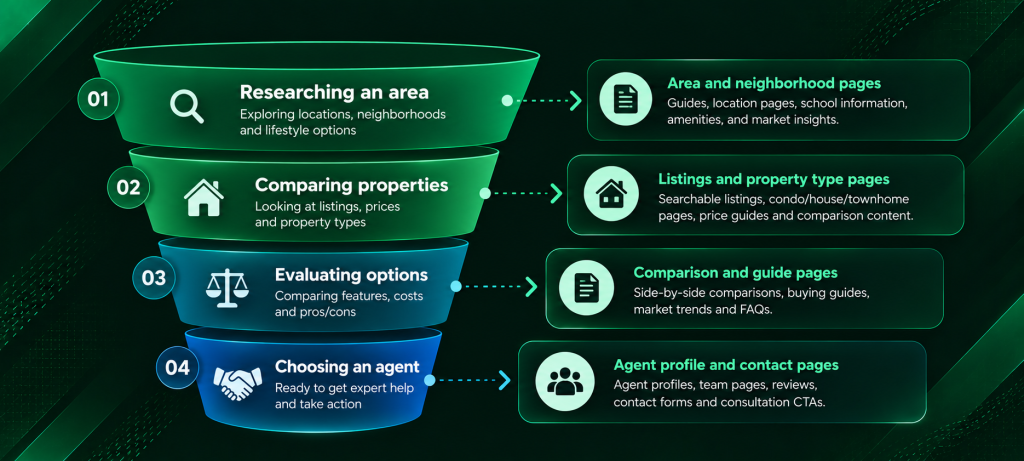
| Researching an area | “living in Riverside Heights” | Neighborhood guide | Help the visitor decide if the area fits |
| Browsing homes | “homes for sale in Riverside Heights” | Neighborhood landing page | Show local market data and active listings |
| Ready to sell | “sell my house in Riverside Heights” | Seller page for that area | Offer a valuation and explain your process |
| Choosing an agent | “realtor near Riverside Heights” | Google Business Profile and agent page | Prove local experience |
| Checking one property | “14 Elm Street Riverside Heights” | Listing page | Describe that single home |
| Checking prices | “recently sold in Riverside Heights” | Sold archive | Show real results |
The rule: give each URL one primary query. If two pages could answer the same query, merge them or change the job of one.
This also separates local pages from your editorial content. Blog topics that educate buyers belong in your real estate content marketing plan. This guide covers only the pages and profiles that carry local intent.
Intent also affects expectations. Searches for an agent or a valuation usually signal stronger intent than area research. Whether those visitors convert still depends on your market, your offer, and your landing page.
How Do Agents Find Hyperlocal Keyword Ideas?
Start with data you already own, then add outside ideas.
- Google Search Console: List the queries that already show impressions for your site.
- Google Business Profile Performance: Review the search terms that led people to your listing.
- Google’s “People Also Ask” And Related Searches: Check them for each target neighborhood.
- Local Names: Collect street, subdivision, school, and landmark names. Searchers use these words, and fewer sites target them than city-wide terms.
Google Business Profile Setup For Real Estate Agents
Your Google Business Profile often appears before your website does. It also feeds the map results, so setup mistakes cost you visibility quickly.
Confirmed by Google: local results are based primarily on relevance, distance, and prominence (Google Business Profile Help). You cannot change distance, because it depends on where the searcher is. You can improve relevance with accurate categories and descriptions, and you can build prominence over time.
Can An Agent Have A Profile Separate From The Brokerage?
Yes. Confirmed by Google: its guidelines list real estate agents as individual practitioners who may have their own page (Guidelines for representing your business on Google).
Google’s Practitioner Rules Add Two Conditions To Check Before You Set Anything Up:
- When several public-facing agents work from one office, the office should hold its own separate profile.
- An agent’s profile name should show the agent’s name, not the brokerage name added to it.
Choose the primary category that best describes the profile. Many local SEOs pair “Real estate agent” for the individual with “Real estate agency” for the brokerage. That pairing is a common convention, not a Google requirement.
What Can Go Wrong: Inconsistent names, mismatched categories, and several agents claiming one office profile are common causes of merged or suspended listings (industry observation). Fix the structure first, because no other optimization works on a suspended profile.
How Should An Agent Set A Service Area?
Many guides still suggest a 15 to 20-mile radius, but that no longer fits Google’s setup. Confirmed by Google: you cannot define a service area as a distance around your business. You select cities, postal codes, or other named areas, up to 20 (Google Business Profile Help).
Your setup depends on how you work:
- You Serve Clients At An Office: You are a storefront or hybrid business. A hybrid profile can show your address and list service areas.
- You Meet Clients At Their Homes Or Listings Only: You may qualify as a service-area business and hide your address.
Our recommendation (a Viacon view, not a Google rule): list only the places where you can prove activity, and make sure each one matches a page on your site.
| Before | After | |
|---|---|---|
| Service areas | 14 towns across two counties, chosen to “cover more ground” | 6 cities and ZIP codes where you closed deals or hold listings in the past 12 months |
| Website match | One “Areas We Serve” page | One neighborhood page for each priority area |
This example is illustrative. Use your own transaction history.
Which Profile Habits Help?
Keep hours, categories, photos, and contact details current. Reply to every review. Add photos of real listings and local places.
Posts about open houses and market snapshots help visitors who read your profile. Google has not said that posting weekly improves rankings, so treat posts as a service to people, not a ranking tactic.
Neighborhood Landing Pages: A Blueprint You Can Copy
A single “Areas We Serve” page with one sentence per neighborhood rarely satisfies anyone. Dedicated pages work when they contain facts a visitor cannot get from a generic site.
What Data Should You Collect Before Writing?
Gather these items for each neighborhood and record the source and date. You will need to refresh them.
| Data point | Where to find it | Refresh |
|---|---|---|
| Median sale price, days on market, active inventory | Your MLS reports | Quarterly |
| School assignments | District boundary tool | Yearly |
| Commute times to two or three major destinations | Map app at rush hour | Yearly |
| Transit and walkability | Transit agency, a walkability tool | Yearly |
| Your recent sales or listings there | Your own records, with client permission | Quarterly |
| Your local view: what buyers ask, what surprises them | Your client conversations | Quarterly |
The last row matters most. Competitors can copy a school rating. They cannot copy what you learned from showing homes on that street.
What Structure Should The Page Follow?
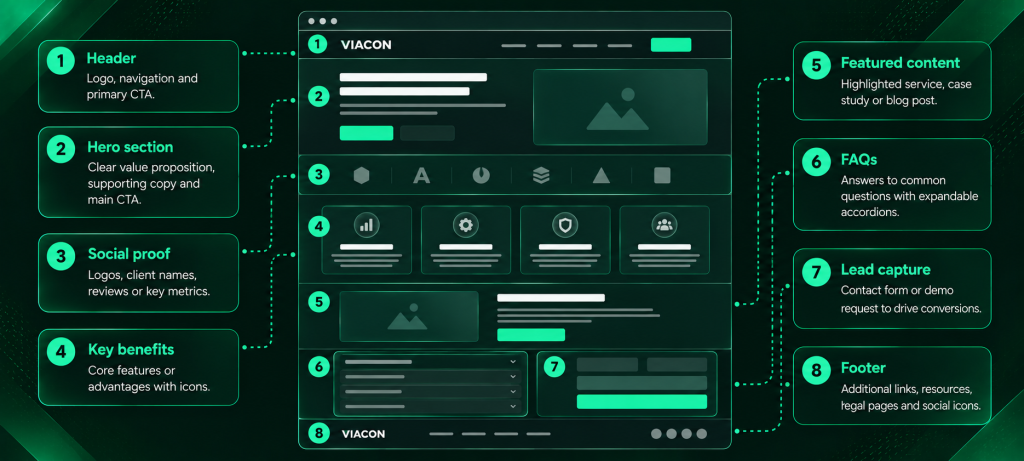
- Opening Summary: Two sentences on who the area suits and the current market.
- Market Snapshot: Dated figures with the source named.
- Living There: Schools, commute, transit, and daily life, each with a source.
- Your Local View: Three to five specific observations from your own work.
- Active Listings: Your IDX feed, plus a short written note about what is available now.
- Recent Results: Homes you sold or listed nearby, with permission.
- Questions: Answer two or three real questions from clients, each in the first sentence.
- Next Step: A clear call to book a consultation or request a valuation.
Which Internal Links Should The Page Include?
- Up to the parent city page.
- Across to two or three adjacent neighborhoods, not to every area you cover.
- Down to the sold archive and to the matching seller page.
- Down to the individual listing pages in that neighborhood.
How Do You Keep Neighborhood Pages From Competing With Listing Pages?
Give each page a different level of detail. The neighborhood page targets the area-level query (“homes for sale in Riverside Heights”). Each listing page targets one address.
Three Habits Keep Them Apart:
- Do not paste listing descriptions onto the neighborhood page.
- Make each listing page link up to its neighborhood page, using the neighborhood name as the anchor.
- Give every page its own self-referencing canonical tag.
IDX content also deserves a check. If your feed loads inside an iframe, search engines generally attribute that content to the vendor’s page, not yours. In that case, the written content around the feed must carry the page.
Before And After: A Neighborhood Page Opening
Before (generic): “Maple Heights is a wonderful neighborhood with beautiful homes and great schools. Contact us today to find your dream home in Maple Heights.”
After (specific, illustrative): “Maple Heights suits buyers who want a 15-minute commute to downtown and a yard under 8,000 square feet. As of this quarter, the median sale price was [figure from your MLS], and homes spent [number] days on the market. Buyers often tell us the traffic on Oak Avenue at 8 a.m. surprised them, so we always schedule showings there at rush hour.”
The second version contains facts, a date, and a decision aid. Replace the bracketed items with your own data.
If your market has a dozen or more neighborhoods, building every page by hand becomes slow. In that case, review how programmatic SEO can generate pages from structured local data, while a human adds the “local view” block to each one so the pages do not turn into near-duplicates.
Listing Pages And MLS Feeds
Neighborhood pages get most of the attention, yet individual listing pages carry their own weight. Many agents leave them to the IDX vendor.
What Makes A Listing Page Worth Indexing?
- A description written by a person, not only the syndicated MLS text.
- Photos with descriptive alt text.
- Accurate price, size, and address details visible on the page.
- Links up to the neighborhood page and across to similar listings.
Alt text shows the difference. “Spacious kitchen” tells a search engine very little. “Renovated kitchen with island in a Maple Heights colonial” describes the image and the place.
Do MLS Feeds Cause Duplicate Content Problems?
They can cause visibility problems, but not necessarily penalties. The same MLS description appears on many agent sites. Search engines usually group such duplicates and pick one version to show. If your page adds nothing beyond the feed, your version is unlikely to be the one chosen.
The fix is additive. Write your own description, add local context, and place your page inside a clear neighborhood structure. If your pages still struggle to appear, read why your website isn’t ranking on Google to rule out technical causes.
What Should Happen To A Listing Page After The Property Sells?
Do not leave the page to return an error. Instead, 301 redirect it to the most relevant page, such as the matching neighborhood page or a “recently sold in [neighborhood]” page. Redirecting everything to the homepage gives visitors less relevant results. The sold archive also doubles as proof of your activity.
One compliance note for US agents: review AI-written property descriptions before publishing. Copy that describes the ideal buyer instead of the property, such as “perfect for a growing family,” can raise Fair Housing concerns.
Structured Data: What It Does And What It Does Not
Structured data is markup that describes your page in a format machines read easily. It does not act as a ranking switch.
What Is The Best Schema Markup For A Real Estate Agent Website?
Use markup that matches what the page shows. A typical setup includes:
- RealEstateAgent (a type from schema.org) for your business details, with your address and coordinates nested inside it as PostalAddress and GeoCoordinates.
- A listing-related type, such as SingleFamilyResidence or RealEstateListing, on property pages.
Validate the markup with the Schema Markup Validator and keep it in sync with the visible page. Wrong or outdated markup can hurt you more than none.
Does Schema Improve Visibility In AI Search?
Confirmed By Google: AI Overviews and AI Mode need no special optimization or extra markup beyond standard SEO fundamentals. Google’s guidance includes keeping structured data consistent with the visible text (AI features and your website).
So the honest answer is this: structured data helps machines read your page accurately. It does not guarantee rankings, rich results, or AI citations. Other AI tools may use different signals, and none of them publishes a promised formula. Our guide to Google AI Overviews explains what is known.
Basic site health still matters. Compress listing photos, keep Core Web Vitals in good shape, and test pages on mobile.
Reviews And Local Links: What Is Confirmed And What Is Observation
Agents hear many confident claims about reviews and links. Sorting them by evidence helps you spend your time well.
How Do Reviews Affect Local Rankings?
| Claim | Status |
|---|---|
| Review count and review score factor into local ranking | Confirmed by Google (source) |
| Replying to reviews helps your profile stand out | Confirmed by Google, which advises replying |
| Review wording, such as a neighborhood name, adds relevance | Industry observation. Practitioner surveys such as Whitespark’s Local Search Ranking Factors report this. Google has not confirmed it. |
| Review recency and frequency (velocity) matter | Industry observation. Google has not confirmed it. |
What To Do With This:
- Ask every client, soon after closing, when the experience is fresh.
- Send a direct link to your review page.
- Suggest that they describe their experience in their own words. Do not script wording.
- Never offer incentives for reviews. Google’s review policies prohibit them.
How Should You Choose Local Link Sources?
Google Confirms This: Prominence draws on information from across the web, including links, articles, and directories. Google does not rank link tactics, so we won’t either. Treat the options below as candidates, then judge each one.
- Local vendors and partners, such as lenders, inspectors, and stagers, that list their agent partners.
- Community sponsorships, such as a youth team or neighborhood event.
- Neighborhood association or HOA pages and newsletters.
- Chamber of commerce and local business directories.
- Commentary offered to regional news outlets.
Judge Each Opportunity With Four Questions:
- Does the site serve the area you target?
- Do real people visit the page?
- Would you want the mention even without a link?
- Is the placement editorial, not bought?
Avoid bulk directory packages. They rarely add real local relevance and can look like a link scheme.
Keep your name, address, and phone number (NAP) consistent across your profile, website, Zillow, Realtor.com, Homes.com, and local directories. Consistency is standard local SEO practice (industry observation), and it prevents confusion for clients.
Write For Questions, Voice, And AI Answers
Spoken searches sound different from typed ones. Nobody says “realtor Willow Creek” to a phone. They say, “Who is a good agent near Willow Creek who works with first-time buyers?”
So write in a question-and-answer format on pages where that fits. Put the direct answer in the first sentence after the question. Then add the detail. This helps human readers, and it makes your answer easy for any system to extract.
Specifics also set a page apart. School names, commute times, and transit lines give a buyer something concrete. “Beautiful homes in [city]” gives nobody anything.
For the mechanics behind spoken queries, see our guide to voice search optimization.
Common Real Estate SEO Mistakes To Avoid
Rankings rarely fall from one dramatic error. A few small habits add up.
- Copying MLS Text Word For Word: Your page adds nothing the other sites lack.
- Listing Service Areas You Do Not Serve: Your profile and your website no longer match.
- Letting Sold Listings Return Errors: You lose the page’s history and a useful landing spot.
- Publishing One Generic “Areas We Serve” Page: You give no neighborhood a real answer.
- Buying Bulk Directory Links: You invite risk without adding local relevance.
- Treating SEO As A One-time Setup: Profiles, data, and reviews need regular upkeep.
Most of these fixes do not need a rebuild. They do need someone to check regularly, which is where many agents run out of time. A dedicated SEO services team can take over that routine.
Realistic SEO Timeline And How To Measure It
Real estate SEO moves at different speeds.
How Long Does Local SEO Take To Show Results?
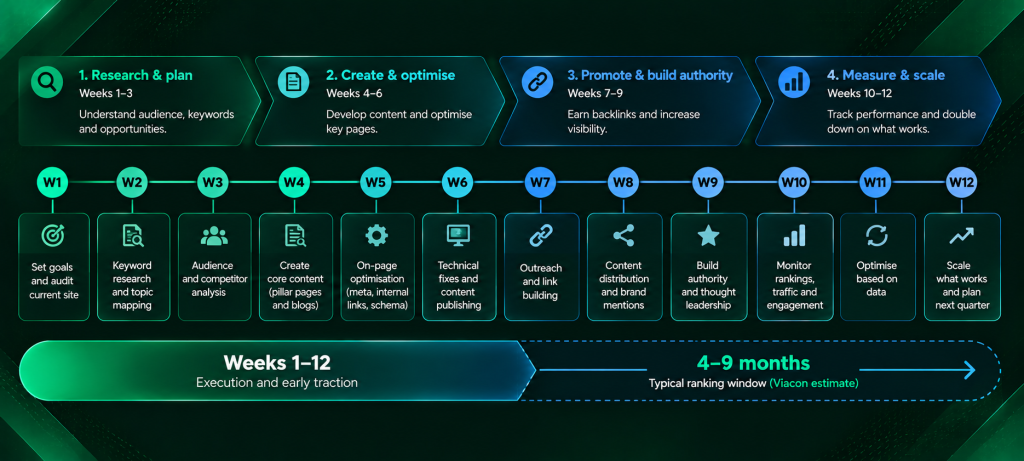
Viacon Estimate: profile changes can affect map visibility within a few weeks, especially in less competitive suburbs. Neighborhood pages and supporting content usually take longer. We typically plan for four to nine months before pages begin to rank consistently. This range comes from our experience, not from Google.
Several Factors Move You Toward Either End Of That Range:
- Competition: Dense metros with established agents take longer.
- Starting Point: A verified profile with existing reviews begins ahead of a new one.
- Page Quality And Depth: Pages with original local data tend to earn their place sooner than thin pages.
- Crawling And Indexing: New pages must be indexed before they can rank at all.
- Consistency: Steady updates beat occasional bursts.
Expect the budget to follow the same pattern. Scattered directory listings rarely move results. A focused monthly effort on content, citations, and technical fixes builds over time. For most solo agents, a 12-month commitment makes more sense than a quarterly test.
What Should Agents Track?
- Google Business Profile Performance: Calls, direction requests, and website clicks.
- Search Console: Impressions and clicks for each neighborhood page, plus the indexing status of new pages.
- Rank Tracking: Your priority neighborhood terms, not only your brand name.
- Leads: How many of those visits became real conversations or booked valuations.
Read the combination, not any single number. Rankings that rise without calls point to a content or trust problem. Calls without rankings suggest you depend on referrals or ads to fill a gap that organic search should close. To turn visits into inquiries, our real estate lead generation guide covers the next stage.
A 90-Day Local SEO Workflow
Use this sequence if you are starting from a typical agent website.
| Weeks | Phase | Actions | You are done when |
|---|---|---|---|
| 1–2 | Audit | Confirm your profile type, name, categories, and service areas against Google’s guidelines; check NAP consistency across your main listings; review Search Console for pages that are not indexed | You have a list of profile, listing, and indexing issues to fix |
| 3–4 | Plan | Build your keyword-to-page map for your top three to five neighborhoods; collect the data points from the neighborhood table | Every priority query has one assigned URL, and the data is ready to write from |
| 5–8 | Build | Publish three neighborhood pages using the blueprint; rewrite your listing page template with a unique description, alt text, and links up to the neighborhood; add structured data that matches the visible content | Three neighborhood pages are live, and new listings use the improved template |
| 9–12 | Reinforce and measure | Start a review request routine for every closing; pursue two or three local link opportunities that pass the four-question test; record your baseline in Search Console and your profile, then compare monthly | Reviews are requested after every closing, and you have a baseline to compare against |
For a longer plan that scales beyond the first quarter, see our guide to building an SEO strategy.
Bringing It All Together
Local visibility for agents comes from several parts working together: a correctly structured profile, neighborhood pages with real local data, listing pages that add something to the feed, honest review habits, and relevant local links.
None of these parts works well alone, which explains why many agent sites underperform. They do one piece well and skip the rest. Our overview of real estate marketing shows where local SEO fits among your other channels.
When To Ask Viacon
If this workload sounds hard to fit between showings and closings, that is common. We help agents plan and run local SEO, from profile structure to neighborhood pages.
To talk through what a plan looks like for your market, schedule a local SEO consultation with us. We will review your area before we recommend anything.