Property listings show what’s available. They don’t explain where someone should live, whether the price makes sense, or why one agent deserves the call over another.
Real estate content marketing closes that gap. It answers the questions buyers and sellers ask before they’re ready to reveal themselves as leads the searches that happen weeks or months before anyone fills out a contact form.
That path runs roughly Search → Discover → Trust → Engage → Convert. A listing can only serve the last two stages. Everything earlier belongs to content: guides, comparisons, neighbourhood breakdowns, and the kind of local detail that only someone who actually works the market would know.
What Is Real Estate Content Marketing?
Real estate content marketing is the ongoing creation and distribution of property, neighborhood, financial, and market information that buyers and sellers are already searching for. Instead of interrupting people with an ad, it meets them mid-question and answers it well enough that they remember who did.
Advertising rents attention for as long as the budget lasts. Content earns it and keeps it. A well-built neighborhood guide or market page can sit in search results for years, pulling in first-time buyers, investors, relocating families, and homeowners who aren’t ready to talk to anyone yet but will be.
Why Content Marketing Matters For Real Estate In 2026
Content gets an agent into the conversation earlier, establishes local authority, and builds trust before a prospect picks up the phone.
(i) Buyers Research Long Before Contacting An Agent
Buyers now bounce between search engines, YouTube, local map results, social platforms, and AI-generated summaries before they ever reach out. No single listing page can carry that whole decision. Buyers want mortgage math, commute times, neighborhood comparisons, inspection red flags, and an honest sense of what their budget actually buys.
(ii) Sellers Want Proof Of Local Expertise
Sellers are evaluating something different: does this agent actually understand pricing movement, buyer expectations, and timing in this neighborhood, not the market in general. Generic advice reads as generic. Specific, local interpretation is what turns information into expertise a seller will pay for.
(iii) Content Builds Trust Before The First Conversation
Good content answers the awkward questions early the ones a prospect is embarrassed to ask an agent directly. Named local examples, original observations, a visible author, and market commentary that gets updated (not left to rot from 2023) all signal the experience and trustworthiness search engines and readers both look for. This is the E-E-A-T layer that separates a page that ranks from one that just exists.
(iv) Good Content Keeps Working After You Publish It
An ad campaign disappears the moment spending stops. A strong buying guide or seller checklist keeps generating organic and local traffic for years, especially if someone on the team refreshes it twice a year with current numbers. Agencies that track this over time typically see their cost per lead drop as older content matures the opposite of how ad spend behaves.
| Is Viacon Able To Help An Agency Build This Kind Of Visibility? Yes, Viacon connects SEO, search intent, distribution, and conversion paths into one measurable content system, rather than treating them as separate projects. |
What Types Of Real Estate Content Should You Create?
The right question isn’t “which format is popular?” It’s “what does this specific prospect need right now?”
| Prospect need | Suitable content | Primary purpose |
|---|---|---|
| Education | Buying and selling guides, mortgage basics, closing costs, inspection advice, common mistakes | Capture informational searches |
| Local understanding | Neighborhood comparisons, schools, amenities, commutes, cost of living, market updates | Establish local authority |
| Property evaluation | Walkthroughs, virtual tours, listing comparisons, luxury showcases, “What $500K buys” features | Address stronger purchase intent |
| Seller guidance | Pricing, staging, preparation, timing, market reports, selling mistakes | Reach prospective sellers |
| Reassurance | Case studies, testimonials, agent expertise, community involvement, behind-the-scenes material | Reduce perceived risk |
| Which Content Type Actually Generates The Most Leads? Property-evaluation content (“what does $500K buy in this ZIP code,” comparison posts) tends to convert fastest because it reaches people close to a decision. But it only works if education and local-understanding content already brought them there; skip those stages and evaluation content just sits unread. |
Video deserves a specific mention here rather than a passing one: short property walkthroughs and neighbourhood explainers now drive a meaningfully higher share of inquiries than static posts, so at least one video-native piece belongs in every content type above, not just the distribution plan.
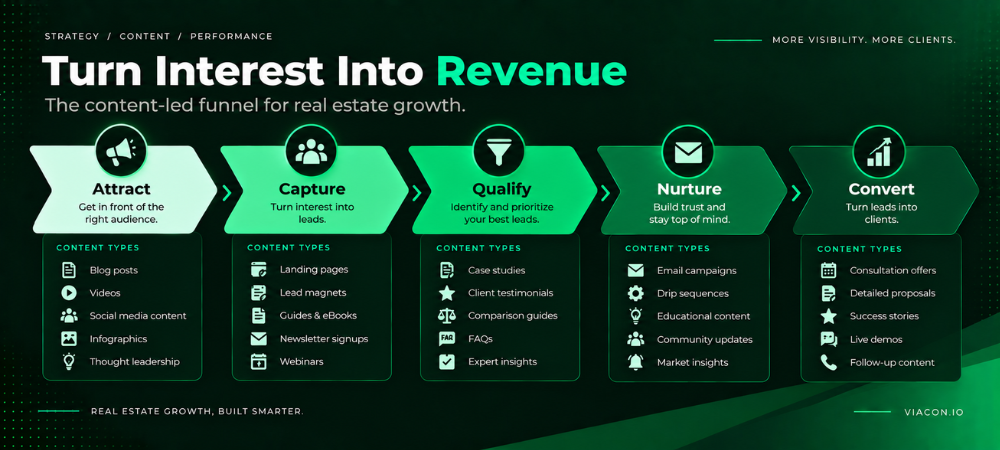
Create Content For Every Stage Of The Buyer’s Journey
Publish only listings, and you enter the conversation late; another agent has likely already shaped the buyer’s preferences by then.
| Funnel stage | Prospect question | Best content |
|---|---|---|
| Awareness | Where should I live? | Neighborhood guides |
| Research | Can I afford this? | Buyer guides and calculators |
| Consideration | Which property is right? | Comparisons and tours |
| Decision | Which agent should I choose? | Reviews and case studies |
| Conversion | What happens next? | Consultation or valuation CTA |
Content Ideas That Attract Buyers And Sellers
First-time buyers need process explanations, checklists, hidden-cost breakdowns, mortgage prep, and a list of mistakes to skip. Move-up buyers need advice on selling before buying, juggling two transactions at once, and evaluating an unfamiliar neighbourhood. Investors want rental trend data, location potential, operating cost realities, and honest ROI discussion, not just upside.
Seller content should mirror the sale itself. Before listing: repairs worth doing, staging, prep, photography. At listing: comparative market analysis, pricing logic, current conditions. During the sale: showings, competing offers, negotiation, and what happens once the listing goes live. A property valuation offer becomes the natural next step here, not an interruption dropped in mid-article.
How To Build A Real Estate Blog That Generates Traffic
A blog that actually produces leads starts with search intent, not a content calendar. Separate informational, local, comparison, and transactional searches early; each one signals a different level of buyer readiness, and mixing them into one undifferentiated post dilutes all four.
From there, build topic clusters instead of one-off posts. A pillar page on buying a home in a specific city can link out to neighbourhood guides, property taxes, mortgages, closing costs, inspections, first-time buyer advice, and local market trends. Internal links should connect pillars to clusters, clusters to each other, blog content to service pages, and neighbourhood pages to live listings. Buyer resources need a direct line to a consultation page; readers rarely find that path on their own.
| Why Do Topic Clusters Outperform Disconnected Posts? A cluster tells search engines you cover a topic in depth, not just once. It also keeps readers on the site longer, moving them from a neighbourhood guide to a mortgage calculator to a consultation booking page without them having to search for the next step themselves. |
Local SEO signals matter as much as the writing itself here. A blog with strong content but a neglected Google Business Profile, inconsistent name-address-phone details across directories, or no schema markup on property and FAQ content is competing with one hand behind its back. Add FAQ schema to buyer and seller guides specifically; it’s what gets a page pulled into AI-generated answers and voice search results instead of just organic listings.
Turn One Piece Of Research Into A Week Of Content
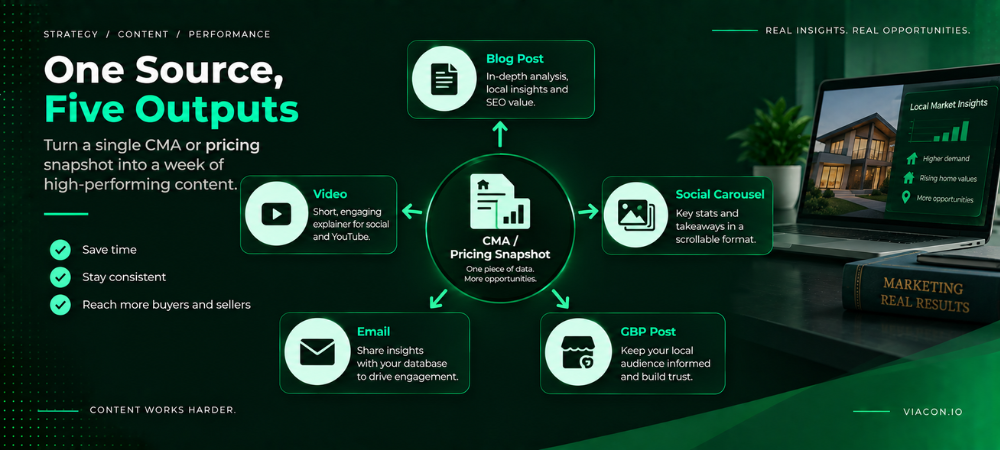
Most agents treat every platform as a blank page that needs its own idea, which is why content production stalls out after a few weeks. The faster approach starts with one data-rich source a CMA, a pricing snapshot, a listing-prep analysis and repurposes it across formats:
- A Blog Post: What buyers are paying in this neighborhood right now.
- A Short Video Script: One market takeaway, sixty seconds.
- A Carousel: Three pricing shifts to watch.
- An Email: A personalized note to a homeowner segment.
- A Google Business Profile Post: The same insight in two sentences.
Same research, five different packages. This is a more sustainable production model than brainstorming six unrelated topics a week, and it’s the difference between agents who publish consistently because they’re writing more and agents who publish consistently because they’re extracting more from what they already have.
Turn Content Into Leads, Then Distribute It
Traffic on its own is a middle step, not a result. Skip the generic “Contact Us” button and match the call to action to the page instead: a home valuation on seller content, a buyer checklist download on first-time-buyer guides, a “view homes in this area” link on neighbourhood pages, a market report request on pricing content, or a direct line to a local expert on comparison posts.
Lead magnets should follow the same split. Buyers respond to affordability tools, neighbourhood guides, checklists, and property alerts. Sellers are more likely to trade contact details for a valuation, a pricing guide, or a local market report.
Distribution Then Carries The Content Where The Audience Already Is:
- Instagram — Reels, Stories, carousels, property visuals.
- Facebook — Listings, community posts, groups, market updates.
- TikTok — Quick myth-busting, neighborhood spotlights, short lessons.
- YouTube — Full tours, market analyses, longer educational videos.
Don’t invent a separate idea for each platform. One “Best Neighbourhoods in [City]” topic becomes a blog post, a YouTube video, a Reel, a carousel, an email, and a Google Business Profile post same research, different packaging, far less work than it looks like from the outside.
How AI Can Improve Real Estate Content Marketing In 2026
AI is genuinely useful for uncovering topics, classifying search intent, spotting content gaps, repurposing blog posts into scripts or social copy, and personalizing messaging by audience or location.
| Does AI-generated Content Hurt Real Estate SEO? Pure AI output without local expertise tends to get filtered out by Google’s helpful-content systems; it reads as generic because it is generic. Content that pairs AI-assisted drafting with firsthand market knowledge, verified local statistics, and an author’s actual name and experience performs meaningfully better than either extreme. AI speeds up structure and first drafts. It doesn’t replace the local knowledge that makes a page worth ranking. |
“AI-assisted discovery rewards material that is specific, verifiable, and easy to interpret. Strengthen the local evidence before you increase content volume.”
— Ejaz Ahmad, COO, Viacon
That’s Viacon’s position in practice: AI-era visibility depends on structured, consistent, verifiable information, not generic promotional copy dressed up with a keyword or two.
Build A Practical Monthly Content Calendar
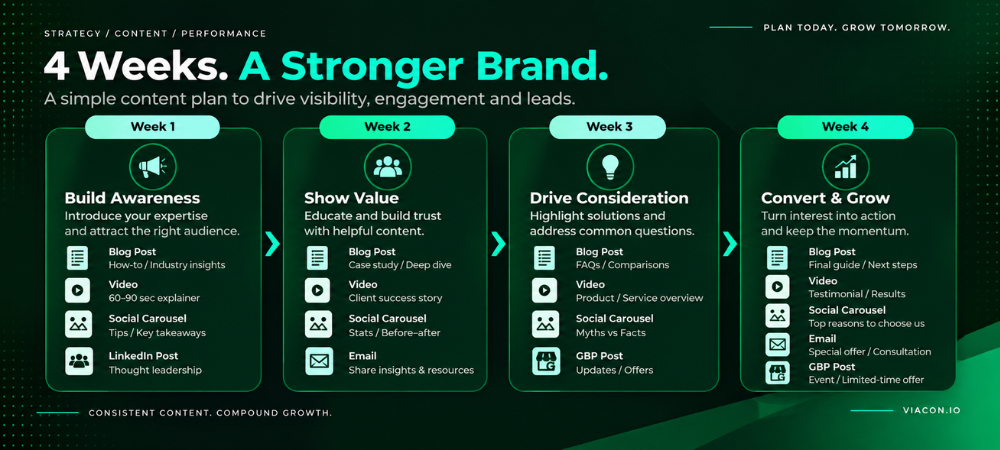
A workable cycle gives each week a specific job instead of a vague quota:
- Week 1 — Buyer Education: A guide, a short video, a checklist.
- Week 2 — Local Authority: A neighborhood article, a local video, a community post.
- Week 3 — Seller Education: Preparation advice, a market update.
- Week 4 — Conversion: A case study, a property showcase, a market report, a consultation or valuation CTA.
| How Often Should An Agent Actually Publish? Weekly is the realistic minimum for momentum; less than that and topic clusters take too long to build authority. More than that without a repurposing system (see above) usually leads to burnout or a drop in quality, which hurts more than it helps. |
Measure Business Value, Not Just Traffic
| Metrics | Factors |
|---|---|
| Visibility | Organic traffic, impressions, rankings, click-through rates, local search presence |
| Engagement | Time on page, video views, returning visitors, interaction rates |
| Leads | Downloads, forms, consultations, assisted conversions, property inquiries |
| Revenue | Qualified leads, appointments, clients acquired, revenue by content source |
A page pulling in 500 well-matched local prospects can produce more business than one pulling in 10,000 irrelevant visitors. Reach looks impressive in a report. Relevance is what pays the bills.
| How Long Before Content Marketing Shows Results? Expect three to six months before organic traffic becomes meaningful, and longer before it converts reliably. This is also where the cost-per-lead advantage shows up. A page that took a week to write and gets refreshed twice a year keeps generating leads at close to zero marginal cost, while ad-driven leads cost the same on day 400 as they did on day one. |
Common Mistakes That Weaken Results
The recurring problems are predictable: publishing only listings, writing interchangeable articles for every market, ignoring local search intent, dropping in a generic CTA instead of a contextual one, and leaving service pages disconnected from the blog entirely.
Other failures show up later: chasing traffic instead of leads, publishing on no fixed schedule, forgetting distribution once a post goes live, or leaning on AI-generated copy with no original expertise behind it. Each of these breaks a different link in the chain between discovery and conversion.
A 30-Day Action Plan
- Days 1–7 — Research: define buyer and seller personas, local topics, search intent gaps.
- Days 8–15 — Create: one pillar page, two supporting articles, a buyer and a seller lead magnet, short-form assets.
- Days 16–23 — Distribute: social platforms, email, YouTube, Google Business Profile, local community groups.
- Days 24–30 — Optimize: review performance, sharpen CTAs, add internal links, refresh weak pages, track conversions.
Content Marketing vs. Traditional Advertising
| Content marketing | Traditional advertising |
|---|---|
| Builds organic visibility and authority | Buys immediate awareness |
| Keeps attracting traffic over time | Usually stops when spending stops |
| Educates across every funnel stage | Typically promotes a single offer |
| Compounds through search and distribution | Produces fast, temporary exposure |
The strongest agencies run both. Advertising creates immediate presence. Content captures the research phase and nurtures the people who aren’t ready to convert yet, which at any given moment, is most of the market.
The Right Content Turns Property Research Into Qualified Conversations
Real estate content marketing isn’t about producing more articles. It’s about putting the right answer in front of the right prospect at the right stage, then giving them a sensible next step.
Viacon applies this across content strategy, SEO, distribution, web experience, and lead generation. Viacon’s Birla Tyres case study shows the same principle at work outside real estate: an SEO-focused content architecture supported stronger visitor journeys and more inquiries, not just more traffic.
If you want a content system built around what your buyers and sellers actually search for, talk to Viacon about a real estate content strategy.