A software company can rank on page one or publish twice a week. Still, its qualified pipeline might flatten. Now, buyers research products through AI-generated answers. They also look at peer discussions, comparison pages, and review platforms. They use internal procurement tools before anyone completes a demo form.
As a result, SaaS customer acquisition has changed. Although search traffic still matters, it is no longer enough. In 2026, acquisition depends on whether your product appears during AI-assisted research, withstands independent scrutiny, and gives several stakeholders enough evidence to approve the purchase.
The funnel hasn’t vanished. Much of its activity has simply moved beyond standard analytics.
What SaaS Customer Acquisition Covers, And What It Costs?
SaaS customer acquisition is the full process of turning a stranger into a paying account that stays. It starts with the first touch and runs through trial, purchase, onboarding, and early product use. It overlaps with B2B SaaS marketing, but it covers more ground. Pricing, sales handoffs, and onboarding quality all affect whether an account signs and renews, so marketing alone can’t fix a weak acquisition engine.
Customer acquisition cost (CAC) measures what that process costs you. The formula is simple:
CAC = total sales and marketing spend in a period ÷ new customers won in that period
Count everything. That includes ad spend, salaries, commissions, content production, agency fees, and software tools. Many teams leave out salaries and report a figure that is half the real number.
Track two versions. Blended CAC divides total spend by all new customers, including organic and referral wins. Paid CAC divides only paid spend by customers from paid channels. Blended CAC can hide a failing ad channel, while paid CAC ignores the compounding value of content and word of mouth. You need both to see the full picture.
| What Is A Good CAC For A SaaS Company? No single number works for every business. A self-serve tool priced at $30 a month can’t carry the same CAC as an enterprise platform that sells for $60,000 a year. Judge your CAC against what each customer pays and how long they stay. The next section shows how. |
Unit Economics Decide Which Channels You Can Afford
Three numbers tell you whether an acquisition channel is worth funding: CAC, customer lifetime value (LTV), and CAC payback period.
Many SaaS investors use two rules of thumb. They look for an LTV to CAC ratio near 3:1, and they like payback inside 12 months for small-business products. Enterprise sellers often accept longer payback because contracts run longer. Treat these as starting points, not laws. Your cash position, churn, and growth goals should set your own targets.
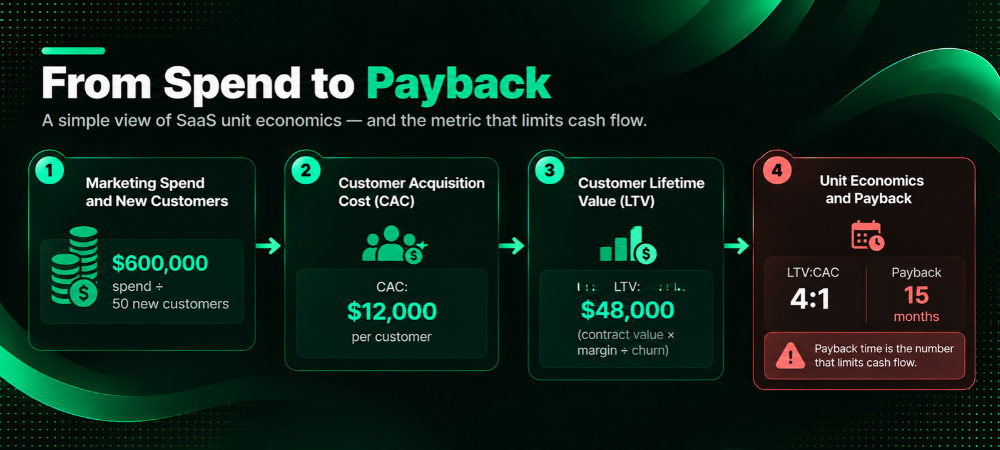
Here is a worked example with illustrative numbers:
| Input | Value |
|---|---|
| Quarterly sales and marketing spend | $600,000 |
| New customers won | 50 |
| CAC | $12,000 |
| Annual contract value | $12,000 |
| Gross margin | 80% |
| Annual customer churn | 20% |
| LTV (annual contract value × margin ÷ churn) | $48,000 |
| LTV to CAC ratio | 4:1 |
| CAC payback (CAC ÷ monthly gross profit of $800) | 15 months |
This company looks healthy on lifetime value but slow on payback. It needs to wait 15 months to recover what it spent, so cash flow, not demand, may limit its growth.
How Do You Calculate CAC Payback?
Divide CAC by the monthly gross profit each new customer produces. Monthly gross profit equals monthly recurring revenue multiplied by gross margin. A shorter payback lets you reinvest sooner, which is why many teams watch it more closely than LTV.
Run these calculations by channel and by customer size. A channel with a low CAC can still hurt you if the accounts it brings churn in six months.
AI Search Has Changed How SaaS Buyers Build Shortlists
Traditional SEO assumed a visible sequence: search, click, browse, convert. AI search can compress the first three stages into a single exchange. A buyer might request project management platforms for distributed engineering teams, compare deployment options, and identify four vendors without visiting any of their websites.
This behavior is no longer marginal. In fact, 94% of business buyers used AI during the buying process. Twice as many respondents used generative AI or conversational search. They see it as a more meaningful source of information than any other.
Websites Remain Relevant, But Their Function Has Changed
Now, product pages supply information that search engines, answer systems, analysts, reviewers, and buyers can all inspect. Thin feature copy gives those sources little usable detail. Technical documentation, pricing logic, implementation requirements, security disclosures, migration guides, and credible customer evidence provide clearer material.
The first acquisition question is no longer simply, “Do we rank?” You also need to ask whether a buyer can find an accurate account of why your product belongs on the shortlist.
Ejaz Ahmed, COO and CDO at Viacon: “Although traditional SEO still matters, Generative Engine Optimization will increasingly determine whether a brand appears during AI-led research.”
So, the practical response is to retain your SEO foundation. Meanwhile, start restructuring high-value pages. This way, AI systems can identify your product facts, use cases, and supporting evidence.
| Should A Small SaaS Team Invest In GEO Yet? Yes, but keep it light. A small team doesn’t need a separate GEO budget. It needs accurate, well-structured pages for its three or four most valuable use cases, plus consistent facts across its profiles, directories, and review listings. Fix those first, then test whether AI tools describe your product correctly. |
SaaS SEO Still Matters, Though The Target Has Moved
There’s a fair case for resisting every new acronym attached to AI search. Google says established SEO practices remain relevant to AI Overviews and AI Mode, with no separate technical requirements to appear in those experiences. Its systems may use “query fan-out,” running related searches across several subtopics and sources before producing an answer.
Don’t replace SaaS SEO with a speculative answer-engine project. Rather, fix the foundation. Basically, pages must be crawlable, internally connected, and written around recognizable buyer problems.
Product categories should be explicit. Integration pages need actual setup information. Industry pages should discuss workflows and operational constraints rather than repeat one template with a different industry name. For a full walkthrough of keyword research, technical fixes, and content structure for software companies, read our guide to SaaS SEO.
| How Long Does SaaS SEO Take To Affect Customer Acquisition? Expect several months before new content earns steady traffic, and longer before it produces closed deals. Sites with existing authority move faster, while new domains in crowded categories move slower. Plan on a six- to twelve-month view, and watch earlier signals such as impressions, branded search growth, and demo requests from new pages. |
Pick An Acquisition Motion Your Product Can Support
Channel choice follows from how your product gets bought. Three motions cover most SaaS companies.
| Motion | How buyers start | Fits best when | Main risk |
|---|---|---|---|
| Product-led | Free trial or freemium signup | Users can reach value alone in minutes, and contract values are modest | Many signups never activate |
| Sales-led | Demo request or outbound conversation | Contracts are large, several stakeholders approve, and setup needs support | Long cycles and high CAC |
| Hybrid | Self-serve entry, then sales help on larger accounts | Teams adopt bottom-up, but buying authority sits higher up | Handoffs between product and sales break down |
Product-led growth depends on the product itself. Onboarding flow, time to first value, and in-app sharing are product decisions, so acquisition and SaaS product development need to share a roadmap. If trial users can’t finish setup without a call, you run a sales-led motion with a free trial attached, and your CAC should reflect that.
Hybrid teams should also define when a free account becomes a sales lead. Use behaviour, such as team invitations or usage limits reached, rather than a form fill alone.
2026 Acquisition Planning Model
The planning model now looks different.
| Older Search Plan | 2026 Acquisition Plan |
|---|---|
| Target one high-volume keyword | Cover the main buyer question and likely follow-up questions |
| Publish a broad feature page | Include limitations, setup steps, integrations, use cases, and qualification criteria |
| Measure rankings and sessions | Track qualified visits, AI referrals, assisted conversions, mentions, and pipeline |
| Gate most useful material | Keep decision-making facts public and gate resources with genuine standalone value |
| Build links mainly for authority | Earn relevant references from publications, communities, partners, and subject experts |
Consider a mid-size HR software provider ranking for “employee onboarding software.” The answer system compares products for a 700-person healthcare organization. So, it needs more than a feature list. It may require information about role permissions, audit records, implementation time, HRIS compatibility, and location-specific workflows.
A generic landing page won’t answer those questions, while several focused pages might.
Match Each Channel To The Stage And Deal Size
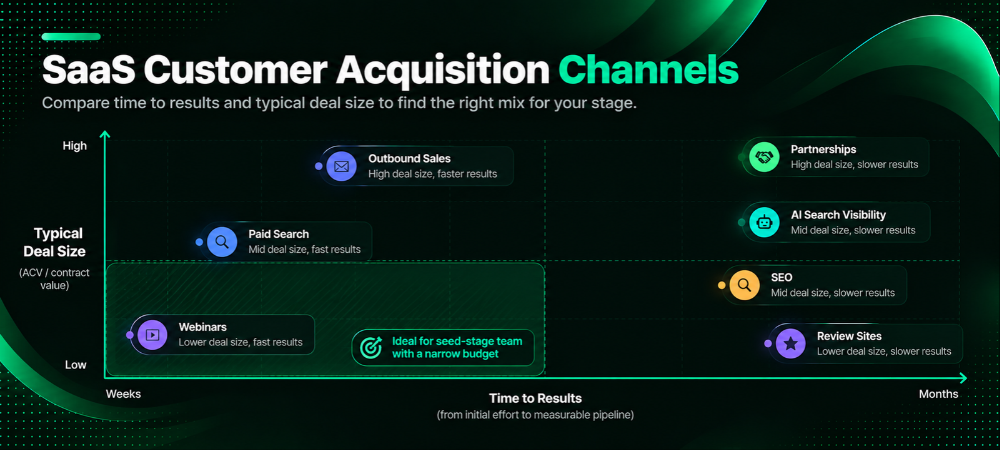
Most SaaS acquisition guides list ten or more channels and rank them by popularity. Popularity tells you little. Fit tells you more. Use this table to shortlist two or three channels, then test them before you add more.
| Channel | Works best when | Time to results | Main risk |
|---|---|---|---|
| SEO and content | Buyers search for solutions and compare options | Months | Slow start, and thin pages that don’t earn trust |
| AI search visibility | Your category appears in AI answers and comparisons | Months | Inconsistent facts across sources |
| Paid search | Buyers already search with purchase intent | Days to weeks | Rising cost per click, and weak landing pages |
| Outbound sales | Deal values are high, and the target list is narrow | Weeks | Low reply rates without relevant research |
| Partnerships and integrations | Your product fits inside another tool’s workflow | Months | Partners rarely prioritize co-marketing |
| Review sites and communities | Buyers check peer opinion before they book a call | Months | Reviews you can’t control |
| Webinars and events | The topic needs explanation or live questions | Weeks | Attendees who never reach a buying stage |
| Referrals and customer advocacy | Customers already get clear value | Months | Growth depends on product satisfaction |
Early-stage teams often do better with one narrow channel done well than five done thinly. A seed-stage company with a $15,000 contract value may start with outbound plus a few high-intent search pages. A growth-stage company with several segments may add partnerships and review programs once its core channels hold steady CAC.
Write Content That Works Outside Its Original Page
AI systems often process content in sections. A definition may come from one page, pricing context from another, and implementation evidence from a third. Each extract may appear without the surrounding brand message.
Write Important Sections So They Can Stand On Their Own
A useful passage should answer one bounded question without requiring six earlier paragraphs. Headings can reflect genuine research questions. However, don’t turn every heading into a question. It feels mechanical.
Tables help buyers compare options. Clarify unfamiliar product terms with short definitions. Meanwhile, concrete examples make commercial claims easier to assess.
Apart from that, stay consistent across public sources. Suppose your pricing page describes a usage-based model. But a partner directory calls it seat-based. Also, an old press release mentions custom contracts only. As a result, buyers receive conflicting information. Moreover, an AI platform may repeat those differences instead of resolving them.
Product Page Checklist
For each important category or product page, check that it gives a plain description of the user, problem, and product category. It should also cover deployment, integration, migration, and onboarding details where relevant. Add limitations or poor-fit cases instead of claiming suitability for every company, and tie evidence to named outcomes with enough context to assess the result. Finally, show current authorship, revision dates, and links to supporting documentation, and keep terminology consistent across sales, support, partners, and review profiles.
If your product includes AI features, add a few more checks. Buyers will ask which data the model uses, where it runs, how it handles errors, and who owns the outputs. Teams that plan these answers early, as covered in our guide to AI SaaS development, publish clearer pages and field fewer security objections later.
This work costs editorial time and often produces longer pages. For a simple, low-cost tool bought by one person through self-serve checkout, exhaustive decision content may slow the purchase. Use deeper coverage where purchase risk and evaluation complexity justify it.
Replace The Linear Funnel With An Evidence Loop
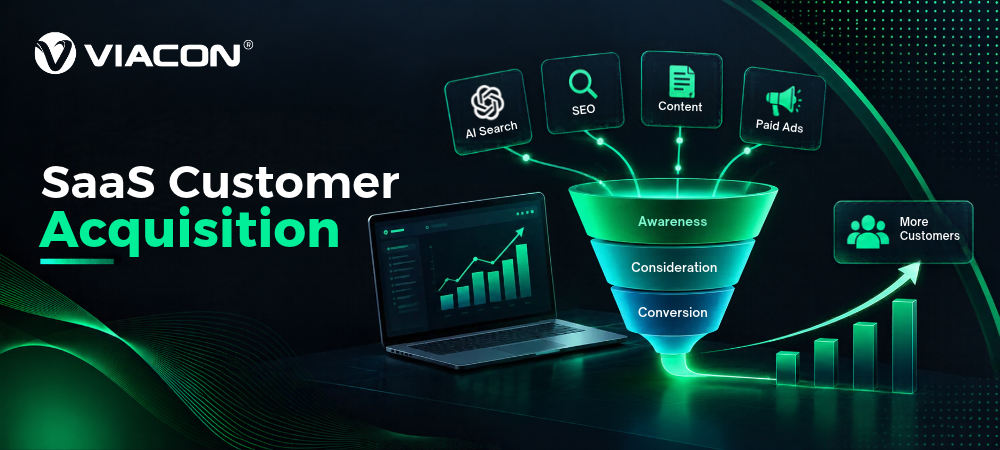
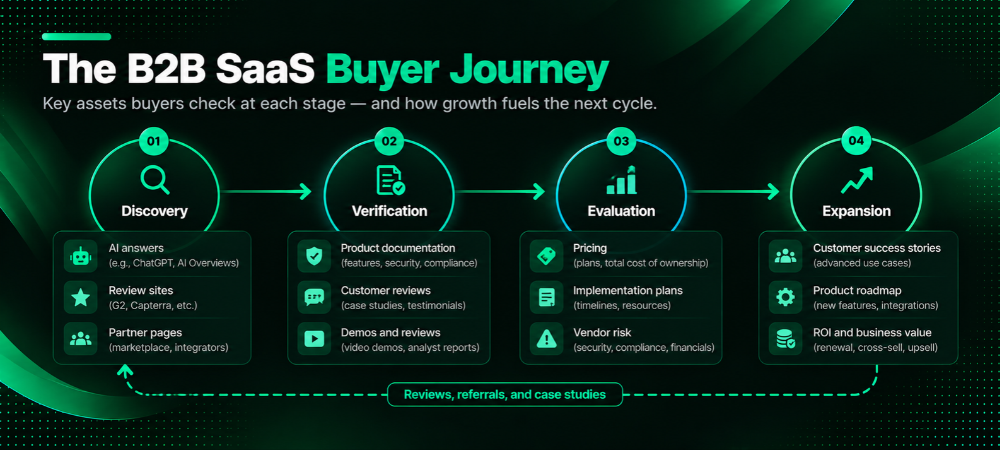
The familiar awareness-to-consideration-to-conversion diagram is too orderly for current SaaS buying. A technical evaluator might begin with documentation, while a finance lead starts with pricing. The eventual user may come in later through a colleague’s recommendation. Then procurement may send everyone back to security, contracts, and data-handling questions.
Basically, a practical SaaS growth funnel contains four working layers.
1. Discovery
This layer covers conventional search, AI answers, communities, review sites, social posts, partner pages, and category publications. The aim is accurate presence in commercially relevant places. Don’t go for maximum exposure on every available channel.
2. Verification
Buyers test the claims they encountered. They examine documentation, security material, reviews, customer stories, integration notes, and recent product updates.
3. Evaluation
The shortlist becomes practical. Pricing, implementation effort, data movement, internal adoption, and vendor risk begin to carry more weight than broad feature claims.
4. Expansion
Even after the initial contract, acquisition economics continue. Activation, seat growth, renewed usage, referrals, and expansion revenue reveal whether a channel produced a suitable customer or merely a signed account.
Existing customers then contribute reviews, implementation examples, community answers, and product feedback that affects later discovery. Weak support and failed implementations produce equally public signals, only with the opposite commercial effect.
Retention Is Part Of Acquisition Cost
Retention changes the math more than most channel tweaks. If a customer who pays $1,000 a month leaves after six months, your effective CAC payback doubles in practice, and your best case study disappears. Treat activation in the first 30 days as an acquisition metric. Check which channels produce customers who reach first value fastest, and shift budget toward them.
Connect Acquisition Content To Sales Evidence
What should marketing publish if buyers can obtain a generic answer from AI tools?
Try to publish information that the tool cannot responsibly invent. That includes original product data, implementation findings, benchmark methodology, annotated workflows, decision criteria, and frank accounts of trade-offs. Our overview of content marketing trends shows why original, experience-based material now outperforms generic explainers.
For instance, a page titled “How to choose billing software” might struggle if it repeats universal advice. Rather, show a comparison of how billing systems handle failed payments, tax rules, invoice corrections, and revenue recognition.
Turn Sales Conversations Into Content Priorities
Your SaaS acquisition strategy must use sales conversations as research. In this case, review lost-deal notes, implementation objections, security questionnaires, support tickets, and questions raised during late-stage calls. These sources expose knowledge gaps that keyword tools may miss.
A team might discover that prospects repeatedly ask whether historical data imports preserve custom fields. That question probably deserves a public answer. So, don’t keep it in a sales deck. Doing so forces every buyer to request a meeting to resolve a basic compatibility concern.
Moreover, some companies will worry about competitors getting the same material. But with holding basic evaluation details creates more friction for buyers than for rivals.
Measure Movement Rather Than Just Visits
At the outset, AI-assisted discovery leads to attribution problems. A prospect may encounter your company in an answer, search the brand later, read documentation on another device, and book through a colleague’s forwarded link. Last-click reporting labels that journey “direct” or “organic” and loses much of what happened earlier.
Don’t manufacture precision. Use several signals instead. Watch changes in branded searches and direct visits after category content goes live. Check referral traffic from AI platforms, recognizing that some visits carry no identifiable referral data.
Count mentions and citations across a fixed set of commercially relevant prompts, and follow product-page visits that continue to pricing, documentation, security, or comparison content. Compare demo quality, sales acceptance, activation, and revenue by entry page or content group, and ask buyers in win and loss interviews where they found the category and shortlist.
Prompt monitoring needs restraint. AI responses vary by wording, location, account context, and time. A weekly screenshot of one favorable answer isn’t a meaningful KPI. Track a stable prompt set, record changes, and connect visibility to later buyer behavior where possible. We built Corda, our new SaaS platform, to help brands find, run, and measure authority-building campaigns, including AI-search visibility.
Pair those signals with a short monthly scorecard. Review CAC and payback by channel, pipeline created per content group, trial-to-paid or demo-to-close rate, 30-day activation, and net revenue retention. Look at trends over a quarter, because a single month can mislead, especially with long sales cycles.
Four Mistakes That Inflate SaaS CAC
Most acquisition problems repeat across companies. The first is counting only ad spend, which makes every channel look cheaper than it is because salaries, tools, and content costs vanish from the math. The second is scaling before the offer converts. More traffic into a page that turns few visitors into trials only raises cost per customer.
The third is chasing signups over activation, since a signup that never reaches first value rarely pays. The fourth is letting facts drift. Pricing, features, and positioning that differ across your site, directories, and reviews confuse buyers and AI tools alike.
A 90-Day Plan To Tighten Acquisition
You don’t need a rebuild. A focused quarter can show where money leaks.
Days 1 to 30: Calculate fully loaded CAC and payback by channel. Audit your top ten product and category pages against the checklist above.
Days 31 to 60: Mine lost deals and sales calls for the ten most common unanswered questions. Publish answers for the first five, and fix inconsistent facts across your site and external listings.
Days 61 to 90: Set a stable prompt set for AI visibility checks. Move budget from your weakest channel to your strongest, then review activation by source.
Make The Growth System Harder To Misread
A sound SaaS growth strategy for 2026 shouldn’t chase AI mentions while leaving conversion friction untouched. It also shouldn’t defend traditional traffic targets after buyers have moved part of their research elsewhere.
Start with the expensive questions prospects must answer before a purchase. Publish evidence around those questions. Strengthen technical search fundamentals, keep product facts consistent across external sources, and measure whether discovered prospects become suitable customers.
The highest risk belongs to companies whose acquisition reports appear stable while qualified buyers quietly create shortlists elsewhere. SaaS customer acquisition now depends on being findable, verifiable, and easy to evaluate. This holds even when the first interaction never appears in analytics.
Turn Search Visibility Into Qualified Demand
Viacon provides SEO and content marketing services. It also works with paid media and conversion optimization. It provides digital growth services for businesses that need acquisition work connected to measurable outcomes.
See how Viacon helped Birla Tyres improve its digital experience, achieving 30% higher user engagement and 40% more organic inquiries: Read the Birla Tyres case study.
If search traffic isn’t producing suitable opportunities, Viacon can identify where discovery, buyer evidence, or conversion is breaking down. The result is a clearer acquisition plan built around how prospects now research, verify, and select vendors.