A real estate search can be casual until it suddenly is not. Someone checks out a neighborhood on Monday, compares listings on Wednesday, and searches for an agent on Friday night.
That last search matters. Why? Because it carries intent, location, urgency, and sometimes a life-changing financial decision in five or six words. Paid search gives real estate agents and brokers a direct route into that moment.
The catch? Bidding on “real estate agent” and waiting for leads is no longer a strategy because competition is now too uneven, automated bidding needs better inputs, and broad traffic can burn through a local campaign before the sales team has a chance to learn anything useful.
So, a strong real estate PPC connects the whole acquisition path:
Search → Ad → Landing Page → Lead → Qualification → Appointment → Client
Each step is critical, and the platform can’t fix those gaps on its own. So, successful real estate Google Ads campaigns in 2026 are becoming less about collecting clicks and more about connecting intent, geography, landing-page relevance, conversion tracking, and lead follow-up. That is where serious work begins.
What Is Real Estate PPC?
Real estate PPC is a paid advertising model that helps agents, brokerages, developers, and property businesses reach people searching for real estate services. Here, advertisers bid for relevant placements across the web and typically pay when a prospect clicks. These campaigns help generate buyer inquiries, seller leads, valuation requests, calls, appointments, and property-viewing registrations.
Google Ads for real estate usually begins with an auction. When someone enters a relevant search, Google considers factors such as the advertiser’s bid, ad relevance, expected performance, and landing-page experience, and the most relevant ad appears in sponsored positions on the search results page. Other campaign types can extend that reach across websites, apps, Gmail, Maps, and YouTube.
Because each of these actions carries a different level of commercial intent, a performance marketing approach treats them as separate signals from day one instead of folding every click into one generic “lead” count.
How To Build A Real Estate PPC Strategy
A PPC campaign does not start inside the Google Ads interface, but with a serious business question: What outcome would make this advertising worth continuing? This question may sound basic, but many accounts still launch with a keyword list, a daily budget, and no firm agreement on what constitutes a useful lead.
That’s why it’s worth reviewing the key steps for drafting a real estate PPC strategy.
Define The Campaign Goal
The first step of this framework is choosing one primary conversion goal for each campaign. A campaign designed to generate open-house registrations needs different keywords, ads, landing pages, and follow-up steps than one targeting homeowners who want a valuation.
Mixing those two objectives muddies reporting and gives automated bidding systems a mixed picture of success. As a result, it doesn’t help anybody.
Instead, The Common Campaign Goals Must Include:
- Buyer leads or direct property inquiries.
- Seller leads and home valuation requests.
- Calls or scheduled consultations.
- Open-house and property-viewing registrations.
- Appointments with a local agent.
The wording here also matters. “Generate leads” is not a sufficiently precise goal, as it leaves the system guessing what kind of leads to generate. At what stage? For which team?
A brokerage may discover that valuation requests are fewer but more worthwhile than general contact-form submissions, and optimization should reflect that reality rather than reward whatever action is easiest to complete.
Define Your Geographic Market
Real estate is local, but location targeting is not always handled locally. Campaigns are sometimes aimed at an entire state while the brokerage meaningfully serves six ZIP codes. As a result, the account collects scattered clicks, agents receive inquiries they cannot properly service, and the reported cost per lead starts lying by omission.
Therefore, organize geographic targeting around a city, neighborhood, ZIP code, postcode, selected radius, or specific property market. The right choice depends on how buyers and sellers actually describe the area. Search behaviour does not always follow municipal borders, as people may search using a school district, suburban name, landmark, development, or informal neighborhood label instead.
Outside the U.S., local search habits shift even further. A brokerage advertising in Dubai works with different norms, price expectations, and buyer behavior than one in Ohio a gap Viacon covers in its UAE real estate marketing guide.
Google’s Housing Ad Policy And Fair Housing Compliance
Real estate sits inside Google’s personalized advertising policy for housing, credit, and employment, and this shapes what targeting is actually available before a brokerage opens the campaign settings at all.
Under this policy, Google won’t let housing advertisers target or exclude audiences by age, gender, parental status, marital status, or ZIP code, and the same restriction applies in the United States and Canada. The rule exists because housing ads fall under fair housing law, and Google built it with input from housing regulators rather than as an internal style preference.
This is worth separating from the location targeting covered above. Choosing a city, radius, or ZIP code as the area where an ad is eligible to show is standard location targeting, and it still works exactly as described. What’s restricted is using demographic or ZIP-code-based audience signals to decide who within that area sees the ad, or to exclude certain groups from seeing it.
Confusing the two leads some accounts to either request a feature Google won’t allow, or to avoid location targeting altogether out of caution, which weakens the campaign for no real reason.
The safer path to reaching a specific buyer type is contextual, not demographic: bid on the search terms that buyer type actually uses, write ads and landing pages that speak to their situation, and build remarketing lists from real site behavior instead of demographic guesses. None of that runs into the housing policy, and it usually produces sharper targeting than demographics ever did.
| Can I Target Specific ZIP Codes With Real Estate Google Ads? Yes, for location targeting. A brokerage can still set a ZIP code, city, or radius as the area where its ads are eligible to run. What Google blocks is using ZIP code as an audience-targeting or exclusion signal to filter who sees an ad within that area a restriction tied to fair housing law, not a technical limit. |
Define Your Ideal Lead
Not every customer belongs to the same campaign. First-time buyers need reassurance and practical guidance, investors care about yield, market movement, and transaction efficiency, and luxury buyers expect discretion and deeper market access.
That’s why a useful ideal-lead profile covers more than age or income. It should explain the desired transaction, location, likely search behavior, pain points, readiness, and commercial value. Relevant segments may include first-time buyers, luxury buyers, investors, sellers, relocating clients, and commercial property prospects.
This isn’t just demographic window dressing. It determines which search terms deserve a bid, what the ad promises, what information appears on the landing page, and how the brokerage qualifies the eventual inquiry. Getting this right connects to the wider system around the campaign sourcing, nurturing, and follow-up, which Viacon breaks down in its guide to lead generation strategies for 2026.
| Why Should Lead Quality Feed Back Into PPC Optimization? Feed lead-quality data into Google Ads because it helps automate bidding to prioritize prospects more likely to become clients, not just submit forms. By tracking qualified leads, appointments, and closed clients, real estate firms can optimize for stronger business outcomes and identify campaigns that look efficient but consistently produce poor sales opportunities. |
Real Estate Google Ads Campaign Types To Consider
No real estate PPC campaign type is universally “best” because the right channel depends on what the prospect already knows and what action the brokerage expects next.
| Campaign Type | Strongest Role | Main Advantage | Main Risk |
|---|---|---|---|
| Search | Capturing active buyer or seller demand | Direct connection to search intent | Expensive irrelevant clicks |
| Performance Max | Expanding reach across Google properties | Automated cross-channel delivery | Limited clarity without strong measurement |
| Display remarketing | Re-engaging prior visitors | Repeated visibility during a long decision cycle | Weak results with broad audiences |
| YouTube | Showing properties, neighborhoods, and expertise | Visual storytelling and local familiarity | Views without meaningful action |
| Brand search | Capturing branded interest | High relevance and controlled messaging | Paying for traffic that may arrive organically |
| Local Services Ads | Connecting directly with ready-to-call buyers and sellers | Pay-per-lead pricing and a Google trust badge | Lead disputes and coverage still limited by MLS participation |
Search Campaigns
Search campaigns are usually the starting point for high-intent PPC for real estate. They let ads appear when prospects search for terms such as “realtor near me,” “real estate agent in Delhi,” or “sell my house in Austin.” Those phrases reveal a service need rather than a general interest in the housing market.
But you still need to interpret the customer’s intent. For instance, “Homes for sale in Seattle” could come from a serious buyer, a casual browser, an existing homeowner checking prices, or someone living thousands of miles away. By comparison, “Schedule condo viewing Seattle” suggests a clearer next action. Both searches may be useful, but they shouldn’t automatically receive the same bid, ad, or landing page.
Performance Max Campaigns
Performance Max can distribute advertisements across Google’s inventory, including Search, Display, Maps, Gmail, Discover, and YouTube. For a brokerage, that may create additional exposure beyond a conventional keyword-based Search campaign and help reconnect with prospects who move between listing research, neighborhood content, videos, and direct searches.
Still, automation is not a substitute for a clear campaign model. Performance Max needs accurate conversion tracking, useful audience signals, distinct creative assets, and goals that represent business value. Because feeding every “form fill” into the same conversion category can steer the system toward easy but weak inquiries.
This is one reason a broader Google Ads strategy for 2026 should define meaningful outcomes before expanding automation.
Display And Remarketing Campaigns
A home purchase rarely happens after one website visit. Sellers also compare agents, valuations, commissions, local experience, and marketing approaches. Display remarketing keeps a brokerage visible while those comparisons happen, as long as the audience and message stay relevant.
Possible remarketing audiences include website visitors, listing viewers, brochure downloaders, past leads, and people who visited a seller’s valuation page. And one generic banner shouldn’t follow all of them around the internet because someone who viewed a luxury property needs different follow-up messaging than a homeowner who abandoned a valuation form.
| What Is Remarketing? Remarketing is a paid advertising strategy that reconnects with people who previously visited the website, viewed listings, explored valuation pages, or abandoned a form. It uses specific ads to bring interested prospects back, helping agents remain visible while buyers and sellers compare properties, services, and competing brokerages online. |
YouTube Campaigns
YouTube is useful when a property or location needs to be seen, not just described. Agents can run property tours, neighborhood introductions, market updates, development explainers, and brokerage-level brand campaigns on this platform. Additionally, video gives prospects an early sense of the agent’s communication style, which matters in a relationship-led business.
The measurement model needs patience, though. A neighborhood video may create familiarity before a prospect later searches for the brokerage by name. That’s why judging that campaign only by immediate form submissions will miss part of its role.
Rather, The Following Factors Should Be Considered To Get The Full Picture:
- View quality
- Engaged visits
- Branded search activity
- Assisted conversions
- Eventual inquiries
Local Services Ads And Google’s Home Listing Ads
Local Services Ads work differently from every campaign type above. Instead of bidding on keywords and paying per click, an agent pays only for a valid lead, a call, a message, or a booked appointment, and Google sets a rate that varies by location and job type rather than a fixed bid the advertiser controls directly.
The badge that used to sit on these profiles carried the name “Google Screened.” Google retired that name and moved to “Google Verified” starting in October 2025, though the underlying idea stayed the same. Screening typically takes three to four weeks and checks licensing, insurance, and background history, and only agents who pass it can display the badge.
The 2026 Expansion: Home Listing Ads With Property Cards
In June 2026, Google expanded the format further, rolling out enhanced Local Services Ads with embedded property cards to all 50 U.S. states, following a pilot that had run in select markets since late 2025. Buyers searching for homes can now see pricing, photos, and key details directly inside the ad, then call, message, or book a tour without leaving the search results page.
HouseCanary supplies the listing data behind this format, which means the enhanced card only appears where an agent’s MLS has a data-sharing agreement in place. Only a handful of MLSs had joined at national launch, with more expected to sign on over time. An agent whose MLS isn’t yet participating can still set up a standard Local Services Ads profile now and gain the enhanced format automatically once that changes.
For a brokerage already running Search campaigns, Local Services Ads work best as an addition rather than a replacement. The keyword-based Search campaign builds broad visibility, while Local Services Ads catch the buyers and sellers who are ready to talk to someone right now.
| What’s The Difference Between Google Ads And Local Services Ads For Real Estate? Standard Google Ads campaigns Search, Performance Max, Display charge per click and require the advertiser to write the ad and manage bidding. Local Services Ads charge per valid lead, use a Google-managed profile format instead of a written ad, and require agents to pass a screening process before the profile can run. |
AI Max And Smart Bidding: What’s Changing In Real Estate Google Ads
Google’s automated tools now touch nearly every part of a real estate account, and 2026 brought one of the bigger shifts: AI Max for Search, which is gradually replacing Dynamic Search Ads and campaign-level broad match. Instead of matching only to a fixed keyword list, AI Max reads signals from the landing page itself and expands beyond the exact keywords entered, sending each search to the page that best matches what the person typed.
For a brokerage running listing pages through Dynamic Search Ads, this matters directly. Property pages go stale fast. A home that sold last week can keep pulling clicks toward a “no longer available” page if URL expansion isn’t scoped carefully. The safer setup points AI Max toward evergreen pages neighborhood search pages, the main property search tool, buyer and seller guides, and a valuation page while excluding individual listing URLs that will disappear within weeks.
Smart Bidding And The Conversion-Volume Problem
Smart Bidding sits underneath all of this, and the strategy chosen, whether Maximize Conversions, Target CPA, or Target ROAS on lead value, needs enough conversion volume to actually learn. Real estate runs into a structural problem here that many other industries don’t face as sharply: a single agent or small brokerage website often produces only a handful of leads a month, and automated bidding needs a meaningfully larger sample to optimize with any confidence.
Accounts below that threshold usually get steadier results from tighter manual or semi-automated bidding, saving full automation for the highest-volume campaigns, such as brand search or a citywide buyer campaign with consistent traffic.
None of this removes the need for guardrails. Brand exclusion lists, a maintained negative keyword list, and accurate offline conversion imports from the CRM still decide whether AI Max and Smart Bidding chase revenue or just chase form fills.
A free digital audit is a reasonable first step for a brokerage unsure whether its account has the volume or tracking maturity to benefit from AI Max yet. Testing any of this in one isolated campaign with its own budget, before switching it on account-wide, gives a far cleaner read on whether it actually helps.
| Does Smart Bidding Work For A Small Brokerage With Few Monthly Leads? It can, but with lower confidence than in higher-volume accounts. Automated bidding needs a steady stream of conversions to learn from, and an account generating only a handful of leads a month may see inconsistent results. Feeding the system offline conversion data on leads that actually turned into appointments or clients helps it optimize toward outcomes that matter, even at lower volume. |
Is Google Ads Still Worth It For Real Estate In 2026?
Yes, Google Ads can still be worth it for real estate in 2026 when the campaign captures commercially useful demand and connects it with a credible conversion experience. At the same time, it can become expensive remarkably fast when targeting is vague, the website is weak, or the brokerage has no process for identifying and following up with qualified prospects.
So the right question isn’t whether Google Ads works for the entire real estate industry, because that’s too broad. Instead, the real question is whether a brokerage can acquire clients at a sustainable cost in its specific market, property segment, transaction model, and competitive environment.
Where Google Ads Fits Into The Marketing Funnel
Google Ads can support more than the final conversion. Search campaigns can capture immediate demand, YouTube can introduce a brokerage to people researching an area, and remarketing can bring listing visitors back. Brand campaigns then help control the experience when a prospect searches for the brokerage after encountering it elsewhere.
| Funnel Stage | Prospect Behavior | Useful Campaign Role |
|---|---|---|
| Discovery | Exploring markets and neighborhoods | Video, Display, broader Search |
| Consideration | Comparing agents or available properties | Search, Performance Max, remarketing |
| Lead generation | Requesting information or a valuation | High-intent Search |
| Remarketing | Returning after an earlier visit | Display, YouTube, audience-led campaigns |
| Conversion | Calling, booking, or attending a viewing | Search, brand campaigns, remarketing |
Remember that the funnel does not always move neatly from top to bottom. Someone may see a property video, search the brokerage, leave the website, return through a listing ad, and finally call from a mobile device. Hence, tracking should accommodate that messy behavior rather than force every client’s journey into a single-click explanation.
| Is Google Ads Better Than Facebook Ads For The Real-estate Leads In 2026? Now, there is no single answer to this question. Google Ads captures high-intent buyers and yields better conversions, while Facebook Ads offer lower lead costs and wider reach. So, the best strategy is to run both to get volume and lead quality. Microsoft (Bing) Ads is worth a smaller test budget too. The search volume is lower, but so is the competition, which can translate into a cheaper cost per lead in markets where fewer brokerages bother to show up there. |
When PPC May Not Be The Best First Investment
Real estate PPC may not be the smartest first expense when the brokerage has a very limited test budget, a difficult website, no CRM, no dependable follow-up process, or no clear geographic market.
Because advertising will then send more people into the existing system, and if it is already broken, additional traffic simply reveals it faster.
The same warning applies when nobody can describe the target lead. A campaign aimed at buyers, sellers, investors, tenants, landlords, and commercial prospects across an entire region becomes several strategies pushed into one account, and spending must wait until the brokerage can make firmer choices.
How To Structure Google Ads Campaigns For Real Estate
In real estate advertising, one oversized campaign may be easier to manage, but it also gives the people running it limited control. Buyer, seller, luxury, location-specific, and branded searches have different intent, lead values, and conversion paths, so separating them makes budgets, messaging, landing pages, and performance easier to manage.
| Campaign | Primary Intent | Typical Conversion | Landing-Page Focus |
|---|---|---|---|
| Buyer leads | Find an agent or suitable property | Consultation or inquiry | Listings, local expertise, buyer support |
| Seller leads | Sell or value a property | Valuation request | Pricing, process, agent credibility |
| Luxury real estate | Buy or sell premium property | Private consultation | Discretion, specialization, quality inventory |
| Location-specific | Find help within a priority market | Call, viewing, or form | Neighborhood-level relevance |
| Brand | Reach users searching for the brokerage | Call or appointment | Brand credibility and direct contact |
Additionally, use separate campaigns when objectives, budgets, locations, or conversion actions differ. Within each campaign, creating different ad groups can better organize closely related searches. For example, “condo realtor Chicago” signals a need for an agent, while “downtown Chicago condos for sale” signals interest in available properties.
Also, avoid fragmenting a modest budget across dozens of campaigns and ad groups. Thin data collection can slow testing and make automated bidding less dependable. The structure should support clearer decisions, not create additional account clutter.
How To Write Google Ads That Generate Qualified Real Estate Leads
Real estate ads should quickly reflect the service, location, and next step a searcher wants. If someone searches “sell my house in Mumbai,” the ad should focus on selling support, local market knowledge, or a home valuation. Generic language about trusted service or dream homes does little to qualify the click.
Effective PPC Ads Usually Do Four Things:
- Match the buyer, seller, or property intent behind the search.
- Mention the relevant city, neighborhood, or property market.
- Offer something useful, such as a valuation, consultation, market report, property alert, or neighborhood guide.
- Use a specific CTA, such as “Get a Home Valuation,” “Talk to a Local Agent,” or “Book a Consultation”.
The landing page must continue with the same message. A seller who clicks on a valuation ad should reach a seller-focused page, not a homepage filled with listings, rental categories, and unrelated company information. Neighborhood names in the ad only work when the landing page, agent credentials, and follow-up experience support local positioning.
That consistency between ad copy and page copy is the same discipline behind Viacon’s approach to real estate content marketing, where every piece is written to match what the reader was promised before they clicked.
Use Ad Extensions To Show More Without Raising Your Bid
An ad’s headline and description only carry part of the message. Extensions add extra, clickable information underneath the ad at no additional cost per impression, and for real estate, a few matter more than others.
Call extensions put a phone number directly in the ad, which matters for the searcher who wants to talk to someone now rather than fill out a form. Lead form extensions let a prospect submit their contact details without leaving the search results page at all, trimming a step out of the funnel for mobile users especially.
Location extensions show the office address and a map pin, useful when local presence is part of the pitch. Sitelinks can point to specific pages, such as a valuation tool, a listings search, or an agent bio, instead of sending every click to the same link the main ad already uses.
None of these replaces a strong core ad. They give Google more material to show when the ad ranks well, and they give the searcher more than one way to act.
| Do Call Extensions Cost Extra In Google Ads? No. Extensions don’t carry a separate fee just for appearing. A call made from a call extension is billed the same way a click on the ad itself would be, based on the account’s standard cost-per-click bidding. |
How To Build A Real Estate PPC Keyword Strategy
A reliable PPC keyword strategy considers intent, location, commercial value, and landing-page fit before moving ahead. Also, group terms by what the prospect wants, not just because they mention real estate.
- High-intent keywords: “real estate agent [city],” “realtor [city],” “sell house [location],” and “homes for sale [location]”
- Location-based keywords: “luxury realtor in [city],” “residential real estate agent [city],” and “commercial real estate agent [city]”
- Problem-based keywords: “how to sell my house,” “how to find a realtor,” “home valuation,” and “property selling agent”
- Negative keywords: “jobs,” “salary,” “course,” “license,” “training,” and “definition”
Here, problem-based terms require closer monitoring because they can attract both early-stage researchers and serious prospects. Negative keywords, on the other hand, should be customized rather than copied across every campaign.
For example, “rental” may be irrelevant to a sales-focused brokerage but commercially important to a property-management company. That’s why regular search-term reviews using the keyword research tools help identify wasted spending and uncover new opportunities.
| Why Are My Real Estate Ads Getting Clicks But No Leads On Google Ads? The main reason your Google Ads get clicks but no leads is inaccurate keyword selection, a weak negative keywords list, and directing traffic to generic landing pages. |
How To Build Landing Pages For Real Estate PPC
Every ad should lead to a page built around the searcher’s immediate objective. Sending all paid traffic to the homepage adds unnecessary steps and weakens the connection between the keyword, ad, and offer. A focused PPC landing-page experience keeps the service, location, and CTA consistent after the click.
So, Use The Page Type From The Following That Matches The Campaign:
- Buyer Landing Page: Include a location-specific headline, relevant listings, agent credentials, property alerts, an inquiry form, and a consultation CTA.
- Seller Landing Page: Focus on valuation, local market knowledge, the selling process, testimonials, and a short valuation form.
- Property-specific Landing Page: Present images, property details, floor plans, amenities, location information, and a visible viewing or inquiry CTA.
Additionally, keep forms proportional to the offer and explain what happens after submission. Mobile speed also matters, especially on image-heavy property pages, because compressed media, limited third-party widgets, and a prominent contact option can keep interested prospects from abandoning the page before they inquire.
Keep Listings And Disclosures Compliant
A landing page built for paid traffic still has to follow the same rules as any other real estate marketing material. Most states require a broker’s name and license number to appear on advertising, landing pages included, and MLS data-usage agreements often carry the same requirement for any page displaying live listings. Skipping this isn’t just a compliance risk; it also undercuts the credibility a serious buyer or seller is looking for.
Stale listings cause a second, quieter problem. A page still advertising a home that went under contract last week wastes the click and damages trust in everything else on the site. When listings sync from an IDX or MLS feed, checking that feed’s update frequency matters as much as the page’s design.
Equal Housing Opportunity language and standard fair housing disclosures belong on these pages too, not only on the brokerage’s general “About” page. It’s a small addition that keeps the landing page aligned with the same fair housing standards shaping targeting decisions elsewhere in the account.
Real Estate PPC Metrics That Actually Matter
PPC reporting usually begins with impressions, clicks, click-through rate, and cost per click because those figures are readily available. They are useful diagnostic metrics and show whether advertisements are visible, whether people respond, and how expensive the auctions have become. However, they do not, by themselves, show whether the campaign is creating clients.
| Measurement Level | Metrics | What They Reveal |
|---|---|---|
| Advertising | Impressions, CTR, CPC, search impression share | Reach, engagement, auction pressure |
| Lead generation | Conversion rate, cost per lead, cost per qualified lead | Efficiency and initial lead quality |
| Sales | Lead-to-appointment rate, appointment-to-client rate, acquisition cost, revenue by campaign | Commercial performance |
| Business outcome | Cost per acquired client | Whether advertising economics are sustainable |
A concrete reference point helps here. Industry benchmark data from LocaliQ’s 2026 search-advertising report, drawn from campaigns running across roughly a year, put real estate’s median click-through rate at 7.61% and its median conversion rate at 3.70%, both comfortably above the all-industry average.
That gap reflects how much intent typically sits behind a real estate search compared with browsing categories. Still, a brokerage sitting below those medians in a specific market isn’t necessarily doing something wrong; local competition, price segment, and how tightly “conversion” gets defined all move the number in either direction.
What Is A Good Cost Per Lead For Real Estate PPC?
There’s no fixed number, because cost per lead depends on the local market, the keyword mix, and how strictly a “lead” gets defined. A brokerage tracking only form fills will report a lower cost per lead than one that also counts phone calls and chat messages, even with identical spend. The more useful benchmark is internal: compare cost per qualified lead and cost per acquired client across campaigns in the same account, rather than chasing an industry-wide number that may not reflect the local market at all.
A key point to remember is that cost per qualified lead is more useful than raw cost per lead, but it is not the endpoint. One campaign may produce ten inexpensive forms and no appointments, whereas another may produce four expensive forms and two signed clients. Therefore, the first campaign may win the surface-level report, but the second may win the business case.
That’s why the most important metric is usually cost per acquired client, assessed against transaction value, margin, sales cycle, and client lifetime value where relevant. That figure requires marketing and sales data to meet, and if the brokerage cannot connect an eventual client to the original campaign, optimization remains partly blind.
Why Connect Google Ads With Your CRM?
Integrating your CRM with Google Ads connects ad clicks to qualified leads, appointments, and acquired clients. It helps real estate firms to record lead sources, assign inquiries, monitor follow-ups, and measure campaign revenue. Even basic tracking and lead stages can reveal which Google Ads campaign has generated actual business opportunities and not just filled out the Excel sheet.
How To Improve Real Estate PPC Conversions
Clicks are rented attention, which is why conversion optimization determines whether that attention becomes a workable business opportunity.
This process includes the page, form, call handling, qualification criteria, appointment system, and sales response, which is why changing a button colour cannot compensate for an offer nobody wants or a call that goes unanswered.
So, track form submissions, calls, appointment bookings, property inquiries, qualified leads, site visits, and closed deals as separate events where possible. Also, don’t set every event as an equally important primary conversion because a page view, five-second call, completed valuation form, and signed listing agreement don’t carry equal value.
Track The Full Conversion Path
In this case, a useful measurement path looks like this:
Click → Lead → Qualified Lead → Appointment → Client
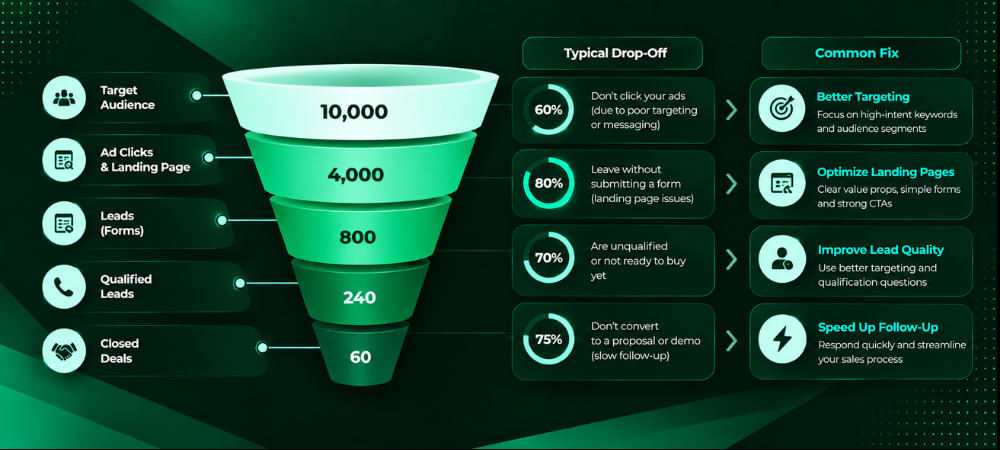
That sequence identifies where value disappears. For instance, if clicks convert into forms but forms rarely qualify, targeting or form design may be the problem. Similarly, if qualified prospects don’t book appointments, follow-up or scheduling may be failing; or if appointments happen but clients don’t sign, the problem may sit outside the advertising account.
PPC optimization improves when these downstream results flow back to the campaign. Google Ads can then receive better signals about which searches and audiences eventually produce meaningful outcomes, rather than simply finding people most likely to complete the shortest form.
| How To Target High-net-worth Buyers With Google Search Ads? The best way to target high-net-worth buyers with Google Search Ads is by focusing on high-intent, ultra-specific search terms like “luxury condos” or “waterfront estates”, Layer Household Income targeting for the top 10%, applying geographical radius control around affluent neighborhoods, and highlighting exclusive perks or discretionary pricing directly in the ad copy. |
How Much Should You Spend on Real Estate PPC?
No universal real estate PPC budget exists; spending depends on local competition, keyword demand, property value, lead value, campaign objective, expected conversion rate, and the volume of data needed for a reasonable test.
That’s why a brokerage should work backwards from acceptable client acquisition costs instead of copying another advertiser’s monthly figure. A useful planning model for Google Ads cost and budgeting starts with the value of an acquired client, the percentage of leads that qualify, appointment and close rates, and the maximum sustainable acquisition cost. From there, the brokerage can estimate an acceptable qualified-lead cost and test budget.
How To Reduce Real Estate PPC Costs
Now, reducing the cost of PPC does not always mean lowering bids because a cheaper click can be worse if it comes from weak intent or an unserviceable location. That’s why cost reduction should focus on waste, relevance, conversion rate, and the economic quality of the resulting pipeline.
Here is how to go about that job:
(i) Improve Quality And Relevance
The first step is improving ad quality and relevance. Tighter keyword-to-ad alignment creates a more coherent experience. The search term informs the advertisement, which leads to a page that continues the same promise. Better copy also filters prospective clients, and specific messaging may produce fewer clicks while increasing the proportion of suitable inquiries.
Now, this is controlled reduction, not indiscriminate restriction. If segmentation becomes too narrow, the campaign may lose valuable demand and collect data slowly, so judge changes by qualified leads and clients, not account neatness.
(ii) Remove Waste
Search-term reviews often uncover job searches, licensing questions, irrelevant rentals, unsuitable locations, low-value property types, and unrelated uses of local place names. This is just waste, and negative keywords and location exclusions help remove that.
Checking time and device patterns can reveal additional inefficiency, although any exclusions here need additional context. For instance, a mobile lead at 9:30 p.m. may appear inconvenient but could be highly motivated. But the problem may be the lack of an after-hours booking or call-response system, not the lead itself.
(iii) Optimize For Lead Quality
Cheap leads can become expensive once you factor in sales time. A campaign that attracts vague inquiries outside the company’s area creates follow-up work that ultimately produces no fruitful results. It also hurts the sales pipeline.
Therefore, the PPC campaign must learn from these rejected leads; reasons like wrong location, unrealistic price expectations, rental intent, no financing, or an impossible timeline can inform targeting, copy, landing-page questions, and bidding priorities for better conversion optimization.
(iv) Improve Conversion Rate
Last but not least, improving the conversion rate is the quickest way to manage PPC costs. While each click costs money, it should bring in enough clients and queries with business potential to justify the real-estate firm’s budget.
Faster pages, shorter forms, stronger CTAs, credible agent profiles, clear contact details, and sensible trust signals can improve the post-click experience. Testimonials help when they are genuine and relevant. Listing volume helps when inventory is current, and market claims work when the brokerage can back them up.
The goal isn’t to strip the page until it says almost nothing. Serious property decisions require enough information to reduce risk, so good conversion design removes unnecessary friction while preserving the evidence a prospect needs to continue.
Common Real Estate PPC Mistakes
Most expensive real estate PPC mistakes are not obscure platform errors. They are ordinary decisions repeated for too long. For instance, an account may keep generating reports and conversions while still failing commercially, which is exactly why the flaws can survive unnoticed.
Some Of The Common PPC Mistakes Include:
- Sending all traffic to the homepage.
- Targeting broad, low-intent keywords.
- Ignoring negative keywords.
- Using the same ad for buyers and sellers.
- Targeting a larger geographic area.
- Failing to track phone calls.
- Measuring CPL without lead quality.
- Following up slowly.
- Running ads without testing landing pages.
- Stopping campaigns before enough data is collected.
- Ignoring Google’s housing ad policy until a campaign gets disapproved.
- Turning on AI Max or Performance Max account-wide without testing it first.
Real Estate PPC vs. SEO: Which Should You Use?
PPC and SEO solve different timing problems. While PPC helps real-estate companies compete for current demand and test messaging quickly, SEO creates pages and visibility that may continue attracting prospects without paying for each visit. Therefore, treating them as rivals misses how often one channel makes the other smarter.
| Factor | PPC | SEO |
|---|---|---|
| Speed | Faster visibility | Slower development |
| Long-term visibility | Limited without continued spend | Strong potential with maintained rankings |
| Immediate testing | Excellent for keyword and offer testing | Slower feedback cycle |
| Cost model | Payment for traffic and management | Investment in content, authority, and optimization |
| High-intent targeting | Strong control | Strong when rankings match intent |
| Long-term asset value | Lower when campaigns stop | Higher through durable pages and authority |
| Best role | Capturing and testing immediate demand | Building sustainable discoverability |
So, PPC search-term and conversion data can reveal which services, locations, and questions deserve organic pages, and SEO can lower dependence on paid traffic for informational and local searches. Remarketing can then reconnect with visitors from both channels.
The strongest model is often PPC plus SEO, where paid search captures immediate opportunities while organic content builds visibility across neighborhood research, selling questions, agent comparisons, and property-market topics. Turning PPC search-term data into an organic content plan is exactly the handoff Viacon’s SEO services team builds around, so the two channels reinforce each other instead of running in separate silos.
Real Estate PPC Works When The Whole Acquisition System Works
Real estate PPC works best when you treat Google Ads as a complete client-acquisition system, not simply a way to buy clicks. Search intent determines who enters, geographic targeting controls where demand comes from, ads set expectations, landing pages convert or lose interest, and tracking, qualification, and follow-up decide whether the inquiry becomes revenue.
Agents and brokerages should therefore judge campaigns by more than CTR, CPC, or even cost per lead; they need to ask more serious questions like: Did the lead fit the market? Did an agent respond? Was an appointment booked? Did the prospect become a client? What did that client cost to acquire?
And Viacon’s performance marketing services provide the necessary answers to these questions. The experts at Viacon help connect campaign planning with paid-media execution, conversion measurement, and ongoing optimization. That integrated approach matters in real estate, where one weak handoff can undo an otherwise strong campaign.
If your brokerage needs a more disciplined route from paid search to qualified appointments, contact Viacon to discuss a real estate PPC strategy built around your market, lead goals, and sales process.