To create momentum after launching a project, you have to think beyond brokers. Real estate development in 2026 asks builders to create awareness before completion, own local search demand, qualify inquiries, and nurture prospects long enough to turn interest into site visits and bookings.
Buyers now investigate projects through search engines, property portals, social media, and YouTube before they ever call a sales office. Reviews and AI-generated answers shape a shortlist earlier than most developers expect.
So the marketing engine needs an integrated journey: market research, awareness, interest, lead capture, qualification, site visit, and booking. It has to start early, well before unsold inventory turns into a problem the sales team has to explain away.
What Is Real Estate Development Marketing?
Real estate development marketing positions, promotes, and sells a new development across its full lifecycle, starting with market validation and pre-launch demand and continuing through booking and referral. It sits inside the broader discipline of real estate marketing, but it behaves differently because the product doesn’t fully exist yet.
Traditional property advertising promoted an available apartment, office, or plot. Development marketing sells a future proposition instead. Branding explains the vision, demand generation builds an audience, lead generation captures intent, and sales enablement gives teams what they need to close. An integrated strategy has to influence buyers well before they speak with sales, because by the time they call, most of the decision is already half made.
Marketing should begin before launch for a practical reason: early campaigns reveal which buyer segments respond, which benefits actually matter to them, and whether the positioning feels credible once real people see it. Waiting until launch day to find any of that out is an expensive way to learn.
Why Development Marketing Is Changing In 2026
Buyers commonly arrive at a site visit with opinions already formed. They compare floor plans across portals, watch neighborhood videos, read reviews, check a developer’s delivery history, and ask AI tools to shortlist projects before calling anyone. The physical visit now confirms digital research rather than starting it.
Developers also have to market more than the property itself. Location, lifestyle, amenities, investment potential, community design, and builder reputation all shape how a buyer perceives value. A swimming pool means little on its own, but a secure, well-connected community built around family routines says far more.
Pre-launch demand gives developers a real advantage here. They can build early-interest databases, collect registrations, test messaging, and find out which units buyers actually want before releasing inventory widely.
Digital trust matters just as much as digital reach. Clear project information, realistic visuals, construction updates, accessible documentation, and visible team profiles reduce hesitation during what is, for most buyers, the largest purchase of their life.
Viacon COO Insight Ejaz Ahmed’s view of the 2026 search shift is direct: “Traditional SEO still matters, but brands must also structure content for AI-led discovery. Developers should make project information easy for both buyers and answer engines to understand.”
1. Start With A Real Estate Development Marketing Strategy
Every campaign needs three foundations: a defined buyer, defensible positioning, and a focused value proposition. Skip any of these and the creative might still look attractive, but it will pull in people with little real purchasing intent.
The Target Buyer Usually Falls Into One Of A Few Groups, And Each One Weighs Risk Differently:
- First-time buyers, who prioritize schools, usable space, and predictable costs.
- Families, who weigh community design and lifestyle fit alongside price.
- Luxury purchasers, who look for exclusivity, privacy, and design pedigree.
- Investors, who study rental demand, infrastructure, and exit potential.
- Relocation or NRI buyers, who need remote-friendly documentation and trust signals.
- Commercial buyers, who evaluate footfall, accessibility, and long-term ROI.
Positioning Then Has To Answer Five Blunt Questions:
- What makes the project different?
- Who is it built for?
- Why this location?
- Why buy now?
- What buyer problem does it solve?
The value proposition that comes out of those answers should connect location, product, lifestyle, trust, and value into one coherent story rather than five separate claims stitched together.
| Can One Message Work For Every Buyer Segment? No, a single message rarely persuades an investor and a first-time family buyer with equal force. Viacon builds segment-specific campaigns that keep a project’s central positioning consistent across channels, so the story adapts without fracturing. |
2. Build Demand Before The Project Launches
Pre-launch activity is what separates a strategic approach to property development marketing from ordinary listing promotion. A focused landing page should explain the project concept, location, amenities, developer background, expected launch window, and early-access offer, backed by a straightforward registration form.
The early-interest database should capture more than a name and phone number. Buyer type, preferred unit, budget, and purchase timeline let sales teams tell likely buyers apart from casual browsers before the first call even happens.
Waitlists can then support VIP previews, private presentation events, priority booking, and early registration. Manufactured scarcity damages credibility fast, though. Early access should offer genuine informational or scheduling value, not a countdown timer with nothing behind it.
3. Use Local SEO To Capture High-Intent Searches
A focused local SEO strategy connects existing demand with a relevant project. Useful targets include phrases like “new residential projects in [location],” “upcoming projects in [location],” “new homes in [location],” and “luxury apartments in [location].” A proper real estate SEO foundation under these pages matters more than chasing any single keyword.
Location pages need substance to earn rankings and hold attention. Neighborhood guides that cover connectivity, schools, healthcare, retail, lifestyle, planned infrastructure, and local property trends give buyers a reason to keep reading past the first paragraph. Dedicated project and location pages then create a simple route: a local query leads to relevant information, which leads to the project page, which leads to a lead form.
| What If The Project Location Has Low Search Volume? Combine broader regional queries with infrastructure, lifestyle, and investment themes. That builds interest before branded demand for the project name develops on its own. |
4. Create A Website That Converts Project Interest
Real estate development project websites need to answer practical buyer questions quickly. A well-built site gives every buyer easy access to:
- Project overview and developer profile.
- Location details and connectivity.
- Floor plans and unit-wise pricing guidance.
- Amenities, gallery, and virtual tours.
- Live construction updates.
- A short, low-friction registration form.
None of this should require hunting through menus or PDFs to find.
Conversion design matters just as much as content. Strong calls to action, short forms, click-to-call tools, WhatsApp options, and mobile-first layouts all reduce friction at the exact moment a buyer decides whether to reach out. A disciplined approach to conversion rate optimization treats the inquiry form as a product feature, not an afterthought bolted onto the last page.
A beautiful website that hides pricing context or buries the inquiry form is still a weak sales asset, no matter how good the renderings look.
5. Build Trust With Legal And Regulatory Transparency
Development marketing sells a promise that won’t be delivered for months or years, and that gap is exactly where buyer anxiety lives. Legal and regulatory transparency closes it faster than lifestyle photography ever could.
Project pages should state the regulatory registration status clearly, along with approval numbers, land title status, and the escrow or payment-protection arrangement buyers are covered by. Where local law requires registration with a housing regulator, that number belongs on the website itself, not buried inside a brochure nobody opens. Construction-stage payment schedules, expected handover dates, and any delay clauses should also be easy to find rather than something a buyer has to request from sales.
None of this needs legal jargon. A short, plain-language summary next to the official documents reassures a first-time buyer more than the documents alone ever do.
| Does Disclosing Regulatory Details This Openly Scare Off Buyers? It tends to do the opposite. Buyers who feel information is being withheld disengage quietly and rarely explain why. Buyers who see clear documentation upfront usually ask sharper, more serious questions the kind that lead to bookings. |
6. Use Content And Video To Build Buyer Confidence
A content strategy shouldn’t talk endlessly about the project itself. Strong real estate content marketing earns attention by being useful first and promotional second.
A Useful Content Mix Usually Covers Three Angles:
- Location content on infrastructure, neighborhood development, market trends, and reasons to invest in the area, not just the building.
- Buyer education on developer evaluation, floor-plan interpretation, new construction versus resale, and the hidden costs of ownership buyers rarely think to ask about.
- Investment content that covers rental potential, location fundamentals, and appreciation alongside honest risk, without presenting uncertain returns as guaranteed fact.
Video does something text can’t: it makes an unfinished proposition feel real.
- Project walkthroughs show units, amenities, and common areas as they’ll actually look.
- Construction-progress videos mark milestones buyers can watch unfold over time.
- Location tours explain connectivity better than a map ever could.
- Developer or architect interviews clarify the design philosophy, sustainability decisions, and quality controls behind the project.
7. Use Paid Media To Generate Qualified Inquiries
Google Search Ads can capture queries related to new projects, apartments, location-specific developments, and property investment. Meta campaigns work differently, building broader demand through video, carousel ads, native lead forms, and retargeting. A proper social media marketing approach treats these as two separate jobs rather than one campaign copied across platforms.
Retargeting should respond to actual behaviour rather than treating every past visitor the same way.
A Tiered Approach Usually Looks Like This:
- Brochure downloaders get a follow-up offer to book a site visit.
- Incomplete-form users get a reminder that removes whatever stopped them.
- Video viewers get a stronger, more specific creative than a cold audience would see.
- Floor-plan visitors get pricing or availability nudges tied to the unit they viewed.
Someone who viewed a pricing page needs a different message than someone who watched ten seconds of a location video, and treating them the same wastes budget on both.
Campaigns should optimize for qualified inquiries above all else. Cheap leads that never book a site visit cost more in wasted sales-team hours than they save in ad spend. A higher cost per lead can still be the better outcome when those contacts actually move toward purchase.
| Metric Approach | Weak Interpretation | Better Interpretation |
|---|---|---|
| Cost per lead | Lower always means better | Compare cost per qualified lead |
| Lead volume | More forms mean success | Assess intent, budget, and timeline |
| Website traffic | Growth proves demand | Track visits to pricing and floor plans |
| Campaign return | Count inquiries | Attribute site visits, bookings, and revenue |
8. Plan A Marketing Budget That Matches The Sales Cycle
Development marketing runs on a longer cycle than most paid campaigns are built for, and budgets that ignore this tend to run dry right when they’re needed most.
A Workable Split Looks Like This:
- 60 to 70 percent to digital channels search, paid social, content, and the website because they compound over the length of the sales cycle
- 30 to 40 percent to experiential activity such as launch events and on-site previews, plus any traditional media that fits the local market
Spend should be phased rather than spread evenly. Pre-launch needs a smaller, steady budget focused on database building and message testing. Launch itself needs a spike, converting months of stored interest into bookings within a tight window.
The sustain phase after that needs less volume but sharper targeting, since the buyers still in the market are the ones who didn’t convert on the first push and need a different reason to act.
Reviewing spend against a proper performance marketing framework cost per qualified lead, cost per site visit, cost per booking makes the budget far easier to defend or adjust mid-campaign than reporting on impressions alone.
9. Build The Developer Brand Alongside The Project
Effective real estate developer marketing reduces how much trust each new project has to build from scratch. Completed developments, delivery history, awards, leadership experience, construction practices, and documented milestones give buyers evidence behind the brand’s promise, rather than asking them to take it on faith.
Transparency strengthens that evidence further. Regular progress updates, accessible documentation, realistic timelines, and clear communication prevent the kind of information vacuum where rumours take hold. Thought leadership can position the developer around architecture, urban development, sustainability, or market change, but it needs to stay specific; generic commentary rarely moves a decision this large.
10. Sell Through Brokers And Channel Partners Without Losing Direct Demand
Most developments still sell through a mix of direct inquiries and broker or channel-partner networks, and marketing that ignores brokers usually ends up competing with them instead of working alongside them. Brokers need their own version of the sales kit: floor plans, pricing sheets, commission structure, and a co-branded landing page they can share with their own contacts without diluting the project’s core positioning.
A simple partner portal, even a basic one, solves the coordination problem that causes the most friction.
At Minimum, It Should Let Brokers:
- Register a lead before working it, so two brokers don’t chase the same buyer.
- Check unit availability without calling the sales office.
- Pull current pricing without waiting on an email reply.
Where this doesn’t exist, the same unit often gets pitched to the same buyer by two different brokers, and both relationships take the hit when that happens.
Direct and broker-driven demand should be tracked separately in the CRM rather than folded into one number. A project that looks healthy on total bookings can be quietly over-reliant on one or two broker relationships, and that only becomes visible once the two sources are reported apart.
11. Turn Marketing Into A Lead-Nurturing System
Not every prospect books immediately, so a project’s lead generation strategy needs to classify interest honestly: hot leads ready for a visit, warm leads still comparing options, and cold leads doing early research. Each segment should get content that matches where it actually sits: brochures, floor plans, inventory updates, construction milestones, pricing changes, event invitations, and market information because repetition without relevance quickly becomes noise a prospect learns to ignore.
CRM integration ties development campaigns to sales activity in a way spreadsheets can’t. Teams should track the source, project interest, preferred unit, budget, follow-up status, site visit, and booking stage for every lead. That level of tracking creates accountability and shows exactly where demand breaks down, instead of leaving everyone to guess.
12. Work With AI Without Removing Human Judgment
AI earns its place in a development campaign by handling the repetitive, high-volume work well before it touches a real conversation:
- Scoring inquiries and identifying buyer intent.
- Routing prospects to the right sales rep or unit.
- Personalizing content and testing creative variations.
- Segmenting audiences and summarizing conversations.
- Triggering responses and reminding sales teams about follow-ups.
What it shouldn’t do is replace the conversations that actually close a sale.
Financial discussions, negotiations, objections, documentation, and relationship building still need a person who can read the room. AI improves speed. Trust still depends on informed people standing behind the numbers.
13. Adapt Marketing To The Development Type
Different projects need different narratives even when the underlying funnel stays the same.
| Development Type | Primary Marketing Emphasis |
|---|---|
| Residential | Lifestyle, amenities, family needs, location, and community |
| Luxury | Exclusivity, privacy, design, premium facilities, and reputation |
| Commercial | Accessibility, foot traffic, infrastructure, ecosystem, and ROI considerations |
| Investment-focused | Rental demand, fundamentals, location potential, risks, and due diligence |
The Complete Development Marketing Funnel
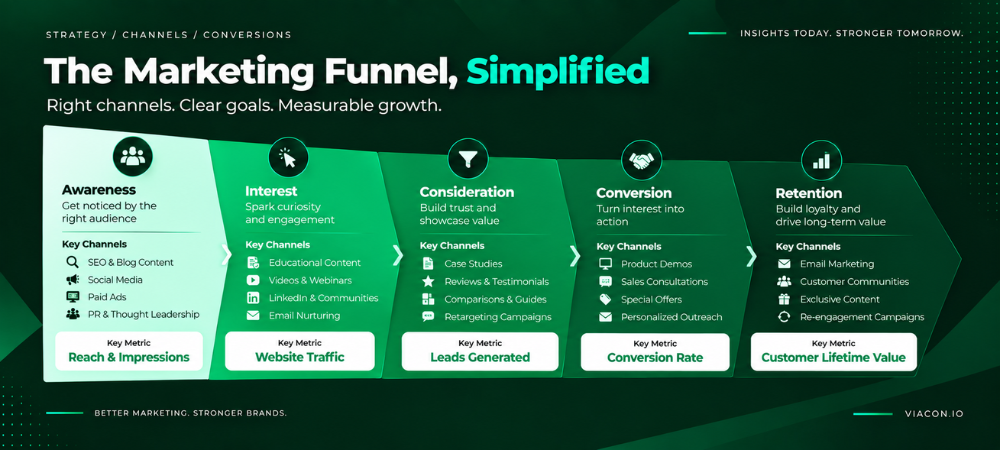
The funnel connects channels rather than treating them as isolated activities. Awareness runs through SEO, social media, PR, paid campaigns, and video. Interest builds through the project website, educational content, and the brochure. Lead capture happens through registration, inquiry forms, and callback requests.
Qualification checks budget, unit preference, timeline, and purchase intent. Nurturing runs through the CRM, email, WhatsApp, and sales follow-up alongside retargeting. Conversion covers the site visit, negotiation, documentation, and booking. Advocacy closes the loop through customer experience, review collection, and referral.
14. Turn Buyers Into Advocates After Handover
Marketing for most developers stops at the signed sale agreement, which means the advocacy stage of the funnel gets the least attention despite being the cheapest source of new demand. Handover is the moment that determines whether a buyer becomes a referral source or a quiet detractor, and it deserves its own plan rather than being left to the operations team by default.
A structured handover experience a clear walkthrough, a documented snag list with resolution timelines, and a follow-up check-in a few weeks after move-in does more for referrals than any thank-you email. Review requests land better when timed to this moment, right after a buyer has seen the finished product match what marketing promised, rather than sent automatically the day the sale closes.
Referral incentives work best when they’re specific and easy to explain: a defined bonus or fee discount for an introduction that leads to a booking, tracked through the same CRM used for the original sale. Vague “refer a friend” messaging with no clear mechanism rarely produces anything measurable.
15. Track Metrics That Connect Marketing With Revenue
Awareness measurement should track impressions, search visibility, website traffic, and video views, since these show whether the campaign is reaching anyone at all. Lead-generation reporting needs to go further and cover total leads, qualified leads, cost per lead, and cost per qualified lead, because raw lead volume says almost nothing about buyer intent on its own.
Sales teams should then monitor site visits, the site-visit-to-booking rate, the overall booking rate, and acquisition cost, while leadership needs the view rolled up further still: revenue by channel, marketing ROI, and customer acquisition cost. Cost per lead alone tells an incomplete story: a costlier channel might generate serious buyers who convert at a much higher rate, while a cheaper source filled with unreachable or unsuitable leads can end up costing more per booking in the end.
Common Marketing Mistakes
The developers who struggle here usually make a few of these mistakes in combination:
- Starting promotion too late, once inventory pressure has already set in.
- Advertising features instead of the outcomes buyers actually care about.
- Depending entirely on portals instead of building any owned audience.
- Sending traffic to generic landing pages instead of a dedicated project page.
- Collecting leads without qualifying them, leaving sales teams to chase contacts who were never going to book.
- Leaving pre-launch registrants without meaningful nurturing after they sign up.
- Judging campaigns by inquiry volume rather than visits and bookings.
The most expensive long-term mistake, though, is promoting every project independently while neglecting the developer’s own reputation, a pattern that forces every new launch to rebuild trust from zero.
A 90-Day Marketing Plan For A New Project
| Timeline | Priority Actions |
|---|---|
| Days 1–30 | Define audiences and establish positioning. Build the website, plan SEO, configure CRM, and produce creative assets. |
| Days 31–60 | Publish search content, begin social campaigns, launch paid search, release videos, and grow the early-interest database. |
| Days 61–90 | Retarget visitors, nurture leads, promote site visits, evaluate qualified inquiries, and improve weak conversion points. |
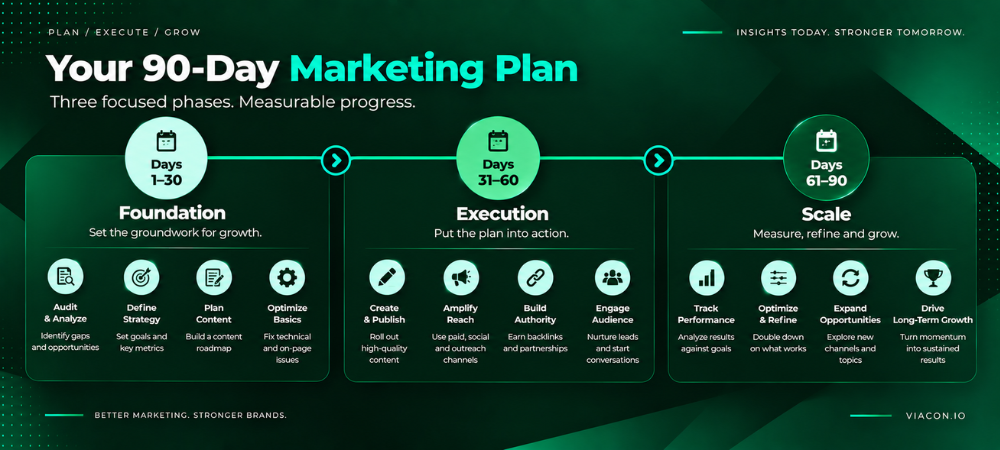
This sequence builds infrastructure before media spending accelerates. Otherwise, paid traffic ends up exposing weak messaging, incomplete tracking, or slow follow-up at considerable cost.
Generate Demand Before Inventory Needs Rescue
Builders can generate real demand in 2026 by building awareness before launch, owning local search, presenting the project visually, capturing first-party data, qualifying prospects, nurturing interest, and converting serious buyers through site visits. Advertising alone doesn’t do this. It takes a connected system that builds trust, captures intent, guides decisions, and measures bookings instead of surface-level lead volume.
Viacon brings SEO, paid media, content, conversion design, marketing automation, and CRM thinking into one project-specific growth framework. The BKS case study shows how a mobile-optimized website and clearer user journeys improved engagement and inquiry performance within 90 days.
For developers, the takeaway is direct: remove digital friction, connect marketing activity with buyer behavior, and make every campaign accountable to qualified demand. Talk to Viacon about building a development marketing engine designed around site visits, bookings, and sustainable developer equity.